
















The Short Answer, and the Real Question
Yes. You can use AI, you can probably afford it, and you almost certainly do not need to hire anyone to make it work.
But that is rarely the actual question. When a small business owner asks “can I use AI?”, what they usually mean is one of these:
“Am I too small for this?”
Every case study features a company with a transformation budget and a head of innovation. You have six staff and a ute.
“Can I afford to find out?”
Not just the subscription: the weekend you will lose to it, and the cost of getting it wrong in front of customers.
“Will it embarrass me?”
The fear that a customer gets a robot, hates it, and tells everyone. This one is rational and worth taking seriously.
“Am I allowed to?”
Privacy, customer data, disclosure. Nobody has explained the rules in language a business owner can act on.
Those are all reasonable, and this article answers them in that order. What it will not do is tell you AI will transform your business, because for most small businesses it will not. It will do something less exciting and considerably more useful: take three or four specific recurring jobs off your plate, reliably, for less than you are currently losing by not doing them.
The reframe worth holding onto: the question is not “should my business adopt AI?” That is a question for a company with a strategy department. Yours is “which specific job that I keep failing to get to could a machine do adequately?” That question has answers, and they are testable in a week.
What Australian Small Businesses Are Actually Doing
Here is where it gets interesting, because the two most-quoted Australian figures disagree enormously, and the disagreement is the most useful thing about them.
~11%
Of small and micro businesses reported using AI, ABS, 2024 to 25
43 to 44%
Of SMEs reported some AI adoption: National AI Centre SME AI Pulse, Dec 2025 to Feb 2026
35%
Of large businesses using AI in 2024 to 25, up from 9% in 2021 to 22
54%
Of adopters use it for content generation, and the same share for data analytics
Both numbers are honest. The ABS asked about AI use in the business in a formal sense during 2024 to 25. The National AI Centre asked SMEs more recently and more broadly, capturing the owner who drafts quotes with a chatbot on their phone. The gap between 11% and 43% is essentially the difference between AI as a project and AI as a habit.
Why that gap is good news for you
It means most of the small businesses “using AI” are not running anything sophisticated. They are using ordinary tools for ordinary jobs, writing, summarising, answering. You are not behind a wave of small competitors who have automated their operations. Very few have. What has changed is that the entry point is now low enough that the ones who try something specific tend to keep it.
The other pattern worth noting: adoption climbs steeply with size, roughly 11% of small and micro, 22% of medium, 35% of large businesses. That is not because large firms have better technology available to them. It is because they have someone whose job includes evaluating it. That is the actual small business disadvantage, and it is a time problem rather than a money problem.
The Three Real Barriers (Cost Is Not One)
Ask non-adopters why, and the answers are consistent, and they are not what vendors assume.
| Barrier | What it sounds like | Whether it is justified |
|---|---|---|
| 1. Trust The biggest one by far |
“I don’t want a machine making decisions about my customers.” Around 65% of businesses not adopting AI cite distrust of AI decision-making or a firm preference for keeping humans in control. | Partly. It is a bad reason to avoid AI entirely and an excellent reason to be specific about what it touches. |
| 2. Skills | “Nobody here knows how to set this up.” | Less true every year. The tools worth using now are configured, not coded, but somebody still has to sit down and do it. |
| 3. Time The one nobody lists |
“I’ll look at it when things quieten down.” | Decisive. This is what actually stops it, and things do not quieten down. |
| Cost | “We can’t afford it.” | ✓ Rarely the real obstacle now. The sticker price on useful tools is small; the real cost is evaluation, setup and upkeep, which is time again. |
Notice that two of the three are the same problem wearing different clothes. Which suggests the correct strategy for a small business is not to get better at AI, but to pick one job, give it a fortnight, and judge it on a number you already track. Anything requiring more commitment than that will not survive contact with your actual week.
What AI Is Genuinely Good At in a Small Business
Sorted by how reliably it works, not by how impressive it sounds.
| Job | How well it works | Why |
|---|---|---|
| Answering the phone when you cannot | ✓ Very well | The alternative is a missed call or voicemail nobody checks. The bar is low and the value is directly measurable. |
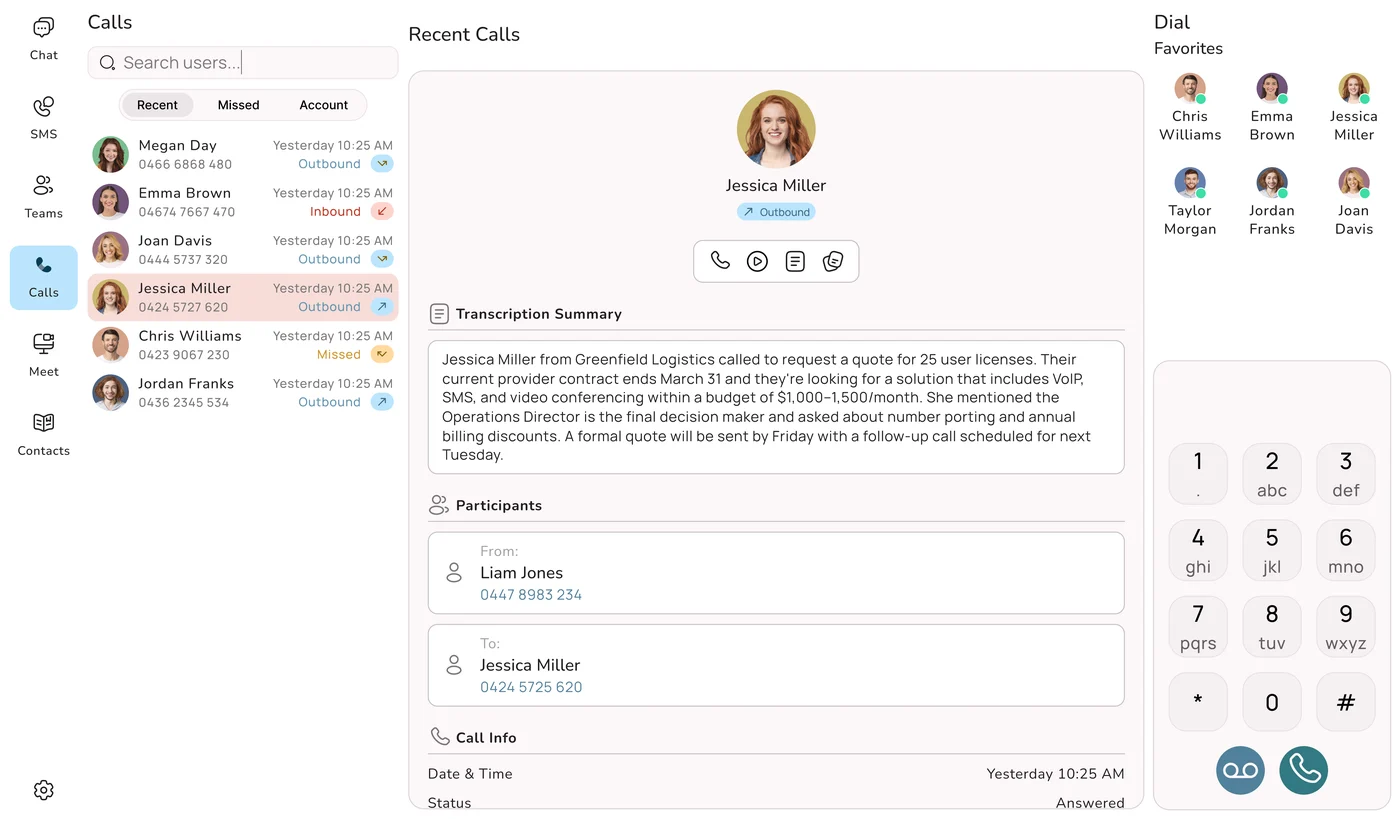
| Turning a call into notes | ✓ Very well | Transcription and summarisation are mature. It removes admin nobody was doing properly anyway. |
| First drafts of writing | ✓ Well, with editing | Quotes, listings, job ads, follow-up emails. Never send unedited: it reads like everyone else’s. |
| Answering the same five questions | ✓ Well | Hours, location, pricing, availability, lead times. This is most of your inbound volume. |
| Booking and qualifying | Well, if scoped tightly | Works when the rules are clear. Struggles the moment a caller’s situation is unusual, so route those out. |
| Summarising documents | Usefully, verify anything that matters | Fine for getting the gist. Not a substitute for reading a contract. |
| Anything requiring judgement about a person | Poorly, and do not | Hiring, credit, complaints, vulnerability. Wrong technically and increasingly a legal exposure. |
The pattern: AI is strong where the task is repetitive, bounded, and currently done badly or not at all. It is weak where the task requires understanding a specific person’s circumstances. Small businesses win by taking the first category seriously and leaving the second alone.
Why the Phone Is the Best First Project
Of everything on that list, one stands out for a small business, and it is worth explaining why rather than asserting it.
The loss is already measurable
You know roughly what a job is worth. Count last month’s missed calls, multiply by your conversion rate. That number is your business case, and you did not have to imagine it.
The task is narrow
“Answer, find out what they want, take details, book or escalate.” That is a well-bounded job with a clear success test, which is exactly where AI is reliable.
You know within a week
Listen to the recordings. Either callers got what they needed or they did not. No consultant required to interpret the result.
It covers when you genuinely cannot
On a roof, under a car, with a client, asleep. The AI is not competing with you answering well: it is competing with nobody answering at all.
It is reversible in a minute
If you hate it, turn it off and calls go back to ringing out. Very few business decisions come with that.
Nothing to install
No hardware, no cabling, no server. It is configuration on a system you are already paying for in some form.
Compare that with the AI projects small businesses usually try first: a chatbot on a website almost nobody visits, or a content tool that produces material indistinguishable from every competitor’s. Neither has a number attached. The phone does. If you want the arithmetic laid out, what missed calls actually cost works through it, and AI voice agents: cost and ROI covers the payback maths.
The thing to get right on day one
Tell callers they are speaking to an automated assistant, and give them an obvious way to reach a human. Not because a regulation currently forces you to in every case, but because the alternative, someone realising halfway through that they have been talking to a machine that was pretending otherwise, is the exact scenario you were afraid of. Disclosure removes almost all of the reputational risk, and costs you nothing.
What You Should Never Hand to AI
This section matters more than the enthusiastic ones, because getting it wrong is how small businesses end up in the news.
| Never automate | Why not |
|---|---|
| A distressed or vulnerable caller | Build an escape hatch that triggers on distress signals and gets a person on the line. If your business has any chance of this, design for it before you switch anything on. |
| Complaints | A complaint handled by a machine becomes a bigger complaint. Route them straight to a human, always. |
| Anything safety-related | Emergencies, hazards, medical questions. No exceptions and no clever exceptions either. |
| Final decisions about people | Hiring, firing, credit, eligibility, pricing that varies by individual. Technically unreliable and squarely in the path of regulation. |
| Sending anything unread | AI drafts, humans send. The moment a machine can email customers unsupervised, you have accepted a category of risk you cannot bound. |
| Your own expertise | Customers buy your judgement. Automating the judgement removes the reason they chose you over the cheaper option. |
A useful rule: automate the parts of a conversation that are the same every time, and hand over the moment the conversation becomes about this particular person. Which calls fall on which side is worked through in which calls to automate, and which never to.
What It Actually Costs
Pricing varies by provider, so treat these as shapes rather than quotes: the useful part is knowing which costs are real and which are hidden.
| Cost | Reality for a small business |
|---|---|
| The subscription | Usually the smallest number in the exercise, and often bundled into a phone system you are already paying for. Ask whether AI is included or a premium tier: that single question changes the total more than anything else. |
| Setup time | The real cost. Budget a few focused hours to write what the agent should say, what it should ask, and when it should hand over. This is a writing job, not a technical one. |
| The first fortnight of tuning | Listening to recordings and adjusting. Perhaps twenty minutes a day for two weeks, and this is the step people skip and then conclude AI does not work. |
| Ongoing | Close to nothing once tuned, beyond a quarterly listen to check it has not drifted from how your business actually operates now. |
| The hidden one | Contract length. A month-to-month arrangement means a failed experiment costs you one month. A three-year contract means it costs you three years. |
The comparison that actually decides it is not AI versus a receptionist. Most small businesses were never going to hire a receptionist. It is AI versus the status quo, which is calls ringing out, voicemails nobody returns, and enquiries going to whoever answered first. Priced against that, the bar is much lower than vendors' ROI calculators suggest. The full cost comparison runs both.
The Legal Part: Privacy, Disclosure and December 2026
This is the section most articles skip, and the one that will matter to you. What follows is general information rather than legal advice: get your own, particularly if you handle health information or operate in a regulated sector.
| Obligation | What it means for a small business |
|---|---|
| Privacy applies to what goes in and what comes out | The OAIC has been explicit: privacy obligations attach to personal information you put into an AI system and to output containing personal information. Pasting a customer list into a public chatbot is a disclosure, not a shortcut. |
| Automated decision-making transparency: 10 December 2026 | APP entities using personal information in automated decisions that could significantly affect someone must set out in their privacy policy the kinds of information used and the kinds of decisions made. OAIC guidance is expected around September 2026, and policies need updating by 10 December 2026. |
| Are you an APP entity? | The $3 million turnover small business exemption still exists as at writing, but plenty of small businesses are APP entities regardless of turnover: health service providers of any size, businesses trading in personal information, and some contractors. Removing the exemption altogether has been on the reform agenda for years, so do not build on it lasting. |
| Tell people it is AI | Sensible practice regardless of what is strictly required, and it removes most of the reputational downside. State it in the greeting. |
| Know where the data goes | Many AI features are resold from overseas platforms, so customer conversations may be processed offshore. Ask which country, and get the answer in writing: see where your calls actually live. |
| Keep a human in the loop for consequential things | The direction of regulation everywhere is towards transparency and human oversight of decisions that affect people. Designing that in now is cheaper than retrofitting it. |
The practical read
None of this makes AI off-limits for a small business. An AI agent that answers the phone, tells someone your opening hours and books an appointment is not making a decision that significantly affects anyone. The obligations bite when AI starts influencing outcomes for individuals, who gets credit, who gets hired, who gets a different price. Stay on the first side of that line and your compliance burden is: disclose it, know where the data is, and do not paste customer information into public tools.
A Thirty-Day Plan With No IT Person
| Week | Do this | Time needed |
|---|---|---|
| Week 1: Measure | Find out how many calls you missed last month and when. Most phone systems report it; if yours cannot, that is itself the finding. Write down the five questions you are asked most. | One hour |
| Week 2: Write | Write the script: how it greets people, the five answers, what it asks to book something, and exactly when it hands to a human. This is the whole project, and it is writing rather than technology. | Two to three hours |
| Week 3: Switch on, narrowly | After hours only. Not your main line during business hours. You want a real test with the smallest possible downside. | An hour to configure |
| Week 4: Listen and adjust | Twenty minutes a day on the recordings. Fix the wording where callers got confused. Widen or narrow the hand-off. Then decide. | Twenty minutes a day |
At the end of thirty days you will have a real answer for your business rather than a general one: this many calls answered that would have been missed, this many bookings taken, this many handed to a person, and this is what customers sounded like. That is a decision you can make. If it worked, widen it. If it did not, you have lost a month of a small subscription and learned something concrete.
Six Ways Small Businesses Get This Wrong
1. Starting everywhere
Trying AI across sales, marketing, admin and support at once. Nothing gets tuned, everything underperforms, and the conclusion is that AI does not work.
2. Hiding it
Letting customers think they are talking to a person. When they work it out, and they do, you have converted a neutral experience into a story they tell.
3. Never listening to it
Switching it on and walking away. The first fortnight of listening is what separates a useful agent from an embarrassing one.
4. No way out
If a caller cannot reach a human within about twenty seconds of wanting one, you have built a wall rather than a front door.
5. Pasting customer data into public tools
The single most common privacy mistake small businesses make with AI, and one of the easiest to avoid once someone has said it out loud.
6. Signing a long contract for an experiment
You are testing a hypothesis. Test it on terms that let you be wrong cheaply.
None of these are technology failures. They are all decisions made before the technology was switched on, which is the honest summary of this entire subject. AI is not difficult for a small business. Being specific about what you want from it, and honest with customers about it, is the whole job.
If you want a wider view of where this fits alongside everything else you are running, the small business tech stack for 2026 puts it in context, and the complete guide to AI business phone systems goes deeper on the phone side once you have decided to try it.