

Business phone system
- Business phone systemA complete cloud phone system, set up for you
- Features50+ features: IVR, queues, recording, desktop and mobile apps
- Call flowsDecide exactly how every call is answered and routed
- AI Agents Built inAnswer, book and follow up on calls, day or night
- Time to upgradeStill on an old PBX? Here is what you are missing
Apps and hardware
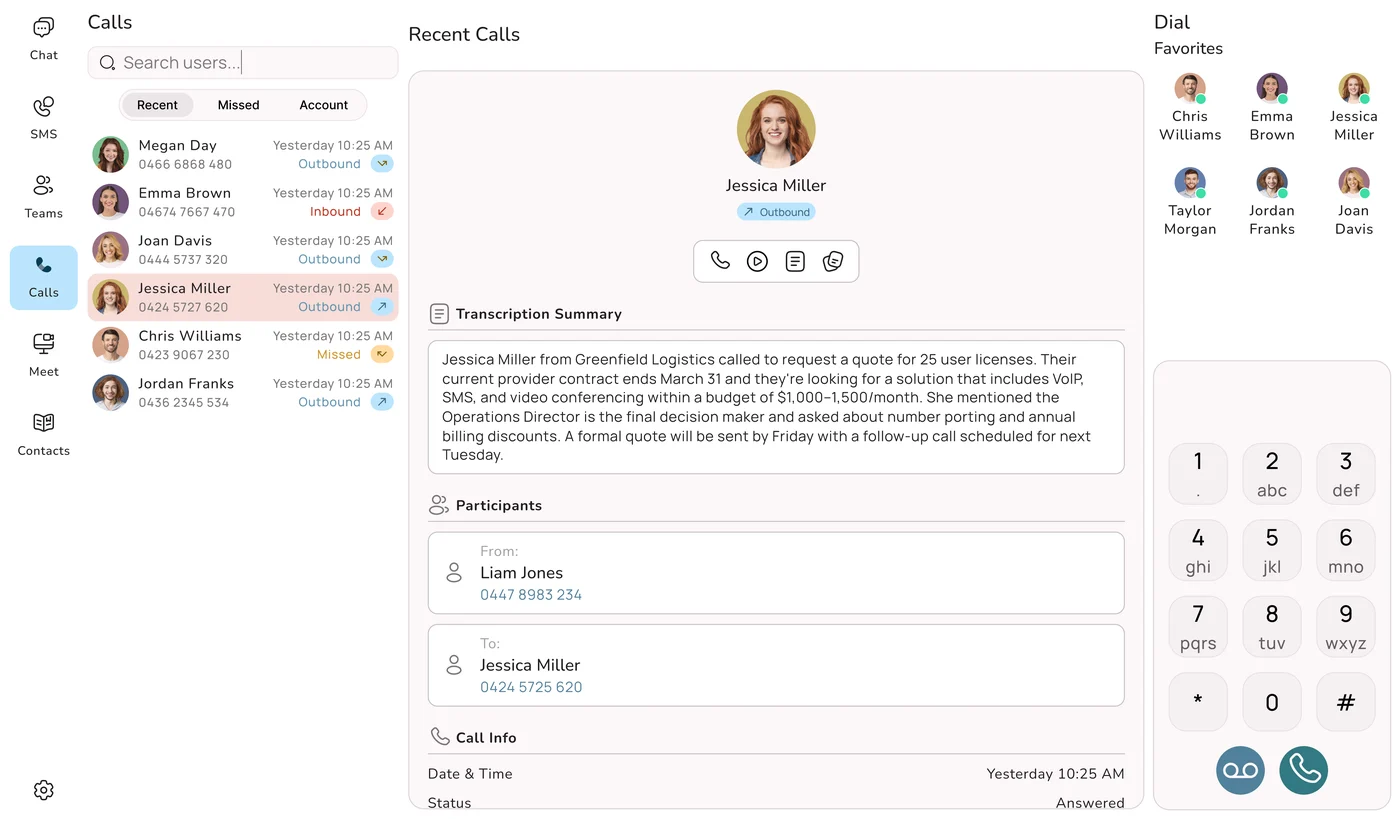
- Desktop app Live demoCalls, chat, SMS and AI summaries in one window
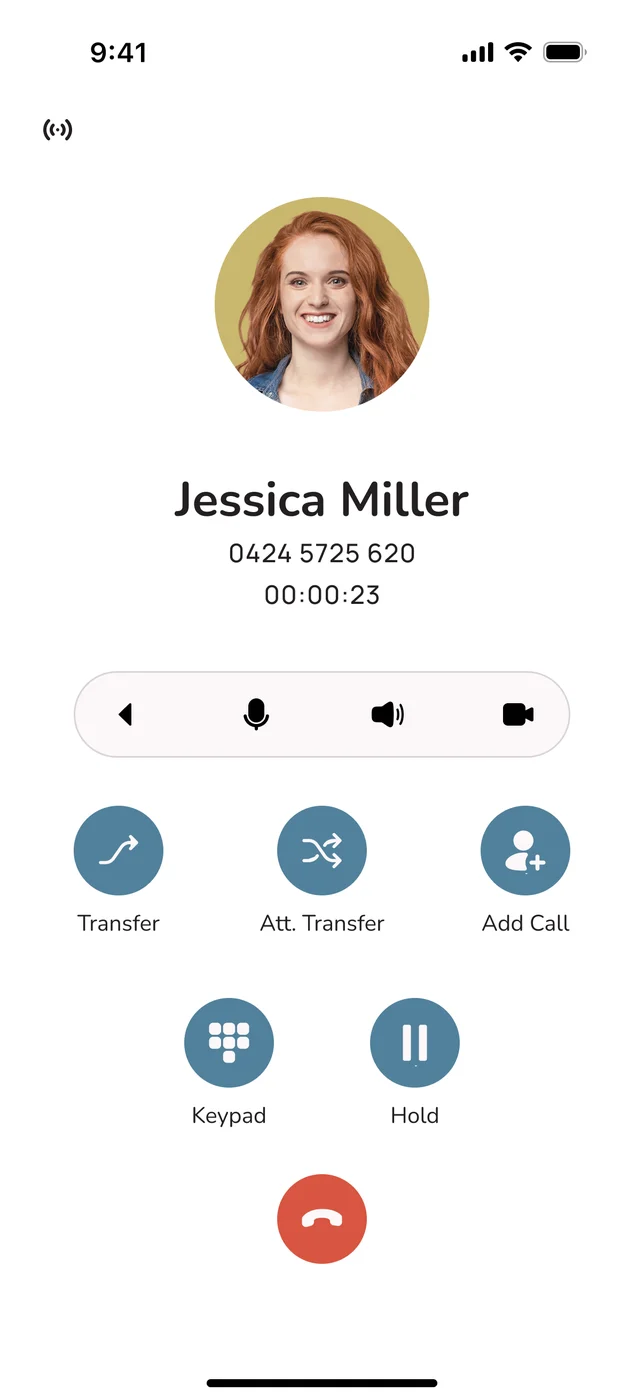
- Mobile app Live demoYour business number on your iPhone or Android
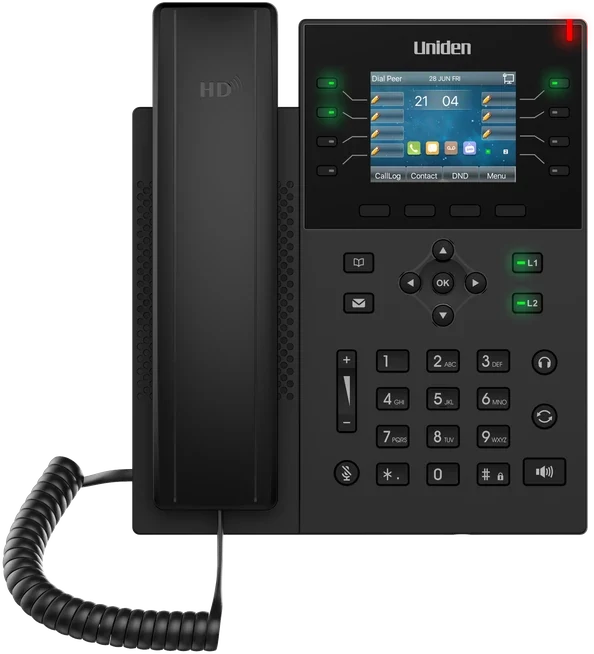
- Uniden desk phonesThe EVOC2 and a full range of office, DECT and conference phones
- Business NBNNBN set up alongside your phones, on one bill
- Why our internetBuilt for voice, so calls stay clear when the line is busy
New Try it liveTake the Uniden Voice apps for a spin, right here
Click through working demos of the desktop and mobile apps: calls with AI summaries, team chat, SMS and more. No download, no sign up.
Desktop app demoMobile app demoDesigned, built, hosted and supported in Australia. Uniden desk phones, cloud apps and AI in one system.Book a demoAll features
AI on your phone line
Uniden Voice vs AI receptionists
See every comparisonAI AgentsEvery call answered, day or night
It answers on your own numbers, books the job, sends an SMS and warm transfers to your team when a person is needed.
Meet your AI agentBuilt into your phone system, not bolted on. No second number, no call forwarding.Book a demo
Professional services
Trades, retail and hospitality
Browse all industries Case study · Optical Solutions AustraliaFive branches, five phone systems, now one.5 sites1 systemRead the story
 Case study · Coco's Wealth of HealthWhen every enquiry and phone order matters.Maroubra organic health-food storeRead the story
 Case study · Shuriken ConsultingFour Sydney offices on one phone system.4 offices1 systemRead the story
 Case study · Carlingford Dental SurgeryEvery call rings the whole team.Dental Carlingford, NSWRead the story
 Case study · PTSD Dogs AustraliaA direct line for veterans, answered from anywhere.Charity Sunshine Coast, QLDRead the story
 Case study · Imperial Realtor GroupSales calls to sales, rentals to property management.Real estate Mango Hill, QLDRead the story
 Case study · Good 2 Eat CateringA catering team on the move, on one number.Catering and events Sunshine Coast, QLDRead the story
 Case study · ManolutionsOne number for the firm, a direct line to Paul.Executive advisory Works across time zonesRead the story





Our customersFrom one-person shops to national brands
See how businesses like yours run their phones on Uniden Voice.
Find your industryWorking on your own? A real business number and NBN for sole traders, no lock-in.Sole tradersStartups
Phone plansBusiness phone planfrom$84.90/month3 users included on a 36-month term. Every feature, one simple per-user rate.Free setup and free number portingDesktop and mobile apps includedAI Agents built inSee phone plans![Uniden Voice mobile app on a call]()
![A small team working together at a desk]()
Internet, hardware and more

Bundle and savePhones and NBN from one Aussie team
One provider to call when something needs fixing. No finger pointing.
See NBN plansWe guarantee to beat any competitor's quote. Keep your existing numbers when you move across.Sign up online1300 881 662
Learn and get set up
The library at a glanceBrowse all
176business
guides398kreads
so far
guides398kreads
so far
Guides by topic
- Phone systems66
- AI24
- Industries18
- Costs12
- NBN8
- Security7
- News5
- Other guides36


Need a hand? Our support team is based in Australia.Contact support
Call us on 1300 881 662 or send a message and the team will get back to you.Send a message
Guides and Articles
Search for a business phone system and every result claims to lead the market. The word is cheap because nobody checks it. So rather than ask you to take it on trust, this article sets out seven measures that genuinely separate a leading business phone system from an ordinary one, shows the evidence for Uniden Voice on each, links to where you can check it yourself, and is candid about the businesses better served by something else.
Choosing a business phone system is one of those decisions that gets made in an afternoon and lived with for three years. The demo goes well, because demos always go well: calls connect, the app looks clean, the menu says press one for sales. What the demo does not show you is the clause about leaving early, the line items that appear on the second invoice, who answers when you ring support at 4:45 on a Friday, or what your callers hear on the morning your internet drops out. Those are the things owners tell us they wish they had asked about. This checklist gives you twenty questions to put to every provider on your shortlist, grouped by the part of the business they protect. For each one you get the reason it matters, what a good answer sounds like and what a red flag sounds like, so you can tell the difference without being a telecommunications expert. There is a scorecard at the end to print and fill in during each call. We have also said how we answer each group ourselves, briefly, because a checklist from a provider that skips its own answers is not worth much.
A business phone system is the arrangement that turns a phone number into a front door for your business. It decides who rings when a customer calls, what happens when they are busy, what callers hear outside opening hours, and where the message ends up when nobody can answer. Most owners start with a mobile, and a mobile works until the second person joins, the first holiday, or the week you realise customers have been ringing out. This guide explains in plain English what a business phone system is in 2026, what it does that a personal mobile cannot, why the old style of office phone system has quietly ended in Australia, and the three types you will be offered when you go shopping. It also untangles the names. Cloud phone system, VoIP, hosted PBX and business phone system describe the same modern arrangement, and knowing that saves a lot of confusion when two quotes use different words for identical things. Finally, there is a simple sizing guide for sole traders, teams of three to twenty and businesses with more than one site, so you can walk into a demo knowing what to ask for.
It is 8.55 on a Monday. The shop opens at nine, the phones are not ringing through, and a customer has just told you on Facebook that your number goes straight to a dead tone. You ring your provider. A recorded voice suggests you visit the help centre. The chatbot offers you an article about resetting your handset. The ticket form promises a response within two business days. That is the moment you find out what you actually bought. Features, prices and apps all look similar across providers in 2026. What does not look similar is what happens when you need help, and it is getting harder to judge because more providers are putting chatbots and ticket queues between you and anyone who can fix the problem. This guide explains how to find a technology partner who knows your business, takes your call and owns the problem until it is solved, and how to test that before you sign rather than after something breaks.
Somebody has probably told you recently that your business needs AI, and there is a reasonable chance they were selling something. That does not make them wrong, but it does mean the question deserves a straighter answer than the one you have been getting. Here is the straight version: no business needs AI. Businesses need calls answered, quotes out the door, notes written, invoices chased, rosters filled and customers who do not have to ring twice. AI is not a goal, it is a means, and in 2026 it has become the cheapest available means for a specific and identifiable set of those jobs, and a genuinely poor means for others. The interesting question is not whether to adopt AI. It is which of your problems are now cheaper to solve than they were eighteen months ago, and whether any of them are costing you enough to bother. That question has an answer, and it is different for a two-person consultancy than for a forty-person clinic group. The Australian evidence is also better than it was: the Bureau of Statistics has measured business adoption, the National AI Centre is tracking it quarterly, and there are now enough real deployments in Australian small businesses that the productivity claims can be checked rather than believed. The numbers do not all agree, and the disagreement turns out to be the most informative part of the whole picture. This is what they say, what they cost, where they do not apply, and what to do first if the answer for you is yes.
Jack Westbury and the #29 Uniden Voice Over Cloud Ute finished the Bathurst 1000 weekend inside the top five in Sunday's Race 4 of the Tyrepower V8 SuperUtes round at Mount Panorama. Watch Jack's race-day message and read how the weekend went, from a tough Friday to a car that was "an absolute jet" by Sunday.
You have just been issued an Australian Business Number. Congratulations, you are officially in business. Most people then do the next few things in whatever order they come to mind: a logo, some business cards, a Facebook page, maybe a website. Then a few months later they discover that half of it has to be redone, usually because the phone number printed on everything was their personal mobile, the business name was never registered, or the bank account is still shared with the grocery shopping. This guide sets out the eight steps that follow an ABN in the order that avoids that rework. Most of them are quick. One of them, choosing your business phone number and the system behind it, looks like a five minute job and ends up being one of the hardest early decisions to undo. We explain why, and what to pick on day one.
There is a version of this that goes badly and it usually starts with enthusiasm. Somebody sees a demo where an AI answers a call, understands a slightly awkward sentence, looks something up, books an appointment and writes a note, and it is genuinely impressive, because that demo is real and the technology behind it works. So the business buys it, points it at the main number, and switches it on for everything. Three weeks later it is off again. Not because it could not understand people, but because nobody decided what it was allowed to promise, nobody wrote down what should happen when it was unsure, nobody told the team it was coming, and nobody agreed in advance what a good week would look like, so when a customer complained about one call there was no way to weigh that against the ninety it handled properly. That is the failure pattern behind Gartner's estimate that over forty per cent of agentic AI projects will be cancelled by the end of 2027, and the three causes it names are escalating cost, unclear business value and inadequate risk controls. Notice what is not on the list. The models are not the problem. The scoping is. An AI agent is not a feature you enable, it is a job you hand over, and jobs get handed over properly or they get handed back. This is how to hand one over properly: how to choose the first one, what to build around it, how to release it over ninety days without betting the main number on week one, and which five numbers tell you whether it is working.
Uniden Voice Over Cloud is backing Jack Westbury and the #29 Ute in the Tyrepower V8 SuperUtes Series at the Bathurst 1000, Mount Panorama, 8 to 11 October 2026. Jack is 19, the leading rookie of the 2026 series, qualified third on debut in Sydney and took a round podium in Tasmania. This post introduces Jack, explains why an Australian phone and nbn company backs a young Australian driver, lists every SuperUtes session in AEDT with Foxtel, Kayo and Channel 7 details, tells you when to meet Jack at the SuperUtes Podium, and wishes him the very best for the weekend.
Watch someone take a customer call at a busy front desk and you will see the same pattern in almost every Australian business. The phone rings, they answer, and within ten seconds they are looking at a screen rather than listening. They type the name, get the spelling wrong, ask again, type the address, lose the thread of what the customer was actually worried about, and then, after the customer hangs up, sit for another minute or two tidying the note into something the next person could use. Meanwhile the phone rings again and somebody else waits. None of this is anybody's fault. Taking notes and listening at the same time is genuinely hard, and most businesses have simply accepted the cost as part of running a phone line. In 2026 that cost is optional. Phone systems can now transcribe a call as it happens and hand back a summary, action items and a clean note the moment the call ends. The technology is the easy part. The part that decides whether it works is how your people use it: what they say out loud so the note comes out right, how they check it in twenty seconds instead of rewriting it, and which kinds of AI note taking you should never allow on your lines at all. This guide covers all of that, with worked numbers on what wrap-up time is doing to your queue.
As of today, 1 October 2026, Australian businesses can no longer add a surcharge when a customer pays with eftpos, Visa or Mastercard, whether the card is debit, prepaid or credit, and whether the payment happens at the counter or online. American Express has announced its own no-surcharge rules from the same date. The Reserve Bank is also cutting the interchange fees that sit underneath what you pay to accept cards, and small businesses are expected to benefit most. For the roughly one in six businesses that surcharged, this week means removing the fee from terminals, checkout pages, invoice templates and phone order scripts, deciding whether to absorb the cost or build it into prices, and telling customers clearly. This guide works through each channel in turn, explains the numbers behind the change, lists the questions to ask your payment provider, and finishes with a first week checklist you can work through in an afternoon.
Most business phone systems in Australia are not replaced because they break. They are replaced because somebody finally adds up what keeping them is costing, and the number is larger than anybody expected. The box in the comms cupboard was a sensible purchase when it went in, and plenty of them are fifteen or twenty years old and still ringing every morning. The trouble is everything around them has moved. The copper lines they were built for are being retired, the manufacturer may have left the market entirely, the parts come from auction sites, and the staff who answer the calls now work from home two days a week on a mobile the system cannot reach. None of this shows up as a fault. It shows up as a receptionist writing messages on a notepad, a customer who rang three times on Saturday and heard voicemail each time, and a technician invoice that nobody queries because it is only a few hundred dollars. This guide is a practical way to decide whether your system has crossed the line. It gives you twelve signs to score in five minutes, explains what the real cost of staying looks like, sets out what you can keep when you move and what you cannot, and walks through a six week upgrade plan that keeps every number and never takes the phones offline. If your score comes back low, the honest advice is to leave it alone. That is a legitimate outcome, and we say so below.
Nobody planned the phone part. When teams scattered, the urgent problems were laptops, video meetings and whether people could reach the file server, and all three got solved within a fortnight. The phones were left roughly where they were, because calls still seemed to be happening and nobody was complaining loudly. Three years on, the same businesses have a set of symptoms they have stopped connecting to that decision. Customers say they cannot get anyone. Staff give out their mobile numbers because it is easier than explaining the alternative. Nobody knows who is available without sending a message to ask. A call that used to be handled by someone leaning over a desk now becomes an email thread with four people on it. And when somebody leaves, three years of customer relationships leave with them, sitting in a personal handset that the business never controlled. None of that is a hybrid work problem. It is a phone problem that hybrid work exposed, because the office phone was quietly doing four jobs that nobody had written down: it was the shared front door, it was a live signal of who was around, it was how work got handed between people without ceremony, and it was where the record of a conversation lived, at least in the sense that somebody nearby had overheard it. Take the building away and all four need replacing deliberately. This is what each one becomes, what to give which staff, what actually matters on a home connection, and the two compliance details that catch people out.
At 6.40 on a Wednesday evening, a customer rings a suburban mechanic. She has a service booked for Thursday, something has come up at work, and she would like Saturday morning instead. While she is at it, she wants to know whether the brake check is included. A simple chatbot can answer half of that. It knows the Saturday hours and it can send her a link to the booking page. An operational AI agent answers the whole call: it finds her booking, checks Saturday, moves it, answers the brake question from the price list, texts her a confirmation and leaves the workshop a note for the morning. That gap, between answering a question and finishing the job, is the most important idea in business AI right now. This guide walks one call through both, explains the five things that make an agent operational, and shows how to tell a real agent from a chatbot with a new label.
In early August 2022 a number of employees at Twilio, one of the largest cloud communications platforms in the world, received text messages on their personal phones. The messages claimed to come from the company IT department. Some said the recipient's password had expired. Others said their work schedule had changed. Each one carried a link to a web address containing words like "twilio", "okta" and "sso", and each address led to a page that looked exactly like the sign-in screen the employees used every day. Enough of them typed their username, password and one-time code into that page for the attackers to get inside. Twilio discovered the intrusion on 4 August and the last unauthorised activity was seen on 9 August. By the time its investigation closed, the company had confirmed that 209 customer accounts had been accessed, out of more than 270,000, and that 93 users of its Authy two-factor app had unknown devices added to their accounts. One of those customers was Signal, which disclosed that around 1,900 of its users had their phone numbers or registration codes exposed. None of this involved a software vulnerability. It involved a text message, a convincing web page and the assumption that a code sent to a phone is proof of who is holding it. For an Australian business in 2026 the incident is worth understanding in detail, because every part of it maps onto something you depend on: the provider that carries your calls and texts, the way your staff sign in, and the SMS codes your customers receive from you.
Nobody sets out to build a bad phone menu. They get built one reasonable decision at a time. Somebody adds an option because accounts kept getting sales calls. Somebody adds a second layer because the first one grew to six options. Somebody records a message about the website because it seemed helpful. Somebody adds a note about a public holiday in 2023 and never takes it out. Two years later a caller with a simple question listens to forty seconds of talking, chooses the option that sounds closest, waits, gets the wrong person, is transferred, explains the whole thing again, and forms a permanent opinion about your business that has nothing to do with what you actually do. The uncomfortable part is that everyone inside the business thinks the menu is fine, because everyone inside the business already knows which option they want and has never once listened past the second one. There is a better way to design this and it is not just a shorter menu. It starts from what people actually ring about, in the proportions they actually ring about them, opens by telling the caller what is going to happen rather than presenting a list, uses a menu only where a menu genuinely earns its place, and defines what happens at every dead end rather than letting the phone ring into nothing. This is that design: the wording for the greeting, the rules for menus and when to skip them entirely, queue and hold settings that people tolerate, overflow, after hours, and seven test calls that will show you exactly what is broken in about fifteen minutes.
Imagine hiring a brilliant temp who has read every book in the library but has never heard of your business. On day one they can write a lovely email, but they quote the wrong price, book a job in a suburb you do not service and tell a caller you open on Sundays. That is roughly what a general purpose AI chatbot does when you point it at your customers. The shift now under way in business AI is toward specialists: models built or tuned for one industry or one task, and grounded in your own information. Gartner predicts that by 2027 more than half of the generative AI models businesses use will be specific to an industry or business function, up from about 1% in 2023. This guide explains what domain-specific AI means without the jargon, the three ways a model becomes a specialist, why the phone is one of the hardest places to get it right, and the questions and tests that sort a real specialist from a general chatbot with a new name.
Two of the most instructive security incidents of the last five years happened to the same company, and neither of them required anything clever. In May 2022 an attacker got into Cisco's corporate network after taking over an employee's personal Google account, which had the employee's work password saved in it, and then ringing that employee repeatedly while firing multi-factor authentication prompts at their phone until one was approved. In May 2024 a German newspaper showed that Webex meeting links belonging to the Bundestag, federal ministries and the armed forces could be found by counting up and down from a known link, which exposed the titles, times and invitees of thousands of meetings, some of them marked confidential. One was a failure of people and process. The other was a failure of product design. Between them they cover almost every way a communications platform can let a business down, and the fixes are specific, cheap and available to a ten person office in Australia today. This is a plain account of both incidents, written for business owners rather than security teams, with the controls ranked by how much effort they take and a list of questions to put to whoever supplies your phones and meetings.
Every year the same thing happens and every year it is a surprise. Somebody remembers on about the twenty-third that the phones need doing, so a message gets recorded quickly, in a hurry, by whoever is still in the office, and it says the business is closed and will reopen in the new year. It does not say which day. It does not say what to do if something is genuinely urgent. It sits on a mailbox nobody will check for two weeks, and by the fifth of January there are thirty-one messages in it, eleven of which are from people who have already gone elsewhere and four of which needed answering on the twenty-eighth. Meanwhile two staff members have spent their break taking calls diverted to their personal mobiles because it seemed easier at the time, and one customer has rung four times, each time hearing an unbounded ring, and has quietly stopped being a customer. None of that is a Christmas problem. It is a scheduling problem that Christmas exposes, and the whole thing is preventable with about ninety minutes of work done in October rather than ninety seconds of work done on Christmas Eve. The 2026 to 2027 run has a particular shape worth planning around: Christmas Day is a Friday, Boxing Day is a Saturday, most states will observe a substitute public holiday on the following Monday, and New Year's Day is a Friday, which produces two consecutive short weeks where the honest answer to "are they open?" is that nobody is sure. Here is how to make sure your customers are not among the people wondering.
Australia only just avoided a per capita recession in the June quarter. Real GDP grew 0.4%, which did little more than keep pace with population growth, and on 29 September the Reserve Bank lifted the cash rate to 4.60%, its fourth rise this year. Bank economists expect growth to slow further through the rest of 2026 as household spending cools. For a small business, that is the backdrop, not the verdict. In a downturn customers still buy. They compare more, ring around more and go with whoever answers, responds and looks after them best. This guide sets out eight practical moves to grow through hard times: answering every call, responding fast, looking after existing customers, keeping marketing where you can measure it, cutting cost without cutting capability, covering the phones without hiring, protecting cash flow and watching a few numbers every week.
In late July 2026 the extortion group ShinyHunters announced that it had taken 623GB of data from RingCentral and demanded payment. RingCentral disclosed the incident the next day, said it had been caused by a sophisticated social engineering campaign, said the core platform was not affected, and declined to pay. The group then published a 280GB archive, and on 13 August the breach notification service Have I Been Pwned loaded 1.6 million unique email addresses from it, along with names, phone numbers and physical addresses. That is the whole of the confirmed story, and on its face it sounds contained: no passwords reported, no payment cards reported, no call recordings, no outage. The problem is what that kind of list is for. A breach at a communications provider does not mainly hurt the provider. It hands attackers an accurate map of who uses which phone platform, who to call, and what to say when they do, and the group responsible has spent the last eighteen months proving that a convincing phone call is the most reliable way into a company. For Australian businesses the incident matters in two ways. Some are RingCentral customers directly or through the Optus Loop migration, and should assume they will be targeted. Everyone else should treat it as the clearest recent demonstration that the phone line has become the front door for serious intrusions, and check whether their own door is locked.
Two quotes land in the same week. One is for a cloud phone system, and it is about what you expected. The other is for contact centre software, and it is three or four times the price per person, from a salesperson who was very clear that you need it. Both documents describe calls arriving and being answered. Both mention AI, reporting, and integration with your CRM. Neither explains the actual difference, because the actual difference is not a feature, it is a shape. Unified communications exists to connect one named person to another named person: you ring Sarah, Sarah answers, and if Sarah is out you leave her a message. Contact centre software exists to take a stream of interactions and distribute them across a pool of people who, for the purposes of that call, are interchangeable: you ring the business, somebody qualified answers, and nobody involved cares which somebody it was. Those are different problems, and a product built for one does the other badly. The good news is that working out which you have takes one question rather than a consultant, and the answer is usually obvious once the question is put properly. The complication in 2026 is that the two categories are converging, mostly because AI has arrived in both, which means the line is moving and some of what used to require an expensive licence no longer does. This is where the line sits, how to tell which side you are on, what changes when you cross it, and how to avoid paying contact centre prices for a business that simply has a busy Monday.
On Tuesday 29 September the Reserve Bank of Australia raised the cash rate by 25 basis points to 4.60%. It was the fourth increase of 2026, a full percentage point since January, and the Board said it would do what it considers necessary to bring inflation down, "including increasing the cash rate target further if needed". For a small business with a variable loan, an overdraft or a car on finance, that lands as a bigger repayment. For everyone else it lands as customers who are a little more careful with their money. You cannot vote on the cash rate, but you do control a surprising number of the costs that leave your account every month, and fixed costs are where a saving shows up fastest. This guide explains what the RBA said, what a rate rise does to a small business, the five fixed costs worth reviewing this month, how to read a phone and internet bill line by line, our half price nbn offer for new bundles, and the costs you should protect even in a tight year.
Count the software your business pays for. For most Australian businesses between ten and two hundred staff the honest number is somewhere between nine and fourteen, and almost every one of them has added AI features in the last eighteen months. The accounting package can categorise transactions. The CRM can draft an email and score a lead. The job management tool can summarise a site note. The help desk can suggest a reply. Each of these is real and each of them works, and yet the thing that has not improved at all is the moment a customer rings up and says "I ordered a part on Thursday, the invoice looks wrong and nobody has rung me back", because answering that sentence requires four of those systems to be in the room at once and none of them can see each other. That is the actual state of AI in most businesses in 2026: a lot of narrow intelligence distributed across silos, with nothing in the middle holding a view of the customer. The industry data reflects it. Around eighty-eight per cent of contact centres report using AI in some form and only about a quarter say they have integrated it properly, and the remaining three quarters are exactly this: capability bolted onto the side of systems that do not talk. Fixing it does not require replacing anything, and it does not require a data warehouse project. It requires deciding which layer sits in the middle, and there is a defensible answer to that question that most businesses have never considered, because they have always thought of the phone system as an endpoint rather than as a platform.
Somewhere around the start of 2026 the industry stopped saying chatbot and started saying agent, and the phone vendors were not far behind. Ask three providers what their AI agent does and you will get three answers that sound identical and mean completely different things. One means a recorded menu with speech recognition bolted on. One means a system that reads your website and answers questions about your opening hours. One means something that takes a booking, moves it, cancels it, and writes the result into the software your staff actually use. All three are called an agent, and only the third one takes work off anybody. The distinction matters more than the marketing does, because the first two get judged by your customers as a phone menu with delusions of grandeur, and the third gets judged as service. There is a single question that separates them, it takes one test call to answer, and almost nobody asks it: at the end of the call, did anything change in a system of record, or did the caller simply have a pleasant conversation with a computer and then have to ring back during business hours? This is what an AI agent is, what agentic actually means when it is not doing marketing work, which calls suit one and which will embarrass you, how the handover to a human has to be built, what the Australian rules require, and how to roll one out over six weeks without discovering the problems in front of your best customer.