

















What GCOT Actually Is
In October 2023, the governments of Australia, Canada, Japan, the United Kingdom and the United States established the Global Coalition on Telecommunications. It is not a treaty organisation or a standards body. It is an officials-level forum, set up to do four things:
Coordinate
Strengthen cooperation between participating countries on telecommunications policy rather than each writing rules in isolation.
Build consensus
Reach broader agreement on the key policy questions before the technology arrives and locks the answers in.
Convene
Enable dialogue between industry, government and academia: the three groups who otherwise design networks past each other.
Promote growth
Encourage innovation and industry opportunity, including in countries that do not manufacture network equipment themselves.
The topics GCOT works on are telecommunications supply chain diversification, future telecommunications, security and resilience, skills, and coordinated approaches to standards development. That list is unglamorous and it is exactly the list that determines what equipment your carrier can buy, from whom, and under what security expectations.
Why supply chain diversification is first on the list
The global market for mobile network equipment is dominated by a very small number of vendors. When several of those became geopolitically contentious, countries discovered how little room they had to manoeuvre. Diversification (including work on Open RAN, where network components from different vendors interoperate rather than coming as one locked bundle) is the structural response, and GCOT published voluntary Open RAN certification principles in January 2025 alongside its first principles on AI adoption in telecommunications.
What Happened in 2026
It has been the coalition’s most active year, and several developments landed in quick succession.
| When | What | Why it matters |
|---|---|---|
| 3 March 2026 | Finland and Sweden formally joined GCOT at Mobile World Congress in Barcelona. | Both are home to major network equipment vendors. Adding them moves GCOT from a like-minded buyers’ club towards including the people who build the gear. |
| 3 March 2026 | GCOT endorsed its Security and Resilience Principles for 6G. | The first attempt by this group to state security expectations for 6G before the architecture is fixed rather than after. |
| May 2026 | The European Union became GCOT’s first strategic partner. | Aligns the coalition with the largest regulatory bloc in telecommunications, which materially raises the odds these principles show up in real rules. |
| May 2026 | Telstra and Ericsson signed a letter of intent to collaborate on 6G research, trials and network innovation in Australia. | Australia stops being purely a policy participant and starts hosting actual 6G research. |
| March 2026 | Qualcomm and other industry leaders committed to a 6G trajectory towards commercialisation from 2029 onwards. | The clearest public timeline yet, and the one to plan against. |
| July 2026 | Australia joined more than 20 governments in a US-led initiative, launched by the NTIA, on secure, interoperable and AI-supported 6G networks. | Broadens the coalition of countries aligned on 6G security beyond GCOT’s core membership. |
The 6G Security Principles, in Plain English
The GCOT principles endorsed in March 2026 cover five areas: containment, confidentiality, integrity, resilience and regulatory compliance. Stripped of the diplomatic register, here is what each is actually arguing for.
| Principle | What it means | Why it is being said now |
|---|---|---|
| Containment | A compromise in one part of the network should not become a compromise of the whole thing. | Flat networks are how a single foothold turns into a national incident. Segmentation has to be designed in, not bolted on. |
| Confidentiality | What crosses the network stays private, including the metadata about who spoke to whom and from where. | Metadata is often more revealing than content, and historically less protected. |
| Integrity | Traffic and configuration cannot be tampered with undetectably. | As networks become software, the attack surface becomes software supply chain, and integrity is what defends it. |
| Resilience | The network keeps working during failure and attack, and degrades gracefully. | Australia has had a string of expensive lessons in what happens when a national network stops. |
| Regulatory compliance | Networks must be buildable in a way that meets legal obligations across jurisdictions. | Lawful interception, emergency calling and data protection all have to work in the architecture, not despite it. |
The reason these are being written in 2026, for a technology arriving around 2030, is the lesson of every previous generation: security retrofitted onto a deployed architecture is expensive, partial and permanent. Every mobile generation so far has spent its life patching decisions made before anyone worried about them.
The Honest Timeline
Telecommunications marketing runs several years ahead of telecommunications reality, so it is worth being blunt about dates.
2029
Earliest commercialisation, per the industry commitment made in March 2026
~2030
Realistic first meaningful deployments in major markets
2030s
When broad Australian coverage would plausibly arrive, on 5G’s precedent
Now
When the architectural and security decisions are actually being made
Do not let anyone sell you 6G in 2026
There is no 6G standard, no 6G spectrum allocated for commercial use in Australia, and no 6G devices. Any product marketed as 6G-ready today is marketing. The genuinely useful current-generation question is whether your carrier has 5G Standalone deployed in the areas you operate in, because that is a real capability with real consequences for latency and reliability, and it is the platform the 6G transition will build on.
What 6G Is Supposed to Do
Every generation gets described in terms of speed, and every generation turns out to be about something else. 3G was data. 4G was apps. 5G was supposed to be speed and has mostly been about capacity and network slicing. 6G is being designed around four ideas that matter more than the headline number.
AI-native
Not AI running on the network: AI inside it, managing capacity, predicting faults and optimising in real time. This is why GCOT wrote AI adoption principles before 6G principles.
Sensing as well as communicating
Using radio signals to detect presence and movement, turning the network into an instrument as well as a pipe. Also the source of the hardest privacy questions.
Terrestrial and satellite as one
Direct-to-device satellite is already appearing in Australia. 6G assumes it as part of the architecture rather than a separate product, which matters enormously in a country this size.
Security designed in
The point of the GCOT principles. Every prior generation retrofitted security onto architecture that was already deployed, and paid for that decision for a decade.
For a business, the honest translation is: more reliable coverage in more places, better performance in dense areas, satellite fallback that just works, and networks that detect and route around their own problems. Useful, incremental, and about a decade away.
The 3G Lesson Australia Already Learned
Australia does not need to speculate about what a generational change does to businesses, because it just lived through one.
When the 3G networks were switched off, thousands of Australian businesses discovered that equipment they considered perfectly functional had stopped working: EFTPOS terminals, alarm panels, lift emergency phones, medical alerts, fleet trackers, and a great many phone systems with 3G failover modules nobody had thought about since installation. The devices had not broken. The network underneath them had moved, and they could not follow.
That is the pattern worth internalising, because it repeats. Hardware bought for a specific network generation has a lifespan determined by that generation, not by the hardware’s condition. Software-defined services do not have that problem, because upgrading them is a deployment rather than a truck roll and a purchase order.
The full account of what that transition cost Australian businesses is in the 3G shutdown aftermath. The 4G and 5G shutdowns are further away, but they are not hypothetical: they are scheduled events on a timeline that starts with 6G deployment.
What This Means for What You Buy Today
Here is the practical argument, and it is the only part of the 6G conversation that should influence a purchase in 2026.
| Question | On-premise hardware PBX | Cloud phone system |
|---|---|---|
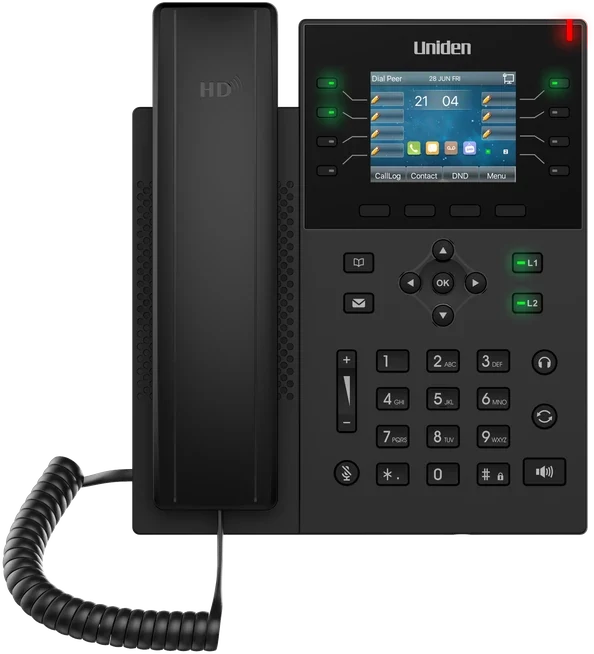
| What happens when the network generation changes? | Hardware may need replacing. Modules, gateways and failover cards are generation-specific. | ✓ Nothing. The service runs over whatever internet exists. |
| How do you get new capability? | A purchase, a project, a technician and often a licence upgrade. | ✓ It appears. AI answering did not exist when most PBXs were installed. |
| What is the asset life? | Depreciated over 5 to 10 years, and the decision is locked for that period. | ✓ No asset. The decision is reversible monthly. |
| Security updates? | Your responsibility, or your integrator’s, and frequently deferred. | ✓ Continuous, at the platform level, without a maintenance window. |
| What if the business changes shape? | Capacity was sized on the day you bought it. Growing or shrinking both cost money. | ✓ Add or remove users. Open a site. Close one. |
| Does it survive losing the premises? | The system is in the building. If you cannot reach the building, you cannot reach the system. | ✓ Runs from a phone in a car park. |
None of this is a 6G argument specifically. It is an argument about the rate of change, and 6G is simply the clearest available evidence that the rate of change is not slowing. The detailed comparison is in hosted PBX versus on-premise PBX.
The AI Part Is Not Waiting for 6G
Notice that GCOT published principles on AI adoption in telecommunications in January 2025, more than a year before the 6G security principles. That ordering is not accidental. AI is arriving in networks and in communications products now, well ahead of the network generation being designed around it.
Which means the thing most often described as futuristic is the thing already available.
| Available now | What it does |
|---|---|
| AI voice agents | Answer calls in a natural Australian accent, handle common questions, qualify, book appointments and escalate to a person when required. |
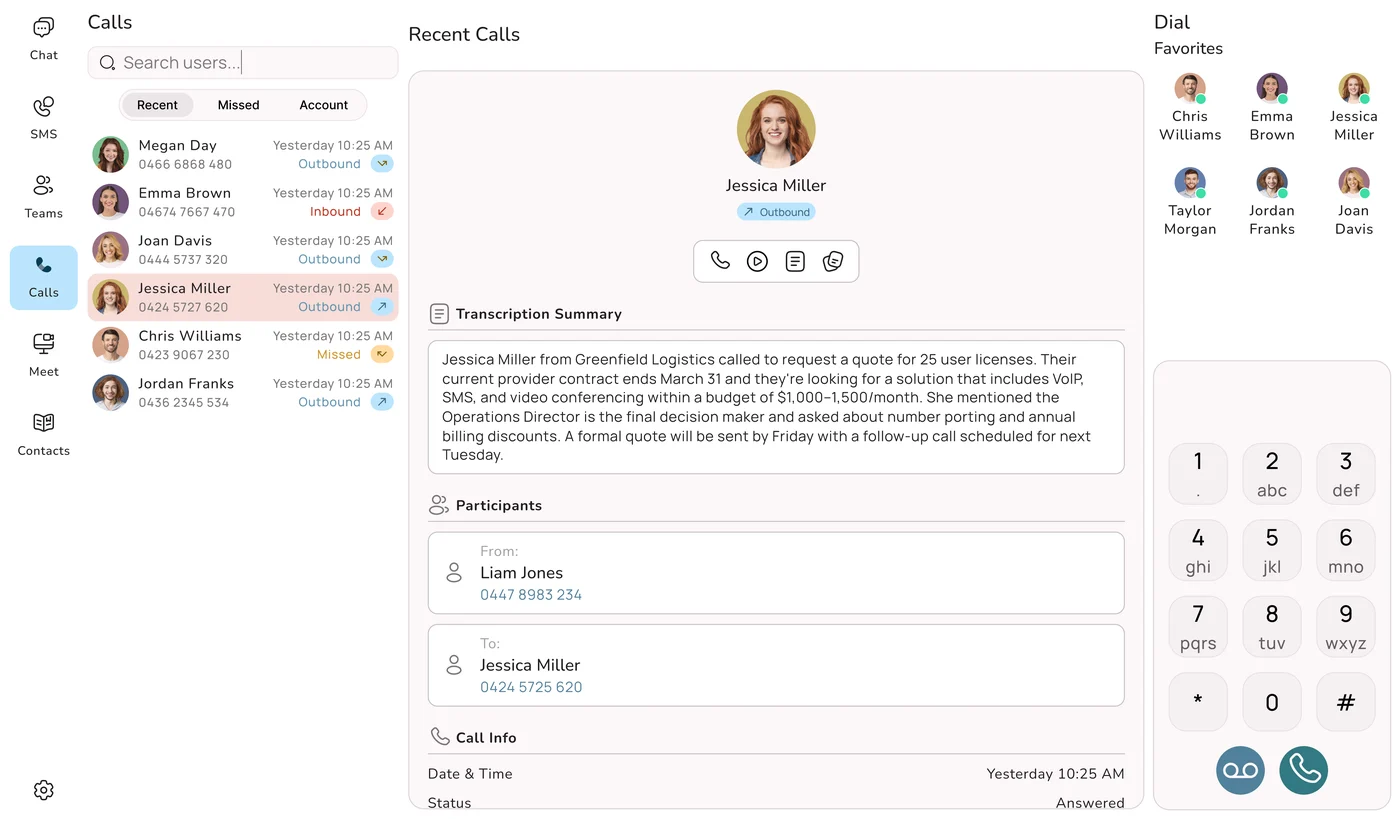
| Transcription and summaries | Every call becomes searchable text with the actions extracted: see call transcription and CRM notes. |
| Automated quality scoring | Consistent review across every call rather than three samples a month: see AI call scoring. |
| Intelligent routing | Calls sent by intent and history rather than by the order somebody pressed a key. |
A business waiting for 6G to modernise its communications is waiting for the wrong thing. The capability gap between an average Australian business phone setup and what is available today is already larger than the gap 6G will introduce.
Why Sovereignty Is in the Conversation
Read GCOT’s agenda again (supply chain diversification, security and resilience, standards, skills) and a theme emerges that goes beyond technology. Governments are treating telecommunications as strategic infrastructure whose ownership and control matter, not as a commodity to be bought at the lowest price from whoever is cheapest.
That logic does not stop at the national level. The same questions apply to a business choosing a communications provider.
Where does it run?
Many phone services sold in Australia are resold badges on overseas platforms. Your call data lives wherever that platform lives.
Who operates it?
A provider that owns its platform can fix things and add capability. A reseller can only pass your ticket along and wait.
Whose law applies?
Australian Privacy Principle 8 makes you accountable for information you send overseas. Knowing the jurisdiction is not paranoia, it is compliance.
Who answers at 4pm on a Friday?
The least strategic-sounding question and often the one that decides how a bad week actually goes.
Those questions are unpacked properly in where your calls actually live.
Five Questions to Future-Proof a Decision
| Ask | What a good answer sounds like |
|---|---|
| “What do I own that is generation-specific?” | Ideally nothing. If the answer includes gateways, failover modules or anything with a SIM in it, put a review date in the calendar now. |
| “How do new features reach me?” | Automatically and included. “As a chargeable upgrade project” means you will not get them. |
| “How long am I committed for?” | Month to month. In a decade of change, a five-year contract is a bet you are being asked to place on someone else’s behalf. |
| “Does it work if the building does not?” | Yes, from a phone, anywhere. Anything else fails the only test that matters on a bad day. |
| “Who actually owns the platform?” | A named company you can reach, in a jurisdiction you can name. |
Australia sitting at the table where 6G security is being written is genuinely good for the country. For your business, the takeaway is narrower and more immediate: the networks under you will keep changing, faster than any equipment purchase cycle can track, and the only sensible response is to stop owning the parts that go out of date.