

Business phone system
- Business phone systemA complete cloud phone system, set up for you
- Features50+ features: IVR, queues, recording, desktop and mobile apps
- Call flowsDecide exactly how every call is answered and routed
- AI Agents Built inAnswer, book and follow up on calls, day or night
- Time to upgradeStill on an old PBX? Here is what you are missing
Apps and hardware
- Desktop app Live demoCalls, chat, SMS and AI summaries in one window
- Mobile app Live demoYour business number on your iPhone or Android
- Uniden desk phonesThe EVOC2 and a full range of office, DECT and conference phones
- Business NBNNBN set up alongside your phones, on one bill
- Why our internetBuilt for voice, so calls stay clear when the line is busy
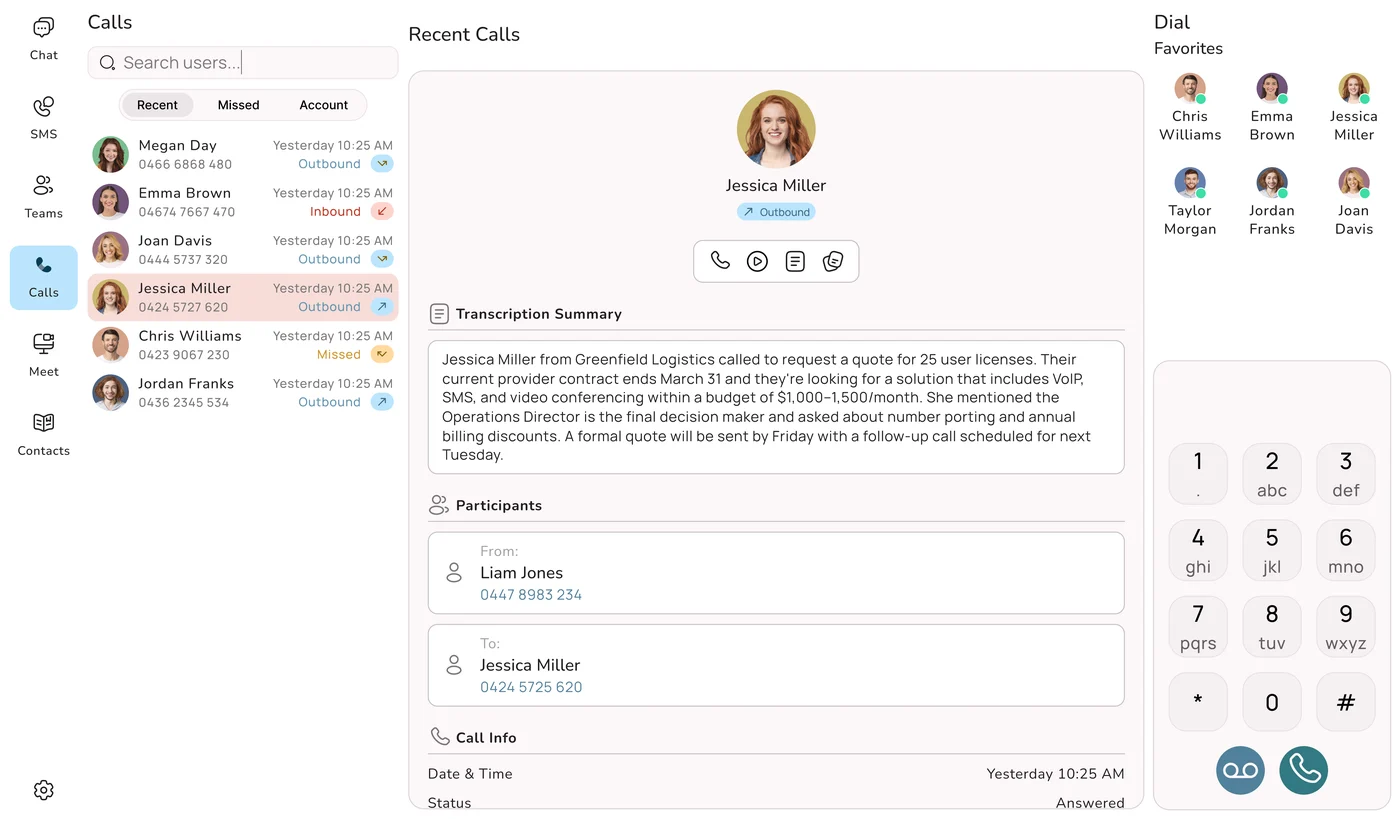
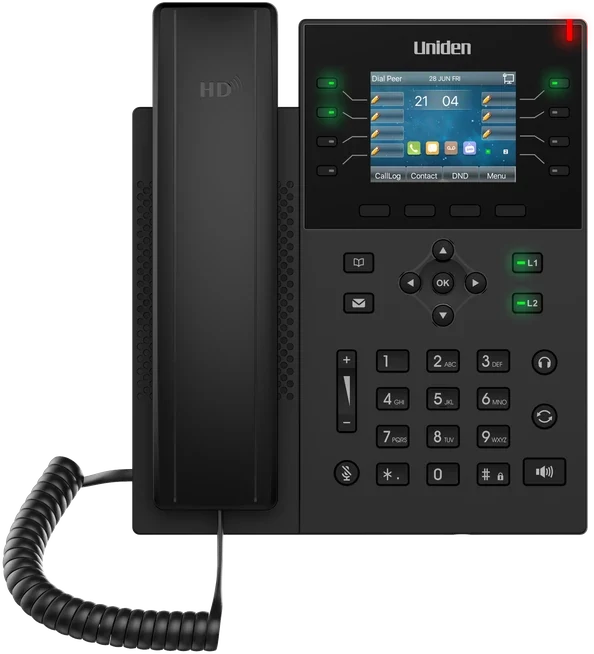
New Try it liveTake the Uniden Voice apps for a spin, right here
Click through working demos of the desktop and mobile apps: calls with AI summaries, team chat, SMS and more. No download, no sign up.
Desktop app demoMobile app demoDesigned, built, hosted and supported in Australia. Uniden desk phones, cloud apps and AI in one system.Book a demoAll features
AI on your phone line
Uniden Voice vs AI receptionists
See every comparisonAI AgentsEvery call answered, day or night
It answers on your own numbers, books the job, sends an SMS and warm transfers to your team when a person is needed.
Meet your AI agentBuilt into your phone system, not bolted on. No second number, no call forwarding.Book a demo
Professional services
Trades, retail and hospitality
Browse all industries Case study · Optical Solutions AustraliaFive branches, five phone systems, now one.5 sites1 systemRead the story
 Case study · Coco's Wealth of HealthWhen every enquiry and phone order matters.Maroubra organic health-food storeRead the story
 Case study · Shuriken ConsultingFour Sydney offices on one phone system.4 offices1 systemRead the story
 Case study · Carlingford Dental SurgeryEvery call rings the whole team.Dental Carlingford, NSWRead the story
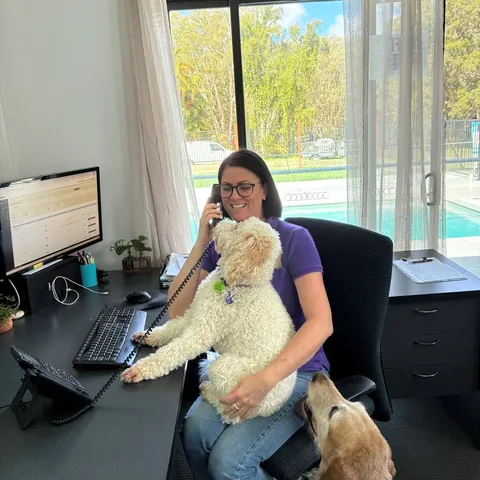 Case study · PTSD Dogs AustraliaA direct line for veterans, answered from anywhere.Charity Sunshine Coast, QLDRead the story
 Case study · Imperial Realtor GroupSales calls to sales, rentals to property management.Real estate Mango Hill, QLDRead the story
 Case study · Good 2 Eat CateringA catering team on the move, on one number.Catering and events Sunshine Coast, QLDRead the story
 Case study · ManolutionsOne number for the firm, a direct line to Paul.Executive advisory Works across time zonesRead the story





Our customersFrom one-person shops to national brands
See how businesses like yours run their phones on Uniden Voice.
Find your industryWorking on your own? A real business number and NBN for sole traders, no lock-in.Sole tradersStartups
Phone plansBusiness phone planfrom$84.90/month3 users included on a 36-month term. Every feature, one simple per-user rate.Free setup and free number portingDesktop and mobile apps includedAI Agents built inSee phone plans![Uniden Voice mobile app on a call]()
![A small team working together at a desk]()
Internet, hardware and more

Bundle and savePhones and NBN from one Aussie team
One provider to call when something needs fixing. No finger pointing.
See NBN plansWe guarantee to beat any competitor's quote. Keep your existing numbers when you move across.Sign up online1300 881 662
Learn and get set up
The library at a glanceBrowse all
180business
guides403kreads
so far
guides403kreads
so far
Guides by topic
- Phone systems67
- AI24
- Industries18
- Costs13
- NBN8
- Security7
- News5
- Other guides38


Need a hand? Our support team is based in Australia.Contact support
Call us on 1300 881 662 or send a message and the team will get back to you.Send a message
Industries / Start up
Uniden Voice for Start up
Enterprise buyers check whether you are a real company.
Your product might be excellent and your team might be four people in a co working space. The moment a serious customer rings and gets a mobile voicemail, a very specific doubt forms about whether you will still exist next year.
Answers 24/7Genuine Australian voices1300 numbers availableScales as you hire
Every fundraise
Your companyThu 10:05am
Founders in a customer demoThe most important meeting of the quarter.Selling
Enterprise buyer doing diligenceChecking whether you are real.09s19s30s41sMissed
Existing customer with an issueConsidering whether to renew.05s12s20s28sMissed
One demo delivered. One deal doubted, one renewal at risk.
The bit nobody counts
Credibility is cheaper to buy than to rebuild
Early stage companies spend enormous effort looking legitimate, then answer the phone in a way that undermines all of it. Procurement teams notice.
1Enterprise buyers assess durability. They are betting their own reputation on you. An unanswered mobile is evidence you are too small to depend on.
2Support expectations arrive with your first real customer. The moment somebody pays properly, they expect to be able to reach you. Founders cannot be the support line forever.
3Founder time is the scarcest resource you have. Every routine call answered by a founder is a call not spent building or selling.
UNIDEN VOICE · CREDIBILITY LEDGER
Illustrative only. Put your own numbers in.
Calls per week50
Answered by a person24
Rang out or abandoned26
Share of those who were
a genuine buyer or customerx 0.35
Genuine buyer calls lost per week9
Average annual contract value$18,000
AT RISK PER WEEKNine conversations
AT RISK PER YEARYour whole pipeline target
Uniden Voice, per weeka fraction of that
Change the two highlighted lines to your own figures.
The arithmetic is the point, not our example.
At seed stage a single enterprise deal changes the trajectory of the company.
The arithmetic is the point, not our example.
At seed stage a single enterprise deal changes the trajectory of the company.
Six things every founder says out loud
You have said at least four of these this month
These are not phone problems. They are credibility and founder time problems that arrive down a phone line.
01
Founders are the switchboard
The two people who should be selling and building are answering support calls, because there is nobody else.
The agent handles the routine so founders do founder work.
02
A mobile voicemail fails diligence
Procurement and security reviews look for signs you are a functioning company. Your phone is one of them.
A proper business number, greeting and routing from day one.
03
Support expectations arrive suddenly
Your first serious customer expects business hours support. You have not hired for it yet.
24/7 coverage before you can justify a support hire.
04
Timezones do not care about your headcount
Sell to the US or Asia and half your customer conversations happen while you are asleep.
The agent covers every hour, and books calls into the overlap.
05
Everything is in someone's head
What was promised to a customer on a call exists only in a founder's memory, until it becomes a problem.
Recording, transcript and summary against every account.
06
You will outgrow whatever you set up now
Cheap tools that work for three people become the thing you rip out at thirty.
One platform that scales from one user to a thousand without a migration.
Watch one of them get saved
7:15am. Before standup. The enterprise deal survives.
This is the call that used to reach a mobile voicemail. Here it is being answered by a Uniden Voice AI phone agent, in an Australian accent, from what you told it about your company.
It sounds like it is from here. Genuine Australian voices, not a call centre accent and not a robot reading a script.
It makes you sound established. A proper greeting, real routing, and a company that clearly has a process.
It routes sales and support separately. So a buyer never lands in a support queue and a customer never lands in sales.
It protects founder hours. Routine calls stop reaching the two people who should be building.
Uniden Voice AI Agent Live on line 100:46
AgentGood morning, thanks for calling Arden Systems. How can I help?
BuyerI am doing some due diligence ahead of a procurement decision. I need to understand your support arrangements.
AgentHappy to point you to the right person. Are you evaluating us for an enterprise deployment, and roughly how many users would that be?
BuyerYes, enterprise. Around four hundred seats to start.
AgentThank you, that is helpful. That conversation should be with one of our founders directly. I have Priya available Tuesday at 9am or Wednesday at 4pm, and I will send our security and support documentation ahead of the call.
BuyerTuesday at nine. I am Alan Whitfield from Corella Group.
AgentBooked, Alan. I have emailed you the documentation and texted the calendar invite. Priya will have the deployment size in front of her before you speak.
What happened before standup
- Enterprise buyer answered by a company, not a mobile voicemail
- Opportunity qualified at four hundred seats before a founder was involved
- Security and support documentation sent automatically
- Founder call booked with full context, and logged in the CRM
One number, a real company behind it
Sales and support should never share a queue
Publish one number. Behind it, buyers reach sales, customers reach support, and founders stop being the switchboard for both.
Live call being routedOverflow and after hours to the AI agent
Demand peaks
Launches and funding rounds create calls you cannot staff
Startup call volume is spiky by nature. A launch, a press mention, a funding announcement or a conference all produce concentrated bursts against a headcount of four.
An AI agent gives you enterprise grade coverage without an enterprise headcount. Every call answered, routed and logged, at any hour, which is precisely what diligence is looking for.
Inbound calls across a startup yearshape, not scale
What your team can realistically answer Overflow the AI agent picks up
Illustrative shape. Your own curve depends entirely on your launch and funding timing.
It plugs into what you already run
Your phone should know which account is calling
Uniden Voice connects to more than a thousand apps and offers open APIs, which matters more to a startup than most, because you will want to wire the phone into your own product and data.
SalesforceHubSpotXeroZohoMondaySlackGoogle Business ProfileGoogle DriveMicrosoft OneDriveOpen APIs for the rest
01 · ON THE RING
Screen pops before you say hello
The caller's name, their history and their open account appear on the handset or in the app as it rings, so the first thing out of your mouth is their name and not "who am I speaking with".
02 · DURING THE CALL
Click to call from anywhere
Ring a customer straight from the record in your CRM or support system, without ever typing a number. Fewer wrong numbers, and every call logged against the right file automatically.
03 · AFTER THE CALL
Notes that write themselves
Recording, transcript, AI summary and the next action land in your CRM or your shared drive. Nobody has to remember what was promised on a Friday afternoon.
Why Uniden, and not the other twelve
An Australian platform that scales from four people to four hundred
Plenty of platforms will sell you AI. Very few are Australian owned, hosted and supported, and almost none let you start at one seat and grow without a migration.
Onshore, end to end
Designed and built in Australia, hosted in Australian datacentres, and supported by Australians you can actually get on the phone. Your customer conversations do not leave the country.
An accent that lands
The AI answers in a genuine Australian voice. It matters, because a caller who thinks they have reached an offshore call centre hangs up before you get the chance to help them.
Desk, pocket and back office
The EVOC2 desk handset where you want something solid to grab, plus real Uniden apps for Windows, Mac, Linux, iOS and Android. Same number, whether you are at a desk or working remotely.
Open APIs, because you will want them
Full API access and webhooks, so you can wire calls into your own product, your own data and your own workflows rather than being limited to whatever integrations happen to exist.
Straight answers
The questions founders ask us first
Can we start tiny and scale?
Yes. Plans start at a single user and go to a thousand or more on the same platform, so you are not choosing a throwaway tool now and a real one later.
That matters more than it sounds. Migrating a phone system at forty people, with numbers customers already have, is genuinely painful.
Can we get a 1300 number?
Yes, and for a startup selling to Australian business it is worth having. A 1300 number reads as a national company, which is exactly the signal you are trying to send during diligence.
You can hold both a 1300 and a local geographic number, and route them differently.
Do you have proper APIs?
Yes, plus more than a thousand app integrations. For a technical team the APIs are usually the more interesting half, because you can wire call events into your own product, trigger flows from your own systems, and push call data wherever you keep it.
It means the phone stops being a separate silo bolted onto the side of your company.
What happens when the AI cannot help?
It hands over, and you decide where. Pricing negotiations, security reviews and anything contractual can go straight through to a person, to a specific queue, or to a manager's mobile.
The caller is not asked to repeat themselves either. Whoever picks up gets the context the agent already gathered. Outside hours the agent takes the details, sends an SMS confirmation and queues the callback.
Do I have to change my phone number?
No. Number portability is standard, including 1300 and 1800 numbers, so the number on your website, your contracts and your app store listings and on years of Google results stays exactly as it is.
We port it across and plan the cutover around your hours, not ours.
What happens if the internet drops?
Calls keep flowing. The mobile app keeps working over 4G and 5G, so your people can answer on their handsets while a site connection is down, and call flows can be set to divert to mobiles automatically.
You can also take your NBN service from Uniden Voice, so the connection and the phone system are one provider with one support number, instead of two companies each suggesting the problem belongs to the other.
How long does it take to get running?
A single site can be live quickly, because the apps need no hardware and the handsets arrive ready to plug in. The part worth doing properly is the call flow and the AI agent's knowledge of your business, and we build that with you rather than handing you a manual.
Number porting is the one step with an external timeline, so we usually run your new setup alongside the old line until the port completes. You never trade a day without a phone.
Now You're Talking
Sound like a company before you are one
Book fifteen minutes. Show us how calls reach you today, and we will show you the version that survives procurement.
1300 881 662 · info@unidenvoice.com · www.unidenvoice.com