
















The Problem Plug-and-Play Actually Solves
Ask anyone who installed a phone system before about 2015 what the worst day was, and they will describe the same afternoon: a box of handsets, a laptop, a printed spreadsheet of extension numbers and SIP passwords, and several hours of typing credentials into a web interface one handset at a time, with a mistake somewhere in the middle that will not surface until Thursday.
That is the job plug-and-play removes. Not “makes easier”, removes. A correctly provisioned handset is never configured by a human at all. Somebody records its MAC address once, and every setting after that arrives over the network.
The distinction matters commercially because it is the difference between an installation and a delivery. An installation needs a technician, a booking, a site visit and an invoice. A delivery needs a courier. For a business adding two desks at a branch office, that gap is most of the cost of the project.
The one-sentence version: the EVOC2 does not need to be told anything, because it knows how to ask. Everything below is an explanation of who it asks, in what order, and what happens when the answer does not come back.
What Happens in the First Ninety Seconds
Here is the sequence, in order, when a factory-reset EVOC2 is plugged into a PoE switch port.
| # | What the phone does | What can go wrong |
|---|---|---|
| 1 | Draws power over Ethernet. No power adapter needed if the switch supports PoE: consumption is 1.55W to 10.4W. | Switch port is not PoE, or the PoE budget is exhausted. Symptom: nothing happens at all. |
| 2 | Negotiates the link and requests an IP address by DHCP. The phone ships in DHCP mode; static IP and PPPoE are available but rarely used. | No DHCP server on the VLAN, or the phone landed on a VLAN with no route out. Symptom: phone shows no IP. |
| 3 | Looks for a provisioning server. It tries SIP PnP first, then DHCP options, then TR-069, then static provisioning: highest priority to lowest. | Nothing answers. The phone boots to an unregistered state with no extension. |
| 4 | Downloads its configuration file over FTP, TFTP, HTTP or HTTPS, depending on what the server specifies. | A firewall blocking outbound HTTPS to the provisioning host. Rare, but it happens on locked-down networks. |
| 5 | Applies the configuration (SIP account, display name, DSS key layout, time zone, phonebook, ring tones) and registers to the platform. | MAC address was never entered against the extension. This is the usual cause and it is a one-line fix. |
| 6 | Synchronises the time over SNTP and shows the extension on screen. Dial tone. | Nothing, at this point. If you have reached step six you are done. |
Why the priority order matters
The EVOC2 supports SIP PnP, DHCP custom option, DHCP option 66 (the default), DHCP option 43, TR-069 and static provisioning. If several are enabled it works down the list from PNP to DHCP to TR-069 to static. In practice this means a handset will find its way home on almost any sanely configured network, and on an unusual one there are five other routes to try before anybody has to touch a keypad. That redundancy is the actual engineering behind the phrase “plug and play”.
The Uniden Voice Way: MAC Address and Factory Reset
On Uniden Voice, the whole exercise reduces to two actions.
1. Enter the MAC address
In the Uniden Voice portal, open Extensions, choose the extension, and edit the Uniden Handset Configuration field to add the handset’s MAC address. That is the entire association between a physical phone and a person.
2. Factory reset the phone
On the handset, Menu → System → option 6 → Clear All → Enabled → OK. The phone restarts, provisions itself and comes up on the right extension.
Or skip both
Order handsets through Uniden and they are configured against your account before they ship to your business address. The reset step exists for phones you are moving, re-assigning or reviving.
Moving a phone later
Re-point the MAC to a different extension in the portal and reset the handset. Staff changes, desk moves and branch transfers are a two-minute portal edit rather than a site visit.
The consequence worth dwelling on: a handset is not tied to a person, a desk or even a building. It is tied to a line in a portal you can edit from a phone. Someone leaves, someone joins, the office moves: none of that requires a technician, and none of it requires anyone to remember a SIP password that was written down once in 2021.
The Full Specification
Product pages tend to list four highlights and a photograph. Here is the whole sheet, because the details are where you find out whether a phone suits your business.
| Category | Specification |
|---|---|
| SIP lines | 12 SIP lines, SIP hotspot, 3-way conference |
| Display | 2.8-inch 320×240 colour LCD, on-screen key labels, screen saver |
| Keypad | 31 keys: 7 DSS keys with LED indicators, 1 page-switch key, 4 soft keys, 4 function keys (phonebook, MWI, headset, redial), 4 navigation keys, 2 line keys with LEDs, OK key, 12 digit keys, 3 volume keys, 1 hands-free key |
| Directory | Local phonebook 1000 entries, remote phonebook via XML/LDAP 1000 entries, call logs 1000 entries in/out/missed, black and white list call filtering |
| Audio codecs | Narrowband G.711a/u, G.723.1, G.726-32K, G.729A, iLBC. Wideband G.722, AMR-WB, Opus |
| Audio processing | HD handset and hands-free, 0 to 7kHz frequency response, 16kHz wideband ADC/DAC sampling, full-duplex AEC, VAD, CNG, BNE, noise reduction, packet loss concealment, dynamic adaptive jitter buffer |
| Network | Dual 10/100/1000Mbps ports, bridged for PC bypass. IPv4/IPv6/dual stack. DHCP, static IP or PPPoE. 802.1x, VLAN, LLDP, QoS, VPN via L2TP or OpenVPN |
| Protocols | SIP 2.0 over UDP/TCP/TLS, RTP/RTCP/SRTP, STUN, DHCP, IPv6, LLDP, PPPoE, 802.1x, L2TP, OpenVPN, SNTP, FTP/TFTP, HTTP/HTTPS, TR-069 |
| Call features | Hold/resume, waiting, intercom, transfer (attended and unattended), forward (always/busy/no answer), parking and pick-up, redial, DND, anonymous call, auto-answer, voicemail with MWI, hot line, hot desking |
| Wireless | Built-in Bluetooth 2.1 for headsets. Wi-Fi via USB dongle: when a dongle is fitted, wireless takes priority over the cable |
| Headsets | RJ9 headset port, EHS wireless support: Plantronics via APD-80 EHS cable, Jabra via Fanvil EHS20 cable |
| Recording | To USB flash drive or to the server |
| Management | Auto-provisioning via FTP/TFTP/HTTP/HTTPS/DHCP OPT66/SIP PnP/TR-069, web management portal, web packet dump, config export and import, phonebook import and export, firmware upgrade, syslog, Action URL / Active URI, uaCSTA |
| Ports | 2× RJ9 (handset, headset), 2× RJ45 (network, PC), 1× USB 2.0 type A, safety keyhole |
| Power | PoE 1.55 to 10.4W, or 5V/2A adapter at 1.24 to 9W |
| Physical | Black. Desk stand 181×175.75×184.4mm or 181×175.85×185.1mm depending on angle; wall-mounted 181×115.43×208.75mm (wall bracket sold separately). Red status indicator light |
| Environment | Operating 0 to 45°C, humidity 10 to 95% |
| In the box | HD handset, RJ9 handset cord, 1.5m CAT5 Ethernet cable, back rack/stand |
$249
Per handset, configured before it ships
$25
USB Wi-Fi adapter, for desks with no Ethernet
1000
Phonebook entries locally, plus 1000 remote via XML/LDAP
nbn ready
Built for Australian broadband conditions
The Screen, the Keys and Why On-Screen Labels Matter
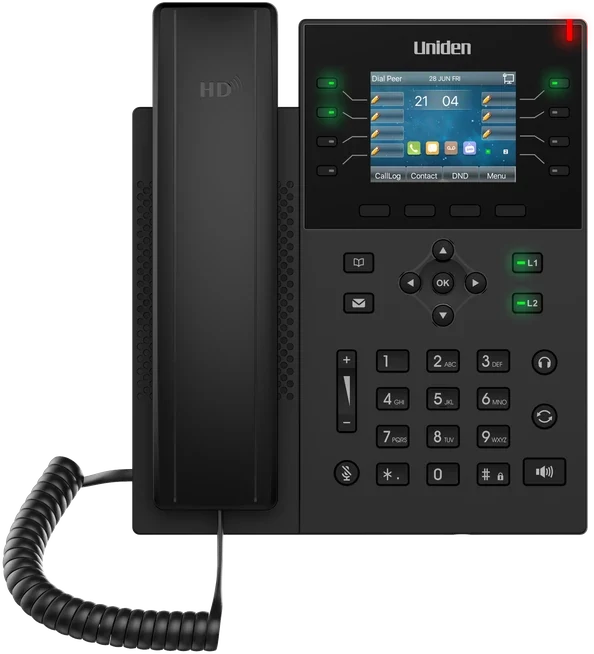
The specification line that changes daily life in an office is not the codec list. It is seven DSS keys with LED indicators and on-screen labels.
On an older desk phone, the buttons beside the screen were labelled with a strip of paper behind a plastic window. Someone printed it in 2019. Two of the people on it have left, one extension was renumbered, and nobody has changed it because doing so means finding the template, printing on the right stock, and prising the plastic off with a fingernail. So the buttons quietly become decorative.
On the EVOC2 the labels are drawn on the 2.8-inch colour screen next to each key, which means they update when the configuration updates. Change a name in the portal, re-provision, and the button says the right thing. The LED beside each key shows line and presence state, so a receptionist can see at a glance who is on a call before transferring, which is the actual job that BLF keys exist to do, and the one that stops working the moment the labels go stale.
7 DSS keys with LEDs
Speed dial, line appearance or busy-lamp-field monitoring, with a lamp that tells you the state before you transfer.
Page-switch key
Flips the DSS keys to a second page, so seven physical keys cover more than seven destinations.
4 context soft keys
Change with the situation: Conf and Xfer appear during a call, DND and Menu when idle. Nothing to memorise.
Red status light
Visible across a room. Message waiting or ringing, without looking at the screen.
Audio: The Part You Only Notice When It Is Bad
Nobody has ever chosen a phone for its acoustic echo canceller. Everybody has been on a call where one was missing.
The EVOC2 runs HD voice on both the handset and the speakerphone with a 0 to 7kHz frequency response and 16kHz wideband sampling, and carries the wideband codecs that make that audible: G.722, AMR-WB and Opus. Opus is the one worth knowing about: it adapts its bitrate to the connection in real time, which on an Australian broadband service with variable evening congestion is the difference between a call that degrades gracefully and one that turns into robot noises.
| Feature | What it does | When you notice it missing |
|---|---|---|
| Full-duplex AEC | Cancels the echo of your own voice returning through the speaker | Speakerphone calls where the other party hears themselves a beat behind |
| Adaptive jitter buffer | Smooths packets that arrive out of order or late | Choppy audio on a busy office connection at 4pm |
| Packet loss concealment | Fills brief gaps rather than dropping to silence | Words disappearing mid-sentence on a marginal link |
| VAD / CNG / BNE / NR | Detects speech, generates comfort noise, estimates and reduces background noise | Workshop and warehouse calls, where the fan is louder than the caller |
If your business takes calls from a workshop, a shop floor or anywhere with machinery, the noise-reduction chain is the specification that matters most and the one nobody reads. For everything else about call quality on Australian connections, the VoIP and SIP troubleshooting guide covers the network side.
Networking: One Cable, Two Ports, No Power Brick
The EVOC2 has two gigabit ports, bridged. The wall drop goes into the network port and the desktop PC plugs into the other. One cable to the desk carries both, and neither device is throttled to 100Mbps, which sounds obvious until you meet the many desk phones still shipping with a 100Mbps pass-through port that quietly halves the speed of the computer behind it.
Power comes down the same cable via integrated PoE, drawing between 1.55W and 10.4W. No power adapter, no second cable, no powerboard under the desk with one spare socket. If the switch has no PoE, a 5V/2A adapter is available and the phone draws 1.24 to 9W on it.
For the person who will actually configure the network
The phone supports VLAN tagging, LLDP, QoS marking and 802.1x network access control, which is what you need to put voice on its own VLAN and give it priority over data on a shared office link. It will also build a VPN over L2TP or OpenVPN, which is how a handset at a home office or a remote branch reaches a head-office platform across the public internet without exposing SIP to it. Both are optional; neither is needed for a straightforward single-site deployment.
Headsets, Bluetooth and the Wi-Fi Dongle
Three connectivity options that each solve a specific and common problem.
EHS wireless headsets
Electronic hook switch means answering and hanging up from the headset itself while walking around. Plantronics through the APD-80 cable, Jabra through the Fanvil EHS20. For anyone on the phone for hours.
Built-in Bluetooth 2.1
Pairs a Bluetooth headset directly, answer, hang up and redial from the headset button. No dongle needed for headsets; a USB adapter is required for the phone to support a U-disk-based pairing on some models.
USB Wi-Fi dongle
$25, and it removes the single most common blocker to putting a desk phone somewhere. Note the behaviour: when a dongle is fitted, Wi-Fi takes priority even if a cable is also plugged in.
USB recording
The same USB port takes a flash drive for local call recording, as an alternative to server-side recording. Check your obligations first: Australian call recording law is state-based and specific.
Deploying One Desk, or Forty
The realistic timelines, assuming handsets pre-configured by Uniden and a network with PoE and DHCP.
| Scale | What is involved | Realistic time |
|---|---|---|
| One handset New starter, extra desk |
Unbox, clip the stand, plug the Ethernet cable into a PoE port, wait for it to boot and provision. | ✓ Under 5 minutes |
| A small office, 5 to 10 desks | Same, times ten, plus a walk around to check every phone shows the right name. One person, no technician. | ✓ Under an hour |
| 40+ desks, single site | Worth checking the PoE budget on the switch first, and worth putting voice on its own VLAN. Handsets still self-provision; the work is cabling and planning, not configuration. | Half a day, mostly cabling |
| Multi-site or work-from-home | Ship pre-configured handsets directly to each location. Staff plug them into their own router. VPN over L2TP or OpenVPN if the platform requires it. | ✓ Courier time |
Two things to check before ordering forty handsets
PoE budget. A switch rated for PoE has a total wattage budget, not just per-port support. Forty phones at up to 10.4W each is up to 416W before you count access points and cameras on the same switch. Check the number, not the sticker.
Whether you need forty. Genuinely. Uniden Voice runs on free apps for Windows, Mac, iOS and Android, and in most businesses a meaningful share of staff never touch the desk phone after week two. Buy handsets for the desks that take real call volume, and let everyone else use the app. It is a smaller invoice and usually a better outcome.
When a Handset Comes Up Blank
It is uncommon, and when it happens it is almost always one of five things. Work down this list in order.
| Symptom | Most likely cause | Fix |
|---|---|---|
| No lights, no screen, nothing | Port is not PoE, or the switch PoE budget is exhausted | Try another port, or use the 5V/2A adapter to confirm the phone itself is fine |
| Boots but shows no IP address | No DHCP on that VLAN, or the port is on the wrong VLAN | Check the port config. Menu → Status shows what the phone thinks it has |
| Has an IP but no extension | MAC address not entered against the extension in the portal. This is the common one | Add it in the portal, then factory reset the handset: Menu → System → 6 → Clear All → Enabled → OK |
| Shows the wrong person’s name | The handset was previously provisioned to another extension | Re-point the MAC in the portal and factory reset. Two minutes |
| Registers, then drops repeatedly | Network rather than handset, usually a firewall SIP ALG or an aggressive NAT timeout | See the SIP troubleshooting guide. Turning off SIP ALG fixes this more often than anything else |
Notice that four of the five are network conditions rather than handset faults, and the fifth is a missing line in a portal. That is what a mature provisioning system looks like: when it fails, it fails for reasons you can name.
Who Should Buy Desk Phones At All
An honest section to end on, because the answer is not everybody.
Buy a desk phone if
The person is at a desk most of the day, takes or makes a high volume of calls, needs to transfer constantly, or works reception. A physical handset with real keys and BLF lamps is faster than any app for that job, and it never runs out of battery.
Use the app instead if
The person is mobile, hybrid, in and out of vehicles, or takes a handful of calls a day. Uniden Voice apps for Windows, Mac, iOS and Android are free, and a phone in a pocket goes places a desk does not.
Most businesses need both
Handsets on reception, accounts and the service desk; apps for everyone else. Hot desking on the EVOC2 means a shared desk phone can be logged into by whoever is sitting there.
The maths
A handset is a one-off $249. An app is $0. Getting the mix right is usually worth more than negotiating the per-seat price, and it is the part providers rarely volunteer.
If you want the wider argument for buying the phone and the platform from the same company, hardware and software from one company makes that case properly. And if you want to know what else in the Uniden range connects to a network, the connected products guide lists the lot.