
















The Shape of a Clinic’s Phone Day
Ask any practice manager when the phones are worst and you will get the same answer to the minute. It is the first twenty minutes.
The mechanism is not mysterious. Patients wake up unwell, wait until the practice opens rather than calling at 7am, and then all call at once. Same-day appointments are limited and everybody knows it, so calling early is rational behaviour. The result is a demand curve that is almost vertical at opening and then falls away.
A single reception queue handles that badly, and it fails in a specific and consequential way. The calls that abandon are not randomly distributed. A patient booking a routine check-up in six weeks will happily wait on hold. A patient who is unwell and anxious, or elderly, or calling from work with three minutes to spare, hangs up. So the morning wall systematically filters out the callers you would most want to reach.
The thing to measure before you change anything
Do not start with features. Start with two numbers: how many calls arrive in each half-hour block, and how many abandon before being answered, broken down by time of day. Most clinics have never seen this because legacy phone systems cannot report it. Once you have it, the design decisions make themselves: you will be able to see the wall, see exactly how many patients it costs you, and see whether the problem is staffing, routing or both.
The design goal is not to answer everything instantly, which is not achievable with a finite front desk. It is to get the low-value calls out of the queue so the front desk can reach the high-value ones. Almost everything below follows from that single idea.
Four Call Types, Not One Queue
Clinic calls look homogeneous from the outside and are nothing of the sort. Sorting them is the highest-leverage change available.
| Call type | Share of morning volume | What it actually needs |
|---|---|---|
| Booking, rescheduling, cancelling | The largest group by a wide margin | Almost none of this needs a human. Online booking, and a phone path that can handle a straightforward booking or cancellation, removes the bulk of the wall. Cancellations especially, a cancellation you make easy is an appointment you can refill |
| Results and script requests | Substantial, and time-insensitive | These do not need to be handled at 9am. A callback path, or a defined window when the practice returns these calls, moves them out of the peak entirely without disadvantaging anyone |
| Administrative and third-party | Steady all day: pathology, specialists, imaging, insurers, reps | Should never sit in the same queue as patients. A separate number or a routing rule for known clinical contacts keeps the patient queue for patients |
| Urgent or uncertain | Small in number, largest in consequence | Must reach a human quickly and must never be automated away. Every decision above exists to protect this group's access to the front desk |
Put plainly: the reason to automate routine bookings in a clinic is not cost saving. It is so that the person who is genuinely unwell gets answered. That is a clinical argument as much as an operational one, and it is the framing that gets these projects approved by principals who are rightly suspicious of automation in a healthcare setting.
Keep the front door short
A long menu at a clinic is a bad idea. Two or three options, spoken in plain language, with an unmistakable path to a person. Elderly and distressed callers do not navigate deep menus, and those are exactly the callers who must not be lost.
Offer a callback instead of hold
For results and scripts, a callback in the practice's own return-call window is better service than eleven minutes of hold music, and it flattens the peak. Patients accept it readily when the reason is explained.
Separate the clinical inbound line
Give pathology, imaging and specialist rooms a path that does not queue behind patients. A registrar returning a call about a result should not wait eight minutes.
Design the 8:59am overflow deliberately
Decide in advance who picks up the overflow at opening: a second staff member rostered for twenty minutes, a nurse-triage path, or an AI handler taking straightforward bookings. Not deciding is also a decision, made by whoever is on the desk.
Make the recorded messages useful
If you cannot answer immediately, the hold message should carry the two things callers most often ring for: opening hours and how to get urgent help. That alone deflects calls.
Report weekly, not annually
Answer rate, abandonment and call volume by half-hour, reviewed at the practice meeting. It turns front-desk staffing from an argument into an observation.
The Exemption You Do Not Get
This is the section most practice managers have never had explained to them, and it changes how you should think about your phone system.
Australian privacy law has a small business exemption: many organisations with an annual turnover at or below $3 million are not bound by the Australian Privacy Principles. It is why a great deal of general small business advice treats privacy compliance as optional.
It does not apply to you. Organisations that provide a health service and hold health information, other than in an employee record, are covered by the Privacy Act regardless of annual turnover. A two-chair dental practice, a solo physiotherapist, a three-doctor general practice: all covered, all bound by the APPs, on exactly the same footing as a hospital group.
And health information is sensitive information
The Privacy Act treats health information as one of the most sensitive categories of personal information and applies extra protections to how it is handled. So a clinic is not merely inside the regime; it is inside the strictest part of it. The practical implication is that “we are only small” is not an answer to any question in this section, and never was.
Where does the phone system come into it? Because a clinic’s telephone system holds and moves health information constantly, and most practices have never inventoried it.
| Where health information lives in a phone system | The question to ask |
|---|---|
| Voicemail: a patient leaving a message about a symptom or a result | Who can listen to it? Is it emailed anywhere, and to whose inbox? How long is it retained, and who deletes it? |
| Call recordings, if you record | Where are they stored, in which country, for how long, and who can retrieve them? Consent is a separate question, covered below |
| Transcriptions and AI summaries | Which service processes the audio, and where? If a transcript of a clinical conversation is generated, it is health information the moment it exists |
| Call notes written into the practice system | Appropriate and often required, but ensure notes go into the clinical record rather than a spreadsheet or a personal notebook |
| SMS conversation history | Two-way SMS with patients creates a record. Where does it live, who can read it, and is it in the patient's file? |
| Mobiles and personal devices | The commonest weak point. A clinician taking practice calls on a personal phone creates health information on a device the practice does not control |
The two questions worth putting to any provider before you sign: where is this data stored, and who can access it? For a clinic, “somewhere in our global cloud” is not a satisfactory answer to the first, and “our support team, as needed” is not a satisfactory answer to the second. Where your data actually lives covers why the jurisdiction question is not an abstraction.
Recording Clinical Calls: The State Question
Call recording is genuinely useful in a clinic, for training, for resolving disputes about what was said, and for evidence when a complaint arises. It is also the area where practices most often assume there is one national rule. There is not.
Recording a private conversation is governed primarily by state and territory surveillance devices legislation, and the requirements differ. Broadly:
| Jurisdiction | Principal legislation | Broad position on a participant recording |
|---|---|---|
| NSW | Surveillance Devices Act 2007 | All-party consent approach |
| ACT | Listening Devices Act 1992 | All-party consent approach |
| SA | Surveillance Devices Act 2016 | All-party consent approach |
| WA | Surveillance Devices Act 1998 | All-party consent approach |
| VIC | Surveillance Devices Act 1999 | Participant recording generally not caught by the state offence |
| QLD | Invasion of Privacy Act 1971 | Participant recording generally not caught by the state offence |
| TAS | Listening Devices Act 1991 | Participant recording generally not caught by the state offence |
| NT | Surveillance Devices Act 2007 | Participant recording generally not caught by the state offence |
Two important cautions about that table. First, even where a participant may record, using or disclosing the recording is separately restricted: the fact that making it was lawful does not mean you may share it. Second, the federal Telecommunications (Interception and Access) Act 1979 sits over the top, and privacy obligations apply to the recording as health information regardless of which state you are in. This is a summary for orientation, not legal advice, and a multi-site practice should get its position confirmed.
The practical answer that works everywhere
Do not try to run different rules per state. Adopt the strictest approach across the practice: announce at the start of the call that it may be recorded, say why, and offer a genuine alternative for a caller who does not want to be recorded. That satisfies an all-party jurisdiction, is more than sufficient in a one-party jurisdiction, and, importantly for a clinic, is also the approach most consistent with the transparency the APPs expect. It costs you one sentence at the front of the call. Call recording law and setup in Australia goes into more detail.
A related point on AI. If you use transcription or AI summaries on clinical calls, the transcript is health information from the moment it is created, and the processing location matters. AI call transcription and notes covers the mechanics; the clinic-specific requirement is knowing which service processes the audio and in which country.
What the RACGP Standards Say About Your Phone
General practices seeking accreditation against the RACGP Standards for general practices (5th edition) are assessed against criteria that speak directly to telephone practice. Practice managers often discover this shortly before an accreditation visit, which is a poor time to design a phone system.
| Criterion | What it addresses | What your phone setup has to demonstrate |
|---|---|---|
| C1.2 Communications | That patients receive open, timely and appropriate communication about their care | Documented arrangements for telephone and electronic communication, including what information and advice your team can and cannot give over the phone. This is a written policy, not a shared understanding |
| C1.4 Interpreter and other communication services | Access for patients who need an interpreter or other communication support | A working, practised path to interpreter services, and that reception knows how to use it under pressure, not just that a number exists somewhere |
| GP1.3 After-hours care | “Our patients can access after-hours care” | Covered in the next section: it is the one with the most specific implications for how your phones behave when you are closed |
The C1.2 requirement is worth dwelling on because it is so often unmet in a specific way. Most practices have a de facto understanding of what reception may say: they will confirm an appointment, they will not interpret a result. Very few have written it down, and the criterion is about documented arrangements. Writing that policy is a one-hour job and it also happens to be the single best training document for a new receptionist.
On C1.4, the failure mode is almost never the absence of interpreter access. It is that the path is theoretical. If the only person who knows how to get an interpreter onto a call is on leave, the practice does not have interpreter access that day. Test it, and make the instruction visible at the desk.
After-Hours: A Criterion, Not a Courtesy
Criterion GP1.3 states that “our patients can access after-hours care”, and an interim amendment made the expectation more specific in a way that directly affects your recorded messages.
If a practice cannot provide after-hours care itself, and cannot obtain a formal arrangement with an after-hours provider, it must inform patients how to access synchronous care delivered by clinicians who meet Australian health professional obligations when the practice is not open.
Unpack the two operative words, because both matter.
"Synchronous"
Real-time contact with a clinician. A recorded message telling patients to leave a voicemail that will be checked in the morning does not meet this, and neither does an email address.
"Clinicians who meet Australian obligations"
The pathway you direct patients to has to lead to appropriately qualified Australian practitioners. This is a real constraint on which services you name in your message.
Your after-hours message is the artefact
In practice, GP1.3 compliance for most practices lives in the recording that plays when you are closed. It has to name the pathway clearly enough that a distressed caller can act on it.
Emergencies come first in the message
The after-hours greeting should open with the emergency instruction, call 000, before anything about the practice's hours. Put it first, not after thirty seconds of opening times.
Public holidays are the gap
Most practices get weeknights right and then play the standard weekday greeting on Anzac Day. Configure holiday routing once, as a calendar, rather than remembering each time.
Test it from outside
Ring your own practice at 7:30pm and on a Sunday from a mobile. Listen as a patient would. Practices are routinely surprised by what their own after-hours message actually says.
The most common after-hours failure
Not the absence of a message, almost every practice has one. It is a message recorded three years ago that names an after-hours arrangement that has since changed, or gives a number that has been disconnected. Put a calendar reminder to re-record and re-verify the after-hours greeting every six months. It is the lowest-effort item on this entire page and the one most likely to be wrong right now.
Connecting the Phone to the Practice Software
In most clinics, the phone system and the practice management system are two unconnected islands with a receptionist ferrying information between them. Every call involves someone hearing a name, typing it, and searching.
Connecting them changes the front desk experience more than any other single improvement.
| Capability | What it looks like at the desk | Why it matters in a clinic specifically |
|---|---|---|
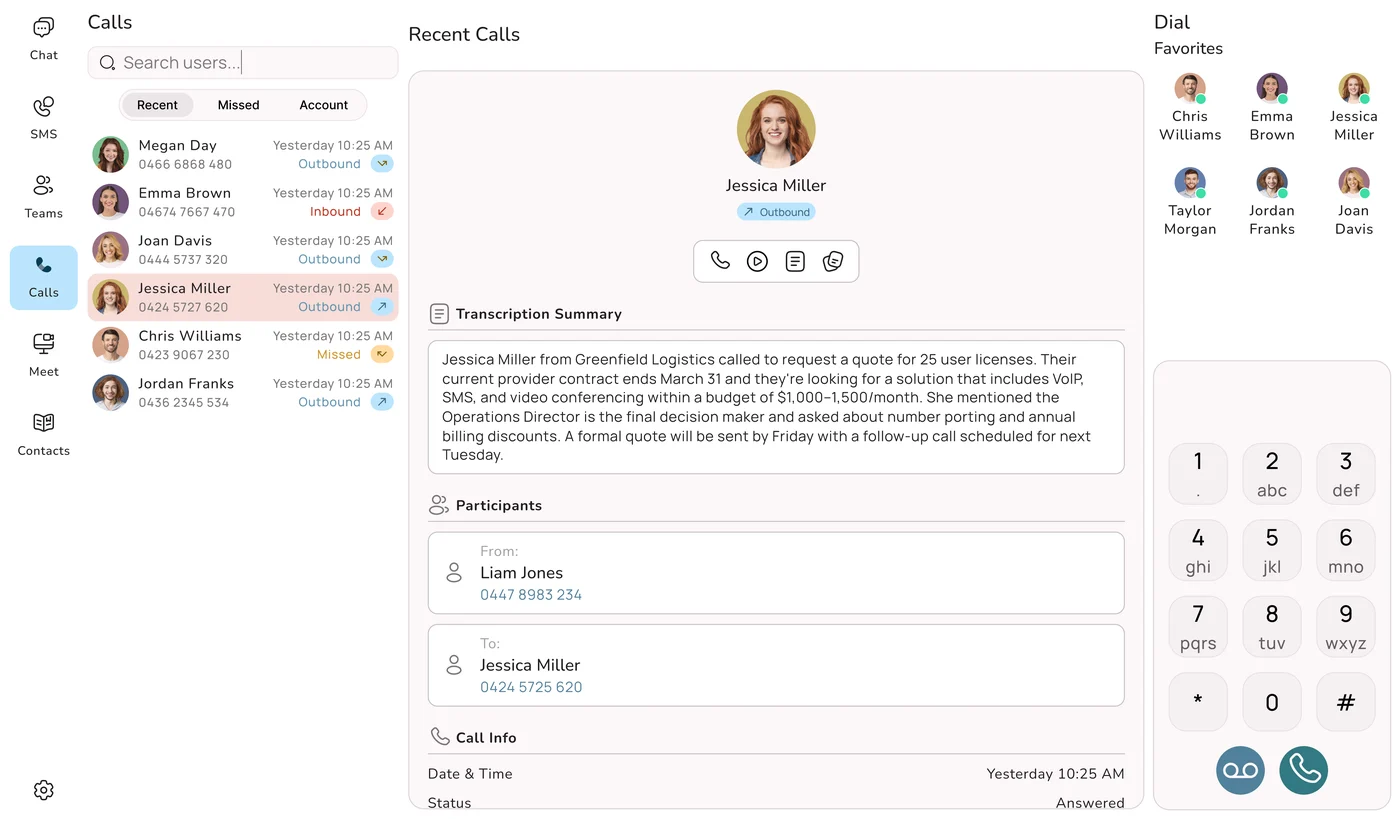
| Screen pop on inbound call | The patient's record opens as the phone rings, matched on the calling number | Saves 20 to 30 seconds per call. Across a morning wall that is a meaningful amount of queue time. It also means you greet patients by name, which matters more in healthcare than anywhere |
| Click to call from the record | Return calls dial from the patient file rather than being keyed in | Eliminates misdials on results callbacks: a category of error with real consequences |
| Call logged against the file | Time, duration and who handled it recorded automatically | Supports the documentation expectations of accreditation and is invaluable when a complaint turns on whether contact was attempted |
| Appointment context | Reception can see the caller has an appointment tomorrow before saying hello | Most calls are about an appointment. Knowing which one removes the entire opening exchange |
Australian practices run a well-defined set of systems: Best Practice, MedicalDirector and Zedmed in general practice; Cliniko, Halaxy and similar in allied health; the major dental packages in dentistry. Not every combination has an off-the-shelf connector, so the honest question to ask a provider is “show me this working with the system we actually run” rather than accepting a logo on a page. Where a native connector does not exist, an open API usually does: integrations and open APIs and the Australian SaaS directory cover the approaches.
Reminders and the Failure-to-Attend Problem
Missed appointments are the clearest financial problem in a clinic. A patient who does not arrive is a consultation slot that cannot be resold, in a book that was fully committed.
SMS reminders are the standard answer and most practices already send them. The gains left on the table are in the details.
Make the reminder repliable
A one-way reminder tells the patient. A two-way reminder lets them cancel by replying, which converts a no-show into a slot you can refill. This is the single highest-value change available.
Keep a short-notice list
A reminder-driven cancellation is only worth money if somebody fills the gap. Maintain a list of patients who want an earlier appointment and message them when one opens.
Send from an identifiable sender
Health-related messages from an unrecognised number get ignored or reported as scams. Sender identity is now inside a regulated system: see the SMS Sender ID Register.
Keep clinical detail out of the SMS
A reminder should carry time, place and practice. Not the reason for the appointment, the specialist's discipline, or anything a person reading over a shoulder should not see.
Time it for cancellation, not confirmation
A reminder sent two hours before cannot be refilled. Far enough out that a cancellation is useful, close enough to be remembered: practices generally land on the previous day.
Log the conversation in the file
Two-way SMS with a patient is a record about their care. It belongs in the practice system, not stranded in a messaging app.
The mechanics of business SMS from a phone system are covered in business SMS from your phone system.
What a Clinic Must Never Automate
An article that recommends automation in a healthcare setting owes the reader a clear boundary, so here it is without hedging.
The absolute limits
Clinical triage. Nothing automated should assess how sick someone is or how urgently they need care. That is a clinical judgement made by a clinician. Clinical advice. No automated system should answer a question about symptoms, medication or what a result means. Emergencies. Any indication of an emergency must route to a human or to the emergency instruction immediately, with no menu in between. Distress. A caller who is upset needs a person, and the system must make reaching one obvious and fast.
Inside those limits, the useful territory is genuinely large: routine booking and rescheduling, cancellations, opening hours, location and parking, billing enquiries, the after-hours pathway, and routing to the right part of the practice. All administrative, all high volume, all currently consuming the front desk during the exact window when the unwell patient is trying to get through.
That is the whole case, and it is worth stating in the language a principal will accept: automating the routine is what buys back human attention for the clinical. Which calls to automate works through the general version of the boundary, and AI receptionist versus human receptionist covers the comparison honestly, including where the human wins.
How to Actually Set It Up
A sequence that works, in the order that causes the least disruption to a running practice.
| Step | Do this | Why in this order |
|---|---|---|
| 1. Measure | Get call volume and abandonment by half-hour for a fortnight | You cannot design for the wall until you can see it, and the numbers settle internal arguments about staffing before they start |
| 2. Write the C1.2 policy | Document what your team can and cannot say over the phone | One hour, satisfies an accreditation expectation, and doubles as the best induction document you will have for reception |
| 3. Fix the after-hours message | Re-record it. Emergency instruction first, then the synchronous after-hours pathway. Test it from a mobile | Cheapest, fastest, highest-risk-reduction item on the list, and it is very likely wrong today |
| 4. Split the traffic | Separate paths for patients, clinical third parties, and results or script callbacks | Removes load from the patient queue without automating anything clinical |
| 5. Decide on recording, once | Announce and offer an alternative on every call. Confirm storage location, retention and who can access | Adopting the strictest approach practice-wide avoids maintaining per-state rules and is more defensible under the APPs |
| 6. Connect the practice software | Screen pop, click to call, call logged to the file. Insist on a demonstration with your actual system | Biggest per-call time saving, and it builds the documentation trail accreditation looks for |
| 7. Make reminders two-way | Repliable cancellation, identifiable sender, no clinical detail, short-notice fill list | Where the money is. Also the change patients notice and appreciate most |
| 8. Review monthly | Answer rate, abandonment by time of day, failure-to-attend rate | Three numbers at the practice meeting. Enough to keep the system honest without creating a reporting burden |
None of this requires a large project. Steps two and three take an afternoon between them and address the two items most likely to be non-compliant today. The rest can follow at whatever pace the practice can absorb.
The underlying idea is worth restating, because it is what makes the whole design defensible in a clinical setting: a clinic’s phone system exists to make sure the person who most needs to be heard is the one who gets answered. Every routing rule, every automation and every reminder in this guide is in service of that, and any change that fails the test should not be made.