


















What Changed on 1 November 2025
The Aged Care Act 2024 commenced on 1 November 2025, and the strengthened Aged Care Quality Standards took effect on the same day. Taken together they are the most significant restructuring of aged care regulation in decades.
The elements that matter to a communications discussion:
| What the Act introduced | Why it reaches your phone system |
|---|---|
| A Statement of Rights for people receiving care | Rights that include being heard, being informed and being able to raise concerns. All of those are exercised, in practice, over the phone |
| Strengthened complaints mechanisms and rights to complain | A complaint usually arrives as a phone call. Whether it was recognised as a complaint, logged and responded to is a records question |
| New provider registration requirements | Registration brings obligations you must be able to demonstrate on request, not merely assert |
| New governance and accountability requirements | Governance means the board can see what is happening. Response times and complaint volumes are reportable facts, or they are not |
| Expanded civil and criminal penalties for serious non-compliance | Raises the cost of not being able to show what happened. Absence of records is now a materially worse position |
| Quality Standards that are more detailed and measurable | Measurable is the operative word. “We always respond promptly” is not measurable. A response-time report is |
The single shift worth internalising
The old Standards could largely be satisfied by good practice described well. The strengthened Standards are built to be demonstrated. That is a documentation and systems change more than a care change: most providers were already doing the right things and simply could not show it. The phone system is where a great deal of the unshowable work happens, because calls are the least-recorded part of most providers’ operations.
A note on scope. This article is about communications design, not about how to comply with the Act. Nothing here substitutes for the Aged Care Quality and Safety Commission’s own guidance or your own advice. What it does is take the obligations as given and ask a narrower question: what should your phones do differently?
The Five Conversations
Aged care providers are frequently sold generic business phone systems, which is why so many end up with a system that handles none of their real situations well. A provider’s calls are not a single stream. They are five, with almost nothing in common.
The family enquiry
Emotional, often from interstate, often about something that happened yesterday. Needs the right person, context in front of them, and no repetition of the story.
The care worker in the field
Standing in a client's home, needing a decision now. Needs to reach a clinical decision-maker fast, from a mobile, with the call recorded against the client.
The incident
Escalation with a clock on it. Needs a defined path that does not depend on who happens to be at a desk, and a timestamped record.
The complaint
Now a formal right with strengthened mechanisms behind it. Needs to be recognised as a complaint even when it does not use the word, then logged and tracked.
The after-hours call
The one that gets tested and the one most often mishandled. Needs a real on-call path, not a voicemail box and an assumption.
And underneath all five
A record: who called, when, who answered, how long it took, what was decided. That is the layer the strengthened Standards care about most and the layer most systems cannot produce.
1. The Family Enquiry
The most emotionally loaded call a provider receives, and the one most damaged by ordinary phone system design.
The typical experience: a daughter rings the main number, explains who her father is, gets transferred, explains again, is told the person she needs is on shift, leaves a message, and rings back the next day to start over. Nothing about that breaches anything. It also produces a family who has concluded that the provider is disorganised, which is the sentiment that precedes most complaints.
| What goes wrong | What fixes it |
|---|---|
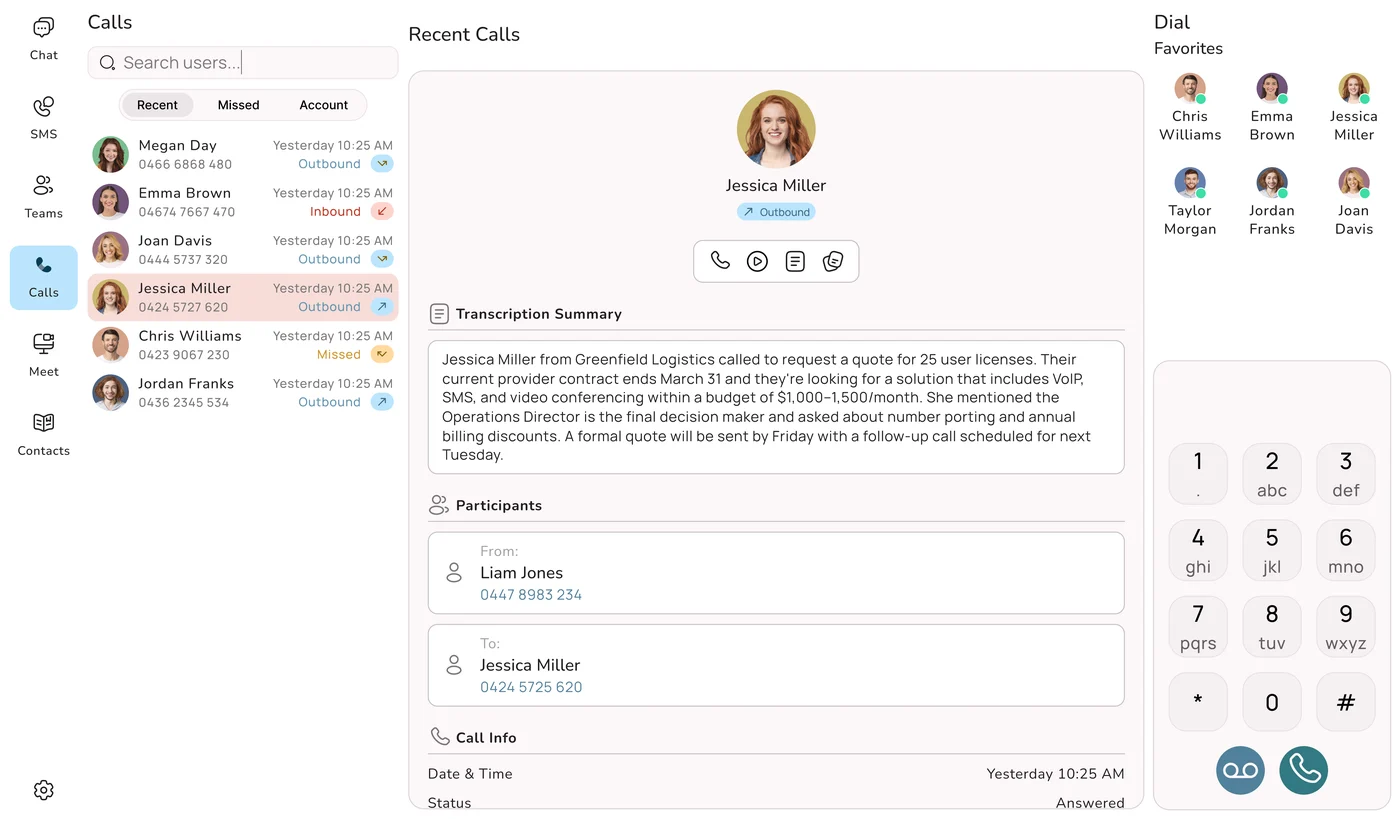
| The caller retells the situation to each person | Screen pop from the client record on inbound call, matched on the calling number, so whoever answers already knows who the client is and who is calling |
| The right person is on shift and unreachable | A named contact with a real escalation path behind them, plus a commitment to call back within a stated time, and a system that tracks whether that happened |
| Nobody knows what was discussed last time | Calls logged against the client record with a note. The next person has the history without needing the same conversation |
| The caller is not the authorised representative | The system should surface who is authorised to receive information before the conversation gets going, not after |
| Interstate families call outside your hours | Deliberate design for time zones. A Perth family ringing a Brisbane provider at 4pm their time is calling at 6pm yours |
The authorisation trap
Family calls create a real privacy risk that busy staff resolve badly under pressure. A caller who sounds distressed and says they are the son may or may not be authorised to receive information about that client. Getting this wrong in either direction is a problem, disclosing to an unauthorised person is a privacy breach, and refusing an authorised person is a complaint and arguably a rights issue. The answer is not staff judgement in the moment. It is having authorisation visible on screen when the call connects, so the decision is already made.
2. The Care Worker in the Field
Home care providers run a mobile workforce, and their communications are usually the weakest-designed part of the operation.
A support worker is in a client’s home. Something is different: the client is unsteady, confused, or has declined care. The worker needs a decision, from someone with clinical authority, in the next few minutes.
What generally happens is that the worker calls a coordinator’s personal mobile from their own personal mobile. Which mostly works, and creates four problems.
| Problem | Consequence | Fix |
|---|---|---|
| The call is invisible to the organisation | No record that advice was sought or given. If this becomes an incident, the most important five minutes are undocumented | Workers call through the provider’s system via an app on their phone, so the call is logged and attributable |
| It depends on one person answering | If the coordinator is driving or with another client, the worker is alone with a clinical question | A clinical escalation queue, not an individual. Rings a group in order, then an on-call clinician |
| Personal numbers get exchanged | Clients and families acquire staff mobile numbers. Boundaries erode, and the numbers leave when the worker does | Calls present the provider’s number, so the personal number is never disclosed |
| Notes are written later, from memory | Contemporaneous documentation is the expectation. Reconstructed notes are weaker evidence and less accurate care records | Log the call against the client at the time, ideally with a transcript or summary where consent and policy allow |
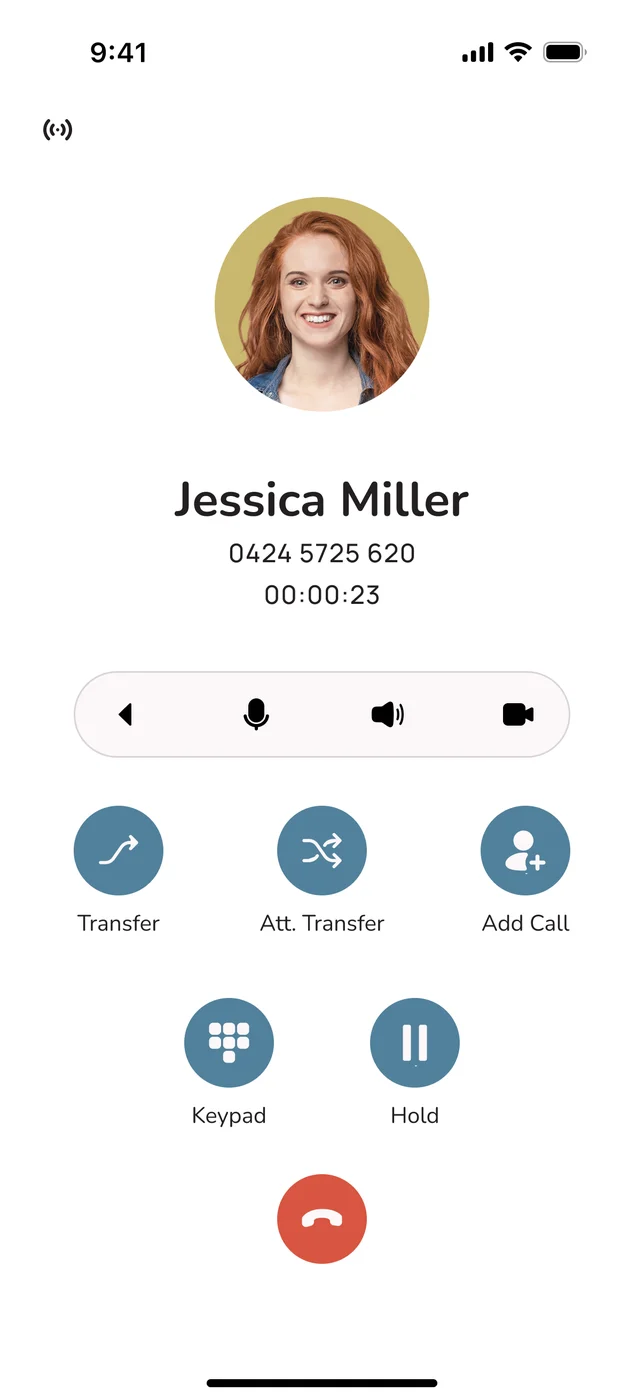
The mobile-first requirement here is genuine. Field staff will not carry a second device, will not use a system that needs a desk, and will not adopt anything that adds steps when they are standing in a client’s kitchen. Softphones on mobile and laptop covers how this works in practice; the key criterion is that using the compliant path must be easier than using a personal mobile, not merely permitted.
3. The Incident
Incident management has defined obligations, and the phone system’s role is narrow but important: getting the escalation to the right person quickly, and creating a timestamped record of the attempt.
Escalate to a role, not a person
An incident path that depends on a named individual fails the moment they are on leave. Route to a role that is always filled, with a defined sequence behind it.
Timestamp everything
When the call came in, when it was answered, who answered, how long the escalation took. Reporting obligations have clocks in them, and a clock needs a start time you can evidence.
Design the unanswered path
The important design question is not what happens when someone answers. It is what happens when nobody does. Cascade to a second and third contact automatically, and alert a manager if it reaches the end.
Connect it to the incident record
The call log and the incident report should reference each other. Reconciling two systems by hand months later is where detail gets lost.
Test it quarterly
Ring the escalation path from outside, at 3am, once a quarter. Providers regularly discover the third contact in the cascade left the organisation last year.
Report on it to the board
Governance obligations mean someone above operations should see escalation response times. That requires a system that measures them.
4. The Complaint
The Act strengthened complaints mechanisms and the rights of people receiving care to complain. This has a specific and underappreciated implication for how phones are answered.
Most complaints do not announce themselves. Very few callers say “I wish to make a formal complaint.” They say that lunch was cold again, that the same worker has been late three times, that nobody told them their mother had a fall. If the person answering treats that as a conversation rather than a complaint, it is never logged, and an unlogged complaint is invisible to governance, invisible to trend analysis, and indefensible if it escalates.
The under-recognition problem
A provider that logs very few complaints usually does not have few complaints. It has poor recognition at the point of contact. That is a worse position than a high complaint count, because it means the organisation cannot see its own problems and the board is being told everything is fine. Under-recognition is the failure mode to design against, and the fix is at the front desk rather than in the complaints policy.
| What to build | Why |
|---|---|
| A one-click way to flag a call as a concern | If logging a complaint requires opening another system and typing a summary, it will happen for the serious ones only. Make it a single action on the call, with the note added after |
| Train recognition, not just process | Staff need examples of what a complaint sounds like when it does not use the word. This is a fifteen-minute training item with a large effect on data quality |
| Log the call alongside the complaint | The complaint record says what was raised. The call log proves when it was raised and how quickly you responded. You need both |
| Report volume and trend upward | Governance requirements assume the board can see this. A rising trend in one service is exactly the signal the strengthened Standards want surfaced early |
| Make the complaint pathway easy to find by phone | Rights are not exercisable if the route is hidden. If someone rings wanting to complain, the path should be obvious and short |
Call recording is genuinely valuable here, and consent rules differ by state. NSW, ACT, SA and WA take an all-party consent approach, while VIC, QLD, TAS and NT generally do not catch a participant recording their own conversation. Rather than run different rules per state, announce recording on every call everywhere and offer an alternative: that satisfies the strictest jurisdiction and matches what transparency obligations expect anyway. Note also that even where recording is lawful, using or disclosing it is separately restricted. Call recording law and setup has the detail.
5. The After-Hours Call
Care does not stop at 5pm, and after-hours is where the gap between what a provider believes it has and what it actually has is widest.
The common arrangement is a mobile carried by whoever is rostered on call. It works until the phone is flat, or in a black spot, or the roster was not updated, or the person is asleep and the phone is in another room.
| Failure | What it looks like at 2am | Design that prevents it |
|---|---|---|
| Single point of failure | The on-call phone is flat. There is no second path | A cascade: rings the on-call number, then a second, then a manager. Automatic, with no human deciding to escalate |
| Stale roster | Calls route to someone who has not been on call for six months | On-call routing driven by a roster that operations already maintain, not a setting somebody has to remember to change |
| No record of the attempt | A family says they rang three times. The provider cannot confirm or refute it | Every attempt logged whether answered or not. This protects the provider as often as it exposes it |
| Unclear triage | The on-call worker takes a clinical question outside their scope because there is nobody else | Separate paths for clinical and non-clinical after-hours calls, so the clinical one reaches a clinician |
| Emergency instruction buried | A distressed caller listens to thirty seconds of office hours | The emergency instruction comes first in any recorded message. Always |
The test that takes ten minutes
Ring your own after-hours number from a mobile at 10pm tonight. Then have someone ring it while the on-call phone is deliberately switched off. What happens on the second call is your actual after-hours capability: everything else is the version described in your policy. Providers are consistently surprised, and it is the cheapest assurance exercise available.
Records: What You Will Be Asked For
The strengthened Standards being “more measurable” means specific things get asked for. Here is what a phone system should be able to produce without a manual exercise.
| Question | What answers it |
|---|---|
| Did the family’s call get answered, and how quickly? | Inbound call logs with answer times, by service and by time of day |
| Did we return the call we promised to return? | Outbound call log against the client record, matched to the commitment |
| When was this concern first raised with us? | The timestamped call log, which is usually earlier than the complaint record |
| Did the worker seek clinical advice before acting? | The call from the field, logged and attributed, rather than an invisible personal-mobile call |
| How long did the after-hours escalation take? | Cascade logs showing each attempt and when it was answered |
| Are complaint volumes rising in one service? | Flagged-call reporting aggregated over time |
| Who accessed this recording of a client conversation? | Access logs on the recording store: a question providers rarely can answer |
Two privacy points sit underneath all of that. First, where you hold health information, the Privacy Act applies regardless of your turnover: the small business exemption is unavailable to organisations providing a health service and holding health information, and health information attracts extra protections as sensitive information. Second, the same inventory question that applies to clinics applies to you: voicemail, recordings, transcripts, SMS threads and staff mobiles all hold health information, and you should know for each where it is stored, who can access it, and how long it is kept. NDIS provider record keeping for phone calls covers the closely parallel obligations, and many providers operate under both frameworks.
The Silent Failure Nobody Plans For
This section is short and it is the most important technical warning on the page.
Back-to-base personal alarms can fail silently
Many clients have a monitored personal alarm or medical alert pendant that reports to a monitoring centre over a phone line. When a phone service changes, these can stop reaching the monitoring centre while continuing to appear to work locally. The pendant beeps, the base unit lights up, and nothing arrives at the other end. Nobody finds out until it is needed.
The same applies to fire panel diallers, lift emergency phones and door intercoms in residential facilities.
The procedure, which should be non-negotiable in any phone system change at a care provider:
| Step | Detail |
|---|---|
| Inventory before you change anything | Every device with a phone connection, at every site and in every client home where you are responsible for the line |
| Contact each monitoring provider first | Alarm, medical alert, fire and lift are separate contractors with separate lead times. Fire and lift are usually the longest and are frequently the critical path |
| Get a written signal test after cutover | Not a verbal assurance. A test that confirms the monitoring centre received a signal, in writing, per device |
| Never cut over on a Friday | If something fails silently, you want a full working week with contractors available to find it |
If your organisation is also facing a legacy service retirement, this applies with more urgency: the products being retired and their dates covers that side, and the alarm question is the first item to address, not the last.
Building It, in Order
Providers cannot pause operations for a communications project, so this order puts the highest-risk and lowest-cost items first.
| Stage | Do this | Why here |
|---|---|---|
| 1. Test after-hours tonight | Ring the after-hours number from a mobile. Then ring it with the on-call phone switched off | Free, ten minutes, and it tells you whether your largest risk is real. The second call is the one that matters |
| 2. Inventory monitored devices | Every alarm, medical alert, fire dialler, lift phone and intercom on a phone connection | Highest consequence of failure, longest contractor lead times, and it must precede any change |
| 3. Fix the emergency message order | Emergency instruction first in every recorded greeting, then the on-call path, then hours | Costs nothing and is very likely wrong today |
| 4. Build the cascades | After-hours and incident escalation route to roles with automatic fallback, driven by the roster | Removes the single points of failure that produce the worst nights |
| 5. Get field workers off personal mobiles | App on their own phone, presenting the provider number, calls logged and attributable | Solves the invisible-advice problem, the boundary problem and the documentation problem at once. Only works if it is easier than the workaround |
| 6. Connect the client record | Screen pop with authorisation visible, calls logged against the client, click to call from the record | Fixes the family experience and builds the evidence trail as a by-product of normal work |
| 7. Make complaint flagging one click | Single action on a call, plus fifteen minutes of recognition training | Attacks under-recognition, which is the real complaints risk |
| 8. Report monthly, quarterly test | Answer times, callbacks kept, escalation durations, flagged-call trend. Test the cascade every quarter | Turns “we respond promptly” into something measurable, which is what changed on 1 November 2025 |
Steps one to three cost nothing and take an afternoon between them. They also address the two failures with the worst consequences: an after-hours path that does not actually cascade, and a monitored alarm that has quietly stopped reporting.
The principle underneath the whole design is simple enough to hold in mind while making decisions: in aged care, the phone is how a person exercises the right to be heard. A family member who cannot get through, a worker who cannot reach a decision-maker, a complaint that is never recognised: each is a communications failure first and a compliance failure second. Build for the first and the second largely takes care of itself.