


















Two Teams, Two Problems
The structural point first, because everything else follows from it.
| Sales | Property management | |
|---|---|---|
| Who calls | Buyers, vendors, prospective vendors. People choosing whether to deal with you. | Tenants, landlords, tradespeople, strata, insurers. People who already have to deal with you. |
| Value of one call | Potentially a listing. Very high, very variable. | Low individually, unavoidable collectively, occasionally carrying legal consequence. |
| Cost of missing it | The enquiry goes to a competitor within the hour. Usually invisible: you never learn what you lost. | Escalation, a complaint, a tribunal application, or a cost you have to wear. |
| Time sensitivity | Minutes. A portal enquiry is being made to several agencies simultaneously. | Varies from "next week" to "twenty-four hours, statutory". |
| Volume | Moderate, bursty, concentrated around listings and open homes. | High, constant, and rising with portfolio size regardless of staffing. |
| What the team needs | Never to miss one, and to be reachable on a mobile from a car. | Protection from interruption, plus an accurate record of everything agreed. |
Notice that the two requirements are almost opposites. Sales needs maximum interruptibility. Property management needs the ability to do focused work (writing entry notices, preparing tribunal material, reconciling) without a call every four minutes. Running both through one number, one queue and one greeting guarantees that sales calls wait behind tenant calls and property managers are interrupted by buyer enquiries they cannot help with. That is the single most common design fault in agency telephony, and it is free to fix.
The Sales Side: A Speed Problem
A portal enquiry is not an exclusive lead. The same buyer is enquiring on three properties from three agencies within a few minutes, and the first agency to have a human conversation is disproportionately likely to get the inspection. So the design goal is narrow: a live human voice, quickly, every time, including when everybody is out.
Agents are not at desks
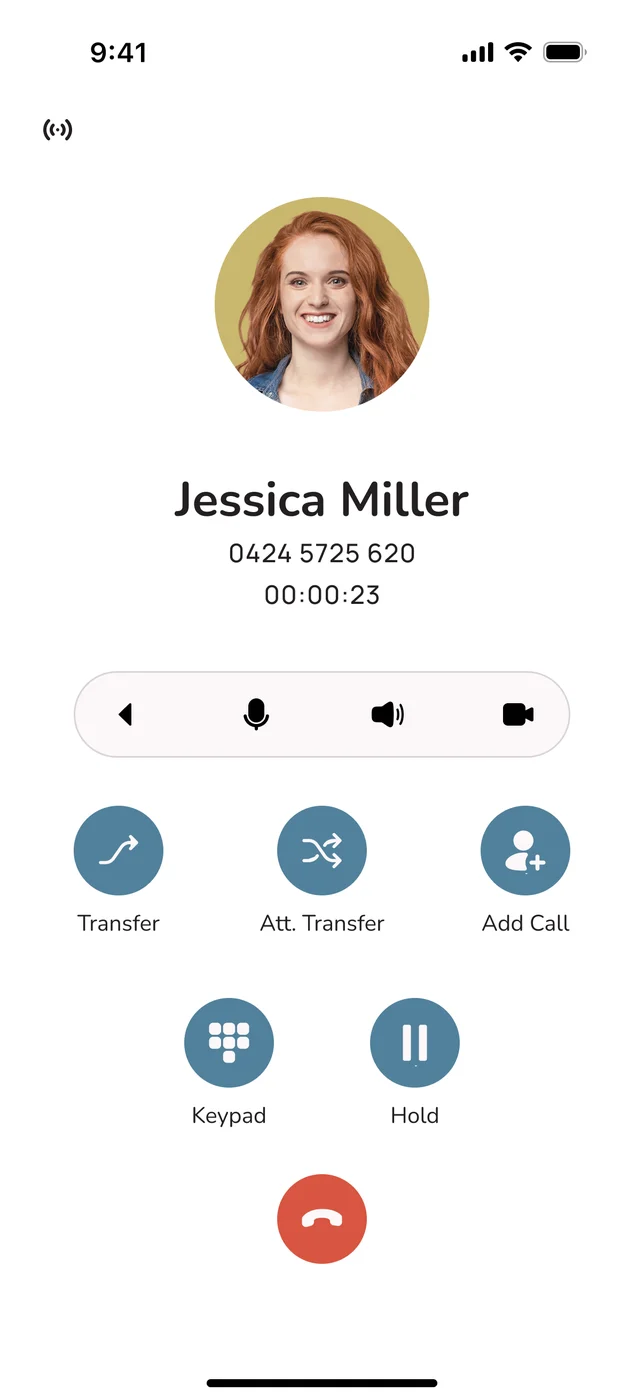
They are at open homes, in cars, at appraisals. A desk phone with a mailbox is not a sales phone system. Mobile apps that present the office number, with calls following the agent, are the baseline rather than a feature.
Ring the group, not the individual
An enquiry about a listing should ring the listing agent and then a small sales group, not roll to a mailbox. A colleague who can book an inspection is worth far more to the vendor than a voicemail with the right agent's name on it.
Saturday is a business day
Open home weekends generate the week's highest enquiry volume, and most agency phone systems are configured as if Saturday were a Sunday. Hours should reflect when property is actually bought.
An answer beats a mailbox
When nobody can take it, an AI answer that identifies the agency, answers the two or three questions the caller actually has (price guide, inspection times, address) and books a callback converts vastly better than a recorded message. Our note on AI answering covers the mechanics.
One measurement worth adding, because agencies almost never have it: how many inbound sales calls went unanswered last Saturday, and how long the average return took. The number is usually uncomfortable and it is the only honest baseline for judging any change.
The Property Management Side: A Volume Problem
Property management is one of the few roles where the telephone is simultaneously essential and the primary obstacle to doing the work. A manager with a portfolio of 150 properties is handling routine calls from tenants, landlords, tradespeople, strata managers and insurers, while also being expected to produce documents that must be accurate and timely.
| Call type | What it usually needs | Design response |
|---|---|---|
| Routine maintenance request | Logging accurately, with detail, and confirming what happens next. | Route to the portfolio manager, but capture the detail whether or not it is answered. A transcribed message is a work item; a voicemail is a task to listen to later. |
| Urgent repair | Immediate acknowledgement, and a trade contacted quickly. | Its own path, its own recording, and an answer every time. See the next two sections. |
| Rent, arrears, statements | An answer from someone with access to the ledger. | Route to accounts where one exists. Nothing frustrates a landlord more than a property manager reading a screen they cannot change. |
| Landlord asking about a decision | The history of what was agreed. | This is where transcription and summaries pay for themselves: the answer is usually in a phone call from three weeks ago. |
| Tradesperson coordinating access | Speed and a short answer. | Frequently better handled by SMS from the same system than by a call, and it leaves a written record. |
| Prospective tenant enquiries | Inspection times and application process. | The most automatable category in the entire agency. High volume, identical questions, no judgement required. |
The realistic goal
Not "answer every call instantly": that is not achievable at portfolio scale and pretending otherwise is how good property managers leave the industry. The goal is every call captured accurately, triaged correctly, and acknowledged, with focused work protected in blocks. A tenant who gets an immediate acknowledgement and a callback at a stated time is materially more satisfied than one who reaches a person immediately and is told to send an email.
Urgent Repairs and the Statutory Clock
This is the part of agency telephony that is genuinely a compliance matter, and it is worth being careful and accurate about it.
Residential tenancy legislation is state and territory based, and the detail differs, but the general structure is consistent across jurisdictions. Certain repairs are classified as urgent, typically things that threaten the structure, create a safety risk, make the premises unsafe or insecure, or cut off an essential service. Examples commonly listed include a burst water service, a gas leak, a dangerous electrical fault, a serious roof leak, a blocked or broken toilet, and failure of an essential service such as water, electricity, gas or hot water.
Once notified, the landlord or agent is required to arrange the repair within a short timeframe. Twenty-four hours to arrange the repair is the commonly cited benchmark, with the work then to be carried out as soon as practicable; some jurisdictions distinguish essential services, with Western Australia requiring a repairer to be contacted within twenty-four hours for essential services and forty-eight hours for other urgent repairs. In most jurisdictions, if the landlord or agent cannot be contacted or does not arrange the repair within the required period, the tenant may arrange the urgent repair themselves and recover the reasonable cost, up to a prescribed limit.
What that means for your phone system, precisely
The clock generally starts when the tenant notifies you. So the questions that decide your exposure are: did the notification reach you, when, and can you prove it? An emergency mobile that rings out does not stop the clock: it removes your ability to demonstrate when notification occurred, while the tenant's own phone records show exactly when they tried. At a tribunal, one party has a record and the other has a recollection. The after-hours answering arrangement is therefore an evidence mechanism, not a customer service nicety. Check the specific requirements for each state you operate in, because thresholds, timeframes and cost limits differ, and this article is not legal advice.
Designing the After-Hours Path
Four common arrangements, honestly assessed.
| Arrangement | How it fails | Verdict |
|---|---|---|
| A recorded message with an emergency mobile number | Depends on one person having their phone on, awake, and available. Fails silently and leaves no record of the attempt. Also asks the tenant to make a second call, which many will not. | The most common arrangement and the weakest. Better than nothing, and not much better. |
| An on-call rotation ringing several mobiles in sequence | Better coverage, still no record of what was said, and still relies on somebody answering. Rotation fairness becomes a management problem. | A genuine improvement. Worth doing, and incomplete without recording and logging. |
| An external after-hours answering service | Costs per call, varies in quality, and the operator does not have your portfolio, your trade list or your context. Messages arrive as emails somebody must read. | Works for some agencies. Ask specifically how the record of the call reaches your system and how quickly. |
| An AI answer with triage and escalation | Cannot exercise judgement and must not be asked to. Requires the escalation rules to be right. | Strongest, when scoped correctly: it answers every call on the first ring, records and transcribes, asks the triage questions, and escalates real emergencies to a human immediately. |
Whichever you choose, four things should be true of the after-hours path.
| Requirement | Why |
|---|---|
| It answers every time. | A ring-out is the failure mode with the statutory consequence. Nothing else on this list matters if this is not true. |
| It records the time and the content. | The time is what stops the clock argument. The content is what settles the "they said it was just a drip" argument. |
| It distinguishes urgent from routine, by asking, not by guessing. | Ask the specific questions that map to the statutory categories: is water entering the property, is there a gas smell, is there no hot water, is the property insecure. Let the answers route the call. |
| It tells the tenant what happens next, specifically. | "A property manager will call you within thirty minutes" is an answer. "Please call during business hours" is the sentence that leads to a tenant-arranged plumber and an invoice you have to justify. |
Routing a Portfolio
Property management routing has a structure most other businesses do not: callers are attached to a property, and properties are attached to a manager. Routing on the caller's number alone gets you halfway.
| Approach | How it works | Where it fits |
|---|---|---|
| Caller recognition | The caller's number is matched to a tenant or landlord record, and the call is routed to the responsible manager with the property on screen. | The default. Works well for the majority of calls and removes the "which property are you calling about" opening. |
| Portfolio queues | A queue per portfolio or per team, so a manager's absence does not create a dead end. | Essential. Single-manager routing with no queue produces the unreachable-manager complaint that drives most escalations. |
| A dedicated maintenance number | One published number for maintenance across the whole rent roll, routed by triage rather than by property. | Strong for agencies above roughly 300 properties, and it simplifies the after-hours message enormously. |
| Separate landlord line | A number published only to landlords, staffed differently. | Useful in agencies where landlord service is a differentiator, and it stops owner calls queuing behind tenant maintenance. |
| Trades via SMS | Access coordination by message from the same platform, so it is written and logged. | Underused and very effective. It also produces the access-notice trail you want in a dispute. |
Whichever mix you use, the caller should never have to know the internal structure. The mistake to avoid is a menu that asks a distressed tenant to choose between six departments: the argument against menus generally is in why phone menus are obsolete.
The Evidence Trail
Property management disputes are resolved months after the events, in front of a tribunal, on the strength of records. That makes the phone system a records system, and most agencies do not treat it as one.
| What gets disputed | What settles it |
|---|---|
| When the tenant reported the problem. | A timestamped record of the call, ideally with the audio or a transcript. This is the single most common factual dispute in urgent repair matters. |
| What the tenant described. | A recording or transcript. "A bit of water" and "water coming through the light fitting" are different matters with different obligations. |
| What the agent said would happen. | A transcript or a summary written at the time. Verbal commitments made in a hurried call are the most common source of landlord and tenant complaints alike. |
| Whether the landlord authorised the expenditure. | A record of the authorisation call, or an SMS confirming it. This is frequently the difference between a recoverable and an unrecoverable cost. |
| Whether notice of entry was given properly. | Written channels, which is why coordinating access by SMS from the same system is worth more than it appears. |
Retention should match dispute timelines, not storage costs
A tenancy dispute can surface long after the conversation, and bond and compensation matters routinely arise at the end of a tenancy about events from its beginning. Set retention against how long your disputes actually take to appear, and remember that the obligation attaches to your business rather than to the platform holding the files, which matters if you ever change providers. The legal framework for recording is state-based and set out in the call recording guide.
Privacy, Recording and Whose Information It Is
Agencies hold a great deal of personal information about people who had no choice about providing it: tenancy applications, identity documents, income evidence, rental history, and now call recordings.
| Consideration | Practical implication |
|---|---|
| Recording law is state-based | Notify at the start of every recorded call, on every line, including the after-hours path. A single notification standard across the agency is simpler than a per-state one and errs correctly. |
| Recordings are personal information | They fall within your privacy obligations, and a tenant or landlord may ask for access. Be able to find a specific call without a two-day search. |
| Landlord and tenant data are separate | A landlord is not entitled to a tenant's information merely because they own the property. Keep the distinction in mind before playing a recording to an owner. |
| Trust account and financial records | Have their own statutory retention under state agents legislation. Where a call evidences an authorisation to spend, treat it as part of that record set. |
| Automated decisions | From 10 December 2026, using personal information in automated decisions capable of affecting a person's rights or interests carries a privacy-policy disclosure obligation. Automated tenancy application prioritisation would be worth examining against that. See the December 2026 obligation. |
Where AI Helps, and Where It Must Not Decide
Real estate is one of the better verticals for AI on the phone, because so much of the volume is identical questions. It is also a vertical with a hard boundary that should not be crossed.
| Good use | Why it works |
|---|---|
| Prospective tenant enquiries | Inspection times, application process, whether pets are considered. Enormous volume, no judgement, and the caller genuinely prefers an instant answer to a callback. |
| Buyer enquiries out of hours | Price guide, inspection times, address, and booking a callback. Beats a mailbox by a wide margin on a Saturday evening. |
| After-hours triage questions | Asking the specific questions that identify an urgent repair, recording the answers, and escalating. The AI collects; a human decides. |
| Transcription and summaries | The highest-value application in property management. A role built on verbal commitments gets a written record of each one without anybody typing it. |
| Routine status updates | "Has the plumber been booked?" Answerable from the maintenance record without interrupting a manager. |
Four things not to automate on an agency line
The urgency decision. Whether a repair is urgent under tenancy law has legal consequences. Collect the facts automatically; let a person classify. Authorising expenditure. A landlord's authorisation to spend money is a decision, not a data capture. Anything involving a vulnerable caller. Family violence, hardship, eviction distress: these must reach a human quickly, and the path should be obvious to the caller. Application outcomes. Beyond the process questions, a decision affecting someone's housing should not be delivered by an automated voice, and from December 2026 it also carries a disclosure obligation.
Multiple Offices and Franchise Networks
Most agency groups are multi-office, and many are franchise networks, which adds a governance layer on top of the design.
| Question | The workable answer |
|---|---|
| Should offices share a phone platform? | Yes, with per-office configuration. Each keeps its own local number, hours and greeting; overflow between offices covers absences and after-hours. |
| Should sales enquiries overflow between offices? | Only after you settle who gets credit for a listing that came from another office's enquiry. Technical change: five minutes. Commercial argument: not five minutes. |
| Who holds the numbers? | The most important question in a franchise agency. A published local number registered to a departing franchisee leaves with them, taking the directory listings and every customer who has it stored. Settle it in writing: see who owns your 1300 number. |
| Who can hear the recordings? | Separate businesses, separate records. If a franchisor can access a franchisee's recordings, that is a disclosure between entities and needs a basis. |
| Can after-hours be shared across the network? | Often the strongest argument for a shared platform: one properly staffed after-hours arrangement across many offices is cheaper and better than each office's on-call mobile. |
The general framework is in multi-site and franchise phone systems.
What to Measure
Six numbers. Most agencies have none of them, which is why phone problems get argued about rather than fixed.
| Measure | Why it matters here specifically |
|---|---|
| Unanswered sales calls, by day and hour | Saturdays and weekday evenings are where the losses concentrate, and they are invisible without this. |
| Time to return a missed sales enquiry | Against a market window measured in minutes. Any figure in hours is a figure worth changing. |
| After-hours calls, and outcome of each | Volume, urgency classification, and whether a human spoke to the caller. This is your compliance evidence as much as your metric. |
| Repeat callers within 48 hours | In property management, a second call usually means the first produced nothing. A better satisfaction proxy than any survey. |
| Calls per property per month | The workload measure nobody has. It tells you whether a portfolio size is reasonable and which properties consume disproportionate time. |
| Calls resolved without a callback | The efficiency measure that actually correlates with tenant and landlord satisfaction. |
Consistent definitions matter more than any single figure: see the metrics guide.
Building It, in Order
Ordered by the size of the problem each step solves, not by ease of installation.
| Step | What | Why here |
|---|---|---|
| 1 | Fix the after-hours path so every call is answered, recorded and timestamped, with triage questions and a real escalation. | It is the only step with a statutory consequence attached, and the exposure is ongoing every night until it is done. |
| 2 | Split sales and property management into separate numbers, queues and hours. | Free, immediate, and it stops the two teams degrading each other's service. |
| 3 | Put every published number onto something that answers, including the ones on old signboards and portal listings. | Agencies routinely have live advertised numbers that ring nowhere. An audit of your own published numbers usually finds one. |
| 4 | Turn on transcription and summaries for property management. | The highest return per dollar in the whole build, because the role runs on verbal commitments. |
| 5 | Add caller recognition and portfolio queues. | Removes the "which property?" opening and eliminates the unreachable-manager dead end. |
| 6 | Automate prospective tenant and out-of-hours buyer enquiries. | Largest volume, least judgement. Do it after the flows are separated, or you automate the wrong queue. |
| 7 | Set retention deliberately, and confirm your numbers are registered in the agency's name. | The two things that determine whether any of the above survives a dispute or a provider change. |
How We Set These Up
We build agency systems as two flows on one platform, because that is what the business actually is.
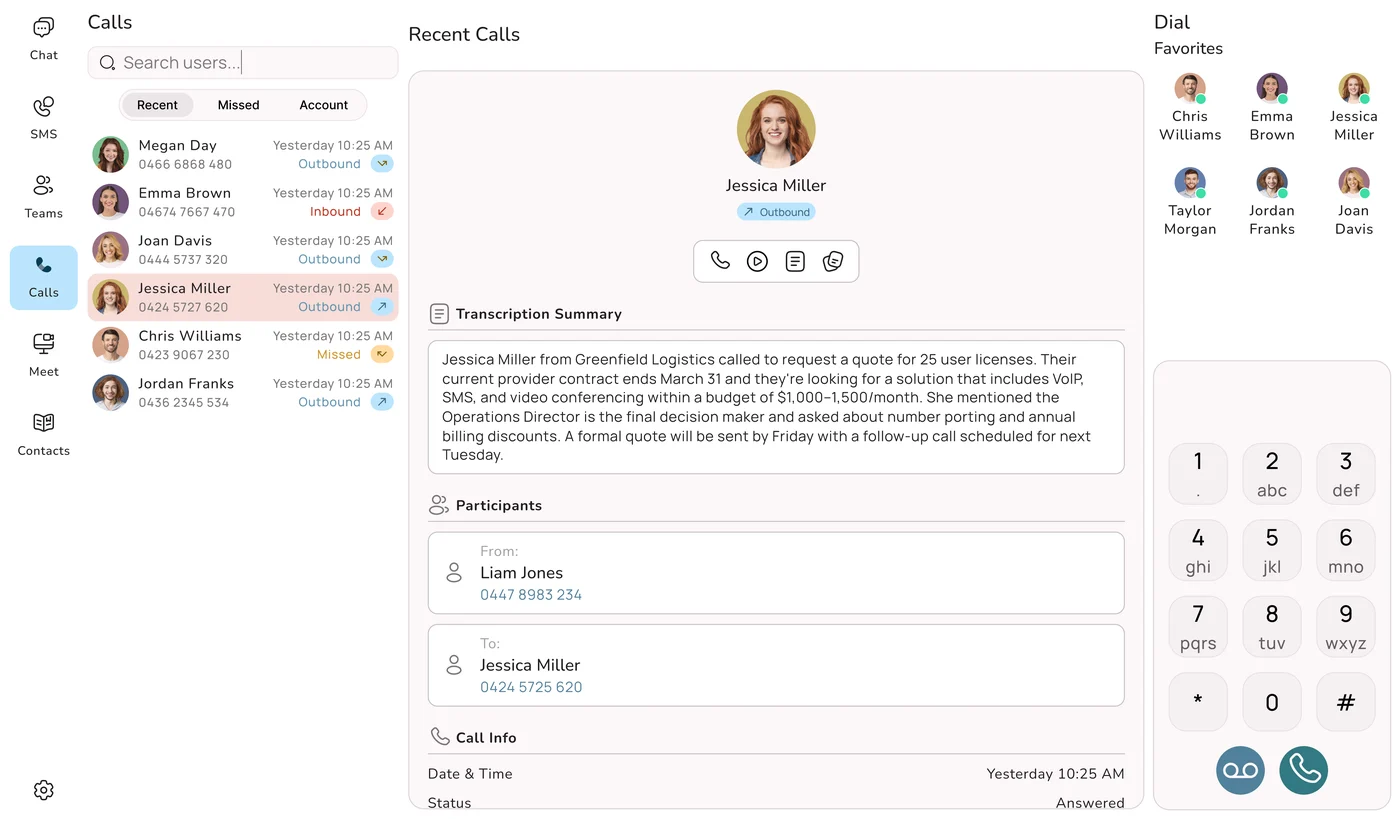
The sales flow presents the office number from every agent's mobile, rings a group rather than an individual, treats Saturday as a trading day, and answers rather than takes a message when nobody is available. The property management flow routes on the caller's record to the responsible manager with a portfolio queue behind them, captures and transcribes every call whether or not it is answered, and coordinates trade access by SMS from the same platform so the record is written. The after-hours path answers on the first ring every night, asks the triage questions that map to the urgent repair categories, records and timestamps the conversation, and escalates a genuine emergency to a person immediately, while never being asked to decide whether something is legally urgent.
Numbers we allocate are registered with rights of use in the agency's name, which matters more in this industry than most, because a published local number on a signboard and in a portal listing is an asset. And retention is set to match how long your disputes take to surface rather than to a default.
The summary
An agency has two phone problems. Sales is speed: a portal enquiry is being made to several agencies at once, and a mailbox loses it. Property management is volume and evidence: unavoidable calls, verbal commitments, and disputes resolved months later on records. Split them into separate numbers, queues and hours first: it is free and it stops each degrading the other. Treat the after-hours path as a compliance mechanism: tenancy law requires urgent repairs to be arranged quickly once notified, commonly within twenty-four hours, and generally lets a tenant who cannot reach you arrange the work and recover the cost, so an unanswered emergency mobile is an exposure with a paper trail that runs against you. Answer every time, record and timestamp, ask triage questions rather than guessing, and say specifically what happens next. Automate prospective tenant enquiries, out-of-hours buyer enquiries, triage collection and transcription. Never automate the urgency decision, expenditure authorisation, a vulnerable caller, or an application outcome. Check the specific requirements in each state you operate in.
Related reading: call recording law and setup, multi-site and franchise systems, what AI answering actually does, SMS from your phone system, and the metrics that matter.