



















The Honest Answer
Your business does not need AI. It needs the phone answered when everybody is on site. It needs the quote sent the same day rather than on Thursday. It needs the note from Tuesday's call to exist somewhere other than in somebody's memory. It needs the customer who rang at 6pm to still be a customer on Monday.
Those are the actual needs, and they have been the actual needs for decades. What changed recently is the price of solving some of them. A machine that can hold a natural conversation, look something up in your system and write a sensible note afterwards used to be impossible, then possible and unaffordable, and is now roughly the price of a phone line. That is a genuine change in the cost of a specific input, and businesses respond to changes in input prices whether or not they find the technology interesting.
So the useful framing is not "should we adopt AI". It is "which of the things that currently cost us time or customers have become materially cheaper to fix, and by how much". That is a question with a number attached, which makes it answerable. The rest of this article is about getting to that number honestly, including the parts that argue against spending anything.
The pressure is real, and it is not evidence
A 2026 Gartner survey found around 91% of customer service and support leaders under executive pressure to implement AI. Pressure of that kind produces purchases rather than outcomes, and it is a large part of why so many deployments exist without anybody being able to say what they achieved. If the honest reason for the project is that somebody senior asked, say so out loud early, because it changes what you should buy: something small, measurable and easy to stop.
Why the Numbers Say 12%, 44% and 69%
You will see all three quoted in Australian coverage, usually without the qualifier that makes sense of them. They are not contradictory. They are measuring three different things, and knowing which is which tells you a surprising amount about what to do.
| Figure | Source and what it counted | What it really tells you |
|---|---|---|
| About 12% | The Australian Bureau of Statistics, measuring businesses reporting use of AI in 2024-25. Around 35% of large businesses (up from about 9% in 2021-22), roughly 22% of medium businesses (up from about 3%), and around 11% of small and micro businesses. | The share of businesses that have adopted AI into the business in a way somebody would report on a statistical survey. This is the number that correlates with changed processes. |
| About 44% | The National AI Centre's adoption tracker, reporting SME adoption at 44% in February 2026, the strongest result in several months. | A tracker aimed specifically at small and medium business, closer to the ground and more sensitive to the fact that adoption is uneven and moves around month to month. |
| About 69% | Commercial survey data on regular AI use among Australian small and medium businesses, up from around 40% in July 2024, with daily use rising from about 9% to roughly 28% in the same period. | The share where somebody uses an AI tool regularly. Often one person, often a general assistant, often without anybody else knowing. |
The spread between twelve and sixty-nine is not measurement error. It is the distance between a person using a chat tool to draft an email and a business that has changed how work gets done. Almost every dollar wasted on AI in Australian small business over the last two years has been spent by organisations that thought they were in the second category because they could see activity from the first.
The practical test for which category you are in: if the person who uses it left tomorrow, would anything about how the business operates change? If the answer is no, you have tool usage, which is fine and often genuinely helpful, but it is not adoption and it will not show up in any number you care about. Adoption means a process runs differently now, and it would have to be deliberately turned back if you stopped.
There is a second reading of the same gap that is worth taking seriously. Small and micro businesses sit at roughly eleven per cent on the ABS measure against thirty-five per cent for large businesses, and the usual explanation is that small businesses are slower to adopt technology. That is not quite it. Small businesses are slower to adopt technology that requires a project. They adopt technology that arrives inside something they already use, immediately and without a project, which is exactly why the highest adoption rates in small business are for AI features embedded in accounting software and phone systems rather than for standalone AI products.
What the Returns Actually Look Like
The outcome data is now decent enough to quote without hedging, provided you read it as self-reported rather than audited.
79%
of Australian small and medium businesses using AI report productivity gains, slightly ahead of the United States at 78% and the United Kingdom at 73%.
43%
say AI has contributed to higher revenue, while roughly a quarter report lower operating costs. Revenue effects outrank cost effects, which is not what most people expect.
2.8×
the growth rate, according to MYOB data drawn from hundreds of thousands of Australian businesses, comparing SMEs using AI with those that are not.
Two cautions about that last one, because it gets quoted badly. It is a correlation across a large population, not a causal finding, and businesses that adopt new tooling early tend to differ in other ways that also drive growth. And it says nothing about your business specifically. Treat it as evidence that the category is real rather than as a forecast of your own result.
A Deloitte survey of Australian businesses found SMEs implementing AI reported average productivity improvements in the range of 25 to 35 per cent, against 15 to 20 per cent for large enterprises, which is the opposite of the usual pattern for technology returns and has a straightforward explanation. Small businesses have less process debt. There is nobody to consult, no change board, and the person who decides is the person who does the work, so a change that would take a large organisation eight months to implement takes a small one an afternoon. That advantage is real and it is temporary, and it is the strongest single argument for a small business acting this year rather than next.
One more that matters for anybody with a phone queue: voice AI is reported to be handling roughly nineteen per cent of inbound contact centre volume in 2026, against about six per cent in 2024. Whatever you think of the technology, customer exposure to it has roughly tripled in two years, and the tolerance question has largely been settled by that exposure. People do not object to talking to a machine. They object to talking to a machine that cannot help them, which is the same objection they have always had to phone menus.
Four Questions That Decide It
Answer these about your own business and you will know within ten minutes whether there is anything here for you. They are deliberately about work, not about technology.
| Question | If yes |
|---|---|
| 1. What happens fifty or more times a week and is nearly the same each time? | That is your candidate. Volume plus sameness is the entire qualification test. Booking changes, status enquiries, after hours calls, invoice chasing, intake forms, call notes. |
| 2. What do customers currently wait for, and how long? | Waiting is where revenue leaks, and it is usually invisible. A quote that takes three days in a market where two competitors take three hours is a losing position regardless of price. |
| 3. What does not get done at all? | The best AI candidates are things nobody is doing: calls after 5pm, follow-ups on quotes that went quiet, notes on calls, the third attempt at a debtor. Nobody has to give anything up, so nobody fights it. |
| 4. What could you measure next month if you wanted to? | If you cannot measure it, do not automate it yet. Not because it will not work, but because you will never know, and unknowable projects get cancelled when the budget tightens. |
If none of the four produces an answer, the correct decision is to do nothing for now, and it is a perfectly respectable one. A five-person business with lumpy, bespoke, relationship-driven work and no queue does not have an AI problem. It has a business that works. The cost of waiting a year in that situation is close to zero.
Where It Pays, Ranked by Payback
Roughly in order of how quickly Australian businesses in the five to two hundred staff range see the money back, based on what we see across our own customer base and what the survey data supports.
| Application | Typical payback | Why it is fast |
|---|---|---|
| 1. Answering calls nobody is answering | Weeks | The comparison is not a staff member, it is a mailbox or a ring-out. Every call that turns into a booking is incremental, and the cost of a missed call in most trades and clinics is measured in hundreds. |
| 2. Call notes and record updates | Weeks to a month | Removes a task everybody hates and half the team skips, and the quality improvement cascades into every report, handover and follow-up downstream. |
| 3. Booking and rescheduling | One to two months | High volume, low variance, and it removes phone tag, which consumes far more time than anybody's timesheet shows. |
| 4. Drafting: quotes, emails, proposals, job descriptions | Immediate, but small | Real time saved per instance, low ceiling. This is the category people mistake for the whole opportunity because it is the one they can try in a browser for free. |
| 5. Summarising and searching your own documents | One to three months | Valuable where somebody currently answers the same internal question repeatedly, which is most businesses with more than about fifteen people. |
| 6. Quality review and coaching | Three months | Reviewing every call instead of six a month changes what you know about your own business, but the payback runs through people changing behaviour, which takes a quarter. |
| 7. Forecasting and rostering | Three to six months | Genuinely valuable at scale, needs clean historical data, and the data cleaning is usually the project. Worth it if you have a queue and shift costs. |
Note the shape of that list. The fast paybacks are all operational and unglamorous, and they cluster around communication: the call that was not answered, the note that was not written, the booking that took four messages. The slow ones are analytical. Most businesses do the analytical ones first because they sound more strategic, and then wonder why the money has not appeared.
Where It Does Not Pay
This section is short and it is the most valuable part of the article, because avoiding one bad deployment is worth more than optimising a good one.
Low volume, high judgement
The complicated thing that eats a senior person's week, happens four times a month, and requires knowing the client. It will be automatable eventually. Today it costs more to set up and supervise than it saves, and it is impossible to evaluate on four instances.
Where an error costs more than the labour
If a mistake produces a safety issue, a regulatory breach or an unrecoverable financial loss, the supervision needed to make automation safe usually costs more than the task did. Keep a person, and use AI to prepare their work instead.
Anything you cannot measure
Not because it will not help, but because you will not be able to defend it. Unmeasurable projects are the first cancelled in a tight quarter, regardless of whether they were working.
Where the underlying process is broken
Automating a bad process produces a faster bad process and removes the friction that was telling you it was bad. Fix the process on paper first. This is the most common expensive mistake in the category.
What It Actually Costs
The quote you receive covers one of these four. Budget for all four or your payback calculation is fiction.
| Cost | What it involves | Commonly underestimated by |
|---|---|---|
| Subscription | The per-seat, per-minute or per-interaction fee. The only line most people budget, and usually the smallest. | Nothing. This one is quoted accurately, which is why it gets all the attention. |
| Integration | Connecting it to the systems that hold your customers, jobs and calendar, in both directions. Reading is easy, writing back is where the value and the work both are. | A lot. Ask specifically whether your integrations are included or charged per connection, and whether they are supported when the other vendor changes their API. |
| Data preparation | Making your records good enough to be useful. Duplicate customers, phone numbers in four formats, a knowledge base last updated in 2023. | Almost always. This is where projects lose their first month, and it is work you should do regardless. |
| Supervision | Somebody reading transcripts, checking outputs and adjusting, roughly half an hour a day at first and an hour a week once it settles. | Entirely. It is usually left out of the business case and then quietly absorbed by whoever cares most, which is how it stops happening in month three. |
If the business case excludes supervision, it is not a business case
Half an hour a day of a competent person's time is roughly a hundred and twenty hours a year. At any realistic loaded rate that is a real number, frequently larger than the subscription, and leaving it out is the single most common reason an AI project that "paid for itself" turns out not to have. Include it, and the good news is that it falls sharply after the first quarter, which is a much better story than pretending it was never there.
Two Worked Examples
Both are composites of real patterns, with conservative assumptions. Substitute your own numbers.
A twelve-person plumbing business. Around forty calls a week arrive outside hours, of which about twenty-five are new work. Historically roughly half of those left a message and a bit under half of those messages converted, so call it six jobs a week from after hours enquiries. The lost ones were not recorded anywhere, because a call that rings out leaves no trace. An AI answer that handles the common questions, books where it can and takes proper details for the rest lifts conversion on that traffic to somewhere around sixty per cent, which is roughly nine more jobs a month at an average job value of $420. That is about $3,800 a month in revenue that was previously leaking, against a few hundred a month in platform cost and about two hours a week of supervision in the first quarter. The payback is measured in weeks, and the entire case rests on work nobody was doing.
A four-site allied health practice. Reception spends an estimated eleven hours a week on reschedules across the four sites, and about fourteen per cent of appointment calls arrive when every reception line is busy. Automating reschedules and overflow does not remove a reception role, and pretending it will is how these projects lose internal support. What it does is return roughly nine hours a week to patient-facing work and reduce abandoned calls, which at a conservative two extra retained appointments a week is a real number in a practice where an appointment is worth well over a hundred dollars. The productivity gain is genuine, the headcount saving is zero, and the business case is stronger for saying so plainly.
The Risk Side, Taken Seriously
Around 39% of Australian respondents cite privacy and security as a barrier to AI adoption, higher than in the United States, the United Kingdom and Canada. That caution is well placed and it is also manageable, provided the questions get asked before the contract rather than after the incident.
| Risk | What to ask, and what to do |
|---|---|
| Where the data goes | Which components run where, which models are used, whether your data trains anything, and what is retained and for how long. Get it in writing. "In the cloud" is not an answer to a question about jurisdiction. |
| Accuracy and representations | Anything your system tells a customer is a statement by your business. Australian Consumer Law does not care that a machine said it. Constrain what it is allowed to assert, particularly about price and timing. |
| Privacy Act automated decisions | From 10 December 2026, privacy policies must disclose the kinds of personal information used in substantially automated decisions and the kinds of decisions made. It is a disclosure obligation, not a prohibition and not a right to human review, and the difference matters. We covered it in the automated decisions guide. |
| Record keeping | If your sector requires records of what was said or decided, AI generated records are records. Make sure they are retained in the system of record and not only in a vendor's log with a ninety day retention. |
| Over-reliance | The real operational risk is not a dramatic failure, it is a slow drift where nobody checks any more. The supervision hour survives forever, at a lower level. Put it in somebody's job description. |
On the regulatory backdrop: Australia does not have a standalone AI Act, and the National AI Plan of December 2025 confirmed reliance on existing laws and sector regulators rather than the mandatory guardrails proposed in 2024. In July 2026 the Government set out a direction including legislating Australian Standards for AI and established an Office of AI. For a business, the practical reading is that your obligations come from the law you already had: privacy, consumer law, record keeping, and your own industry's rules.
What Happens If You Do Nothing for a Year
Less than the marketing suggests, and more than nothing. Three specific things move.
Response time expectations shift underneath you. This is the one that actually bites. When a meaningful share of your competitors answer at 7pm and quote the same afternoon, the customer's sense of normal moves, and you are judged against the new normal rather than against your own previous performance. You do not get told this is happening. You get a slightly lower conversion rate and no explanation.
The gap compounds through data. A business that has been writing structured notes on every call for a year knows things about its own demand that a business relying on memory does not, and that knowledge feeds pricing, rostering and where to advertise. Waiting a year does not put you a year behind on software, which you could buy in an afternoon. It puts you a year behind on knowing your own business.
And the easy advantage narrows. The Deloitte finding that Australian SMEs see larger productivity gains than large enterprises reflects a temporary structural advantage in being small and able to change quickly. That advantage exists while large competitors are still forming committees. It does not last indefinitely.
None of that is an emergency. It is an argument for starting one small thing this quarter rather than a transformation programme next year.
A Thirty Day Start
For a business that has done nothing so far. It should cost very little and it should produce a number.
| Days | Do this |
|---|---|
| 1 to 3 | Write down the four answers. What happens fifty times a week, what customers wait for, what does not get done at all, and what you could measure next month. One page. |
| 4 to 7 | Measure the current state of the one you picked. Count it for a week. Almost nobody does this and it is the reason so few AI projects can prove anything afterwards. |
| 8 to 14 | Look at what your existing systems already do. Your phone system, accounting package and CRM have probably shipped AI features you are paying for and not using. Start there before buying anything new. |
| 15 to 21 | Pick one thing and set it up narrowly. One job, one channel, one measure. Write the sentence that says what success looks like by day sixty, with a number in it. |
| 22 to 30 | Run it, read the output daily, and keep a list of what surprised you. At day thirty compare against your week of baseline measurement and decide: keep, adjust, or stop. All three are acceptable answers. |
Two notes on that sequence. Days eight to fourteen return more than any other week for most businesses, because the AI capability you already own and are not using is free, already integrated and already compliant with whatever you agreed to. And the week of baseline measurement in days four to seven feels like a delay and is not, because without it every subsequent conversation about whether this worked will be an argument about impressions.
How to Tell If It Worked
One number from before, the same number from after, and a cost. That is the whole method, and it is rare enough to be a competitive advantage in itself.
The specific numbers depend on the job. For call answering, it is calls that reached a person or a resolution, against calls that reached nothing, plus the conversion on after hours enquiries. For notes, it is the share of calls with a note attached a week later. For bookings, it is the number of touches per booking. For drafting, it is honestly quite hard to measure, which is a reason to treat it as a nice-to-have rather than a project.
Whatever it is, write it down before you start and resist the temptation to improve the metric afterwards. And watch for the specific trap of a measure that improves while the customer's experience does not: calls resolved without a person is a good number only if those same customers are not ringing back the next day.
Where We Come In
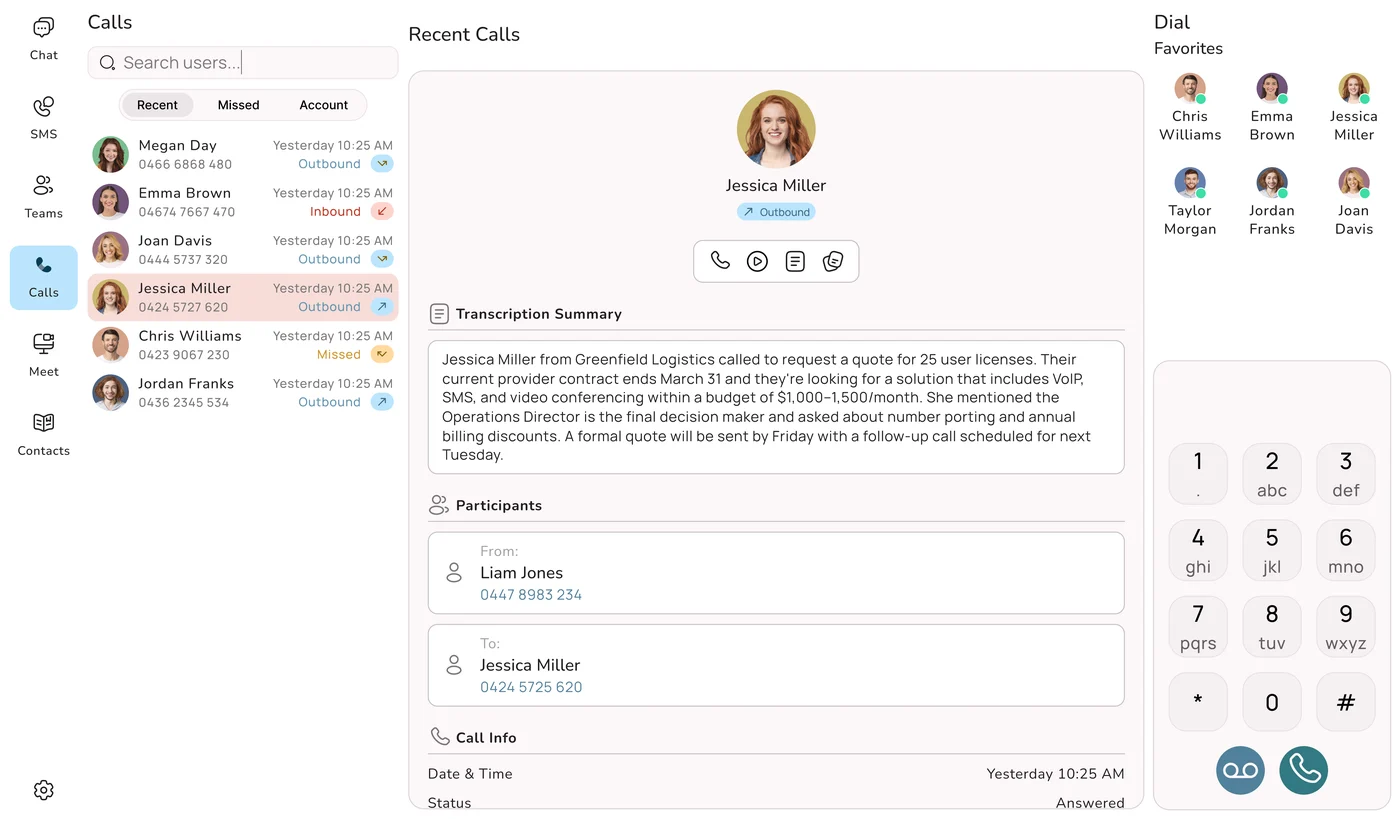
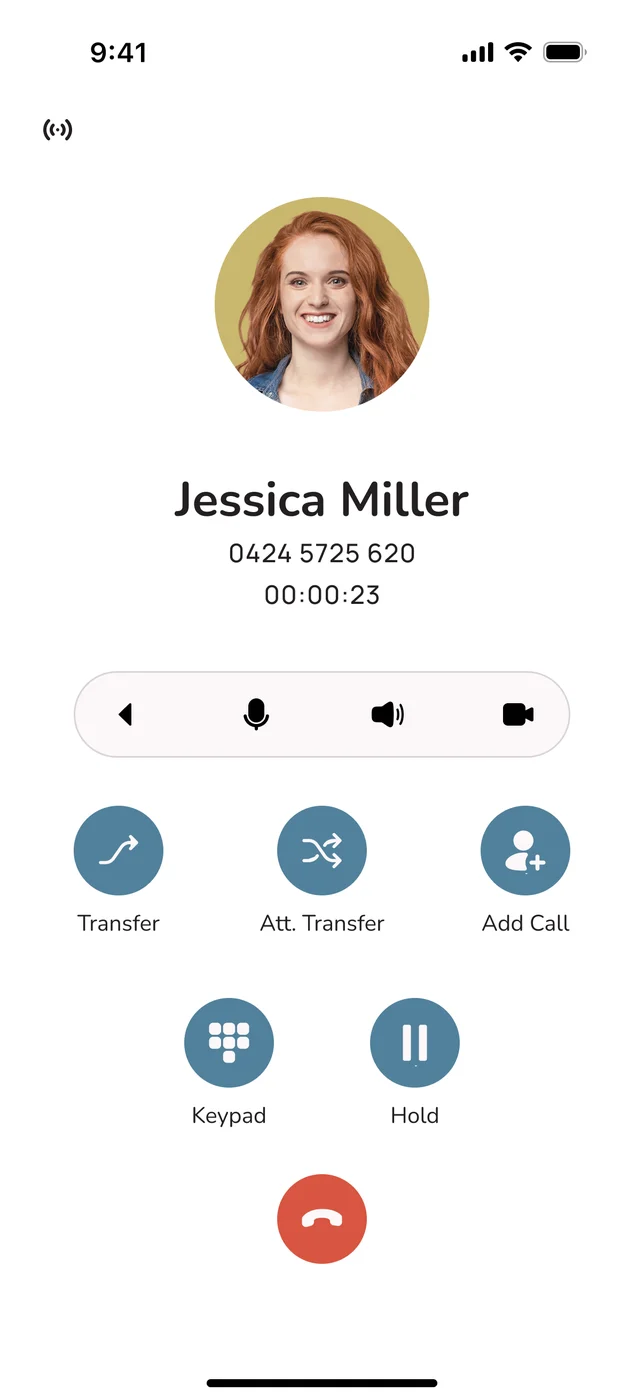
The fastest paybacks on that list are all communication jobs, which is the part of the business we handle. Uniden Voice over Cloud is an Australian owned, Australian hosted and Australian supported cloud phone platform with AI built into the call path rather than bolted alongside it, which means the AI answers on the actual call, sees the caller's record from the first second, and hands over into the same ring groups and rosters your team already uses.
If the answer to the four questions turns out to be after hours calls, or notes that never get written, or bookings that take four messages, that work already runs through us and the setup is a configuration rather than a project. If the answer turns out to be something else entirely, we will tell you that too, because a customer who spends money on the wrong thing this year does not spend it with anybody next year.