











The Short Answer, and Why It Is Not Enough
If you need one number to take into a meeting: most Australian cloud phone systems land between about $20 and $50 per user per month in 2026, with the spread explained mostly by what is included rather than by quality. These are illustrative ranges for budgeting, not quotes.
$20 to $30
Entry tiers. Calling, an app, voicemail, basic groups. AI, recording and integrations usually extra.
$30 to $40
Mid tiers. Queues, recording, reporting, integrations, and increasingly some AI included.
$40 to $50+
Full tiers. AI answering, transcription, scoring, contact centre features, deeper integrations.
Why that range cannot be your budget. Suppose you have twelve staff. At $35 each that is $420 a month, and that is the number most people write down. But four of those twelve only ever use a mobile app and do not need a full seat. Two of the twelve are a workshop and a reception desk sharing devices. You have a 1300 number whose inbound calls are billed to you. Your AI is charged per minute and your inbound volume is seasonal. You keep recordings for two years because of a compliance requirement. And there is $1,800 of porting and integration work that appears once. The real monthly figure is not $420, and the difference is not small. Nine lines is what it takes to find it.
The Nine Lines
Copy this into a spreadsheet. One column per supplier. Fill in monthly and one-off separately, then convert everything to a five-year total at the end.
| Line | What goes in it | Monthly or one-off | Usually wrong because |
|---|---|---|---|
| 1. Seats | Each seat type × its own rate | Monthly | Counted as headcount, not by type |
| 2. Numbers | Service fees plus inbound call charges on 1300/1800 | Monthly | Inbound cost on inbound numbers is forgotten |
| 3. Call spend | Your real destination mix at quoted rates | Monthly | "Unlimited" is assumed to mean unlimited |
| 4. AI | Per minute, per call, per seat or bundled | Monthly, variable | Modelled at today's volume, not at double |
| 5. Storage | Recording and transcript retention | Monthly, growing | Included at 30 days, chargeable at 24 months |
| 6. Hardware | Handsets, headsets, replacements | One-off or amortised | Leases that outlive the contract |
| 7. Setup | Configuration, porting, integration work | One-off | Quoted as services after signature |
| 8. Connectivity | Internet share, failover, UPS | Monthly + one-off | Assumed to be someone else's budget |
| 9. Missed calls | Unanswered calls × conversion × value | Monthly, invisible | Never counted at all |
Line 1: Seats, Priced by Type
The single largest lever on the monthly bill, and the one most often filled in as "one seat each" by default.
| Seat type | Who it is for | Typically includes | Illustrative |
|---|---|---|---|
| Full seat | Desk-based staff who take and make calls all day | Desk phone plus apps, full features, recording, integrations | $30 to $50 |
| App-only seat | Field staff, tradespeople, sales on the road | Mobile and desktop apps, no physical handset | $20 to $35 |
| Shared / common area | Workshop, warehouse, staff room, meeting room, reception overflow | A device on a shared identity, limited features | $5 to $15 |
| Queue or contact centre seat | Anyone answering from a queue with reporting and scoring | Queue membership, wallboards, supervisor tools | Premium over a full seat |
| Non-seats | Alarm lines, lifts, fax-to-email, door intercoms | Not a user. Should not be billed as one. | Nominal |
The exercise that pays for itself in ten minutes
List every person and every device, then put each into one of the five rows above. Most businesses discover between a fifth and a third of their assumed "users" are not full seats at all: a workshop phone, a lunchroom phone, a lift line, a fax number nobody has used since 2019, and several field staff who have never touched a desk phone. Re-classifying them is not a discount; it is correcting a specification. Then check two contract terms: whether the supplier imposes a minimum seat count, and whether you can reduce seats mid-term or only add them. A plan you can only grow is a plan that quietly ratchets.
Line 2: Numbers, Inbound and Outbound
| Item | What to count | The trap |
|---|---|---|
| Geographic numbers | Main line and any published local numbers | Usually cheap or included. Rarely the problem. |
| Direct numbers (DIDs) | One per person who publishes a direct line | Often billed individually. Twenty DIDs is a real line item. |
| 1300 / 1800 | Monthly service fee plus inbound call charges | You pay for inbound calls to these numbers, and rates differ by whether the caller is on a fixed line or a mobile. Most callers are on mobiles. |
| Number ownership | Whether rights of use sit with you or the supplier | Not a cost until you try to leave, then it is the whole negotiation. |
The 1300 line that surprises people
A 1300 or 1800 number is a marketing asset that shifts the call cost from your customer to you. That is the point of it. But it means your inbound number is a variable cost that rises exactly when your marketing works, and the mobile-originated rate is typically the higher one while the overwhelming majority of business callers now ring from mobiles. Model it at your real answered-call volume and real average duration, then model it again at double. If you are unclear on who holds your number, read who owns your 1300 number before signing anything.
Line 3: Call Spend
Take three months of itemised calls from your current bill and split them by destination. Then apply each quote's rates to your own mix rather than to a generic one.
| Destination | What to check |
|---|---|
| Local and national | Usually included in "unlimited" plans. Confirm the definition and the fair-use threshold in writing. |
| To Australian mobiles | The one that matters. Most business outbound now terminates on mobiles, and this is where "unlimited" plans most often carve out. |
| 13/1300/1800 outbound | Frequently excluded from unlimited plans and charged per call. Small businesses ringing suppliers and government lines feel this. |
| International | Rate cards vary enormously between suppliers. If you have any volume at all, compare your top five countries specifically. |
| Conferencing and video | Included, capped by participants, or capped by minutes. Check which. |
Line 4: AI and Automation
The newest line and the one with the widest variance. Ask how it is charged before you ask how much, because the four models behave completely differently at the same volume.
| Charging model | Behaves like | Best when | Risk |
|---|---|---|---|
| Per minute | A variable cost tracking talk time | Volume is low and stable | A campaign, a product issue or an outage doubles inbound calls and doubles this line in the same month |
| Per call | A variable cost tracking call count | Calls are long | Penalises the high-volume, short-duration calls AI is best at |
| Per seat | A fixed cost | You want budget certainty | Pays for capacity you may not use |
| Bundled | Invisible | Simplicity matters most | The mechanism is hidden until the bundle changes at renewal |
Ask for the doubled table
Get a worked example at your actual monthly call count in writing, then ask for the same table with volume doubled. That second table is the one that prevents the disputed invoice, and a supplier who produces both without hesitation is signalling something about how they intend to behave later. Our guide to AI voice agent cost and ROI works through the return side of the same equation.
Line 5: Recording and Retention
A small line that grows every month and is regularly quoted at a retention period nobody would actually choose.
| Question | Why it changes the number |
|---|---|
| What retention is included? | Thirty days included and twenty-four months chargeable is a very common shape, and the difference over five years is substantial. |
| Do transcripts count separately? | Sometimes audio is charged and text is free; sometimes both are charged. Ask explicitly. |
| What retention do you actually need? | Set it against how long a dispute takes to surface in your industry, not against a default. Too short loses your evidence; too long means holding personal information without a reason. |
| What does bulk export cost? | Two years of recordings is simultaneously an asset and a lock-in. Price the exit before you need it. |
Line 6: Hardware
| Item | Illustrative | Note |
|---|---|---|
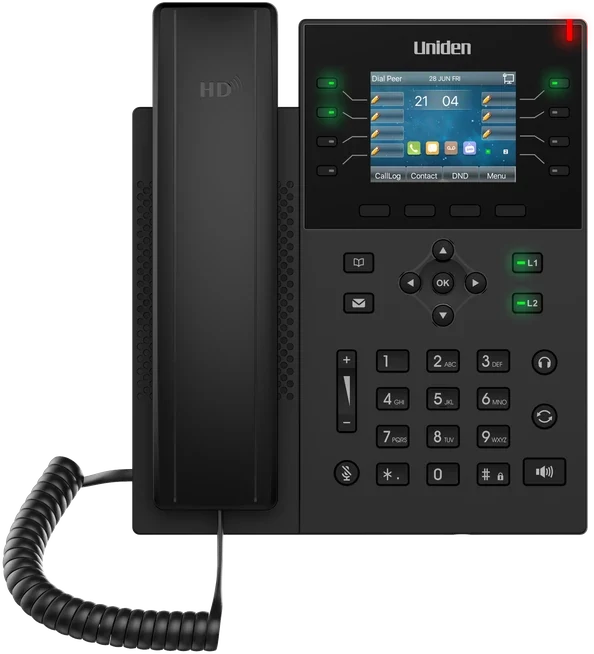
| Entry desk handset | $90 to $150 | Fine for most desks. Buy rather than rent where you can. |
| Mid-range with colour display | $150 to $300 | Reception, anyone managing multiple lines. |
| Cordless | $200 to $400 | Workshops, clinics, venues, warehouses. Walk-test coverage first. |
| Headset | $60 to $250 | The cheapest large improvement in call quality available. |
| Existing SIP handsets | $0 | Frequently supported. Ask for the device list before budgeting replacements. |
Amortise purchases across five years for the comparison. A $150 handset is $2.50 per month over sixty months, which is usually less than the monthly difference between two seat tiers: worth remembering when a quote leads with free hardware and a higher seat rate. Our note on third-party SIP handsets covers what can usually be kept.
Line 7: Setup, Porting and Integration
| Item | What to ask |
|---|---|
| Configuration and onboarding | Included, or a fixed fee, or hourly? Get it in the quote rather than in an email afterwards. |
| Number porting | Per number or per batch? Complex ports of many numbers are sometimes charged differently. |
| Integration work | The line most often quoted as professional services after signature. If the CRM connection is why you are buying, price it before you sign. |
| Training | Included, and how many sessions? The second session matters more than the first. |
| Exit costs | Early termination, and the cost of a bulk export. Nothing hides better than a clause nobody reads. |
Line 8: Connectivity and Redundancy
Frequently treated as somebody else's budget, which is how it ends up unfunded.
The connection itself
If the phones are on the business internet service, a fair share of that service belongs in the phone system's cost. Bundling voice and internet with one provider often reduces the combined figure and removes the argument about whose fault an outage is.
Failover
A mobile backup, or automatic diversion of calls to mobiles when the site is unreachable. Often a few dollars a month or free to configure, and it decides whether an outage is an inconvenience or a lost day.
Power
A UPS for the modem, router and switch. A one-off cost in the low hundreds that keeps the phones alive through the short outages that are most common.
Remediation
Ageing switches without power over Ethernet, or cabling that needs attention. Find this during the network check, not on cutover day when it becomes an emergency.
Line 9: The Calls You Miss
Usually the largest number on the page, and the only one that never appears on a quote, because no supplier is billing you for it.
The arithmetic
Unanswered calls per month × the proportion that would have become customers × your average customer value. Every business has all three numbers or can estimate them within reason. A trade business missing forty calls a month, converting one in five, at $600 a job, is losing something like $4,800 a month: roughly ten times its entire phone bill. You do not need the estimate to be accurate. You need it to be present, because as soon as it is on the page the whole discussion changes from minimising a cost to sizing an investment. Our piece on what missed calls cost works the numbers through in detail.
Get the baseline before you change anything: two weeks of answered calls, unanswered calls, and after-hours volume. That is also exactly what you will need at the thirty-day review to know whether the new system did what it was bought to do.
Three Worked Examples
Illustrative only: figures vary by supplier, volume and contract. Use them to sanity-check your own worksheet, not as a quote.
| Line | Trade business, 4 people | Professional services, 12 people | Contact team, 40 people |
|---|---|---|---|
| 1. Seats | 1 full + 3 app-only ≈ $110 | 7 full + 3 app-only + 2 shared ≈ $340 | 25 queue + 12 full + 3 shared ≈ $1,600 |
| 2. Numbers | 1 local ≈ $0 to $5 | 1300 + 8 DIDs ≈ $60 + inbound | 1300 + 40 DIDs ≈ $150 + inbound |
| 3. Call spend | Mostly mobiles ≈ $40 | Mixed ≈ $90 | High mobile volume ≈ $400 |
| 4. AI | After-hours answering, bundled ≈ included | Answering + transcription ≈ $120 | Answering, transcription, scoring ≈ $500 |
| 5. Storage | 30 days ≈ included | 12 months ≈ $25 | 24 months ≈ $120 |
| 6. Hardware | 1 handset + 1 headset, amortised ≈ $5 | 9 handsets + 8 headsets ≈ $40 | 40 headsets + 15 handsets ≈ $150 |
| 7. One-off | Porting only ≈ $0 to $150 | Setup, porting, CRM ≈ $1,200 to $2,500 | Setup, porting, integrations ≈ $4,000 to $8,000 |
| 8. Connectivity | Share of NBN + UPS ≈ $30 | Share + failover + UPS ≈ $90 | Share + failover + UPS ≈ $250 |
| Monthly total | ≈ $185 | ≈ $765 | ≈ $3,170 |
| Real per user / month | ≈ $46 | ≈ $64 | ≈ $79 |
| 9. Missed calls (est.) | 40 missed × 1 in 5 × $600 ≈ $4,800 | 25 missed × 1 in 8 × $2,000 ≈ $6,250 | 200 missed × 1 in 10 × $900 ≈ $18,000 |
Two things the examples are meant to show. First, the real per-user figure is consistently higher than the headline rate, by roughly a third to a half once every line is present, which is not a scandal, it is simply what the complete number looks like, and knowing it is how you stop being surprised. Second, line 9 dwarfs lines 1 to 8 in all three cases. That is the actual finding of this exercise. Businesses spend weeks arguing over $8 per user and leave five figures a month on the table in unanswered calls, because one number is on a quote and the other is not.
Eight Places a Bill Diverges From a Quote
| Divergence | How it shows up | Prevention |
|---|---|---|
| Promotional rate expiry | Month 13 or 25, quietly. | Ask for the rate in months 13, 25 and 37, in writing. |
| Minimum seat counts | You reduce staff; the bill does not. | Ask whether seats can go down mid-term or only up. |
| "Unlimited" carve-outs | Mobiles or 13/1300 outbound excluded. | Get the definition and fair-use threshold in writing. |
| Inbound 1300 charges | Rises exactly when marketing works. | Model at real volume, then at double. |
| Per-minute AI | A busy month costs multiples of a quiet one. | Ask for the doubled-volume table. |
| Storage growth | Small in month one, material in year three. | Price your real retention over five years. |
| Integration as services | Appears after signature. | Price it before, especially if it is why you are buying. |
| Exit and export | Only visible when leaving. | Read the termination clause and price a bulk export. |
Seven Honest Ways to Reduce the Number
None of these degrade service. Several improve it.
1. Fix the seat mix
The largest single lever. Reclassify app-only, shared and common-area devices instead of buying full seats for everyone. Typically a fifth to a third of assumed users.
2. Prefer bundled AI at real volume
If your inbound volume is seasonal or campaign-driven, a per-seat or bundled AI charge removes the month where the invoice becomes an argument.
3. Set retention deliberately
Match it to how long disputes actually take to surface in your industry. Paying to store five years of calls when twelve months would do is a pure cost with a privacy downside attached.
4. Consolidate suppliers
Voice and internet from one provider is usually cheaper combined, and it removes the finger-pointing when something is wrong. Fewer bills, fewer renewal dates, one number to ring.
5. Keep working handsets
Many existing SIP phones are supported. Ask for the device list before budgeting a replacement fleet you may not need.
6. Buy the tier you use
Pay for contact centre features when you have queues and supervisors, not because the tier name sounds more serious. Equally, do not buy an entry tier and then add four paid extras to reach the mid tier.
7. Answer more calls
The only lever that changes the sign of the total. Line 9 is bigger than lines 1 to 8 combined in most businesses, so a change that recovers even a quarter of missed calls outweighs every saving above.
What to Put in Writing
Six questions. Ask every supplier the same six, in the same words, and compare the answers rather than the brochures.
| Question | What a straight answer looks like |
|---|---|
| "What is the per-seat rate in months 1, 13, 25 and 37?" | Four numbers, not a reassurance. |
| "Show me this bill at double my inbound volume." | A second table, produced without hesitation. |
| "What exactly is excluded from unlimited?" | A specific list, including mobiles and 13/1300 outbound, plus the fair-use threshold. |
| "What is included at my real retention period?" | A figure at your retention, not at thirty days. |
| "What is quoted separately after signature?" | Integration, training and porting named explicitly, or confirmed as included. |
| "What does it cost to leave, and to export everything?" | A number, and a documented export process. |
Then normalise. Five-year total ÷ 60 months ÷ seat count gives one comparable figure per supplier, and that figure is frequently in a different order from the headline rates. For the market view of what different providers charge, see our business phone system pricing guide, and for the ranked comparison of providers themselves, our best business phone systems comparison.
How We Price It
One rate, features included
AI, recording, integrations and the full feature set inside the per-user price rather than stacked as four separate extras, which is what makes the headline rate and the real rate close to each other.
Seat types, not headcount
We will go through your list and reclassify the app-only, shared and common-area devices, because specifying it correctly is worth more than any discount we could offer on the wrong specification.
Voice and NBN together
Australian owned and Australian hosted, and able to supply the internet as well as the phone system, which usually reduces the combined figure and removes the argument about whose fault an outage is.
We will check your worksheet
Send us the nine lines with our quote in one column and we will verify our own numbers and tell you where we think you have under-counted, including line 9, which we would rather you took seriously than ignored.