



















A Thursday Support, Three Systems, Two People
A participant rings on Tuesday. They need Thursday’s support moved to the morning because of a specialist appointment.
Here is what happens in a typical service. Reception answers, does not have access to the roster, and takes a message. The coordinator rings back an hour later, asks the participant to explain again, opens the rostering system, finds a worker, checks the participant’s plan in a second system to confirm the support is funded that way, updates the roster, then opens the client management system to write a note about the conversation: if there is time before the next call, which there usually is not.
Meanwhile the worker who was scheduled for Thursday afternoon finds out by SMS, and nobody tells the participant’s mother, who arranged her day around the original time.
Count the systems: phone, roster, plan, records. Count the humans acting as the integration layer between them: two. Count the times the participant explained themselves: twice. This is not a story about bad staff. It is a story about four systems that have never been introduced to each other, and people compensating with effort.
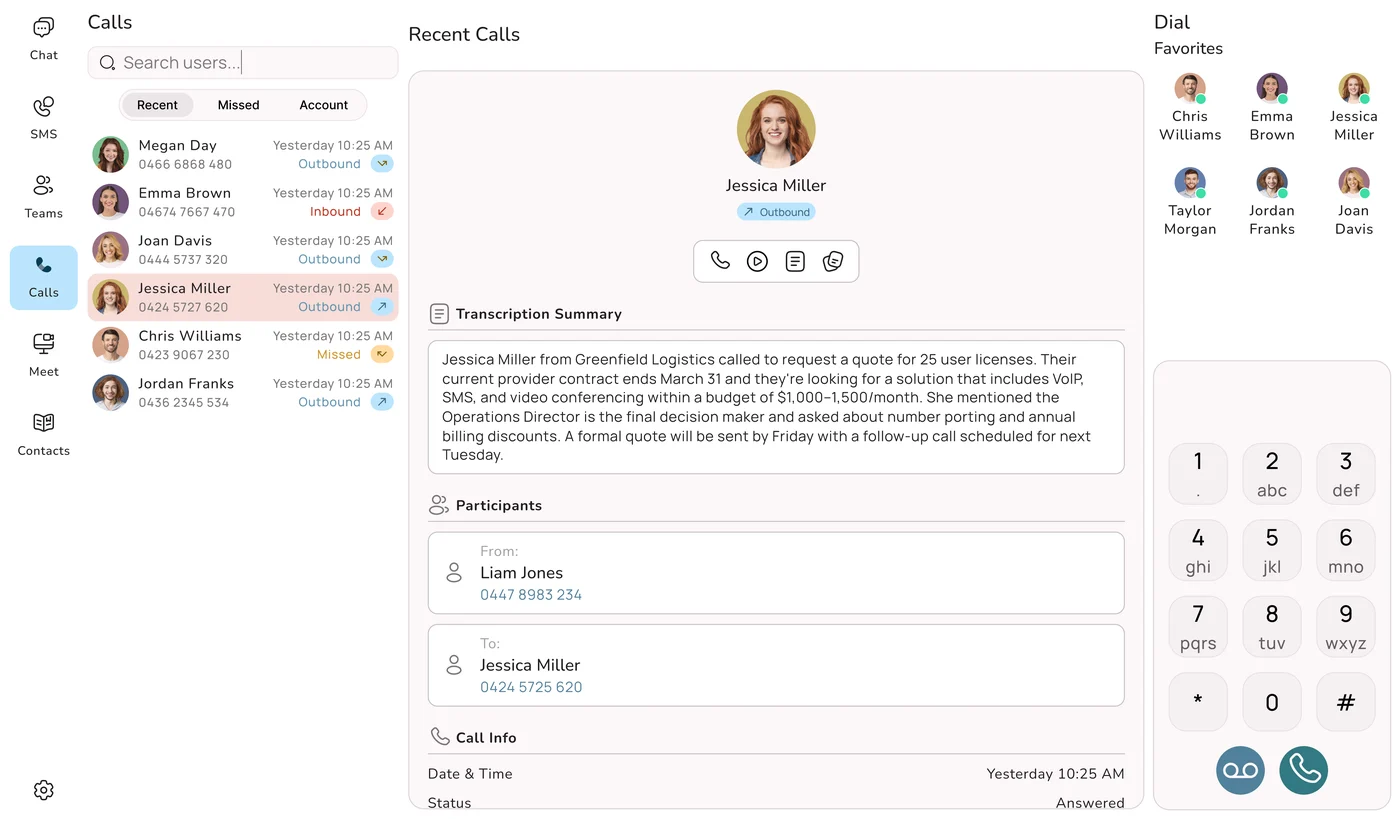
Now run the same request in a connected service. The call arrives and the participant’s record opens automatically on the answering screen: their name, plan, current supports, this week’s roster and the last three interactions. Reception moves the booking themselves, the worker is notified, an SMS confirmation goes to the participant and their nominated contact, and the call summary writes itself into the record. One person, ninety seconds, no repetition.
What Fragmentation Actually Costs
Providers usually frame this as an efficiency issue, which undersells it. There are three separate costs, and only one of them is about time.
The time cost
Coordinators spend hours a week on data movement, retyping, re-checking, reconciling. In a sector where coordinator capacity is the binding constraint on how many people you can support well, that is not overhead, it is unmet need.
The accuracy cost
Every manual re-entry is a chance to introduce an error. A time typed wrong in one system and right in another produces a missed support, and the participant experiences that as being let down.
The relationship cost
The one nobody measures. Being asked to re-explain your own circumstances repeatedly is exhausting, and for people who have spent years explaining themselves to systems, it is worse than exhausting: it signals that the service is not really holding them in mind.
The third cost is the one that should drive the decision. A participant cannot see your integration architecture, but they can absolutely tell the difference between a service that knows who they are when they ring and one that does not. That is a quality-of-support judgement, and it is the judgement they will pass on to their planner, their family and the next person who asks them for a recommendation.
Where the market has moved
Through 2025 and into 2026, NDIS software has consolidated around integrated platforms rather than single-purpose tools, and interoperability has become the competitive differentiator rather than a nice-to-have. Providers increasingly select on the strength of native integrations and open APIs into accounting, payroll, CRM and reporting, because the alternative, manual workarounds, is where errors and lost hours live.
The Six Systems Every Provider Runs
Almost every provider, at any size, is running some version of these six. The names change; the roles do not.
| System | What it holds | Who suffers when it is isolated |
|---|---|---|
| Client management / CRM | Participant details, goals, plans, service agreements, progress notes, consents. | Everyone. This is meant to be the single source of truth, and usually is not. |
| Rostering and scheduling | Who is working, where, with whom, with what skills and travel time. | Workers and participants directly: every mismatch is a real person waiting. |
| Claims and billing | Service bookings, claims, budgets, plan utilisation. | Finance, and then everyone when cash flow tightens or a claim is rejected. |
| Incident, complaints and quality | Registers, investigations, corrective actions, audit evidence. | The organisation, at audit, and participants, when a trend goes unnoticed. |
| Communications: phone, SMS, email | Every actual conversation with participants, families, workers and health services. | Nobody notices until they need to know what was said. Usually the worst-connected of the six. |
| Workforce: HR, payroll, training | Screening checks, qualifications, training currency, availability. | Compliance and rostering, which need to know who is actually cleared to work. |
You do not need one system that does all six. That fantasy has sold a lot of software and delivered a lot of disappointment. What you need is six systems that exchange data reliably, with one of them clearly designated as the source of truth for participant identity.
Why the Phone Is the Missing Link
Of those six, communications is almost always the least connected, and it is the one carrying the most context.
Think about where information actually enters your organisation. A prospective participant rings. A family member raises a concern. A support worker calls in about something that happened. A plan manager queries a claim. A hospital discharge coordinator rings on a Friday afternoon about someone coming home. Every one of those is a conversation, and the conversation is where the information exists first and most completely.
| Connection | What it does | Why it matters here |
|---|---|---|
| Screen pop on inbound calls | The caller’s record opens automatically before you answer, showing plan, supports, roster and recent history. | Ends the “can I take your details again” opening, which is the moment a participant decides how well you know them. |
| Click to call from the record | Dial from inside the client system; the call logs itself against the right participant. | Removes mis-dialling and, more importantly, removes the step where logging depends on somebody choosing to do it. |
| Automatic call notes into the record | Transcript, summary and actions written to the participant’s file with a timestamp. | Contemporaneous documentation without typing: the compliance backbone covered in NDIS record keeping. |
| SMS from the roster | Appointment reminders and change notifications sent from the business number, two-way so people can reply. | Reduces missed supports, and a reply that lands in the record beats a reply to a worker’s personal mobile. |
| Routing based on who is calling | Known participants routed to their coordinator; unknown numbers to intake; the on-call rota after hours. | People reach the person who knows them, first time, without navigating a menu that assumes they are a stranger. |
| Workflow triggers from calls | A call to the complaints line raises a register entry; an on-call incident call starts the notification workflow. | The regulatory clock starts in a system rather than in somebody’s intention to do it later. |
Four Ways Systems Connect
“Integration” covers four quite different things with very different costs. Knowing which one you are being sold matters.
1. Native integration
The two vendors have built and maintain a direct connection. You switch it on and authenticate. Cheapest, most reliable, least flexible, and always the first thing to check for.
2. Webhooks
One system fires an event (call ended, SMS received) and another acts on it. Simple, real-time, and enough for a surprising share of what providers actually want.
3. Open API
Your developer or IT partner builds exactly what you need. Most capable, most expensive, and it needs someone to own it long-term. Fine when the workflow is genuinely specific to you.
4. iPaaS / automation platforms
A middleware layer wires systems together with rules rather than code. Fast to build, easy to change, and the sweet spot for most small and mid-sized providers.
The practical order is: look for a native integration first, then webhooks, then an automation platform, and only build against an API when the first three cannot do it. Providers who start at the API end spend money on something they could have configured in an afternoon. The full landscape, including which Australian platforms connect how, is in 1,000+ integrations and open APIs and the Australian SaaS integration directory.
What Changes for the Participant
This is the part that justifies the work, and it is worth being concrete rather than aspirational.
| Moment | Disconnected | Connected |
|---|---|---|
| Ringing the service | Explains who they are, waits while someone finds their file, sometimes gets transferred and explains again. | Answered by name, by someone already looking at their plan and this week’s roster. |
| Changing a support | Message taken, call back, roster checked, funding confirmed separately, confirmation maybe. | Done on the call, worker notified, SMS confirmation to them and their nominated contact. |
| A new worker attending | Arrives with a name and an address, learns the important things by getting them wrong first. | Arrives briefed: preferences, communication needs, what happened last visit, what matters to this person. |
| Raising a concern | Told to someone who means well; whether it becomes a register entry depends on that individual. | Captured, classified, timestamped, routed, and closed out with the person told what happened. |
| After hours | A mobile that may or may not be answered by someone who may or may not have context. | A real on-call service that reaches the rostered person, with the participant’s record in front of them. |
| Plan review time | Evidence assembled from memory and scattered notes in the fortnight before. | A complete, searchable history of contact, supports, goals and outcomes, produced in minutes. |
Read down the right-hand column and notice that none of it is exotic. This is not artificial intelligence transforming care. It is systems passing each other information that already exists, so that people do not have to.
What Changes for the Workforce
The sector’s hardest constraint is not funding rules or software: it is finding and keeping good people. Integration is, unexpectedly, a retention strategy.
Hours
Per coordinator per week typically lost to moving data between systems by hand
1 entry
Instead of the same fact typed into three places by three people
Day one
A new starter can be useful when context lives in systems rather than in colleagues’ heads
0
Personal mobile numbers that need to be given out to participants
Support coordinators did not enter this field to do data entry, and the ones who leave rarely cite the participants as the reason. When the administrative tax drops, the same headcount supports more people better, which is the only form of scaling available to most providers under current pricing.
There is a wellbeing dimension too. A worker whose personal mobile is the after-hours contact has no way to be off duty. Moving that onto a rostered on-call number with a real escalation path is both a compliance improvement and a genuine kindness, and it intersects directly with obligations covered in the right to disconnect.
Four Risks Worth Managing
Connecting systems is not risk-free, and a provider handling sensitive information about vulnerable people should go in with eyes open.
| Risk | How it shows up | What to do |
|---|---|---|
| Privacy surface grows | Every integration is another system holding participant data and another set of credentials to protect. | Map what each connection actually transfers, apply least privilege, know which country each platform stores data in, and record it in your privacy register. |
| Errors propagate faster | A wrong phone number used to be wrong in one place. Now it syncs everywhere in seconds. | Designate one system as the source of truth per data type and make the others read from it rather than each holding an opinion. |
| Over-automation | Automating a judgement call, or letting an AI summary become the record without human confirmation. | Automate the movement of information; keep decisions with people. Write that boundary into policy explicitly. |
| Vendor lock-in | Deep integration into a platform you cannot leave, holding records you must keep for up to fifteen years. | Test the export before you commit, not after. Open formats, your data, your copy. |
The consent question that gets skipped
If call transcripts start flowing into a client record, that changes what is held about a participant and who can see it. Participants and their families should be told, in plain language, at the point they sign a service agreement, not discovered later. Consent that is informed is also consent that is defensible.
A Staged Plan That Starts With One Connection
The failure mode here is the big-bang platform migration: eighteen months, a large invoice, and a workforce that quietly keeps using the old spreadsheet. Do the opposite.
| Stage | What to do | Why this order |
|---|---|---|
| 1. Map the journey, not the software | Take one real request (a support change, an intake, a complaint) and walk it end to end. Note every system touched and every point a human retypes something. | The retyping points are your integration list, and they are usually fewer and more obvious than expected. |
| 2. Pick the source of truth | Decide which system owns participant identity and contact details. Everything else reads from it. | Skipping this is why integration projects create conflicting records instead of one good one. |
| 3. Connect the phone first | Screen pop and automatic call logging into the client record. One connection, immediate benefit, visible on day one. | It is the highest-context, least-connected system, and success here builds appetite for the rest. |
| 4. Automate the notifications | SMS confirmations and reminders driven from the roster, two-way, from the business number. | Reduces missed supports immediately, which is a number your board will notice. |
| 5. Wire the registers | Complaints line and on-call line trigger register entries and workflows automatically. | Turns your compliance obligations into defaults rather than disciplines. |
| 6. Review quarterly | What is still being retyped? What broke silently? What did the last audit or complaint reveal? | Integrations rot. A quarterly look keeps this from becoming a project you did once in 2026. |
Questions to Ask Any Vendor
Whether you are choosing a client management platform or a phone system, these six questions separate genuine interoperability from a logo on a slide.
“Show me the integration working”
Not a partner page. A live demonstration with the actual platform we use, doing the actual thing we need.
“Where is the API documentation?”
Public, readable documentation is a strong signal. “Available on request under NDA” usually means thin.
“What does the integration cost?”
Per user, per connection, per call, per month? Integration priced as a premium tier changes the business case entirely.
“Which country holds the data?”
For participant information this is a Privacy Act question, and a straight answer should be easy. See where your calls actually live.
“How do we export everything?”
Ask for a sample export file during the trial. Retention obligations run for years; software relationships often do not.
“Who fixes it when it breaks?”
Two vendors pointing at each other is the default failure mode. Establish who owns the connection before you need to know.
The provider that gets this right does not end up with impressive technology. It ends up with something much better: a participant who rings and is greeted by name, by someone who already knows what this call is probably about, and who can fix it before hanging up.