

Business phone system
- Business phone systemA complete cloud phone system, set up for you
- Features50+ features: IVR, queues, recording, desktop and mobile apps
- Call flowsDecide exactly how every call is answered and routed
- AI Agents Built inAnswer, book and follow up on calls, day or night
- Time to upgradeStill on an old PBX? Here is what you are missing
Apps and hardware
- Desktop app Live demoCalls, chat, SMS and AI summaries in one window
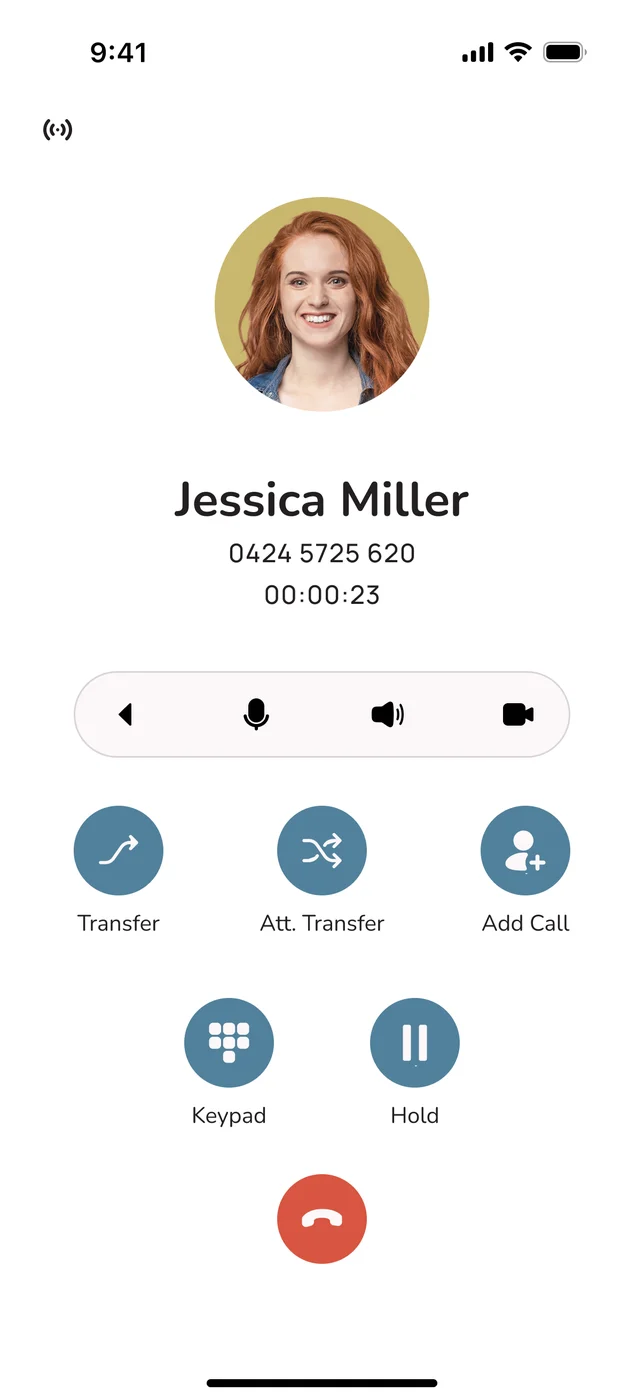
- Mobile app Live demoYour business number on your iPhone or Android
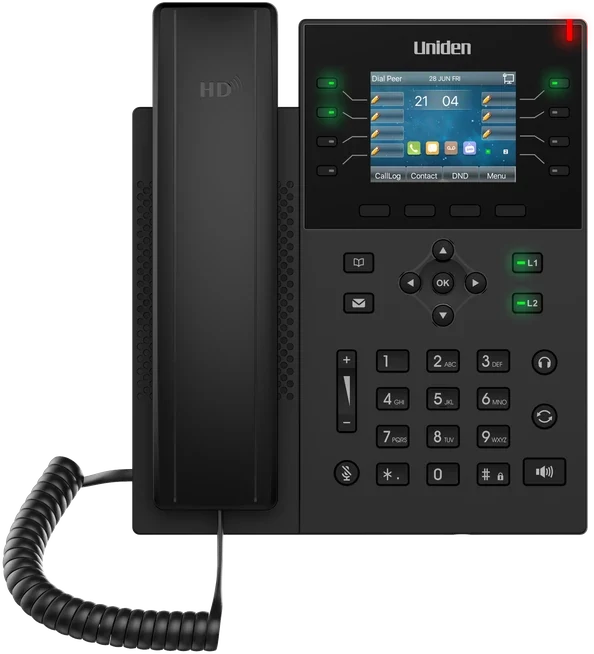
- Uniden desk phonesThe EVOC2 and a full range of office, DECT and conference phones
- Business NBNNBN set up alongside your phones, on one bill
- Why our internetBuilt for voice, so calls stay clear when the line is busy
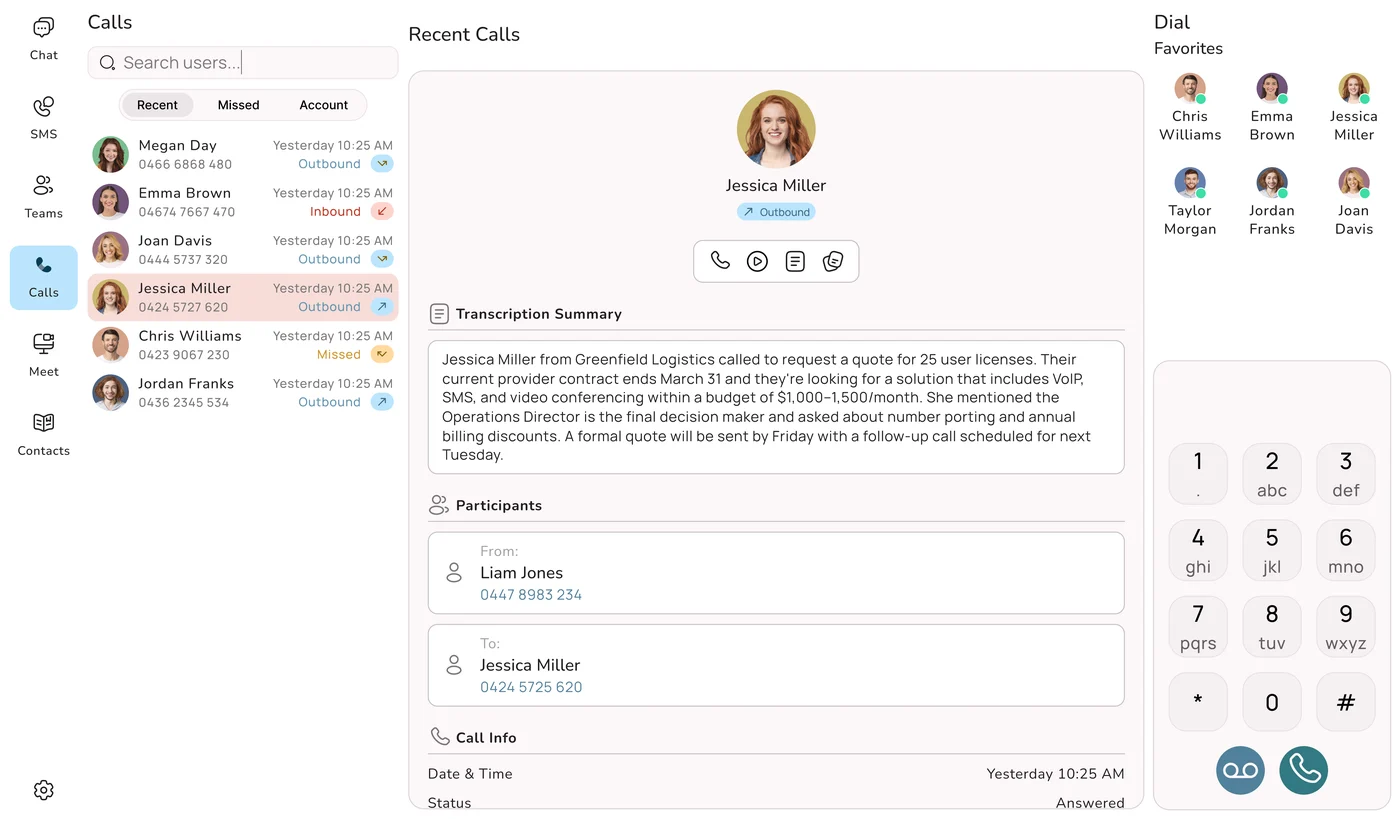
New Try it liveTake the Uniden Voice apps for a spin, right here
Click through working demos of the desktop and mobile apps: calls with AI summaries, team chat, SMS and more. No download, no sign up.
Desktop app demoMobile app demoDesigned, built, hosted and supported in Australia. Uniden desk phones, cloud apps and AI in one system.Book a demoAll features
AI on your phone line
Uniden Voice vs AI receptionists
See every comparisonAI AgentsEvery call answered, day or night
It answers on your own numbers, books the job, sends an SMS and warm transfers to your team when a person is needed.
Meet your AI agentBuilt into your phone system, not bolted on. No second number, no call forwarding.Book a demo
Professional services
Trades, retail and hospitality
Browse all industries Case study · Optical Solutions AustraliaFive branches, five phone systems, now one.5 sites1 systemRead the OSA story
 Case study · Coco's Wealth of HealthWhen every enquiry and phone order matters.Maroubra organic health-food storeRead Coco's story





Our customersFrom one-person shops to national brands
See how businesses like yours run their phones on Uniden Voice.
Find your industryWorking on your own? A real business number and NBN for sole traders, no lock-in.Sole tradersStartups
Phone plansBusiness phone planfrom$84.90/month3 users included on a 36-month term. Every feature, one simple per-user rate.Free setup and free number portingDesktop and mobile apps includedAI Agents built inSee phone plans![Uniden Voice mobile app on a call]()
![A small team working together at a desk]()
Internet, hardware and more

Bundle and savePhones and NBN from one Aussie team
One provider to call when something needs fixing. No finger pointing.
See NBN plansWe guarantee to beat any competitor's quote. Keep your existing numbers when you move across.Sign up online1300 881 662
Learn and get set up
The library at a glanceBrowse all
173business
guides395kreads
so far
guides395kreads
so far
Guides by topic
- Phone systems63
- AI24
- Industries18
- Costs12
- NBN8
- Security7
- News5
- Other guides36

Need a hand? Our support team is based in Australia.Contact support

Call us on 1300 881 662 or send a message and the team will get back to you.Send a message
Australian telecommunications does not usually produce a busy fortnight. This one did. Between 29 July and 13 August 2026, the Telecommunications Industry Ombudsman published a systemic report drawing on nearly 28,000 complaints and told the government the regulatory framework needs overhauling; the ACCC launched a twelve-month inquiry into whether wholesale mobile access, including domestic roaming, should be regulated; the ACMA commenced Federal Court proceedings against Optus Mobile over the September 2025 emergency call outage; and the same regulator published a report ranking 33 telcos on how well they handle complaints. Add the transparency rules that came into force on 30 June and the messaging rules that started on 1 July, and you have six separate developments pointing in one direction. None of them were written with a forty-person business in mind. All of them change what you can verify about a provider before you commit to one, which is the practical point of this article.
Ask most business owners what their phone system does and they will describe something that rings. That description was accurate for about a hundred years and stopped being accurate somewhere around 2023, but the language has not caught up, which is why so many Australian businesses are paying separately for software their phone platform already includes. A cloud voice platform in 2026 answers calls without a human, writes the customer record as it goes, distributes work across a team, creates the follow-up, offers the appointment, hosts the video meeting, sends the confirmation text and then reports on every one of those things in one place. That is eight product categories, most of which are sold separately by somebody, and several of which appear on Australian business bank statements twice. This is an honest inventory of what a phone platform now covers, what it does not, and how to work out which of your subscriptions you are paying for out of habit.
One of the most common questions we are asked during a switch is also one of the most expensive to get wrong: does the hardware have to go? A business with forty desks may have twenty or thirty thousand dollars of handsets bolted to those desks, bought within the last few years, working perfectly well. The idea that changing phone provider means skipping the lot is one of the main reasons businesses stay somewhere they have stopped being happy. It is also, in most cases, untrue. Uniden Voice Over Cloud runs standard SIP, the same published protocol every serious handset manufacturer implements, so Yealink, Fanvil, Grandstream, Snom, Poly, Cisco and a long tail of intercoms, paging speakers and analogue adapters will register and work. This is the detailed version: which brands and models, what auto-provisions and what needs configuring by hand, the provisioning lock a departing provider can leave behind, the five things that never carry across, and how to audit your own fleet in an afternoon.
You have the ABN, the business name, the logo and probably the website. Then somebody asks for your number, and you give them your mobile, because it is right there and the business is only you. Six months later that mobile number is on a hundred invoices, two hundred business cards, the van, three directory listings and every quote you have sent, and it is also the number your kids ring on. Untangling that is the single most annoying job in a growing small business, and it is completely avoidable. This is the whole phone setup for a new Australian business: which number type to choose and why, how many lines you actually need, what you have to buy versus what you can skip entirely, the five call flows to set up on day one, and the seven mistakes that cost real money later. It takes about a week and most of it takes an afternoon.
If you build your business on reselling and supporting 3CX, the last twelve months have been a series of conversations you did not want to have. A fair use policy that caps extensions against simultaneous call licences, with enforcement from April. An edition shake-up that retired Enterprise Plus and renamed Enterprise to AI Edition. Renewal quotes that need explaining. And underneath all of it, the same structural fact that was always true and is now harder to live with: you carry first line support for a platform whose roadmap, pricing and licensing terms you do not control. This is what actually changed, what it does to the margin on a typical Australian deployment, and what a partner program looks like when the vendor owns the network, the platform and the support queue, and pays you every month rather than once a year.
"Please listen carefully as our menu options have changed." Nobody has ever been pleased to hear that sentence. The phone menu is one of the few pieces of business technology that customers actively resent, that staff apologise for, and that almost every organisation running one privately admits is not very good, and yet it is still the front door to a large share of Australian businesses. The reason it survives is not that it works. It is that it solved a genuine problem in 1975, and until a couple of years ago there was nothing better to put in its place. That has now changed, and the change is not "a nicer menu". It is the removal of the menu entirely, in favour of something that simply asks the caller what they need. This covers why menus fail structurally rather than cosmetically, what replaces them, how to migrate off one in a fortnight, and the narrow cases where you should keep yours.
"I want AI to answer my calls." It is now one of the most frequent opening lines in any conversation about business phones in Australia, and it is a completely reasonable thing to want: you are missing calls, you cannot afford a full-time receptionist, and you have watched AI answer questions convincingly enough to think it could handle the twenty people a day who ring to ask what time you close. The complication is that four genuinely different products go by that name, they cost different amounts, they solve different problems, and picking the wrong one is how businesses end up with something their customers dislike. This is the plain-English version: what each option actually does, which of your calls to hand over first, what your customers will hear, the one design rule that decides whether they accept it, what it costs, and the Australian rules that apply.
Changing business phone providers has a reputation it mostly does not deserve. The great majority of changeovers are uneventful, and the ones that go wrong fail on a predictable short list: a contract with an exit term nobody read, a number range that could not be split, an alarm dialler that stopped reporting silently, and a cutover scheduled on a Friday afternoon. None of those are hard problems. They are just problems nobody looks for, because the conversation before a changeover is almost entirely about handsets and monthly cost: the two things least likely to cause trouble. This is the playbook: how to read your exit terms, what genuinely moves and what does not, the full inventory of devices quietly dependent on a phone line, a six-week timeline, and an hour-by-hour plan for the day itself.
Most business phone systems are a black box with a nice front end. Calls go in, calls come out, and the data those calls generate (who rang, when, how long, what was said, what happened next) stays locked inside a portal you can look at but not use. If you want to do something the vendor did not think of, you raise a request and wait. We took the opposite view. Every operation you can perform in our portal is available through an open REST API, every event that happens on your account can be pushed to your systems the instant it occurs, and every record we hold about your calls and messages is yours to pull out whenever you want. This is what that surface actually covers across voice and SMS, seven things teams build with it in about a week, the Australian compliance layer that applies once you start sending programmatically, and why openness is a commercial commitment rather than a feature.
If you run your business phones on Optus Loop, you have probably had a letter, an email, or a phone call about a migration. The service you bought is being replaced by a different platform, built by a different company, with a different app, a different admin console and a different way of doing almost everything. Optus calls it Optus Loop with RingCentral. Underneath the branding it is a platform replacement, and a platform replacement is not an upgrade: nothing carries across by itself, and everything you configured has to exist somewhere on the other side. This is what actually changes, what to check before your cutover date, what other businesses have reported about the experience, and the three options you have. One of them is only free for a short window, and that window is open right now.