












When a Phone System Stopped Being a Phone
There is a specific reason all of this collapsed into one platform, and it is worth understanding because it explains which functions consolidated and which did not.
Every one of the eight jobs below needs the same three facts: who is contacting us, what about, and what happens next. A receptionist needs them. A CRM record is those three facts with a date on it. A queue routes on the first two. A follow-up task is the third one written down. A booking is the third one with a time attached. A confirmation SMS is the third one sent to the customer.
The point where those three facts are born is the phone call
For a large share of Australian businesses (trades, clinics, agencies, professional services, venues) the customer relationship starts with a ringing phone. Historically the phone system was the one system that threw all three facts away the moment the call ended. Everything downstream then existed to re-capture, by hand, information the phone had already had. That is the duplication that has now closed, and it closed at the phone rather than anywhere else because that is where the data originates.
Which also predicts the limits, and predicts them accurately. Functions built on those three facts moved into the voice platform. Functions built on something else (a deal pipeline, a chart of accounts, a project plan) did not, and should not. That distinction runs through the whole of the rest of this article.
1. The Receptionist That Never Sleeps
The first and largest of the eight, because it is the one that changes what a business is capable of rather than merely what it spends.
An AI phone agent answers on the first ring, at any hour, in a natural Australian voice, and holds an actual conversation rather than reading a menu. It answers the questions that make up most of your call volume: hours, address, parking, price ranges, whether you service a suburb, whether you are open on the public holiday. It qualifies a lead. It takes the details. It routes to the right person when a person is needed, and it hands over immediately and unconditionally the moment anyone asks for one.
| What it replaces | Typical separate cost | What changes |
|---|---|---|
| An answering service or after-hours call centre | Per-call or per-minute, and it rises exactly when you get busy | Fixed cost, no per-call penalty for a good week, and it knows your business rather than reading a script card |
| Voicemail as the after-hours plan | Free, and expensive in a way that never appears on a bill | The 7pm caller books an appointment instead of leaving a message that gets returned on Tuesday, by which time they have rung someone else |
| “We will just let it ring out when we are busy” | Nothing, invoiced. Everything, in practice | Ten simultaneous callers are all answered at once, which no receptionist has ever been able to do |
The line worth holding
The businesses customers complain about are the ones that made the human path hard to find. An AI agent that cannot be escaped is worse than the menu it replaced. Anyone who asks for a person gets one, immediately, without repeating themselves. Everything else in this section only works because that rule is not negotiable.
2. The Customer Record You Already Have
This is the one most businesses do not realise they are getting, and it is the one that quietly makes everything else more valuable.
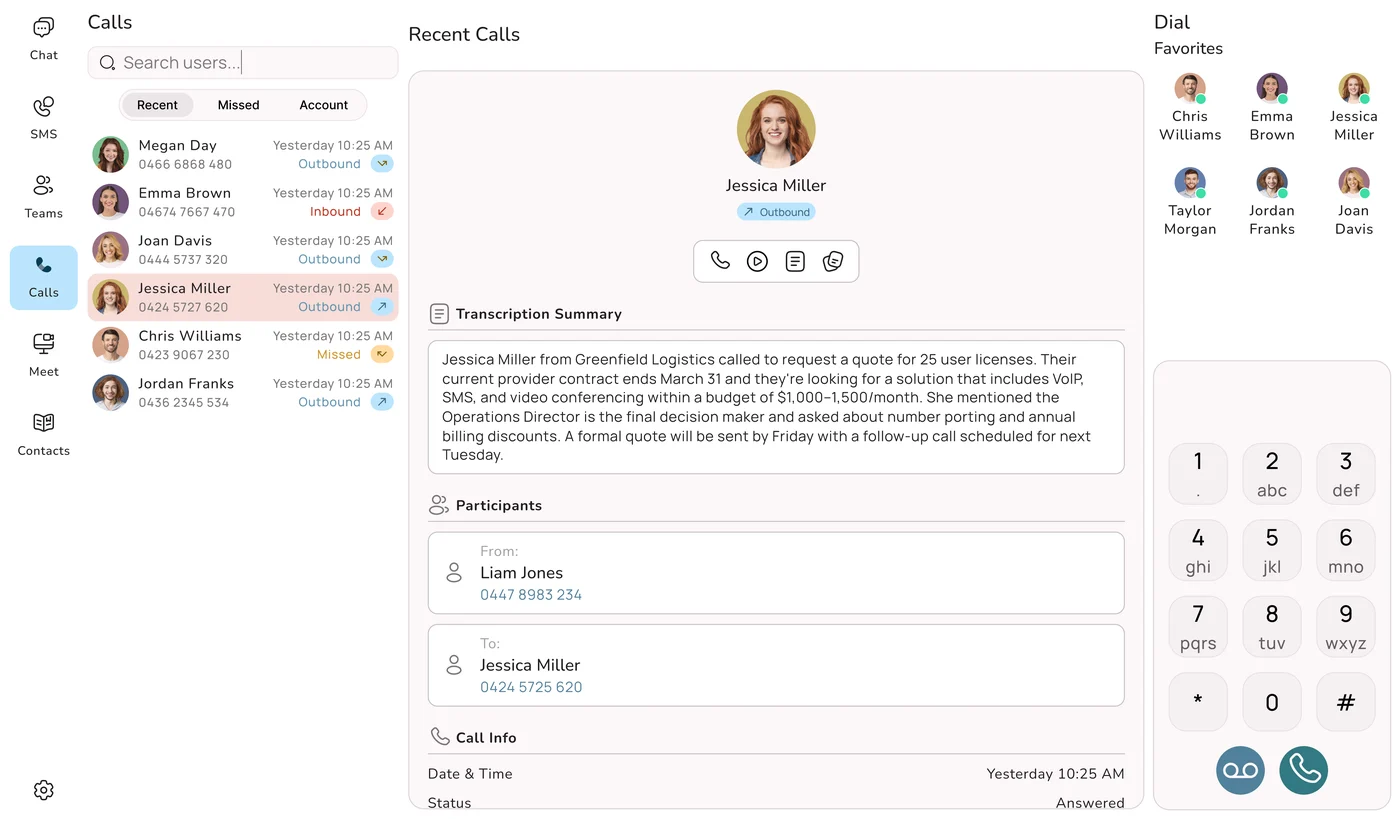
Every call produces a record: the number, the time, how long, who handled it, what happened. Add transcription and summarisation and that record contains what was actually said, condensed to a few lines a human will realistically read. Push it into your CRM and the customer's history writes itself: no note-taking discipline required, which matters because note-taking discipline is the single most reliably abandoned process in any business.
Screen pop before you answer
The record appears as the phone rings, not after you have asked them to spell their surname again. Call screening shows who it is and what they last called about.
Notes written by the call
Transcripts and summaries attached to the customer automatically. The value is not the transcript, it is that nobody had to remember to write one.
Into the system you already use
Salesforce, HubSpot, Zoho, Xero, Monday and a long list of others, plus open APIs for whatever is not on the list. Click-to-call out of the record in the other direction.
Or the record on its own
Plenty of small businesses have no CRM at all. Call history, recordings, transcripts and a shared cloud contact directory is a genuine customer record, and it costs nothing extra.
This is not a claim that the phone system is a CRM. It is a claim about where the data comes from. A CRM with no call history is a database of things people typed in when they had time, which is a much less reliable object than it sounds. See the limits section for where the line actually falls.
3. The Contact Centre You Did Not Buy
“Contact centre software” used to mean a distinct product with a distinct licence, bought by organisations with a room full of headsets. The capability is now simply part of the platform, which means a four-person office has the same routing machinery a hundred-seat operation does.
| Capability | What it does | Who it is for |
|---|---|---|
| Queues with ring strategies | Seven ways to distribute calls across a group (longest idle, simultaneous, round robin and so on) with custom greetings and queue announcements | Anyone whose calls are answered by more than one person |
| Time conditions | After hours, public holidays, lunch cover and on-call rosters, applied automatically rather than by whoever remembers | Every business with opening hours, which is most of them |
| Ring groups and shared lines | One number across several devices; answer from any of them; call out as the business rather than as yourself | Small teams, reception pods, multi-site operations |
| Listen, whisper and barge | A supervisor can monitor a live call, coach the agent without the customer hearing, or join it | Training, escalation and quality work |
| One queue for voice, SMS and chat | The same team handling more than the phone, without switching tools per channel | Anyone whose customers text as readily as they ring |
| Multi-site and international | Branches managed as one system; roaming servers so overseas staff stay on the business number | Businesses with more than one address, or staff who travel |
The threshold has moved and most people have not noticed
The old rule of thumb was that you needed contact centre software at somewhere around fifteen agents. That number is now approximately three, because the capability arrives with the platform instead of arriving with a procurement process. If two people answer your phones and you have no queue, no ring strategy and no reporting, you are not too small for it: you simply have not switched it on.
4. Follow-Ups, and Where They Come From
This is the smallest of the eight to describe and the most commonly under-used.
Most business follow-ups originate in a phone call. Someone rings, something is promised, and the promise then lives in a notebook, a memory or a sticky note on a monitor. The failure rate is not a character flaw; it is what happens when the record of the promise is stored somewhere disconnected from the record of the conversation.
| Signal | What it can trigger |
|---|---|
| A missed call from an unknown number during business hours | An automatic SMS within seconds (“sorry we missed you, we will call back, or reply here”) which is the highest-return automation available to most small businesses |
| A call summary containing a commitment | A task written into the CRM or project tool against the right customer, with the transcript attached |
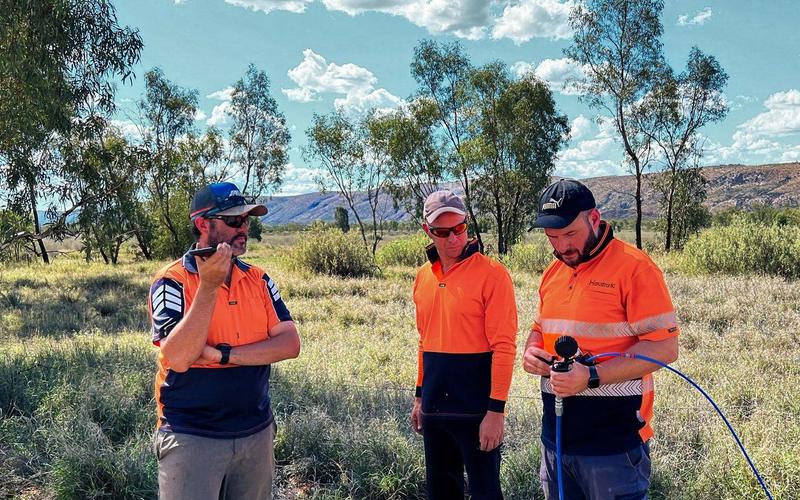
| A voicemail | Transcribed and emailed, so it can be actioned from a phone at a job site rather than requiring someone to sit down and listen |
| A call that ended in a queue abandonment | A callback list, which is a genuinely different thing from a report saying you abandoned calls |
| A quote discussed but not sent | A reminder to the person who promised it, before the customer has to chase |
None of this is a project management tool, and it is not trying to be. It is the specific and narrow case of work that is created by a conversation being captured at the moment the conversation happens, rather than reconstructed later from memory.
5. The Diary at the End of the Conversation
For an enormous number of Australian businesses (dental, allied health, veterinary, trades, salons, mechanics, professional services) the entire commercial purpose of the phone is to convert a conversation into an appointment. Everything else is overhead.
So the meaningful test is not whether the platform has a calendar. It is whether a call can become a confirmed booking without a human transcribing anything.
| Step | What has to be true | Why it is usually the sticking point |
|---|---|---|
| Read real availability | The live diary, including today's changes, not a static grid | A booking against a stale calendar creates a double-booking, which is worse than no booking |
| Respect the rules | Appointment durations, buffers, which staff can do which job, what must never be booked without a human | Every business has rules like these and almost nobody has written them down. That writing job is the real work |
| Write the appointment back | Into the same calendar the team already lives in | A second calendar that only the phone system knows about is not a feature, it is a new problem |
| Confirm it | An SMS to the customer immediately, with the details and a way to change it | Confirmation is what makes the booking real and cuts no-shows. It is also the cheapest part |
The honest boundary
The platform is a booking surface, not a replacement for your calendar. It should read from and write to whatever your team already uses. Any product that requires you to move your diary into it has made your life more complicated in exchange for a demo that looked tidy.
6. Meeting Rooms Without a Second Subscription
This one is straightforward, which is exactly why it so often goes unnoticed on the bill.
Audio and video conference rooms are part of the platform. HD video meetings, screen sharing, password-protected audio bridges, one-click joining from a browser without the guest downloading anything. Recording where you need it. Multi-party rooms that do not stop after forty minutes because a timer expired.
| Question to ask yourself | What the answer usually reveals |
|---|---|
| What do we pay per month for video conferencing? | Frequently a paid tier bought years ago to escape a meeting time limit, still renewing, still on the card |
| How many people actually need to host a meeting? | Far fewer than have licences. Attending is free everywhere; hosting is the thing that costs |
| Does anyone use the recordings? | Sometimes genuinely yes. Often nobody has opened one in a year, and it is paid storage |
| Do our customers care which tool we use? | Almost never, provided joining is one click and does not require an install |
A fair caveat
If your organisation lives inside Teams all day, the meeting is not really the thing you are buying: the chat, the files and the calendar integration are. Direct routing puts your business calling into that environment rather than fighting it, and that is often the right answer. This section is aimed at the very common case of a business paying for a standalone conferencing subscription it barely uses.
7. SMS as a Channel, Not an Add-On
Text messaging is where the gap between what businesses have and what their customers expect is widest. Customers text. A great many Australian businesses still cannot receive one.
Two-way SMS from the business number means the customer can reply to the confirmation, the reminder and the quote, and the reply lands somewhere a person will see it, in the same place as the calls, rather than on somebody's personal mobile.
Missed-call text-back
The single highest-return automation available to a small business. A tradesman on a roof cannot answer, but a text arriving twenty seconds later keeps the job.
Reminders and confirmations
Appointment confirmations and day-before reminders, sent automatically, measurably reducing no-shows in every industry that has tried it.
Two-way conversations
Threaded against the customer, visible to the team, in the same queue as the calls. Not a personal mobile, not a WhatsApp group, not a shared login.
Registered sender ID
Since 1 July 2026, unregistered alphanumeric sender IDs are labelled “Unverified” on Australian handsets. Your messaging provider handles registration, and you should confirm they have.
8. The Reporting Layer Underneath All of It
Last, and the one that turns the previous seven from features into management information.
Because every interaction runs through one platform, the reporting is not seven dashboards that disagree with each other. It is one set of numbers about the same events. That matters more than it sounds: most businesses running a fragmented stack cannot answer basic questions about their own customer contact, not because the data is missing but because it lives in five places with five definitions.
1
Place the numbers come from
8
Functions reporting into it
0
Reconciliation between tools
24/7
Coverage being measured
The numbers worth watching are not exotic. How many calls arrived and how many were answered. Speed of answer and abandonment, split by hour and by day, because the average hides the Monday morning. First contact resolution. Missed calls outside hours and what happened to them. How many bookings came from calls. Which of your numbers and campaigns produced them. All of that is one platform's reporting rather than an integration project.
The Four Things It Does Not Replace
An article that claimed the phone system replaces everything would not be worth reading, and would be easy to disprove with about five minutes of use. Four categories stay where they are, and the reason is the same in each case: they are not built on who called, what about and what next.
| Not replaced | Why not | What the platform should do instead |
|---|---|---|
| Pipeline and deal management | A sales pipeline is a model of probability, forecast and stage over time. That is a genuinely different object from a contact history | Feed it. Calls, transcripts, outcomes and follow-ups into your CRM, so the pipeline is built on real activity |
| Quoting, invoicing and payments | Tax, terms, reconciliation and an audit trail belong in accounting software and should stay there | Integrate. Click-to-call from the invoice, call context against the customer, no re-keying |
| Marketing automation | Segmentation, campaign design, attribution and email sequencing are a separate discipline with separate tooling | Provide the channel and the data (SMS delivery, call outcomes, source tracking) not the campaign builder |
| Project management | Dependencies, resourcing, Gantt charts and sprint boards are not follow-ups with a due date, however much they look alike from a distance | Create tasks into the tool your team already uses, and stop there |
The failure mode to avoid
The worst outcome of consolidation is replacing four good tools with one platform that does all four badly. The test is not whether a feature exists in a demo. It is whether the person who uses that function every day would choose it over what they have now. If the answer is no, integrate instead of consolidating. A well-integrated stack beats a badly consolidated one every time.
Costing Your Actual Stack
Do this before you talk to anyone, including us. It takes about an hour and it is the only way to know whether any of the above is worth money to you specifically.
| Step | What to do | What usually turns up |
|---|---|---|
| 1. Pull the card statement | Twelve months of the card the subscriptions are on. Highlight every recurring software charge | Two or three nobody remembers signing up for, and at least one for a departed employee |
| 2. Write the function beside each | Not the product name: the job it does. “Video meetings”, “SMS reminders”, “after-hours answering” | The duplication becomes visible the moment the products are described as jobs |
| 3. Mark the overlaps | Anything appearing twice, and anything on the list of eight above | Typically messaging, conferencing and answering. Occasionally three separate tools sending texts |
| 4. Add the per-seat multiplication | Per-user pricing times headcount, times twelve. Convert everything to an annual figure | The annual number is the one that changes minds. Monthly pricing is designed so that it does not |
| 5. Count the logins, not just the dollars | How many tools does one customer interaction touch? | The answer is usually between four and nine, and the switching cost is real even though nobody invoices for it |
| 6. Cancel one thing | The clearest duplicate. One, not all of them | Consolidation done gradually sticks. Done all at once it produces a rebellion in week two |
The summary
Eight jobs moved into the voice platform because all eight depend on the same three facts, and those facts are born on the phone call. Four jobs did not move, and should not. The useful exercise is not choosing between consolidation and integration: it is knowing which side of that line each of your tools sits on, and then cancelling the ones that are paying twice for the same thing.
Related reading: what UCaaS actually means for the category definition, the cost of a fragmented stack for the money side worked through, and integrations and open APIs for the boundary between consolidating and connecting.