

Business phone system
- Business phone systemA complete cloud phone system, set up for you
- Features50+ features: IVR, queues, recording, desktop and mobile apps
- Call flowsDecide exactly how every call is answered and routed
- AI Agents Built inAnswer, book and follow up on calls, day or night
- Time to upgradeStill on an old PBX? Here is what you are missing
Apps and hardware
- Desktop app Live demoCalls, chat, SMS and AI summaries in one window
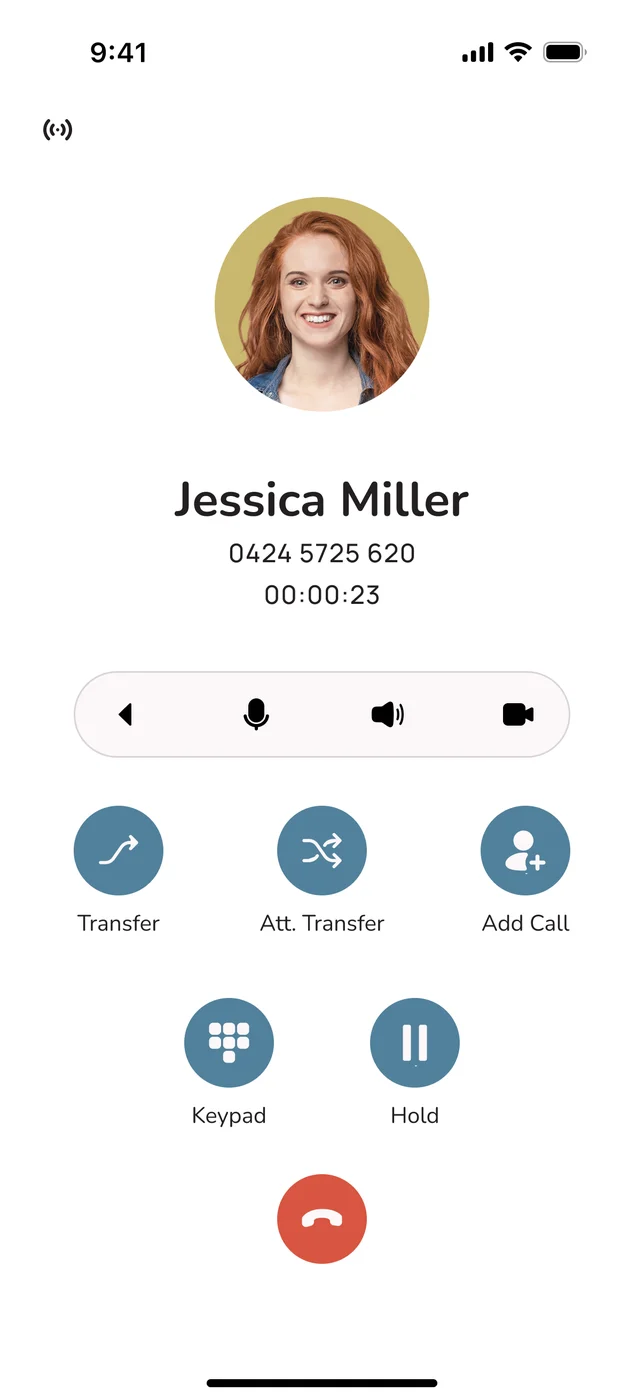
- Mobile app Live demoYour business number on your iPhone or Android
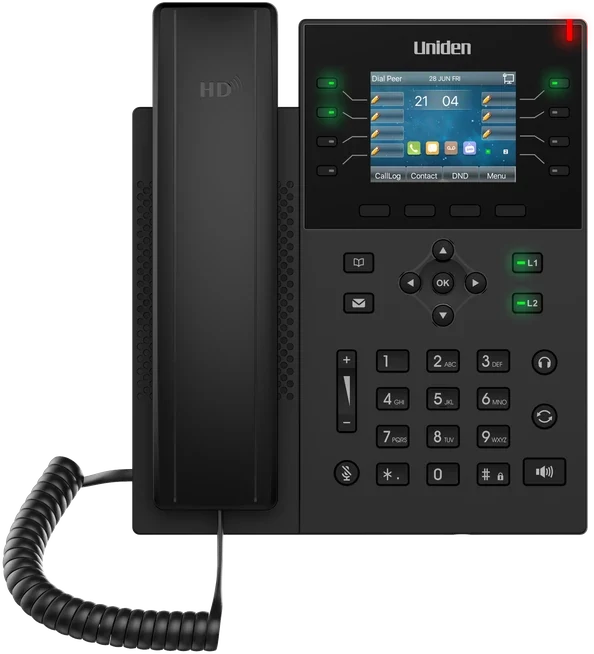
- Uniden desk phonesThe EVOC2 and a full range of office, DECT and conference phones
- Business NBNNBN set up alongside your phones, on one bill
- Why our internetBuilt for voice, so calls stay clear when the line is busy
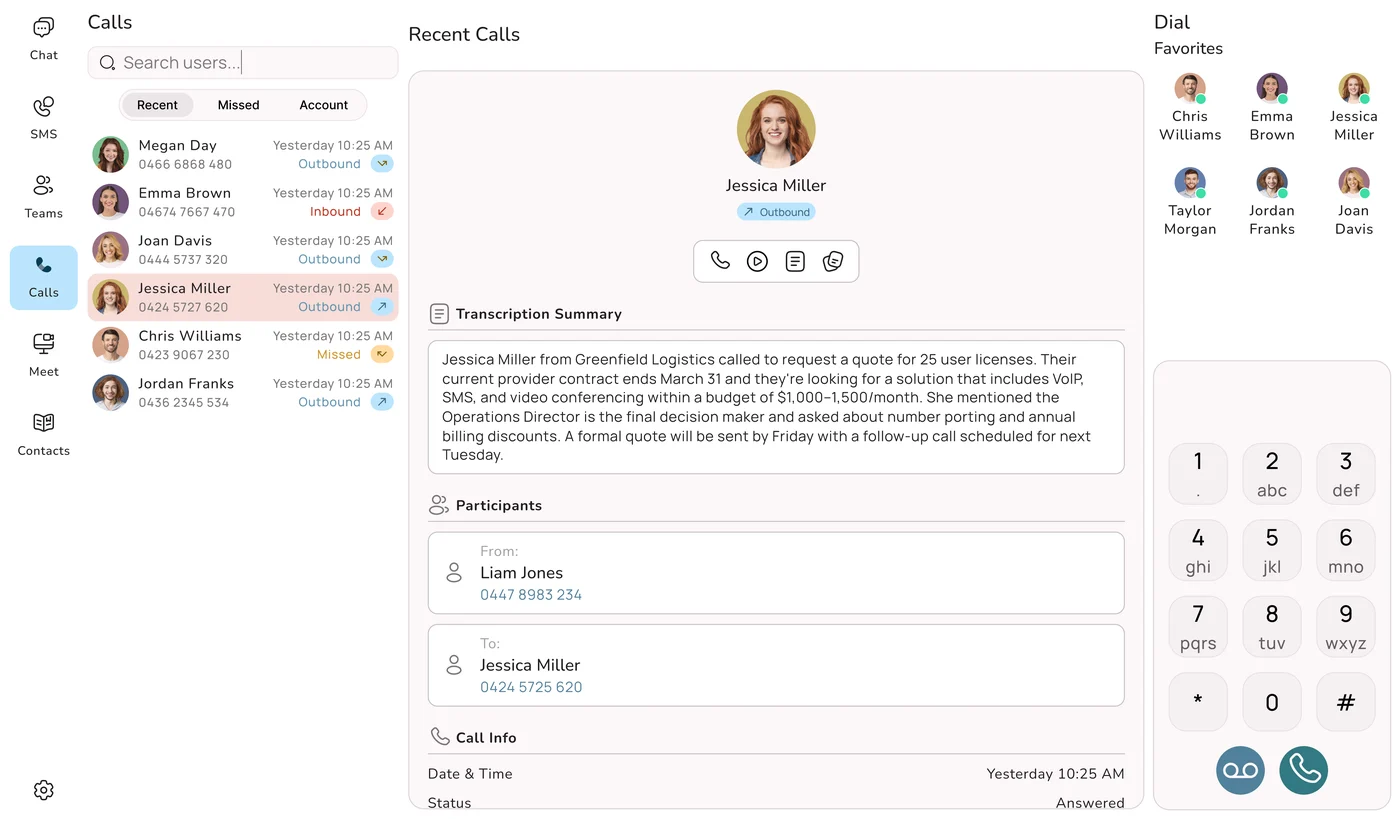
New Try it liveTake the Uniden Voice apps for a spin, right here
Click through working demos of the desktop and mobile apps: calls with AI summaries, team chat, SMS and more. No download, no sign up.
Desktop app demoMobile app demoDesigned, built, hosted and supported in Australia. Uniden desk phones, cloud apps and AI in one system.Book a demoAll features
AI on your phone line
Uniden Voice vs AI receptionists
See every comparisonAI AgentsEvery call answered, day or night
It answers on your own numbers, books the job, sends an SMS and warm transfers to your team when a person is needed.
Meet your AI agentBuilt into your phone system, not bolted on. No second number, no call forwarding.Book a demo
Professional services
Trades, retail and hospitality
Browse all industries Case study · Optical Solutions AustraliaFive branches, five phone systems, now one.5 sites1 systemRead the OSA story
 Case study · Coco's Wealth of HealthWhen every enquiry and phone order matters.Maroubra organic health-food storeRead Coco's story





Our customersFrom one-person shops to national brands
See how businesses like yours run their phones on Uniden Voice.
Find your industryWorking on your own? A real business number and NBN for sole traders, no lock-in.Sole tradersStartups
Phone plansBusiness phone planfrom$84.90/month3 users included on a 36-month term. Every feature, one simple per-user rate.Free setup and free number portingDesktop and mobile apps includedAI Agents built inSee phone plans![Uniden Voice mobile app on a call]()
![A small team working together at a desk]()
Internet, hardware and more

Bundle and savePhones and NBN from one Aussie team
One provider to call when something needs fixing. No finger pointing.
See NBN plansWe guarantee to beat any competitor's quote. Keep your existing numbers when you move across.Sign up online1300 881 662
Learn and get set up
The library at a glanceBrowse all
173business
guides395kreads
so far
guides395kreads
so far
Guides by topic
- Phone systems63
- AI24
- Industries18
- Costs12
- NBN8
- Security7
- News5
- Other guides36

Need a hand? Our support team is based in Australia.Contact support
Call us on 1300 881 662 or send a message and the team will get back to you.Send a message
Two things happen in a real estate office on the same Tuesday. At 11:20am a buyer rings about a property they saw on a portal twenty minutes ago; nobody picks up, the call rolls to a mailbox, and by the time it is returned at 2:45pm they have booked an inspection with another agency and stopped answering unknown numbers. At 6:40pm a tenant rings about water coming through a ceiling; the office closed at 5:30pm, the recorded message gives a mobile number for emergencies, that mobile is on silent because its owner is at their child's concert, and the tenant, reasonably, arranges a plumber themselves. Those two failures look like the same problem, which is why agencies keep trying to solve them with the same fix. They are not. The first is a speed problem in a competitive market where the enquiry is worth thousands and the window is minutes. The second is a compliance and liability problem, because tenancy legislation across the states requires a landlord or agent to arrange urgent repairs quickly (commonly within twenty-four hours of being notified, with tighter timeframes for essential services in some jurisdictions) and generally allows a tenant who cannot reach the agent to arrange the repair and recover the cost. One is about winning work. The other is about what a tribunal will make of your evidence. This article treats them separately, because designing an agency phone system as one undifferentiated flow is the reason both keep happening.
A business rings a customer back about a quote. The customer never sees the call, because their carrier dropped it at the network edge for presenting a caller ID the business does not hold rights of use to. Another business rings the same customer an hour later and does reach the handset: where it displays under a red warning banner suggesting the call may be a scam, and goes unanswered. Neither business did anything wrong on purpose, neither was told what happened, and both concluded that outbound calling "does not work any more". It does work. What has changed is that two independent systems now sit between your dialler and the person you are calling: a network-level blocking regime under Australia's registered scam-reduction code, which is a rules-based system you can comply with precisely, and a reputation-labelling layer applied by carrier screening, handset software and third-party call-identification apps, which is a statistical system nobody publishes the internals of. They have different causes, different symptoms and different remedies, and treating them as one problem is why so many attempted fixes achieve nothing. This article separates them, sets out the six configuration and behaviour patterns that actually cause failed calls, gives you a diagnostic you can run in an afternoon with your own numbers and two handsets, and orders the remedies by how much difference each one makes.
PBX stands for private branch exchange, and the original problem it solved is easy to picture: a business with twenty staff could not afford twenty telephone lines, so it bought a cabinet that let twenty internal telephones share four external ones, and let those twenty people ring each other without using a line at all. Everything else (extension numbers, transfers, hold, hunt groups, a receptionist's console) grew out of that one idea. A century later the cabinet has usually disappeared into a data centre, but the vocabulary has not, which is why a 2026 quote still talks about extensions, trunks and concurrent calls. The difficulty is that the word now covers at least five genuinely different architectures. A traditional PBX and a multi-tenant cloud platform have almost nothing in common except the function they perform, and yet both are sold as "a PBX", and the middle categories (IP PBX, hosted PBX, virtual PBX, cloud PBX) are used interchangeably by vendors who mean different things by each. That matters commercially, because the five models differ in who owns the equipment, who is responsible when it breaks, what happens to your calls when your internet drops, how you are charged, and what you can take with you when you leave. This article defines each one plainly, sets out what you are actually buying, and gives you the questions that reveal which architecture is hiding behind a quote.
There is a particular kind of silence that has now been officially explained. If you dial Triple Zero from a mobile and your own carrier's network is unavailable, your handset will try to place the call through another carrier's network instead. That process is called emergency camp-on, it is the reason emergency calls can be made with no credit, no active service and no SIM card at all, and it takes time. According to advice published today by the federal government and the mobile carriers, it can take up to sixty seconds, and during a Telstra outage earlier this year the maximum stretched to ninety. For the whole of that time there is generally nothing on the line. No ringing, no message, no reassurance. The advice being circulated is specific and slightly counter-intuitive: if the first attempt does not connect within about five seconds, hang up and immediately try again; on that second attempt, stay on the line for up to a minute. This article explains what camp-on actually is, what the screen indicators mean, where the advice came from and what it does not cover, and then does the part the news coverage does not, which is work out what an Australian business should actually change on the strength of it.
Every business with a 1300 number has, at some point, been told it is theirs. It appears on the van, on the invoices, on the shopfront, in the Google listing and on ten years of printed material. And then one day the business decides to change provider, and discovers that the arrangement is more complicated than anyone mentioned at the start. All Australian phone numbers are a national resource managed by the ACMA on behalf of the Commonwealth, so nobody owns one outright, not you, and not your provider. What exists instead is a right of use, held by somebody, recorded somewhere. Which raises the only question that matters: is that somebody you? The good news is that the answer is knowable, the porting rules are considerably stronger than most business owners realise, and the whole check takes about twenty minutes. The less good news is that a number of Australian businesses have never asked, and a small number of them are going to be unhappy with the answer.
Here is a sentence that tells you nothing: "our platform is powered by AI." It is now true of almost every business communications product on the market, and it is compatible with at least five completely different architectures, five different accountability structures and five very different answers to the only questions that matter. At one end sits a company that operates its own network, its own platform and its own infrastructure, and can tell you where a particular call was processed on a particular Tuesday. At the other sits a product built in a few months on a public model API, where the entire technical estate is somebody else's and the company you are contracting with cannot change a thing about how your data is handled, because it does not control the thing handling it. Both companies can pass a feature comparison. Both can run an impressive demonstration, because the demonstration is of the model, and the model is very good. The difference only surfaces in three situations: when a data residency review asks where your customer conversations were processed, when something goes wrong and you need it fixed rather than escalated, and when a regulator asks you, not your supplier, to account for an automated decision. This article sets out the five kinds of company, the layers your call audio actually passes through, and ten questions that separate them in about fifteen minutes.
Every conversation about AI and security in the last two years has been about AI as the threat, and that framing is not wrong. The Australian Signals Directorate has assessed that AI almost certainly enables malicious actors to execute attacks at greater scale and speed, and the numbers behind that assessment are not subtle: more than 84,700 cybercrime reports in a year, roughly one every six minutes, with the average cost per incident rising fifty per cent to $80,850. Convincing phishing used to require somebody who could write. Convincing voice impersonation used to require an impressionist. Neither is true now. What gets far less attention is that the same technology is unusually good at the defensive side of exactly this problem, and that some of the most valuable places to deploy it are on the layer businesses think about least: the phone. Voice is where the social engineering actually lands. It is where the authorisation gets given, where the invoice detail gets changed, where the urgent request from the boss arrives, and it is almost always the least monitored channel in the business. This article sets out eight specific gaps that AI closes on that layer, states plainly the four it does nothing for, and covers the governance you need before you switch any of it on, including the obligation that lands on 10 December 2026 and applies to more businesses than expect it.
Telecommunications reporting in Australia has a habit of stopping at the interesting bit. A carrier posts a result and the coverage is about the share price. A regulator sets a spectrum price and the coverage is about the lobbying. NBN Co changes an eligibility rule and the coverage is about consumer broadband. What almost nobody does is follow the numbers all the way down to the thing a business actually holds in its hand, which is an invoice. So that is what this does. Telstra's full-year results landed on 13 August 2026. The ACMA has settled the renewal price for mobile spectrum licences expiring between 2028 and 2032 at $7.32 billion, over industry objection. NBN Co has removed a requirement that kept several hundred thousand premises off full fibre. Each of those has a path to your phone bill, some of them shorter than you would expect and one of them much longer. Here is the chain, the timing, and the part where a business actually has some leverage.
Ask an Australian business what kind of phone system they have and the answer is usually a brand name, occasionally a technology, and almost never a generation. That is a problem, because the generation is the part that determines what happens next. A business on analogue copper lines, a business running an ISDN PBX in a comms cupboard, a business that bolted SIP trunks onto that same PBX in 2016, and a business on a cloud platform are four genuinely different situations with four different sets of options, four different risk profiles and four different bills. They are also, awkwardly, four situations that can all be described as having a phone system that works. This article lays out the four eras of business telephony (analogue POTS, digital ISDN with an on-premises PBX, VoIP, and Voice over Cloud) and what actually changed at each transition. It spends time on the distinction most buyers get wrong, which is that VoIP describes how voice travels and Voice over Cloud describes where the system lives, meaning they are separate decisions that get sold as one. And it finishes with a diagnostic you can run in five minutes to work out which era you are in, plus the honest arithmetic on when moving is worth it and when it is not.
Ask a business owner who supplies their phone system and they will answer instantly. Ask who supplies the cameras on the yard, the doorbell at the trade counter, the dash cams in the vehicles and the UHF radios in the cabs, and the answer usually takes a while, involves at least three companies, and ends with somebody checking an old invoice. That fragmentation is not free. It shows up as four apps nobody has taught the new staff member, four warranty processes, four support numbers with four different hold times, and a monthly subscription line for each device that quietly outgrows what the device cost to buy. This article does two things. First, it lists every product in the Uniden Australia range that talks to a network or an app as at August 2026: the wire-free cameras and their solar, pan-tilt and 4G variants, the video doorbell, the indoor cameras, the dash cam families, the smart UHF radios and the EVOC2 desk phone. Second, it states plainly what a business gains by running that estate on one brand alongside Uniden Voice, including the subscription-free arithmetic that most buyers never do, and the two places where a single brand buys you nothing at all.