


















The Question Nobody Asks at Purchase Time
Business technology is almost never bought as an estate. It is bought as a series of unrelated emergencies. The phone system gets replaced when the old one fails or the provider retires it. Cameras get bought the week after a break-in. The doorbell goes in when somebody gets tired of walking to the roller door. Dash cams arrive after an insurance dispute. UHF radios turn up when a job site has no mobile coverage. Each purchase is sensible on its own terms, made by whoever was closest to the problem, and the result is an estate that nobody designed.
The question that never gets asked in that sequence is the simple one: what does it cost to run five suppliers instead of one? Not the purchase price: the running cost. The apps, the logins, the subscriptions, the warranty processes, the support numbers, and the half-hour of a new employee's induction that goes on explaining which app shows which camera.
5
Typical suppliers for one small business site
4+
Separate apps and logins to maintain
$0
Subscription cost on the Uniden camera range
1966
Uniden's first year in the Australian market
This article is written the other way round from the usual product page. Rather than starting with the catalogue and hoping the benefits are obvious, it starts with what a business is actually trying to achieve (cover the site, cover the vehicles, cover the phones, and stop paying rent on hardware you own) and then names the products that do it.
The Direct Connection: EVOC2 and Uniden Voice
Start with the one product in the range that connects directly to the phone platform, because it is the only one where "connected to Uniden Voice" is literally true rather than a figure of speech.
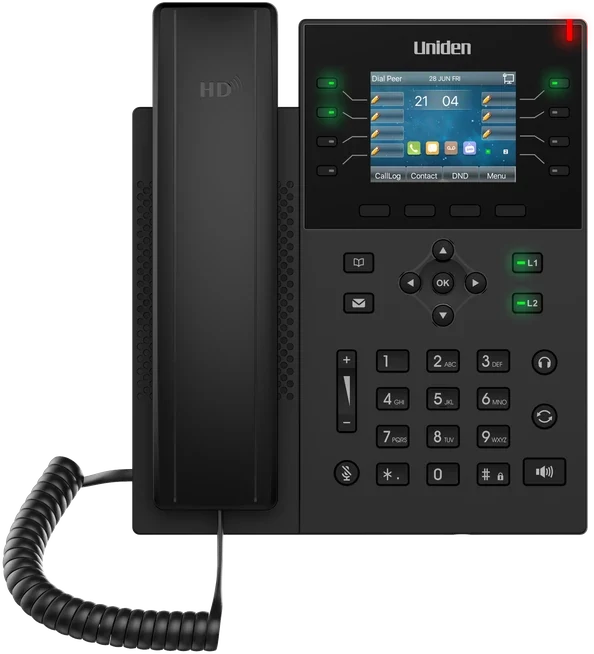
The Uniden EVOC2 is a SIP desk phone built for the Uniden Voice platform. It takes Ethernet with Power over Ethernet, so a single cable does data and power, and it auto-provisions from the Uniden Voice portal. In practice that means you create the extension in the portal, plug the handset in, and it configures itself: no SIP server address typed in by hand, no credentials read out over the phone to a staff member in another state, no visit.
Why zero-touch provisioning is the benefit that matters
Manual SIP configuration is where handset deployments go wrong. Somebody mistypes a server address, somebody else fat-fingers a password, and a job that should take four minutes becomes a support call. Auto-provisioning removes the step that fails. It also means a replacement handset for a broken one is a courier job rather than a technician job: you post the phone, the customer plugs it in, and the extension comes back exactly as it was.
Worth being clear about the boundary here: the EVOC2 is not the only handset Uniden Voice supports. Standards-compliant third-party SIP phones from the usual vendors work too, and we have written about which ones and at what support tier. The EVOC2's advantage is not exclusivity, it is that the provisioning path is ours end to end, so when it does not work there is exactly one company to call.
The Wire-Free Camera Family, 2026 Edition
The App Cam SOLO X2K line is the largest connected family in the range and the one that has grown most in the last twelve months. All of it is 2K Super HD, wire-free, weatherproof, and viewed through the My Uniden+ app. What varies is how it gets power, how it gets a network, and how much it can move.
App Cam SOLO X2K: the base camera
Wire-free 2K spotlight camera with two-way talk, solar compatible with the SPS-X panel sold separately. Available as a single, a twin pack with panels, a four pack with panels and a four pack without. The workhorse for perimeters, yards and entry points.
SOLO X2K PT Kit and PT Pro
Pan and tilt from a single mounting point: the PT Kit covers roughly 355°, and the PT Pro adds automatic motion tracking so the camera follows movement rather than watching it leave frame. One mount instead of three.
SOLO X2K 4G Plus and 4G PT Kit
Takes a nano SIM instead of Wi-Fi. The 4G Plus has a built-in solar panel, 300° tilt and a magnetic DIY mount. This is the answer for a gate, a paddock, a storage yard or a site that has no internet at all and will not have one soon.
SOLO X2K 4G Pro Kit
The top of the family: 4G, solar, pan and tilt with automatic motion tracking, siren, colour night vision, up to a 10,400mAh battery, a 32GB microSD included, OnWatch 24/7 continuous recording and Thermo Sense filtering so trees and shadows stop generating alerts.
SOLO X2K Bullet Kit
Fixed bullet form factor with a solar panel, aimed at a specific line rather than an area. Driveways, gates and single entry points where you want one thing watched properly rather than a wide field watched loosely.
Storage, both ways
Local microSD up to 256GB, plus a seven-day rolling cloud backup included free for the life of the product. Local storage survives an internet outage; cloud backup survives someone taking the camera. Having both is the point.
The specification that matters most for a business is the one people skip: Thermo Sense. A camera that generates forty alerts a day because a gum tree moves is a camera whose alerts get muted within a fortnight, and a muted camera is a recording device rather than a security system. Filtering on heat signature rather than pixel change is what keeps notifications credible, and credible notifications are the entire difference between a camera you watch and a camera you review after the fact.
The Doorbell That Covers a Trade Counter
The SOLO X2K Bell Plus is a wire-free 2K video doorbell with a fisheye lens, a separate wireless chime, two-way talk and motion activation, installed in about ten minutes with no wiring.
Domestically that is a doorbell. In a business it is something more useful: an intercom for a door nobody is standing at. The three configurations we see most often are a trade counter where staff are out the back, a rear gate for deliveries where the roller door is closed, and an after-hours entry for a clinic or a workshop where somebody needs to be identified before the door opens. In each case the value is not the recording, it is the two-way audio, being able to answer a door from wherever you actually are.
The workflow worth building
Pair the doorbell with an after-hours rule on the phone system rather than treating them as separate systems. The doorbell tells you somebody is at the gate; the phone system decides who gets told when. A visitor at 7pm on a Wednesday and a visitor at 7pm on a Sunday are different events, and the phone system already knows which day it is.
Indoor Cameras: Reception, Stockroom, Back of House
Two indoor App Cams sit alongside the outdoor family, both Wi-Fi, both on My Uniden+.
| Model | What it does | Where it goes |
|---|---|---|
| App Cam X25PT | Indoor 2K with automatic motion tracking: the camera follows movement across the room | Reception, showroom floor, stockroom aisles, anywhere a fixed camera would lose the subject |
| App Cam X24 | Indoor Wi-Fi camera with two-way talk | Back of house, plant rooms, cool rooms, server cupboards, the corner of the workshop nobody walks past |
The unglamorous business case for indoor cameras is rarely theft. It is dispute resolution: what time the delivery actually arrived, whether the pallet was damaged when it came off the truck, who was on the floor when the customer says they were ignored. Those questions come up monthly in most businesses and are answered in thirty seconds with footage or thirty minutes without it.
Vehicles: Dash Cams and What Fleets Actually Use Them For
The dash cam range is the deepest part of the connected catalogue, and it splits into families rather than models.
| Family | Models | Front / rear | Notable |
|---|---|---|---|
| Dash View | Dash View 60+, Dash View 60R, Dash View 40R, Dash View SX, Dash View SXR | Up to 5K front; 60R adds 2K rear; 40R is a three-in-one with front, rear and cabin | Wi-Fi and GPS, Sony STARVIS sensors on the SX and 60+ for low light. The 40R took a Good Design award in 2025. |
| iGO CAM | iGO CAM 90, 90R, 63R, 45R, 35 | 4K front on the 90 series, 2K or Full HD further down; R models add a rear camera | On-device LCD displays from 2″ to 3.16″, 135° capture on the 90, 64GB card included on the 63R |
The fleet-relevant point is not resolution, it is GPS and the cabin channel. GPS turns footage into evidence by stamping speed and location onto it, which is what actually settles an at-fault dispute. The three-in-one cabin channel on the 40R matters for anyone carrying passengers or valuable freight, and it is the one specification where the cheaper models genuinely cannot substitute.
Cabin-facing cameras are a consultation, not a purchase
A camera pointed at a driver records an employee at work, which brings privacy obligations and, in most workplaces, an obligation to consult before it goes in. Fit the hardware after the conversation, not before it. The businesses that get this wrong do not get in trouble for the camera, they get in trouble for the surprise.
XTRAK Smart UHF: Radios That Know Where Each Other Are
The XTRAK 50 Pro handheld and the XTRAK 80 Pro in-vehicle unit are the most genuinely novel connected products in the range, because they solve a problem that has existed on Australian work sites for forty years.
UHF radio works where mobile does not, which is precisely why it is still in every serious work vehicle in the country. What it never did was tell you where the other person was. The XTRAK Pro units pair to a smartphone over Bluetooth and share location between a handheld and an in-vehicle radio, described as an industry first when the range launched, so the conversation and the position arrive together.
Location sharing
Positional tracking and location sharing through the XTRAK app on iOS and Android, between handheld and vehicle units. On a large site or a remote job, "where are you" stops being a question.
In-app text and Selcall
The app manages selective calling contacts and additional receive channels, handles settings, and sends in-app text messages: the things that used to require a manual and a spare afternoon.
Built for noise
The 80 Pro has an anti-glare OLED display, a backlit keypad, 2W speakers, four-level voice enhancement, and Bluetooth out to the vehicle's own audio system. Designed for a cab with the windows down.
Where this intersects with the phone system is coverage honesty. A business with crews outside reliable mobile coverage needs two things: radio for on-site coordination, and a phone system that handles the calls those crews cannot take. Those are complementary purchases, not competing ones, and treating them as one decision produces a better answer than treating them as two.
The Complete Connected Range at a Glance
Everything in the current Uniden Australia range that talks to a network or an app, what it needs to work, and which platform it lives on. This is the list to check a quote against.
| Product | Network | Platform | Business use |
|---|---|---|---|
| Uniden EVOC2 desk phone | Ethernet with PoE | Uniden Voice: direct, auto-provisioned | The desk phone. Zero-touch from the portal. |
| App Cam SOLO X2K (1 / 2 / 4 packs) | Wi-Fi | My Uniden+ | Wire-free 2K perimeter and entry. Solar compatible via SPS-X. |
| SOLO X2K PT Kit | Wi-Fi + solar panel | My Uniden+ | ~355° pan and tilt from one mount. |
| SOLO X2K PT Pro | Wi-Fi + solar panel | My Uniden+ | Pan-tilt with automatic motion tracking. |
| SOLO X2K Bullet Kit | Wi-Fi + solar panel | My Uniden+ | Fixed line of sight: driveways, gates, single entries. |
| SOLO X2K 4G Plus | 4G nano SIM | My Uniden+ | Built-in solar, 300° tilt, magnetic mount. No internet needed. |
| SOLO X2K 4G PT Kit | 4G nano SIM | My Uniden+ | Pan-tilt on 4G for remote sites. |
| SOLO X2K 4G Pro Kit | 4G nano SIM + solar | My Uniden+ | OnWatch continuous recording, Thermo Sense, siren, tracking, colour night vision. |
| SOLO X2K Bell Plus | Wi-Fi | My Uniden+ | 2K video doorbell with wireless chime and two-way talk. |
| App Cam X25PT | Wi-Fi | My Uniden+ | Indoor 2K with automatic motion tracking. |
| App Cam X24 | Wi-Fi | My Uniden+ | Indoor with two-way talk. |
| Dash View 60+ / 60R / 40R / SX / SXR | Wi-Fi + GPS | Uniden dash cam app | Up to 5K, rear and cabin channels, STARVIS low-light sensors. |
| iGO CAM 90 / 90R / 63R / 45R / 35 | Wi-Fi to phone | Uniden dash cam app | 4K down to Full HD with on-device displays. |
| XTRAK 50 Pro / 80 Pro | Bluetooth to phone + GPS | XTRAK app | Smart UHF with location sharing, Selcall management, in-app text. |
| XTRAK 50 / 80 | Standalone UHF | Not app connected | 80-channel UHF, instant replay, Master Scan. |
| Digital cordless phones, marine radios, baby monitors | Standalone | Not app connected | Part of the range, not part of the connected story. |
The Subscription-Free Arithmetic
This is the section most buyers skip and it is the one with the largest number in it.
The dominant business model in consumer and small-business security cameras is a subscription. The camera is priced attractively, and the features that make it useful (cloud recording, retention beyond a few hours, person detection, sometimes the ability to review anything at all) arrive as a monthly fee per camera or per site. Over the life of the hardware, the subscription usually exceeds the purchase price, often by a multiple.
The Uniden camera range is subscription-free for the life of the product, and that includes a seven-day rolling cloud backup. Not a trial, not a promotional period, not a tier.
| Four-camera site, five years | Subscription model | Subscription-free |
|---|---|---|
| Hardware | Purchase price | Purchase price |
| Cloud recording and retention | Monthly, per camera or per site, indefinitely | Included, no fee |
| Cost of keeping the cameras a sixth year | Another twelve months of fees | Nil |
| Cost of adding a fifth camera | Hardware plus another subscription line | Hardware only |
| What happens if you stop paying | Retention and often remote viewing stop | Nothing stops |
We are not going to invent a dollar figure for a competitor's plan, because their pricing changes and yours would be wrong. Do it yourself instead, and it takes two minutes: find the monthly fee per camera on whatever you are comparing against, multiply by your camera count, multiply by sixty months. Compare that number to the difference in purchase price. In our experience the answer surprises people, and it surprises them most on multi-camera sites, because subscription pricing scales with camera count while a subscription-free range does not.
The same logic is why we publish phone system pricing rather than quoting it privately. A published rate is a number you can check at renewal. A bespoke rate is a number you cannot benchmark against anything, which feels like a win on the day you sign and is a problem two years later.
Five Benefits That Survive Scrutiny
Plenty of "one brand" marketing does not survive a hard question. These five do.
1. One number when something breaks
The most expensive part of a multi-vendor estate is not any invoice, it is the hour spent establishing whose fault a problem is. When the camera vendor blames the network and the network vendor blames the camera, the business pays for the argument. One supplier cannot hand the problem sideways.
2. One procurement path
One account, one set of terms, one purchase order process, one delivery relationship. For a business adding a site or fitting out a new vehicle, that is the difference between a morning and a fortnight.
3. One warranty channel
A brand that has sold hardware in Australia since 1966 has a warranty process that exists in Australia. That sounds obvious until you have tried to return a camera to a brand whose local presence is a web form.
4. One induction
New staff have to be taught the estate. Two apps and one consistent interface convention is an afternoon. Five apps from five vendors with five notification models is a running cost that never appears in a budget.
5. One country
Australian-owned, Australian-hosted, Australian-supported on the phone side, and a hardware brand with four decades of local distribution behind it. When the support call is in your timezone, the fault gets fixed the same day rather than the next one.
And the compounding one
All five get larger as you add sites. A second branch on the same brand is a copy of a working configuration. A second branch across five brands is the whole exercise again.
Two Things One Brand Does Not Buy You
If this article only listed benefits it would be a brochure, and you would be right to discount it. So here are the two limits, stated first rather than buried.
1. My Uniden+ and Uniden Voice are separate platforms
A camera does not appear inside the phone system, and a call does not appear inside the camera app. They share a brand, a support relationship and a country, not a database. If a supplier tells you the cameras and the phone system are one integrated pane of glass, ask them to demonstrate it, because we will not tell you that. What you get is one company accountable for both, which is worth real money, and it is not the same claim.
2. Not everything in the range is connected
Digital cordless phones, marine radios and baby monitors are good products and they are standalone. They do not have an app, they are not part of a connected estate, and no benefit in this article applies to them. Buy them because they are the right tool, not because they are the same brand.
There is also a third thing worth saying, which is not a limit so much as a caution: single-brand estates create a single point of commercial dependency. That is a real trade-off. Our answer to it is number portability, published pricing, open APIs and standards-compliant SIP hardware, the deliberate absence of lock-in mechanisms, but you should test that answer rather than accept it. Ask what happens if you leave, and get the answer before you arrive.
Four Businesses, Four Configurations
| Business | The problem | The configuration |
|---|---|---|
| Building supplies, one yard | Trade counter unattended, yard perimeter unwatched, deliveries disputed | SOLO X2K Bell Plus at the counter, four SOLO X2K with solar on the yard line, X24 indoors at the counter, EVOC2 handsets on the desks with an after-hours rule on the phone system |
| Plumbing, six vehicles, no office | Nobody answers the phone, at-fault disputes, crews out of coverage | Dash View 40R in each vehicle for front, rear and cabin, XTRAK 80 Pro in the two lead vehicles with 50 Pro handhelds, phone system on mobile apps with AI answering the calls nobody can take |
| Clinic, two rooms, after-hours access | Front door unattended, patients arriving out of hours, privacy obligations | Bell Plus at the entry, X25PT in reception, EVOC2 at the desk, and the phone system doing the privacy-sensitive work: no recording of clinical calls without consent, no messages read out in a waiting room |
| Storage yard, no internet on site | Remote site, no fixed line, no power at the fence | Two SOLO X2K 4G Pro Kits on the gate and the main run (4G SIM, solar, OnWatch continuous recording, Thermo Sense to keep the alerts honest) with calls diverting to whoever is on call |
Where to Start
Not with the catalogue. With three questions that take twenty minutes and are useful whatever you buy afterwards.
What are you paying monthly for hardware you own?
Go through the card statement, not the phone bill. Every per-camera, per-site and per-device subscription. Total it and multiply by sixty. That number is the honest cost of your current estate and almost nobody knows it.
How many apps does a new employee need?
Count the logins, not the vendors. Then ask who currently teaches them, and how long it takes. That is your training overhead, and it is recurring.
Which of your sites has no internet?
That answer determines whether you are shopping for Wi-Fi cameras or 4G ones, and it is the single decision most often got wrong. A Wi-Fi camera at a gate with no Wi-Fi is an expensive ornament.
The summary
The EVOC2 connects directly to Uniden Voice and provisions itself. The camera, doorbell, dash cam and smart UHF ranges connect to their own Uniden apps, not to the phone system, and they are subscription-free for the life of the product, which is where the money is. What one brand buys you is accountability, procurement, warranty, training and a support call in your own timezone. What it does not buy you is a single pane of glass, and anyone who tells you otherwise is selling harder than we are.
Related reading: the original connected-products walkthrough for the device-by-device detail, how EVOC2 provisioning actually works, which third-party handsets we support and at what tier, and the brand's Australian history for where the 1966 figure comes from.