

















What Waiting Is Costing You
Hardly anyone switches phone systems because they enjoy it. They switch because the old setup has started to cost them work. The trouble is that the cost is easy to miss. A call that rings out does not appear on any report. The customer simply rings the next business on Google, and you never hear about it.
Put numbers on it and the picture changes quickly:
62%
of calls to small businesses are never answered
85%
of people sent to voicemail do not try again
$73k+
yearly all-in cost of a full-time receptionist
24/7
is when some of your competitors already pick up
Every one of those unanswered calls was a quote, a booking or a repeat customer. So the useful question is not "can we afford to change?" but "how many more months of missed calls can we afford?" If you recognise your business in the table below, the answer is probably not many.
| What you notice day to day | What it is really costing | What changes after the switch |
|---|---|---|
| The phone rings out at lunch, after 5pm and on weekends | New enquiries going to whoever answers first | An AI agent picks up, takes details and books jobs around the clock |
| The phone bill grows and nobody can explain why | Line rental, call charges and per-handset fees creeping up each quarter | One clear monthly price per user, with no line rental |
| Anyone away from the office misses business calls | Calls bounced back to the office, or mobiles handed out to customers | The business number rings on their app, and personal numbers stay private |
| An old PBX and copper lines nobody wants to support | A failure waiting for the worst possible day | Nothing on site to break, and the system runs in the cloud |
| Every call has to be answered by a person | Staff pulled off paid work to answer simple questions | Routing by what the caller needs, with AI covering overflow |
| No idea how many calls come in or get missed | Decisions about staffing and marketing made on gut feel | Call reports and analytics showing volumes, misses and drop-offs |
Your Jobs vs Our Jobs
The picture most owners have of a phone change goes something like this: a lost weekend under the desk with cables, a manual nobody can follow, and a nervous Monday wondering whether the phones will ring. That is not how a switch to Uniden Voice works, mainly because almost none of the work is yours.
Here is the honest split. On your side of the table:
- Book a demo and spend half an hour telling us how your calls work today.
- Sign a porting authority so we can request your number from your current carrier.
- Make a handful of decisions: who answers what, what the AI agent should do, and which devices your team wants.
- Pick a quiet time for the cutover, then approve go-live once you have seen the tests.
On our side, your dedicated Australian account manager maps your current setup, lodges and manages the port, builds your call flows, configures and trains the AI agent, sets up every app and handset, links your business software, runs the testing, trains your staff and then stays on as your contact after go-live. There is no do-it-yourself portal and no offshore help desk.
That arrangement is possible because Uniden Voice is 100% Australian built, hosted and supported. The person running your switch is local, you can ring them, and there is 24-hour support behind them. Uniden has been a trusted name in Australian homes and offices since 1966, and the same expectation of gear that simply works now applies to the cloud phone system.
"I can't thank the team at Uniden Voice Over Cloud enough for our upgraded phone system. They managed to get my number back online after my previous provider disconnected my service, in a matter of 30 minutes we were back to business. The whole setup process was fast and exactly what we needed."Lukey Luke, Owner, Benzina Garage
Most switches are calmer than that one, because there is no emergency to fix. The rest of this guide follows a planned switch in the order things actually happen.
Before You Sign: The Demo and the Questions We Ask
The first conversation is free and commits you to nothing. You see the real product, not slides: AI call agents speaking with Australian voices, routing based on what callers ask for, call transcription and the reporting dashboard. Then your account manager asks questions so the quote fits your business rather than a template:
- Which numbers matter? Every number you want to keep, and who supplies them now.
- Who picks up the phone? How many people take calls, and whether they sit in an office, work from home or spend the day driving.
- When does it get busy? Peak times, after-hours calls and the calls you suspect you are losing.
- What software do you live in? Xero, MYOB, Salesforce, HubSpot, Google Workspace, Zoho or ServiceM8, so calls can be logged there automatically.
You leave with a written quote on simple per-user pricing, with no minimum number of users, and a plan for your switch written in plain English.
LOOKING IS FREE
Plenty of owners book a demo just to understand what an AI phone system can do before deciding anything. That is fine by us. If you want the background first, our 2026 explainer on AI phone systems for Australian businesses covers how they work and what to compare.
Moving Your Number Across
"Our number is on the van, the website, the invoices and every Google listing. We cannot lose it." We hear that in nearly every first conversation, and the answer is always the same: you will not lose it. Keeping your existing number is how a normal switch works.
Taking a number from one provider to another is called porting. In Australia it is a regulated, routine process that carriers handle every day. It runs like this:
- One form from you. You sign a porting authority, which lets us ask your current provider to release the number. That is the only paperwork on your desk.
- We deal with the old carrier. We lodge the request, agree the timing and handle any back and forth. You do not need to ring them or cancel anything in the meantime.
- Your old service keeps working. Calls keep arriving on your current phones until the agreed cutover, and we book that for a quiet time that suits you.
- The changeover takes moments. Once the port completes, the same number simply rings on Uniden Voice. Callers notice nothing.
Ordinary local numbers port across, and so do 1300 and 1800 numbers. You can also add a new 1300 or 1800 number as part of the switch. Porting is free for a limited time.
Choosing How Much the AI Handles
This is the part of the switch that changes how your business runs, so it is worth a little thought. Your account manager sits down with you and designs what happens on every call, then builds it.
Start with the path a call takes
A call flow is the route a call follows from the moment it connects. Typical choices include:
- A welcome message and options menu, or none at all. Plenty of owners would rather a caller just hears it ringing.
- Intent-based routing: the system listens for what the caller wants, for example a quote or an invoice query, and puts them through to whoever deals with that.
- Groups of phones that ring together first, with the call moving on to mobiles and finally to the AI agent or voicemail if nobody grabs it.
- After-hours and public holiday rules, so calls outside opening times are captured rather than lost.
Then decide the AI agent's job
AI comes as standard in the plan, not as a costly extra. Your Australian-voice AI call agent can answer at any hour, take after-hours enquiries, book appointments, transcribe calls, write details into your CRM and pick up on how a caller is feeling. Most owners choose one of three roles for it:
Overflow cover
Your team answers first. The AI agent only steps in when everyone is busy, so nobody hits a ringout during the rush.
After-hours only
Your people handle business hours. The AI agent covers nights, weekends and holidays, booking and taking details.
Front of house
The AI agent greets every caller, deals with routine questions and passes the rest to the right person.
You can change the role later as you get comfortable. If you are weighing AI answering against hiring someone, our cost comparison between an AI agent and a paid receptionist runs the numbers, and the Uniden AI Agents page shows what an agent can do on a call.
Phones, Apps and Headsets
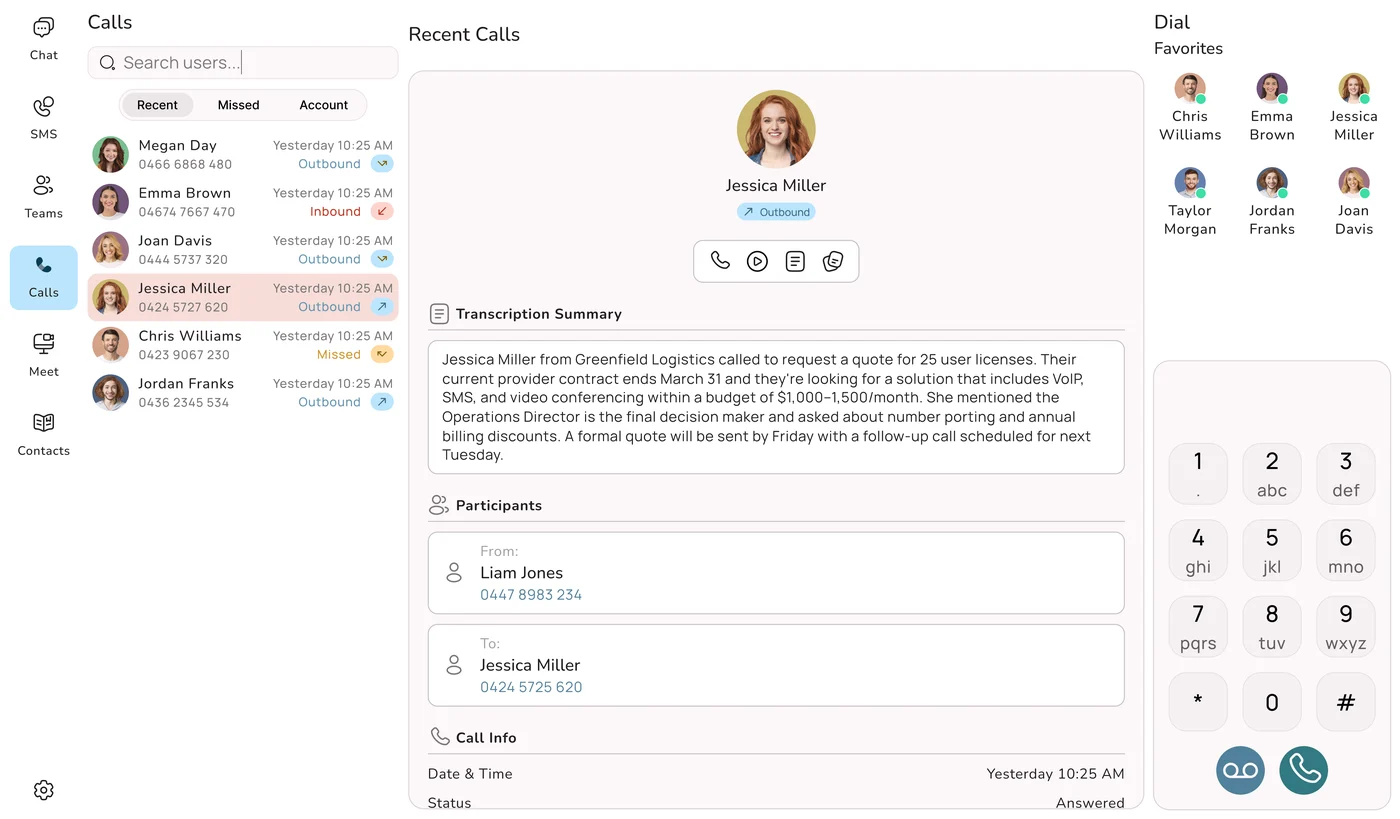
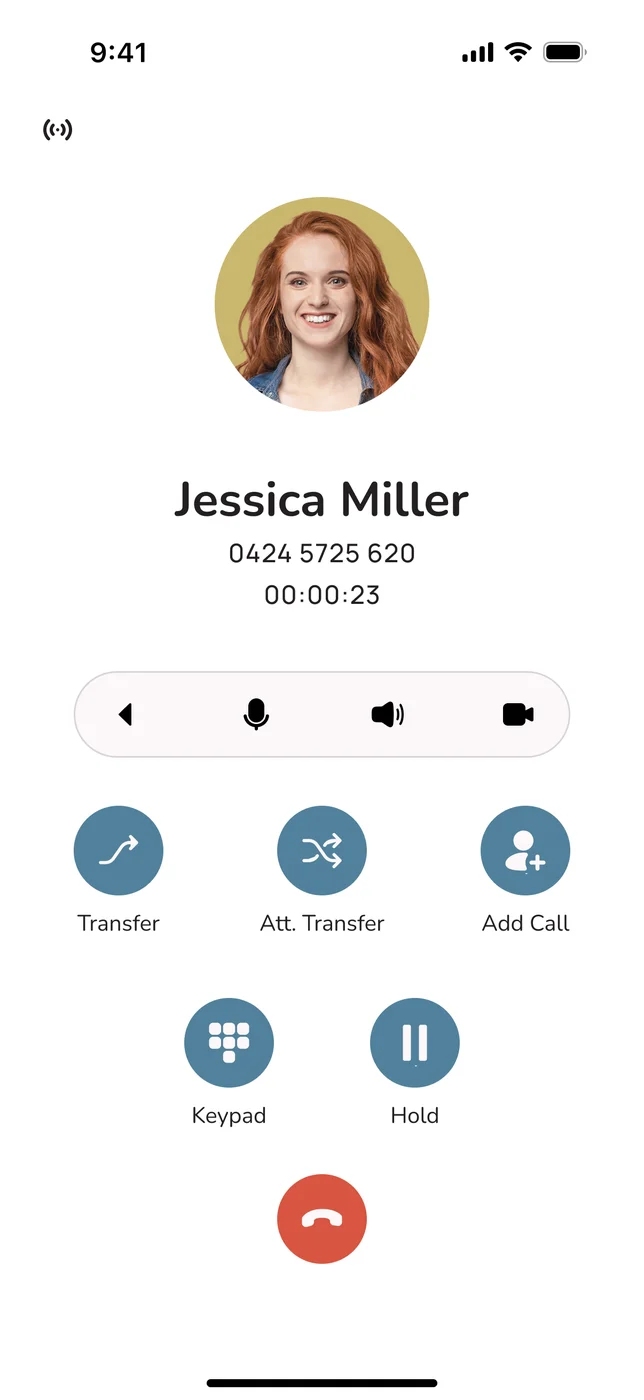
Uniden Voice runs in the cloud, so your team can take calls on whatever suits the way they work. Nobody needs to run cable or find space for an exchange in a cupboard. Your account manager sets up each device and shows staff how to use it.
On the computer
Full apps for PC and Mac, so anyone at a desk can make and answer business calls from their laptop with a headset.
On the mobile
iOS and Android apps put the business line on a smartphone, and the caller never sees the staff member's personal number.
On the desk
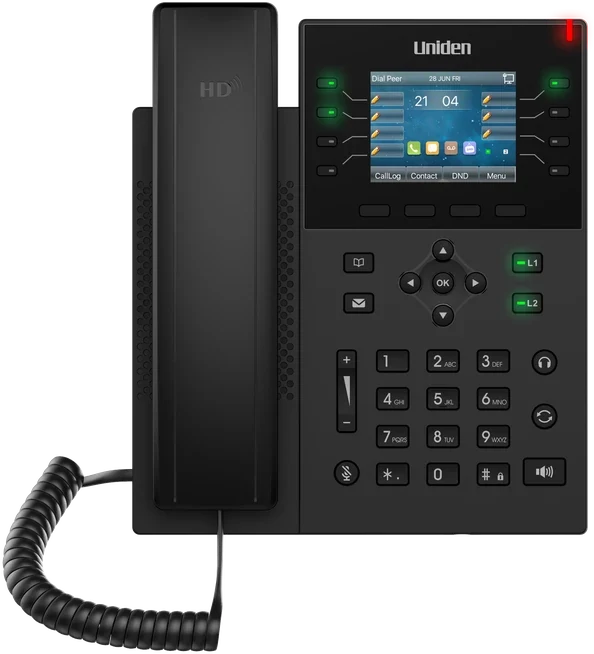
The optional Uniden EVOC2 HD desk phone with Bluetooth, a one-time $249, for staff who want a proper Uniden handset in front of them.
There is no cut-down version on any of these: every app has the full feature set. If you want the hardware to arrive ready to plug in, ask about the Uniden phone in a box option. And if your calls need to reach other software, open APIs and ready-made connectors for the main Australian business platforms keep contacts and call records in step.
Rehearsal and Go-Live Day
Before your number moves, the whole new system is built and tested while your old service keeps working. Think of it as a dress rehearsal with nothing at stake. Your account manager checks:
- Calls in and out on every type of device your team will use.
- Every routing rule, group and out-of-hours setting against real situations, such as a Saturday call or a lunchtime rush.
- The AI agent's greeting, questions and handovers, until it sounds the way you want.
- Your integrations, so call records land in the right place from the first day.
Staff get a short walk-through on their apps or handsets during this stage too. Only when you are happy is the cutover booked, usually early in the morning or after close. Because the number keeps ringing on your old service right up to that moment, there is no downtime. One call arrives on the old system, the next on Uniden Voice, and customers cannot tell the difference.
Going live is not the end of the relationship. Your account manager remains your single contact afterwards, with 24-hour local support behind them, ready to adjust a call flow or answer a question whenever you need.
The Switch on a Calendar
Most businesses are completely moved over within one to two weeks, and simpler setups often finish sooner. The stage that varies most is the number port, which partly depends on your current provider. Your account manager keeps that moving so you do not have to. Here is how the work is shared across a typical switch:
| When | Your part | Your account manager's part |
|---|---|---|
| Day 1 | Join the demo and discovery call | Shows the system, then sends a quote and plan the same day |
| Days 1 to 2 | Sign up and sign the porting authority | Lodges the port and starts the build |
| Days 2 to 5 | Approve call flows and the AI agent's role | Builds call flows and the AI agent, and sets up apps and devices |
| Days 3 to 7 | Watch the tests and attend a short training session | Tests everything beside your current service and trains staff |
| Cutover | Choose a quiet time and approve go-live | Completes the port with no downtime, often within 1 to 2 weeks in total |
If you are in a hurry, for example because your current provider has left you stranded, the team can move much faster. The Benzina Garage quote above is a real case: a disconnected number back online and the business running again in 30 minutes.
Questions From Sceptical Owners
Fear of disruption keeps more businesses on old phone systems than any actual problem. So here are the doubts we hear most, with straight answers.
"WHAT IF THE PHONES GO DEAD OR WE LOSE THE NUMBER?"
The whole process is designed so this cannot happen. Your number is ported in the usual way, while the current line carries on taking calls right up to a scheduled cutover that is over in seconds. At no point is there a gap where the phones stop. After switching, the most common comment we get is surprise at how little anyone noticed.
"Am I locking myself into a contract?" Pricing is a simple rate per user, with no minimum number of users. Your account manager can also help you plan the end of your old service, so there is no stretch of paying twice and no surprise from an old contract term.
"What if our internet or the NBN drops out?" Fair question. Your call flows sit in the cloud, not in your building, so an outage at your office does not stop calls arriving. The platform simply sends them somewhere else: to the apps on your team's mobiles, to the AI agent, or through the rules you set for after hours. Your office being offline does not mean your business is.
"My staff are not technical." They do not need to be. The apps are laid out like the phones people already use, and your account manager sets them up and trains everyone. Within a day or so, most teams stop thinking about it. If someone has told you switching is a nightmare, read why Uniden Voice has become Australia's most popular business phone.
WHO CARRIES THE RISK
These concerns are the reason the switch is run by your account manager, with every part tested before cutover. The risk sits with us, not you: we build it, prove it works, and only then go live. And because Uniden Voice is 100% Australian, when you ring with a question, a local person who knows your account picks up.
The Price of Switching, Line by Line
Moving across costs less than most owners assume, and several of the usual charges do not apply at all.
WHAT YOU PAY, AND WHAT YOU DO NOT
The demo: free. See the system working and get your quote without paying anything.
Installation: free. Your account manager does the full setup, with no setup or onboarding charge.
Number porting: free for a limited time. Bring your current number across at no cost while the offer runs.
Ongoing: one rate per user. A clear monthly price for each user, AI included, no minimum users, and no line rental or hidden fees.
Extras are optional and priced up front, so you only pay for what you choose:
| Optional extra | Price | Who usually adds it |
|---|---|---|
| Dedicated 1300 or 1800 number | $19.90 a month | Businesses taking calls from across Australia |
| Additional numbers | $3.90 a month | Teams wanting separate lines for departments or campaigns |
| Unlimited call pack | $30 per user a month | Staff who spend much of the day on outbound calls |
| Cloud call recording | From $10 a month (10 hours) | Businesses that train staff or keep records of calls |
| Uniden EVOC2 desk handset | $249 one-time | Anyone who prefers a physical phone on the desk |
Full details are on the pricing page.
Five Minutes of Prep
JOT THESE DOWN BEFORE YOUR DEMO
You do not need to prepare much, but these notes make the first call quicker:
- Every number you want to keep, and the name of the provider that supplies it.
- How many people answer calls, and whether they work in the office, at home or on the road.
- When your busy periods are, and what happens to calls after hours now.
- The software you would like calls logged into, such as Xero, MYOB, Salesforce, HubSpot, Google Workspace, Zoho or ServiceM8.
- Whether your team wants EVOC2 handsets, apps only, or a mix of both.
- A quiet time of day or week that would suit the cutover.
Bring that list to the demo and your account manager handles the rest.