


















What Is Different About Christmas 2026
Every year the same pattern catches someone out. December is busy and the account looks healthy. Then the pre-Christmas pay run goes out, customers shut for two or three weeks, invoices sent on 18 December are paid in late January, and the business reopens with less cash than wages. business.gov.au puts the fix plainly: if your business has known quiet periods, plan to have enough cash to get through them.
This year five things make that plan matter more.
| Change | Date | What it does to your cash |
|---|---|---|
| Payday Super | From 1 July 2026 | Super must reach the fund within 7 business days after each payday. Under the old quarterly rules, super on October to December wages was not due until 28 January. That money now leaves in December. |
| Interest on ATO debt not deductible | GIC incurred from 1 July 2025 | Carrying a tax debt costs more after tax than it used to. The general interest charge is 11.51% a year for October to December 2026, compounding daily. |
| ATO dropping credit cards | Announced 1 October 2026, cards accepted until 30 June 2027 | Paying the BAS on a card and clearing the card later still works this Christmas, but it is a method with an end date. |
| Card surcharges ended | 1 October 2026 | Card fees now come out of your margin unless your prices allow for them. |
| Cash rate 4.60% | Raised 29 September 2026 | Overdrafts, business loans and variable rate equipment finance cost more to lean on over the break. |
Payday Super
The ATO's Payday Super guidance says that from 1 July 2026 super guarantee contributions must be received by employees' funds within 7 business days after you pay them. The rate is still 12%, now calculated on qualifying earnings, and the Small Business Superannuation Clearing House has closed. The Fair Work Ombudsman notes the main exception: a new employee's first contribution has 20 business days. This is the first Christmas under the new rules, and the quiet loss is the float. If your December wages are $50,000, the $6,000 of super on them used to sit in your account until late January. This year it goes out with each pay run (figures illustrative).
The general interest charge
The ATO confirmed in its June 2025 reminder that any general interest charge incurred on and after 1 July 2025 is no longer tax deductible, even when the debt belongs to an earlier year. The law on asking the ATO to remit interest has not changed. The ATO's published rate for October to December 2026 is 11.51% a year, or 0.03153425% a day. On an illustrative $20,000 debt that is about $6.31 a day, and about $576 over 90 days if the rate stayed where it is.
Paying the ATO by credit card
On 1 October 2026 the ATO announced it would stop accepting credit cards after 30 November 2026, citing the Reserve Bank's surcharging review. After small business pushback, the government announced on 9 October that it would fund the ATO to keep accepting credit cards until 30 June 2027. After that date, the release says, the ATO will still accept credit cards through third parties, alongside debit card and bank transfer. Around five per cent of small businesses paid by credit card in 2024-25. If that includes you, this Christmas is unaffected, but next year's plan needs another method.
Surcharges and the cash rate
The Reserve Bank's review conclusions ended surcharging on debit and credit cards from 1 October 2026. If you have not yet adjusted, our card surcharge ban checklist covers it by channel. On rates, the RBA raised the cash rate to 4.60% on 29 September, and its next decision follows the 2 to 3 November meeting. We covered what that means for fixed costs in the RBA rate rise and your business costs, so we will not repeat it here.
Build a 13-Week Cash Flow Forecast
A profit and loss report says whether you made money. A cash flow forecast says whether you will have money on a given Monday. For Christmas, the useful length is 13 weeks: start on Monday 26 October and you finish in the week of 18 January, which takes in the BAS, every December pay run, the shutdown and the slow return. business.gov.au has a free cash flow template you can use, or a spreadsheet with a column per week does the job.
- Start with the real bank balance on Monday morning, not the figure in your accounting software if bank feeds are behind.
- Cash in, by week: list every unpaid invoice and the week you honestly expect it, based on how that customer has paid before. Then add expected sales, lower for the weeks you or your customers are closed.
- Cash out, by week: wages and the super that now goes with them, rent, loan repayments, supplier accounts, BAS and PAYG withholding, insurance, and the recurring debits that come out whether you are open or not.
- Mark the floor: the lowest balance you are comfortable with. One week of wages is a common starting point.
- Find the low point and the week it falls in. That week, not the total, is what you are planning for.
- Update it every Monday. Replace estimates with what actually happened and roll it forward a week.
Note the BAS dates
The ATO's due dates put the July to September quarterly BAS on 28 October, with up to two extra weeks for some online lodgers. The October to December BAS is due 28 February, and it does not get a further online extension because that date already includes one. Monthly lodgers pay November's BAS on 21 December.
A Worked Example (Illustrative)
This is a made-up six-person landscaping business, used only to show how the forecast works. It starts with $24,000 in the bank, pays $10,500 a week in wages and super, pays its quarterly BAS of $9,800 on 28 October, and closes from Christmas until 4 January, with a slow fortnight either side.
| Week starting | Cash in | Cash out | Closing balance | What is happening |
|---|---|---|---|---|
| 26 Oct | $14,000 | $20,300 | $17,700 | Wages plus the quarterly BAS |
| 2 Nov | $15,000 | $14,700 | $18,000 | Supplier account |
| 9 Nov | $16,000 | $15,100 | $18,900 | Rent and monthly debits |
| 16 Nov | $15,500 | $16,500 | $17,900 | Supplier account |
| 23 Nov | $17,000 | $12,500 | $22,400 | Vehicle costs |
| 30 Nov | $16,000 | $15,100 | $23,300 | Rent and monthly debits |
| 7 Dec | $18,000 | $18,000 | $23,300 | Stock order for January jobs |
| 14 Dec | $15,000 | $12,500 | $25,800 | Busiest week, looks healthy |
| 21 Dec | $9,000 | $21,000 | $13,800 | Last pay run, leave paid before the break |
| 28 Dec | $1,500 | $4,600 | $10,700 | Closed, rent still due |
| 4 Jan | $3,000 | $2,000 | $11,700 | Customers still away |
| 11 Jan | $9,000 | $14,500 | $6,200 | Back at work, invoices not yet paid |
| 18 Jan | $12,000 | $10,500 | $7,700 | Recovering |
The best week is 14 December. The worst is 11 January, at $6,200, well under the floor of one week's wages. Now apply two changes from the playbook below. The owner calls the customers behind $9,000 of overdue invoices and collects it across early November, and moves the $7,500 stock order onto 60-day supplier terms so it falls due in February. The low point rises from $6,200 to $22,700. Nothing about the business changed except timing.
Get Paid for Work You Have Already Done
Money customers already owe you is the fastest cash there is. business.gov.au's guide on what to do when you haven't been paid starts in the same place we would: check what the contract says, then make contact, because a missed payment is often an oversight.
Pick up the phone
A third reminder email lands in the same folder as the first two. A call gets you an answer: a date, a reason, an invoice query nobody raised, or the name of whoever approves payments. Ring the oldest five invoices first, from your business number so the customer sees who it is, and ask for a specific payment date rather than "as soon as possible". If they cannot pay in full, agree an amount now and the rest on a date.
Follow up with a text
Straight after the call, send an SMS from the same business number that confirms the amount, the date you agreed and how to pay. It gets read, and it gives you both a written record. Keep it factual and polite: "Hi Sam, thanks for your time today. As discussed, invoice 1043 for $2,860 will be paid by Friday 6 November. Payment details are on the invoice, or reply here with any questions." Our guide to business SMS from your phone system covers setting it up.
Invoice on completion, not month end
If you batch invoices at the end of the month, a job finished on 3 December is invoiced on 31 December and paid in February. Invoicing the day the job is done moves that cash weeks earlier for no cost. business.gov.au also suggests accounting software to send invoices sooner and automatically.
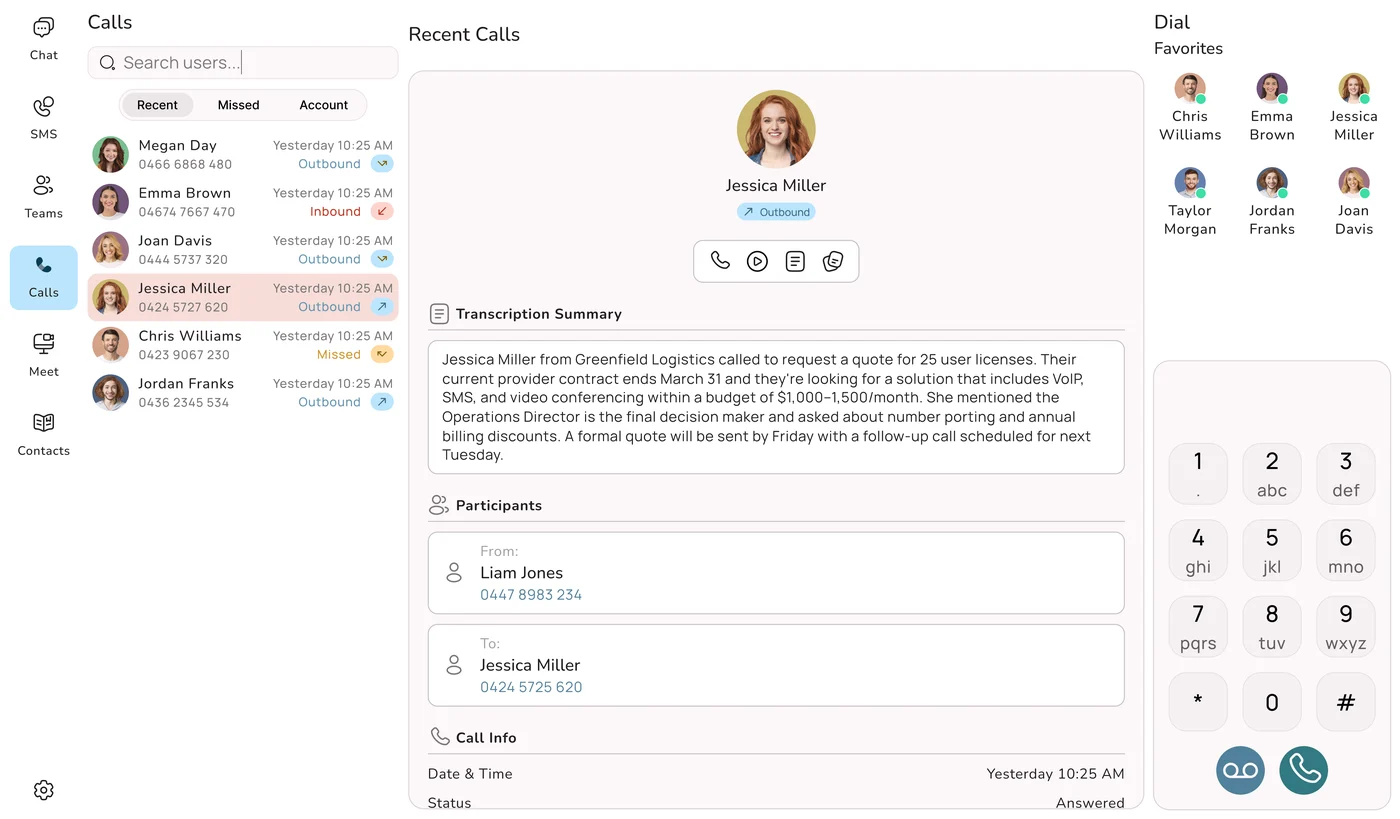
Where Uniden Voice helps. Calls and texts go out from your business number on the mobile and desktop apps, so a reminder made from a job site still shows your business name, not a personal mobile. Calls, chat, SMS and AI call summaries sit in one window, so whoever rings the customer next can see what was promised last time. Fewer days between invoice and money.
Chasing individual consumers rather than businesses? Read the ACCC and ASIC debt collection guideline before you step up calls or texts.
Payment Terms for December Work
business.gov.au's page on payment terms describes them as the rules you set for how and when customers pay, forming part of the contract. Christmas is a reasonable time to tighten them, as long as you tell customers before the work starts, not on the invoice.
- Deposits on December jobs and special orders, so materials are paid for before the break.
- Shorter terms for work finished in December, such as 7 days instead of 30, stated on the quote.
- Progress claims on longer jobs rather than one invoice at the end.
- A clear early payment discount, if your margin allows it, which business.gov.au lists among ways to encourage early payment.
Do the arithmetic on any discount first. With surcharges gone, card fees already come off your margin.
If the ATO Bill Is the Problem
The worst outcome is a BAS that is neither lodged nor paid. Lodge on time even if you cannot pay in full, then deal with the payment. The ATO's payment plan guidance says that if you owe $200,000 or less you may be able to set up a plan yourself through Online services for business, under Accounts and payments. Income tax and activity statement debts need separate plans, and you need to phone the ATO if you owe more, if online set up fails, or if you need longer than two years.
A payment plan is not interest free
The ATO's payment plans page is clear that debts on a plan keep accruing GIC, compounding daily, and that you must also pay new tax debts on time or the plan can default. Keep the plan as short as your forecast allows. The ATO itself suggests talking to your tax professional about whether other finance would cost less, and about the tax treatment if you take it.
If you currently pay the ATO by credit card, nothing changes before 30 June 2027. Use the time to set up a direct debit or bank transfer, and if a payment plan is linked to a card, update it before then.
Recurring Costs: Subscriptions, Phone and Internet
Cutting costs frees cash more slowly than collecting it, but it repeats every month. List every recurring debit on the last three bank statements. Look for subscriptions nobody uses, software seats for people who have left, and a telco bill that has crept up since it was signed.
For phone and internet in particular, two of our guides do the work: the business phone system cost calculator builds your real monthly figure line by line, and bundling your business phone and nbn explains when one provider for both saves money and when it does not. For comparison, Uniden Voice business phone plans start from $84.90 a month including three users on a 36-month term, with free setup and number porting, and we also offer nbn plans. If your current bill is higher for the same team, it is worth a quote. If it is not, keep what you have.
Stock and Supplier Terms
business.gov.au makes the point simply: the more unsold stock you have, the less money you have. Before the December order, check last year's leftovers, order for the January you expect rather than the one you hope for, and ask suppliers what terms they offer. Some will extend terms over the break for a regular customer who asks early. If you are going to pay a supplier late, ring them before the due date and agree a new one. A supplier who hears from you first is usually more flexible than one who finds out from their aged debtors report.
The Order to Do It In
| When | Do this |
|---|---|
| This week | Build the 13-week forecast. Ring the five oldest unpaid invoices and confirm each by text. |
| By 28 October | Lodge the quarterly BAS. If you cannot pay in full, set up a short ATO payment plan. |
| Early November | Change December quotes to deposits and shorter terms. Switch to invoicing on completion. |
| Mid November | Go through three months of recurring debits. Ask suppliers about terms before the Christmas order. |
| Every Monday | Update the forecast with what actually happened. |
| Before you close | Set your phones for the shutdown so January enquiries are not lost. Our Christmas shutdown phone checklist has the steps. |
General information, not financial advice
This article explains public rules and general practice. It is not financial, tax or legal advice and does not account for your circumstances. Check the current position at ato.gov.au and business.gov.au, and talk to your accountant or registered tax agent before acting.
Want the platform first? See what a Uniden Voice business phone system includes.