

Business phone system
- Business phone systemA complete cloud phone system, set up for you
- Features50+ features: IVR, queues, recording, desktop and mobile apps
- Call flowsDecide exactly how every call is answered and routed
- AI Agents Built inAnswer, book and follow up on calls, day or night
- Time to upgradeStill on an old PBX? Here is what you are missing
Apps and hardware
- Desktop app Live demoCalls, chat, SMS and AI summaries in one window
- Mobile app Live demoYour business number on your iPhone or Android
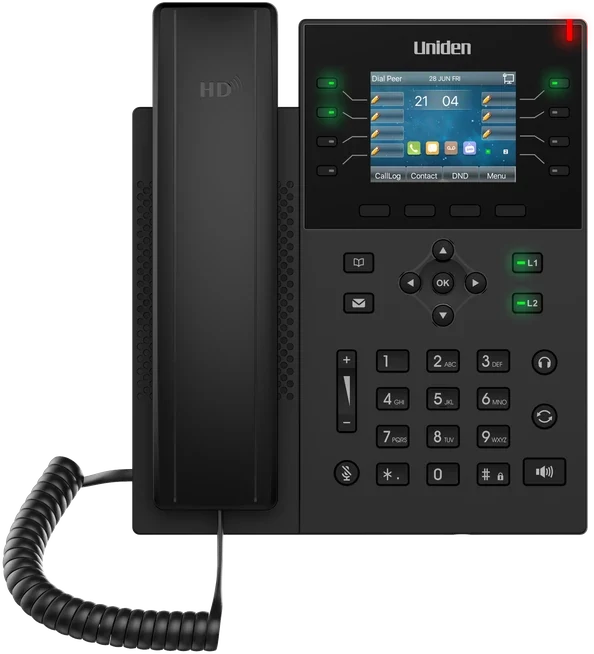
- Uniden desk phonesThe EVOC2 and a full range of office, DECT and conference phones
- Business NBNNBN set up alongside your phones, on one bill
- Why our internetBuilt for voice, so calls stay clear when the line is busy
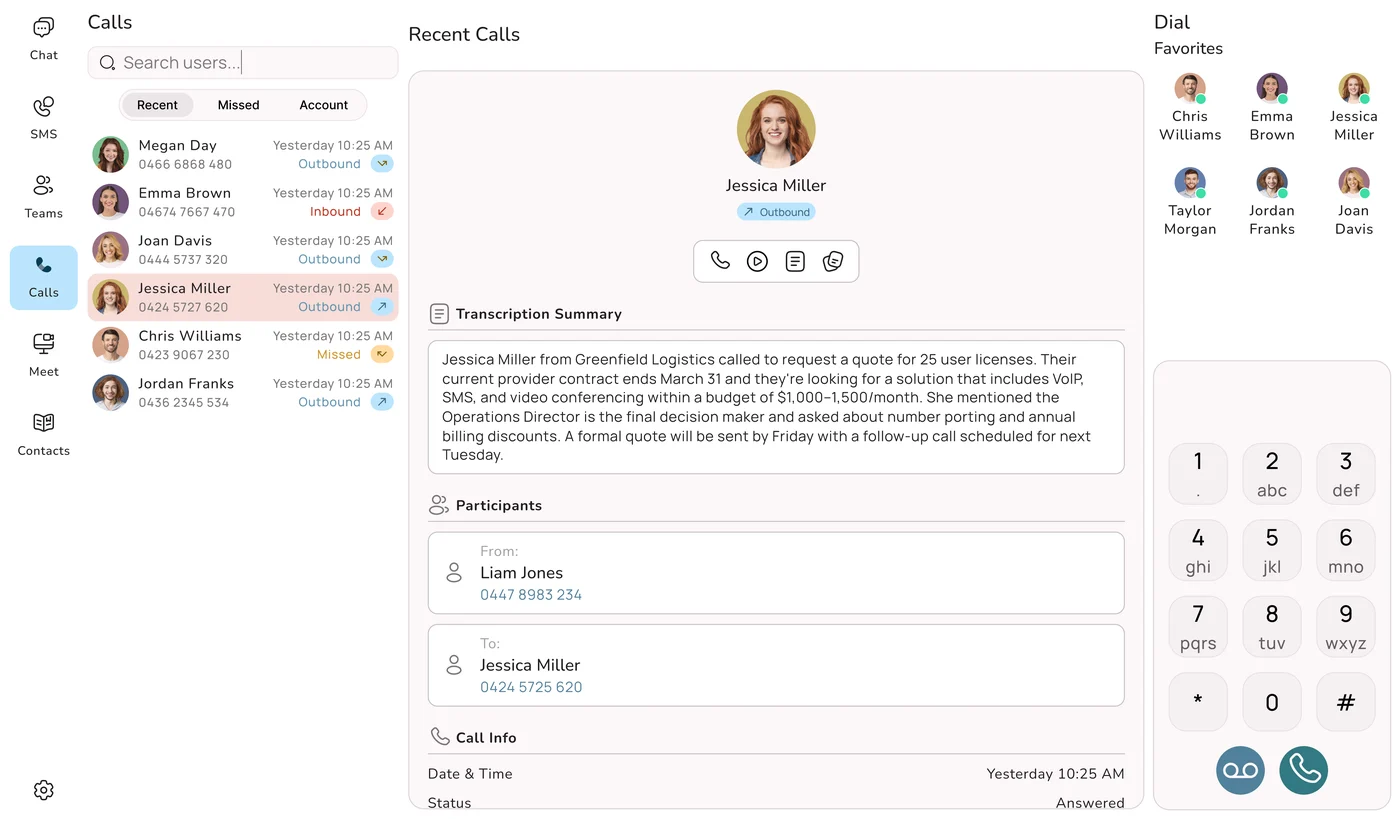
New Try it liveTake the Uniden Voice apps for a spin, right here
Click through working demos of the desktop and mobile apps: calls with AI summaries, team chat, SMS and more. No download, no sign up.
Desktop app demoMobile app demoDesigned, built, hosted and supported in Australia. Uniden desk phones, cloud apps and AI in one system.Book a demoAll features
AI on your phone line
Uniden Voice vs AI receptionists
See every comparisonAI AgentsEvery call answered, day or night
It answers on your own numbers, books the job, sends an SMS and warm transfers to your team when a person is needed.
Meet your AI agentBuilt into your phone system, not bolted on. No second number, no call forwarding.Book a demo
Professional services
Trades, retail and hospitality
Browse all industries Case study · Optical Solutions AustraliaFive branches, five phone systems, now one.5 sites1 systemRead the story
 Case study · Coco's Wealth of HealthWhen every enquiry and phone order matters.Maroubra organic health-food storeRead the story
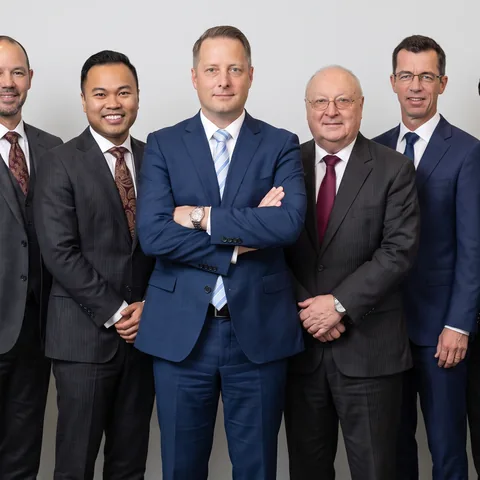 Case study · Shuriken ConsultingFour Sydney offices on one phone system.4 offices1 systemRead the story
 Case study · Carlingford Dental SurgeryEvery call rings the whole team.Dental Carlingford, NSWRead the story
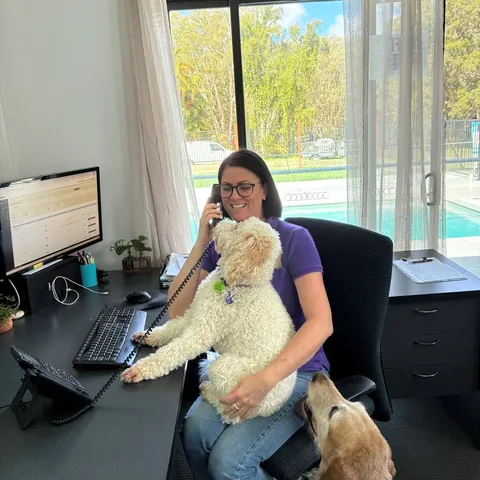 Case study · PTSD Dogs AustraliaA direct line for veterans, answered from anywhere.Charity Sunshine Coast, QLDRead the story
 Case study · Imperial Realtor GroupSales calls to sales, rentals to property management.Real estate Mango Hill, QLDRead the story
 Case study · Good 2 Eat CateringA catering team on the move, on one number.Catering and events Sunshine Coast, QLDRead the story
 Case study · ManolutionsOne number for the firm, a direct line to Paul.Executive advisory Works across time zonesRead the story




Our customersFrom one-person shops to national brands
See how businesses like yours run their phones on Uniden Voice.
Find your industryWorking on your own? A real business number and NBN for sole traders, no lock-in.Sole tradersStartups
Phone plansBusiness phone planfrom$84.90/month3 users included on a 36-month term. Every feature, one simple per-user rate.Free setup and free number portingDesktop and mobile apps includedAI Agents built inSee phone plans![Uniden Voice mobile app on a call]()
![A small team working together at a desk]()
Internet, hardware and more

Bundle and savePhones and NBN from one Aussie team
One provider to call when something needs fixing. No finger pointing.
See NBN plansWe guarantee to beat any competitor's quote. Keep your existing numbers when you move across.Sign up online1300 881 662
Learn and get set up
The library at a glanceBrowse all
176business
guides398kreads
so far
guides398kreads
so far
Guides by topic
- Phone systems66
- AI24
- Industries18
- Costs12
- NBN8
- Security7
- News5
- Other guides36

Need a hand? Our support team is based in Australia.Contact support
Call us on 1300 881 662 or send a message and the team will get back to you.Send a message
Industries / Mining
Uniden Voice for Mining
Sites, camps and contractors in four states, on one switchboard.
Resources operations run across enormous distances with rotating crews, layered contractors and communications that have to work in places nothing else does. The phone system is either infrastructure or it is a liability.
24/7 by definitionGenuine Australian voicesKeep every numberSites, camps and head office
Every shift change
Your operationMon 5:40am
Coordinator on a mobilisation callOne person, one call, a queue behind it.Engaged
Contractor confirming crew mobilisationFlights and rosters depend on it.12s26s41s56sMissed
Supplier about a critical partEquipment down until it arrives.06s14s22s31sMissed
One crew mobilised. One crew delayed, one machine still down.
The bit nobody counts
Downtime is measured in thousands per hour, and it often starts with a phone call
In resources the cost of a communication failure is not a lost sale, it is idle equipment, delayed mobilisation and rosters that no longer line up with flights.
1Equipment downtime dominates everything. A critical part call that does not connect can leave a machine idle for a shift, which is not a small number.
2Mobilisation is a chain of dependencies. Crews, flights, camps and inductions all depend on decisions confirmed by phone, often at odd hours.
3Rosters mean the right person changes constantly. Two weeks on, one week off, across multiple sites. A static phone directory is wrong most of the time.
UNIDEN VOICE · DOWNTIME LEDGER
Illustrative only. Put your own numbers in.
Inbound calls per week1,400
Reached the right person first time890
Misrouted or rang out510
Share of those who were
operationally criticalx 0.12
Operationally critical calls that did not connect61
Cost per hour of delay$1,100
AT RISK PER WEEK$67,100
ACROSS A YEARExtremely significant
Uniden Voice, per weeka fraction of that
Change the two highlighted lines to your own figures.
The arithmetic is the point, not our example.
That assumes one hour of delay per failed critical call, which is conservative.
The arithmetic is the point, not our example.
That assumes one hour of delay per failed critical call, which is conservative.
Six things every operation says out loud
You have said at least four of these this month
These are not phone problems. They are operational continuity problems that arrive down a phone line.
01
Rosters make directories wrong
Who to call for a given site changes every rotation. A printed list or a static extension map is out of date immediately.
Roster aware routing, so calls follow who is actually on shift.
02
Coverage is genuinely difficult
Sites, camps and haul roads have coverage that ranges from good to nonexistent.
Cloud answering plus apps over any data connection, including satellite.
03
Contractors multiply the complexity
Layers of contractors and subcontractors, each with their own crews and their own urgency.
Separate queues per contractor stream, with priority for anything operational.
04
Critical part calls cannot wait
A supplier with the part that returns a machine to service is the most valuable call of the day.
Priority routing that jumps every other queue.
05
Shift changes create call storms
Twice a day, everybody needs to reach somebody, and switchboard becomes a bottleneck.
Unlimited simultaneous answering, so shift change stops queueing.
06
Audit trails matter here more than anywhere
Safety, compliance and contractual disputes all require knowing exactly who was told what and when.
Every call recorded, transcribed and logged, onshore.
Watch one of them get handled
4:10am. Shift change. The critical part call connects.
This is the call that used to sit in a queue. Here it is being answered by a Uniden Voice AI phone agent, in an Australian accent, from what you told it about your operation.
It sounds like it is from here. Genuine Australian voices, which matters to crews and contractors.
It knows your sites and rosters. Which site, which crew, who is on shift and who is on their week off.
It prioritises operational calls. A machine down call jumps every queue, by design.
It logs everything onshore. Which matters for safety, compliance and contract disputes.
Uniden Voice AI Agent Live on line 100:44
AgentGood morning, you have reached Karrata Operations. How can I direct your call?
SupplierI have the hydraulic pump for the excavator that is down at the northern pit. I need to confirm freight.
AgentThat is an equipment down matter, so I will treat it as priority. Which unit number is the pump for?
SupplierUnit 412.
AgentThank you. Unit 412 is at the northern pit and the maintenance superintendent on shift is contactable now. I am putting you through and sending him the part and unit number ahead of the call.
SupplierGreat, thanks.
AgentConnecting you now. I have logged this against unit 412 so the maintenance record shows when the part was confirmed.
What happened at four in the morning
- Answered instantly rather than queueing behind shift change traffic
- Recognised as equipment down and prioritised over everything else
- Routed to the superintendent actually on shift, not a static directory entry
- Logged against the unit number for the maintenance record
One number, an operation behind it
An equipment down call should never queue behind an induction question
Publish one number. Behind it, operational calls are prioritised, contractors have their own streams, and routing follows the roster rather than a printed list.
Live call being routedOverflow and after hours to the AI agent
Operational peaks
Shutdowns and mobilisations create call storms
Resources call volume spikes hard around shutdowns, mobilisations and shift changes. Those are precisely the periods when getting the right person on the phone matters most and is hardest.
An AI agent answers unlimited simultaneous calls, routes by roster, and prioritises anything operational, so a shutdown does not turn your switchboard into the bottleneck for the whole operation.
Inbound calls across an operational yearshape, not scale
What your coordinators can realistically answer Overflow the AI agent picks up
Illustrative shape based on typical shutdown and mobilisation cycles. Your own curve depends on your operation.
It plugs into what you already run
Your phone should know which site is calling
Uniden Voice connects to more than a thousand apps and offers open APIs, so routing can follow your rosters, maintenance systems and contractor directories rather than a printed list.
SalesforceHubSpotXeroZohoMondaySlackGoogle Business ProfileGoogle DriveMicrosoft OneDriveOpen APIs for the rest
01 · ON THE RING
Screen pops before you say hello
The caller's name, their history and their open work order appear on the handset or in the app as it rings, so the first thing out of your mouth is their name and not "who am I speaking with".
02 · DURING THE CALL
Click to call from anywhere
Ring a contractor straight from the record in your maintenance or ERP system, without ever typing a number. Fewer wrong numbers, and every call logged against the right file automatically.
03 · AFTER THE CALL
Notes that write themselves
Recording, transcript, AI summary and the next action land in your CRM or your shared drive. Nobody has to remember what was promised on a Friday afternoon.
Why Uniden, and not the other twelve
An Australian platform for operations that cannot afford a communications failure
Resources operations are safety critical and heavily audited. Very few platforms keep every call onshore end to end, and almost none are backed by a brand that has been making Australian industrial communications since 1966.
Onshore, end to end
Designed and built in Australia, hosted in Australian datacentres, and supported by Australians you can actually get on the phone. Your customer conversations do not leave the country.
An accent that lands
The AI answers in a genuine Australian voice. It matters, because a caller who thinks they have reached an offshore call centre hangs up before you get the chance to help them.
Onshore, and auditable
Calls, recordings and transcripts stay in Australian datacentres, on an Australian owned platform, supported by Australians. Which matters when a record is needed for a safety or contractual review.
One provider, one bill
Keep your numbers including 1300 and 1800, and take the NBN connection from us too. Fewer vendors to chase when something goes wrong at the worst possible moment.
Straight answers
The questions resources operations ask us first
Can routing follow our rosters?
Yes, and for a rotating workforce it is the single most valuable capability. Call flows can route by site, by shift, by day of roster and by on call arrangement, so a call at 4am reaches whoever is genuinely on shift.
Where your rostering system can be reached through an integration or an API, that can drive routing directly rather than being maintained by hand.
Will it work at remote sites?
The apps work over any data connection, which in practice means fixed wireless, satellite and site networks as well as mobile. Critically, the agent answers in the cloud, so a caller is never left ringing out because of coverage at one end.
For genuinely remote crews we would usually combine app based calling with ruggedised handsets and mobile fallback.
Can operational calls be prioritised absolutely?
Yes. Equipment down, safety and mobilisation calls can be configured to jump every other queue and to attempt multiple destinations in sequence until somebody answers.
That is a very different behaviour from a normal business queue, and it is exactly what a shutdown needs.
What happens when the AI cannot help?
It hands over, and you decide where. Any safety incident, any contractual matter and any media enquiry can go straight through to a person, to a specific queue, or to a manager's mobile.
The caller is not asked to repeat themselves either. Whoever picks up gets the context the agent already gathered. Outside hours the agent takes the details, sends an SMS confirmation and queues the callback.
We run more than one site. Does it handle that?
That is where it earns its keep. You advertise one number and we route behind it: by site, by time of day, by queue, with overflow so a call at a flat out site rings somewhere quieter instead of ringing out.
Each site can keep its own greeting and its own direct number as well. Reporting rolls up across all of them, so you can finally compare how each one handles its phone.
Do I have to change my phone number?
No. Number portability is standard, including 1300 and 1800 numbers, so the number on every published site, camp and contractor number and on years of Google results stays exactly as it is.
We port it across and plan the cutover around your hours, not ours.
What happens if the internet drops?
Calls keep flowing. The mobile app keeps working over 4G and 5G, so your people can answer on their handsets while a site connection is down, and call flows can be set to divert to mobiles automatically.
You can also take your NBN service from Uniden Voice, so the connection and the phone system are one provider with one support number, instead of two companies each suggesting the problem belongs to the other.
How long does it take to get running?
A single site can be live quickly, because the apps need no hardware and the handsets arrive ready to plug in. The part worth doing properly is the call flow and the AI agent's knowledge of your business, and we build that with you rather than handing you a manual.
Number porting is the one step with an external timeline, so we usually run your new setup alongside the old line until the port completes. Operations are never without a working phone path.
Now You're Talking
Make the phone system part of the operation, not a risk to it
Book fifteen minutes. Show us how calls reach your sites today, and we will show you the version that follows the roster.
1300 881 662 · info@unidenvoice.com · www.unidenvoice.com