


















The Ute Test: How to Judge Any Phone Setup
Walk into any phone shop or open any comparison site and you will be shown call quality ratings, handset specs and long lists of features. That stuff matters to an accounts team sitting at desks all day. It barely matters to a plumber. For a trade business there is one test that sorts the good systems from the useless ones, and we call it the ute test.
Picture yourself on a job. Say you are halfway through a switchboard upgrade, or you have a sander going on a deck, or you are sitting at a red light on the way to the next site. The phone rings. You cannot touch it. Now ask: what does the person on the other end hear, and what do you know about that call an hour later? If the answer is "a beep, then nothing", the system has failed, no matter how many features it lists.
That is the whole point of this guide. Everything below is about that single moment, because it is where trade businesses win or lose most of their new work. The figures on unanswered calls are blunt.
62%
of small business calls can ring out with nobody picking up
85%
of people sent to voicemail never call that number again
$31,200
the yearly value of one extra $600 job each week
1966
the year Uniden started selling in Australia
Trade jobs range from a $300 callout to $5,000 and beyond for a hot water system, a rewire or a bathroom. When a caller hangs up and dials someone else, you do not just lose that one job. You lose the review they would have left, the referral to their neighbour and the repeat work three years later when something else breaks. A phone system that passes the ute test is not a nice extra. It is the last link in all the marketing you already pay for: the signwriting on the ute, the Google listing, the magnets and the word of mouth.
Where Your Missed Calls Actually End Up
It helps to follow a missed call all the way through, because most tradies only ever see the start of it (a notification in the cab) and never the end.
Minute one: the caller has a problem, not a plan
People ring a tradie because something is wrong. Water is on the floor, the power is off, the air con has stopped on a 40 degree day, or the car will not start. They are not comparing brochures. They found you in a search or on a card on the fridge, and they want someone to say "yes, we can help" before they hang up.
Minute two: they ring the next name
If nobody answers, almost nobody waits. They go straight back to the search results and try the next listing, then the one after that. Whoever answers first, sounds organised and gives them a time usually wins the job. Price barely comes into it at that point.
Hour three: you call back to someone who has moved on
By the time you are off the roof, washed your hands and found the missed call, the customer has already booked someone. You might get a polite "we've sorted it, thanks", or you might get no answer at all. Either way, the lead you paid for went to a competitor.
Why it keeps happening
None of this is about being slack. Trade work means hands full, gloves on and grinders running. It means live circuits, ladders and roofs, ceilings and crawl spaces, plus a fair chunk of every day behind the wheel, where picking up a handheld phone is illegal anyway. It also means standing in a customer's kitchen while they watch you work and pay for your time. Stopping to take a call in any of those spots is unsafe, rude or flat out impossible.
Voicemail is not a backup plan
A lot of tradies treat voicemail as the safety net. The numbers say otherwise: roughly 85 in every 100 people who reach it hang up without leaving anything worth calling back on. Someone with a flooded laundry is not going to record a polite message and sit by the phone. If voicemail is your plan for missed calls, you are giving most of those jobs to whoever answers next.
Eight Questions to Put to Any Provider
You do not need to understand SIP trunks or codecs to pick a good system. You need to ask the right questions and listen closely to the answers. Here is the list we would use if we were buying for our own van.
- "What happens when I don't pick up?" The only good answer is that something answers it, every time, and actually deals with the caller. Ring-outs and a voicemail box are a fail.
- "Can I hear what my customers will hear?" Ask for a demo with a trade-style enquiry. You want a clear Australian voice that copes with local suburb names and plain speech like "the hot water's cactus", not an overseas phone tree.
- "Will it find out what the job is?" A good setup gets the problem, the address, how urgent it is and whether it falls inside your area. A message saying "call me back" is close to worthless.
- "How does an emergency reach me?" You want the genuine emergencies sent to your mobile and the routine work booked in, using rules you set.
- "What lands on my phone afterwards?" Look for a text or app notification with the name, number, address and job, so nothing gets written on a docket in the cab.
- "Can I keep my mobile number private?" You should get a business number you can call out from, so customers never see your personal one.
- "Does it talk to my other software?" Ask about Xero, MYOB, your job management app and open APIs. Retyping jobs is a waste of evenings.
- "What happens when I hire someone?" Adding an apprentice, a second van or an office person should take minutes on the same platform, with no new contract and no new phones for everyone.
Any provider worth signing with will answer all eight without squirming. Uniden Voice Over Cloud was built around exactly these questions, and the rest of this guide shows how it answers each one.
What the AI Receptionist Does on a Real Call
"AI receptionist" can sound like a gimmick, so here is what actually happens on a call, step by step. Imagine you run a small electrical business on the Gold Coast and you are up in a ceiling running cable.
The phone rings on your business number. The AI agent answers on the first ring with your business name and a friendly greeting in an Australian voice. The caller says their power keeps tripping when the kettle and the oven are both on. The agent asks which suburb they are in and confirms it is inside your area. It asks whether any power is off right now, or whether there is a burning smell, because you have told it those two things mean "urgent". The caller says no, it just trips now and then. So the agent offers the next free slot in your calendar, the caller takes Thursday morning, and the agent reads the details back to confirm.
Thirty seconds after the caller hangs up, your phone buzzes with a text: the customer's name, mobile, street address, a one-line description of the fault and the booked time. You read it when you climb down. If the caller had said there was smoke, the agent would have followed your other rule and put the call straight through to your mobile, or told them you would ring back within minutes and flagged it at the top of your list.
First-Ring Pickup
Every call on your business number is answered straight away, day or night, whether you are on a roof or halfway down the highway.
Sounds Local
A natural Australian voice that handles local place names, accents and the way people actually describe a problem on the phone.
Sorts the Job Out
Gets the fault, the address and the urgency, and checks the suburb against your service area before anything is promised.
Fills the Calendar
Offers real free times and books routine work in, so your week fills up while your hands are busy.
Summary by Text
A tidy text or app alert after every call with the who, where and what, ready when you next look at your phone.
Emergencies to You
Gas smells, floods and total power loss go straight to your mobile, following whatever rules you set.
The reason it can handle a call like that is that Uniden Voice Over Cloud's AI Agents are trained on your own business details: the work you do and do not take on, the suburbs you cover, how you price callouts, and when you are happy to be booked. It is not reading a generic script written for a dentist. Your account manager sets it up with you, and you can change the rules as the business changes.
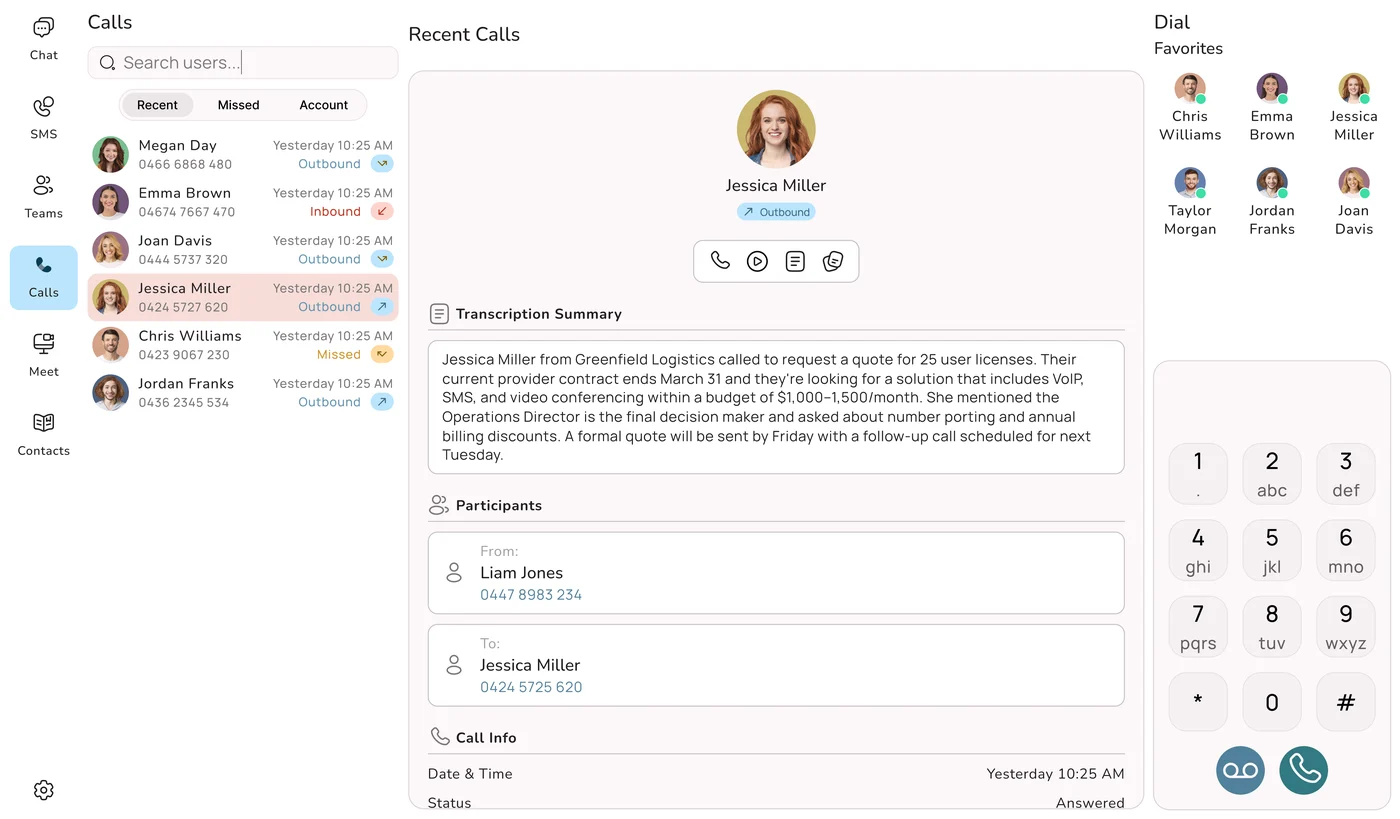
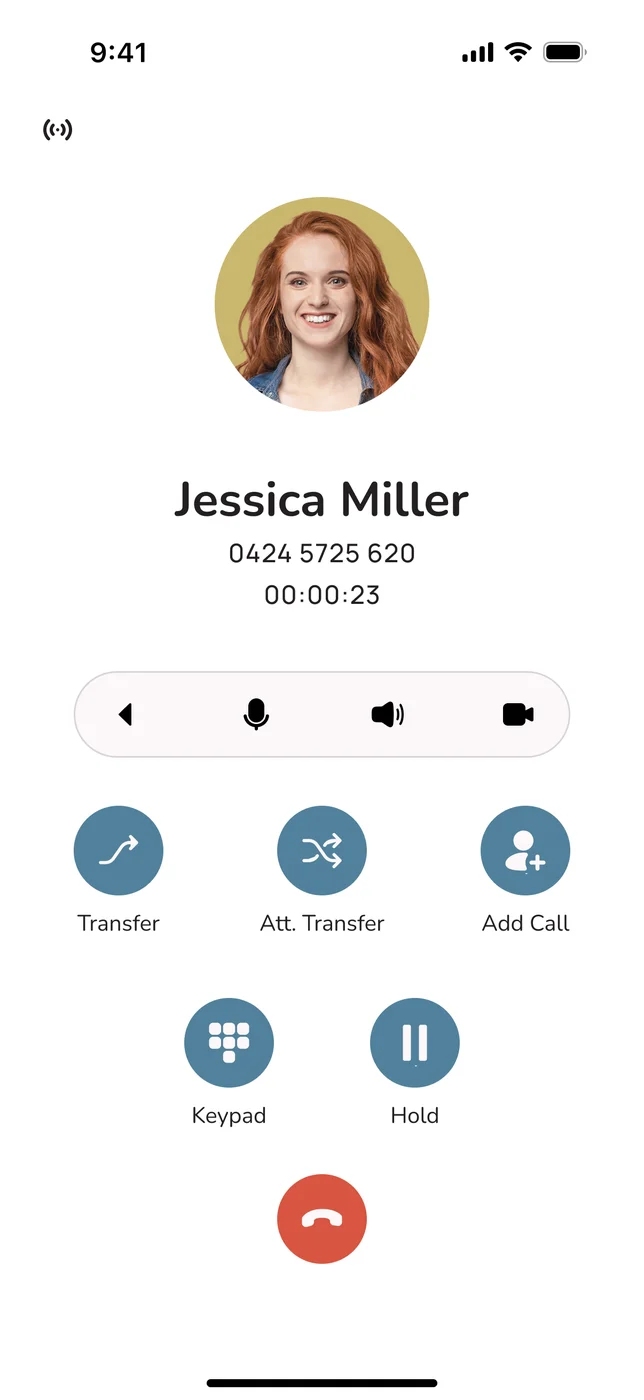
Back in the ute, the free mobile app shows every call, every booking and every message in one list. When you ring a customer back, you do it from the business number, so they see your company name and you keep your own number to yourself.
Four Ways to Handle the Phone, Compared
Most trade businesses end up in one of four setups. Rather than tick boxes against a list of features, the table below asks the same five practical questions of each one.
| Setup | Who picks up when you can't? | After 5pm and weekends | What you end up with | How the cost behaves |
|---|---|---|---|---|
| Your mobile and voicemail | ✗ Nobody | ✗ Voicemail, mostly ignored | ✗ A missed call and maybe a message | ~ Cheap on paper, dear in lost work |
| Human answering service | ~ An operator on a general script, often offshore | ~ Usually extra | ~ A message to call back | ✗ Per call or per minute, climbs as you get busier |
| Part-time receptionist | ✓ A person who knows the business | ✗ Office hours only | ✓ Booked jobs, during their shift | ✗ Tens of thousands a year with super and leave |
| Uniden Voice AI receptionist | ✓ An AI agent trained on your business | ✓ Always on, no extra charge for nights | ✓ Qualified, booked jobs and a text summary | ✓ Simple per-user pricing, AI included |
The mobile-only trap
Nearly everyone starts on their own mobile, and it is the leakiest of the four. It only works in the gaps between jobs, and voicemail catches very little. The longer you run it, the worse it gets, because your personal number ends up on every quote and invoice and you can never really turn it off.
The answering service bill
A call centre does stop the ring-outs, which is better than nothing. The catch is that the operator is reading a script for hundreds of businesses, often from overseas, and usually takes a message instead of booking work. Because the charges are per call or per minute, a busy month costs you more, which is a strange way to reward growth.
The receptionist ceiling
A good receptionist is worth their weight in gold, and plenty of established firms will always want one. But for a small operator the wage, super and leave add up to tens of thousands a year, and they still go home at five, which is exactly when a lot of the urgent work rings.
Where the AI receptionist fits
The AI option answers like a receptionist, around the clock, at a flat monthly cost that does not change with call volume. With Uniden Voice Over Cloud the AI is part of the system rather than an expensive add-on, there is no minimum user count, and it hooks into Xero, MYOB and your other tools. If you do have office staff, it simply takes the overflow and the after-hours calls so they can get on with the quoting and invoicing.
How It Works Trade by Trade
Every trade has its own idea of what counts as urgent and what can wait. The system does not force one set of rules on everybody. Here is how different trades tend to set theirs up.
Plumbers and gasfitters
Burst pipes, flooding and any mention of a gas smell go straight to the mobile. Blocked drains, dripping taps and quotes for a new hot water unit get booked into the next free slot. Rental managers who ring with several jobs at once get everything captured in one call, with each address noted separately.
Electricians
Total loss of power, sparking, burning smells and anyone mentioning a shock are flagged as emergencies. A dead powerpoint, extra lights or a switchboard quote are booked. The agent can also ask whether the caller is a homeowner, a tenant or a builder, which changes who you need to talk to about access and payment.
Air conditioning and refrigeration
A cool room that has stopped at a restaurant is a very different call from a split system that is "a bit noisy". The agent asks what kind of system it is and whether it is commercial, then sends the commercial breakdowns to you and books the domestic servicing.
Builders and carpenters
Most calls are quotes and site visits, not emergencies. The agent collects the scope (deck, extension, kitchen, repairs), the address and a rough timeframe, then books a site visit or sends you the lead to call back. Storm damage and make-safe jobs can be set to come straight through.
Landscaping and outdoor crews
Seasonal rushes are the problem here. In spring the phone does not stop, and you are outside all day with machinery going. The agent books quotes for new work, captures maintenance requests and tells regular customers when you are next in their street.
Mechanics and auto workshops
With a car up on the hoist, nobody is answering the front counter. The agent takes bookings for services, asks for the make and model, and puts breakdowns and towing questions through to the workshop. It is a fit we see often: one of our workshop customers put it this way.
"I can't thank the team at Uniden Voice Over Cloud enough for our upgraded phone system. They managed to get my number back online after my previous provider disconnected my service, in a matter of 30 minutes we were back to business. The whole setup process was fast and exactly what we needed." Lukey Luke, Owner, Benzina Garage
Worked Example: Two Vans and a Heatwave
Numbers on a page only go so far, so let us walk through an example. This one is made up, but anyone in air conditioning will recognise it. Picture a two-van air con business in western Sydney: the owner, Mel, on one van, and her leading hand, Josh, on the other. It is the first proper heatwave of summer.
Monday, without an answering system
The phone runs hot from 7am. Mel is on a roof replacing an outdoor unit, so calls ring out to her mobile's voicemail. Josh is in a ceiling space with no reception. By lunchtime there are eleven missed calls. Mel returns them from the ute at 1pm. A property manager with a broken unit in a childcare centre has already found another firm. Two homeowners wanting installs have booked whoever answered first. Three never pick up. In the end she gets back two small service jobs out of eleven calls, and she spends her whole lunch break on the phone instead of eating.
Say the install jobs and the childcare repair were worth $600 each (the installs would likely be worth far more). That is $1,800 of work gone in one morning, before the afternoon rush even starts. Over a week of 40 degree days, the figure gets ugly fast.
Monday, with the AI receptionist on the line
The same eleven calls come in. The agent answers all of them. It asks each caller whether the site is commercial or residential and whether anyone vulnerable is affected by the heat, because Mel set that up as her urgent rule. The childcare centre is flagged straight away, and the agent puts the property manager through to Mel's mobile. Mel tells them Josh can be there by two, and he is. The two install enquiries are booked in for quotes later in the week. The service calls are slotted into the gaps in the schedule, and three people who only wanted prices get a callback note.
At lunch Mel opens the app, sees a full calendar and a tidy list of three callbacks, and eats her sandwich. Same day, same calls, very different outcome. And because every job came in through the business number, nobody has Mel's personal mobile for the 10pm "is it meant to make that noise?" calls.
The point of the example
It is not that the AI is clever. It is that every call got answered and sorted while both people in the business were doing the work that pays the bills. In a busy week, that is the difference between a stressful scramble and a booked-out schedule.
Handsets, Headsets and the Uniden Name
There is a good chance you have owned something with the Uniden badge on it already: a cordless phone at home, a UHF radio in the ute, maybe a dash cam. Uniden has been selling in Australia since 1966, and Uniden Voice Over Cloud is that same brand's business phone system. For a trade business that matters in two ways.
The first is trust. When you are choosing who will answer your customers, it helps to deal with a name that has been around longer than most of the companies selling phone plans. The second is that the hardware comes from the same people as the service, so you are not juggling one company for the phones and another for the line.
What you can plug in
- Your mobile, for free. Most tradies run the whole thing from the free Android or iOS app, plus the free desktop app for Windows, Mac and Linux on the office computer. No hardware needed at all.
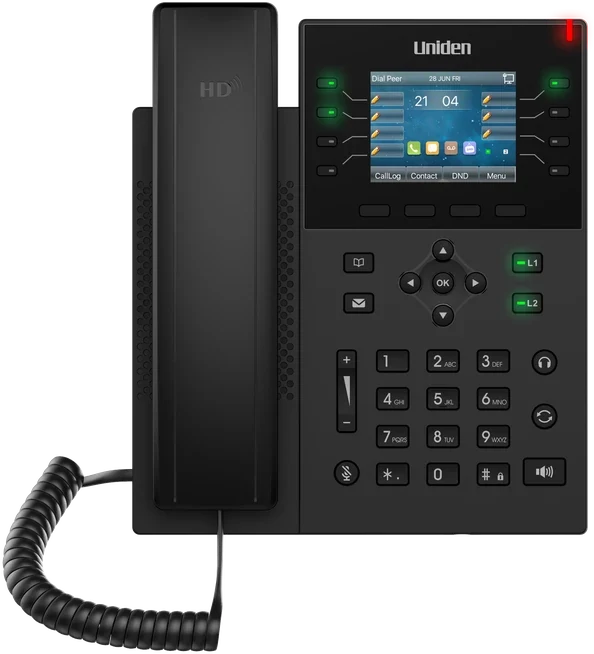
- The Uniden EVOC2 desk handset. If someone sits at a desk for part of the day, the EVOC2 HD Bluetooth handset gives them a proper phone with clear audio. It is a one-off $249, not a rental.
- Headsets. For the office person who spends half the day on the phone chasing quotes and suppliers.
- Conference phones. For the bigger firm that runs a weekly toolbox meeting or calls with builders and project managers.
If you would rather not think about it, there is a phone in a box option that arrives ready to go. And because the service is Australian-hosted, your calls are handled on local servers and your customer data stays onshore.
Your Number: Port It, Stop Printing Your Mobile
Ask any tradie who has been at it for ten years what they wish they had done differently in year one, and plenty will say they wish they had never put their personal mobile on the ute.
Once that number is on the signwriting, on quotes, invoices and fridge magnets, it is out there for good. Customers ring it on a Sunday night. You cannot hand the business phone to an apprentice or an office person, because the business phone is also your personal phone. And if you ever sell the business, take on a partner or step back, the number your customers know is tied to you, not to the business.
The fix
Uniden Voice Over Cloud gives you a business number that is separate from your own. It can be a local number, or a 1300 or 1800 number, which makes a one-van business look like an established firm. Calls to that number are answered by the AI or by whoever on the team is free. When you ring out through the app, the customer sees the business number, not your mobile.
Already have a business number on all your marketing? Keep it. You can port your existing number across for free for a limited time, and full number portability means customers keep ringing the same number they always have. Your account manager handles the paperwork.
Nights, Weekends and Public Holidays
Some of the best-paying work in the trades turns up when everyone else has knocked off. A hot water system dies at 9pm. A tree comes down on a fence in a Saturday storm. Air conditioning quits on the Australia Day long weekend. People in that situation are not chasing three quotes. They want the first competent person who answers.
The trouble is that you also need to sleep, see your kids and have a weekend. Being on call around the clock wears people out, and that is how good tradies end up leaving the trade.
Setting the after-hours rules
The AI agent never knocks off, so it answers the 9pm call just as it answers the 9am one. What changes after hours is what it does next, and you set that. A common setup looks like this: genuine emergencies come straight through to your mobile, or the caller is told you will ring back within ten minutes; anything that can wait is booked for the next working day; and anything outside your area or the kind of work you take on gets a polite no and a note to you.
Your rules, your trade
You decide what "urgent" means. A plumber might put gas smells and flooding through and book everything else. A sparkie might put total power loss through and leave a faulty light for the morning. A builder might only put storm damage through. Your dedicated account manager sets up these call flows with you, and they can be changed whenever your on-call roster changes.
The upshot is that you pick up the high-value after-hours work without the phone buzzing all night for jobs that could wait until Monday. And on the weekends you are genuinely off, the business still answers and still looks switched on.
From Phone Call to Invoice
A booked job is only half the story. It still has to get into your schedule, be quoted, done and invoiced. Every time you retype a customer's details from a text into another app, you are wasting time and adding mistakes. This is where a phone system either fits your business or gets in the way.
Job management software
Lots of trade businesses run ServiceM8, Tradify, AroFlo, simPRO or something similar. Ideally, when the AI books a job, the customer's name, number, address and the job description flow into that software as a new lead or job, ready to dispatch. And when an existing customer rings, the system should already know who they are.
Uniden Voice Over Cloud provides open APIs so it can be connected to job management platforms like these rather than sitting off to one side. If you are not sure whether your software is covered, ask. The team will tell you what already works and, thanks to the open API, can build the connection where one does not exist yet.
Accounting and CRM
For the books, there are native integrations with Xero and MYOB. If you use a CRM such as Salesforce, HubSpot or Zoho, those connect too. The aim is that the job the AI took at 7am ends up in your schedule and your accounts without anybody typing it in three times.
"Uniden Voice Over Cloud perfectly complements our billing software. The ease of integration with our billing software and great local support improved our own customer interactions and now many of our customers have made the switch." Chris, Operations Manager, PracBill
Following up quotes
Every trade business has a stack of quotes that were sent and then forgotten. The customer got busy, you got busy, and a $4,000 job drifted off. Plenty of quotes only get accepted after a follow-up call, yet follow-ups are always the first thing dropped in a busy week. With every call and customer logged in one place, you can see who has been quoted and who has gone quiet, and ring them from the business number in a gap between jobs. The AI can make outbound calls as well, so the follow-ups happen even when you forget.
Your Google listing
For most trades, new work starts with someone typing "plumber near me" or "electrician" plus their suburb and tapping the call button on your Google Business profile. Uniden Voice Over Cloud has native Google My Business integration, which helps keep your listed hours right and makes sure the calls from that listing land in the same system that answers them. The search brings the call in, the AI picks it up, and the job ends up in the calendar. No gaps.
"Knowing that our phones are always connecting our customers with the right staff has streamlined our customer engagement. Having features like this, which are usually only available to larger companies, in a cost-effective manner is excellent. Now that I am using the mobile application I can stay connected with my business when I am out of the office." Marie-Claire, Owner, Wealth of Health
Do the Sums Before You Spend a Cent
You would not buy a new van without working out whether it pays for itself. Treat the phone system the same way. Here is a simple way to run the numbers on the back of a quote pad.
The break-even sum
Step 1: pick your average job value. We will use $600, but use your own number.
Step 2: work out what one extra job a week is worth. $600 x 52 weeks = $31,200 a year.
Step 3: work out what one extra job a month is worth. $600 x 12 months = $7,200 a year.
Step 4: compare that to the phone bill. A cloud phone system with the AI included runs on simple per-user pricing that is a small fraction of either figure. Even the cautious case, one extra job a month, leaves you thousands of dollars ahead.
Now put it next to the other options. A part-time receptionist costs tens of thousands a year once you add super, leave and the hours they are not needed, and still only covers office hours. An answering service charges more the busier you get. The AI agent costs the same whether it handles ten calls a week or a hundred, it covers nights and weekends, and it never calls in sick.
The other way to look at it: you already pay for those calls. The ute signage, the Google listing, the website and every job you did well enough to earn a referral all exist to make the phone ring. A missed call is that money going to someone else.
Growing the Business on the Same Phones
Very few trade businesses stay the same size. You go out on your own, pick up an apprentice, add a second van, then a leading hand, then someone to run the office. Each step changes how calls should be handled, but none of them should mean a new phone system.
| Stage | Who answers first | What you add |
|---|---|---|
| Just you | The AI agent, every call | One user, the free app, a business number. There is no minimum user requirement. |
| You plus an apprentice or a mate | The AI, then whichever of you is free | A second user in minutes, a shared calendar, no technician visit |
| Three or four on the tools | The AI, feeding whoever runs the schedule | Job software connection so jobs can be assigned to each van |
| A crew with office staff | Your admin, with the AI on overflow and after hours | Call recording for training, call analytics, desk handsets and headsets |
The point is that it is one platform from start to finish. Nobody has to move numbers, learn a new app or sign a new contract when the business grows. You add users and switch on the features you need as you get there.
A Name You Know
From Uniden, in Australia since 1966. Hosted on Australian servers, so call quality is local and your data stays onshore.
Free Apps
Android and iOS for the ute, plus desktop apps for Windows, Mac and Linux in the office. One business number on all of them.
Local Support, 24 Hours
Real people in Australia, around the clock. When something needs fixing, you talk to a person, not an overseas ticket queue.
Free Demo and Setup
Free demonstration, free installation and free number porting for a limited time. You do not have to touch a settings screen.
Your Own Account Manager
One person who learns your business, sets up your call flows and trains your AI agent, and is there when you want changes.
Phones and nbn Together
Simple per-user pricing with 50+ features and AI included, and business nbn bundles if you want one bill for the lot.
Switching Over: What Actually Happens
The biggest reason tradies put up with a bad phone setup is that changing it sounds like a week of lost work. It is not. Your account manager does the heavy lifting and your existing number keeps working throughout. Here is what the move looks like.
First: a short conversation and a demo
Go to unidenvoice.com/get-started or ring 1300 881 662. You will talk about your trade, your service area and how calls come in now, and you will hear the AI handle a trade-style enquiry so you know what your customers will get.
Second: your number and your rules
Your existing number is ported across (free for a limited time), or you pick a new local, 1300 or 1800 number. Your account manager trains the AI agent on what you do, where you go and when you can be booked, and sets up which calls count as urgent and where they go.
Third: apps and any hardware
Install the free app on your phone and, if you have an office, the desktop app as well. If anyone wants a real handset, the Uniden EVOC2 ($249 one-time) can be sent out, along with headsets or a conference phone if you need them.
Fourth: go live and fine-tune
From the first call, every enquiry gets answered, sorted and sent to you. Over the first few weeks your account manager checks in, looks at how calls are being handled and adjusts the rules, so the setup suits the way your trade actually runs.
Tradie Questions, Answered
Further Reading
If you want to go deeper before you make a call, these guides from the Uniden Voice library pick up where this one leaves off.