














Who LightFast Networks Are
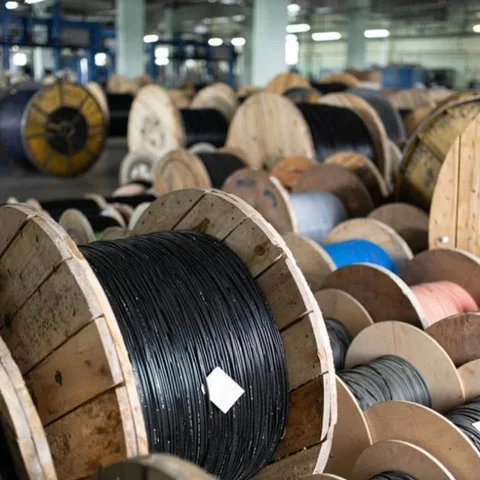
LightFast Networks is an Australian fibre infrastructure company. It partners with property developers to build and operate open-access fibre networks in new residential communities, so the estate is designed with fibre from the beginning rather than having it retrofitted a decade later.
Two words in that sentence do a lot of work. Infrastructure means LightFast is the network underneath, not the company that bills you for your internet plan: the equivalent role to the one nbn plays where nbn is the network. Open access means LightFast does not lock you into a single retailer: residents and businesses choose from more than 100 connected retail service providers, and that competition is the point.
10 Gbps
Published symmetrical speed capability: the same up as down
400 Gbps
High-capacity backbone behind the access network
99.95%
Network uptime guarantee
100+
Connected retail providers to choose between
LightFast also states that its engineers and account managers are Australian-based, and that developers carry no capital cost for the infrastructure, which is why estates get built with it. Featured communities on their site include Innova Rochedale and Innova Shailer Park in Queensland, and they describe operating Australia-wide.
Why the backbone figure is the one to notice
Anyone can advertise a big access speed. What determines whether you actually get it at 8pm is the capacity behind the access network and the engineering behind that. A published backbone figure and an uptime guarantee are the two numbers a wholesale network can be held to, which is why they are worth more attention than the headline speed.
What GPON Fibre to the Home Actually Is
You will see the terms GPON, FTTH, FTTP and PON used almost interchangeably. Here is what each one means, without the acronym soup.
FTTH / FTTP
Fibre to the Home or to the Premises. Glass runs the whole way from the exchange equipment to a small box on your wall. No copper anywhere in the path. The two terms mean the same thing in practice.
PON: Passive Optical Network
One fibre from the exchange is split optically (using glass, with no electronics and no power) so a single feed serves a group of premises, typically up to 32. Nothing in the street to fail.
GPON and XGS-PON
Gigabit PON is the generation that made mass fibre affordable. XGS-PON is its successor, delivering 10 Gbps symmetrically: the class of service LightFast publishes.
ONT and OLT
The OLT is the equipment at the exchange end. The ONT is the small box on your wall where the fibre terminates and your router plugs in. That is the entire hardware story.
The word doing all the work is passive. In a copper network, and in nbn's FTTN and FTTC, there is powered equipment in cabinets in the street, plus metallic conductors running to your premises. Every one of those is a thing that can corrode, get wet, lose power or degrade. In a passive optical network, between the exchange and your wall there is nothing but glass and a splitter with no moving parts and no power supply.
That is not a marketing distinction. It is the reason fibre estates report dramatically fewer faults than copper areas: most copper faults occur in precisely the components that a PON does not have.
Why Glass Is the Best Thing to Happen to Voice
Business phone systems have spent thirty years being blamed for problems caused by the access network underneath them. Fibre to the home ends most of that, and it is worth being specific about which problems it ends.
Voice is not a bandwidth-hungry application. A single call needs roughly 100 kbps in each direction. What voice needs is consistency: packets arriving at even intervals, in order, without gaps. A connection can pass a 500 Mbps speed test and still deliver terrible calls, because a speed test measures throughput over seconds while a call is ruined by twenty milliseconds of chaos.
| What damages calls | On copper (FTTN / FTTC / old lines) | On GPON FTTH |
|---|---|---|
| Distance attenuation | Real. Your performance depends on how far you are from the street cabinet. | ✓ Not a factor across an estate |
| Crosstalk between pairs | Real, and worse when neighbours are busy. | ✓ Physically impossible in glass |
| Moisture and corrosion | The classic intermittent fault. Calls fine in dry weather, awful after rain. | ✓ Nothing metallic to corrode |
| Powered street cabinets | Present, and a shared failure point for the whole neighbourhood. | ✓ Passive: no power in the field |
| Electrical interference | Real. Copper is an antenna. | ✓ Light is immune |
| Upstream congestion | Severe on asymmetric plans: the top cause of bad calls in offices. | Solved by symmetrical service, not by fibre alone |
Note the last row, because it is the honest one. Fibre removes the physical causes of poor call quality. It does not remove congestion: that is a function of the plan you buy and what else is using it. Which brings us to the single most important word in this whole article.
Symmetrical: The Word That Matters Most
Everything your business sends travels upstream. Your voice on every call. Your camera in every video meeting. Your screen when you share it. Every file you upload, every backup you run, every photo your team sends to a client.
Consumer internet is built for the opposite pattern, receiving streamed video, so it is deliberately lopsided. A residential 500/50 plan gives you ten times more download than upload. A symmetrical service gives you the same in both directions.
Here is why that decides how your calls sound. Ten simultaneous calls need about a megabit upstream: trivial. The problem is never the calls; it is what the calls have to share the upstream with. One machine starting a 40 GB cloud backup will saturate 50 Mbps of upstream and every call in the building degrades at the same moment. On a symmetrical service with hundreds of megabits upstream, the same backup is invisible.
This is why a LightFast connection is genuinely well matched to a cloud phone system rather than just being fast on paper. Symmetrical fibre gives voice permanent headroom, and it does the same for HD video meetings, which are the other thing that quietly needs upstream and gets blamed on the meeting software instead. The arithmetic is in how much bandwidth a phone system actually needs.
GPON FTTH vs Every Other Access Technology
Where a LightFast fibre service sits against the alternatives, judged for a business that answers phones rather than for a household streaming television.
| Technology | Path to your premises | Upstream | Suitability for voice |
|---|---|---|---|
| GPON / XGS-PON FTTH LightFast estates |
Glass all the way, passive splitting | Symmetrical, up to 10 Gbps published | ✓ Best available |
| nbn FTTP | Glass all the way | Asymmetric tiers: up to 400 Mbps up on gigabit | ✓ Excellent |
| nbn HFC | Fibre to a node, coaxial cable to you | Limited upstream; shared segment | Good, occasionally variable |
| nbn FTTC | Fibre to the kerb, short copper run | Modest | Usually fine, distance-sensitive |
| nbn FTTN | Fibre to a street cabinet, then copper | Weak, and degrades with distance | Workable but the common cause of quality complaints |
| 5G / fixed wireless | Radio | Variable by cell load and conditions | Excellent as a backup path, riskier as the only one |
The practical upshot: if you are moving into a LightFast community, you are getting the best access network available to an Australian business, and you should stop treating the connection as the likely cause of any future call-quality problem. That is a genuinely new position to be in. If you are on the nbn instead, how Uniden Voice works on the nbn covers each technology in detail, and the full-fibre upgrade programme covers how to get off copper if you are still on it.
The New-Estate Problem: There Is No Landline
This catches almost everybody moving into a new community, and it is worth stating plainly because people only discover it when they try to order a phone service.
There is no copper in the ground. Nobody ran a twisted pair to your block, because it would have been a waste of money. So there is no line to connect, no line rental to pay, and no way to attach a traditional phone number to your building. The model where a phone number belonged to an address, and a phone plugged into a socket on the wall, does not exist on a fibre estate.
People treat that as a problem. It is closer to an upgrade, provided you understand what replaces it.
Your number lives in the network
Australian geographic numbers, mobile numbers, or 1300 and 1800 numbers: assigned to your account rather than your address. Existing numbers port across free.
No hardware required
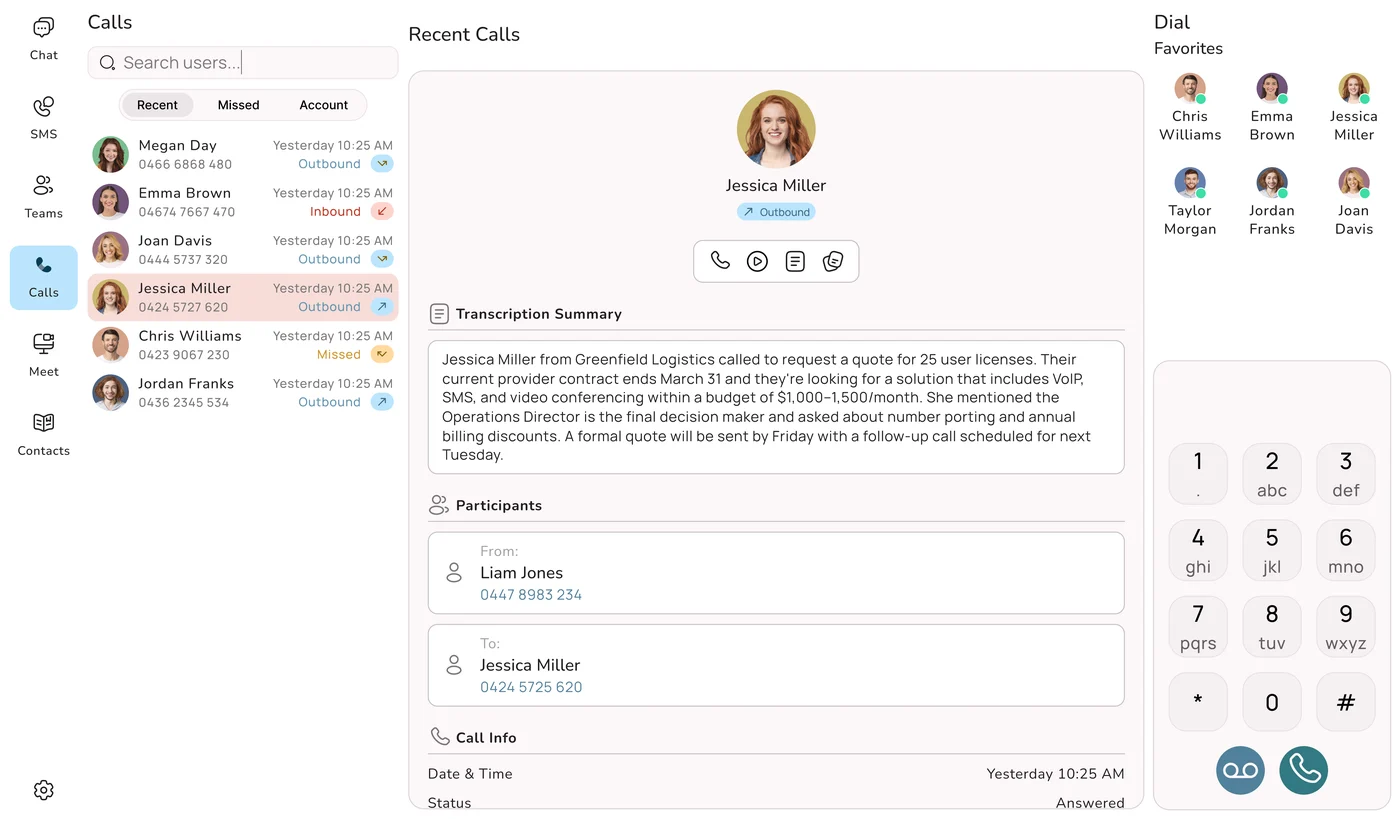
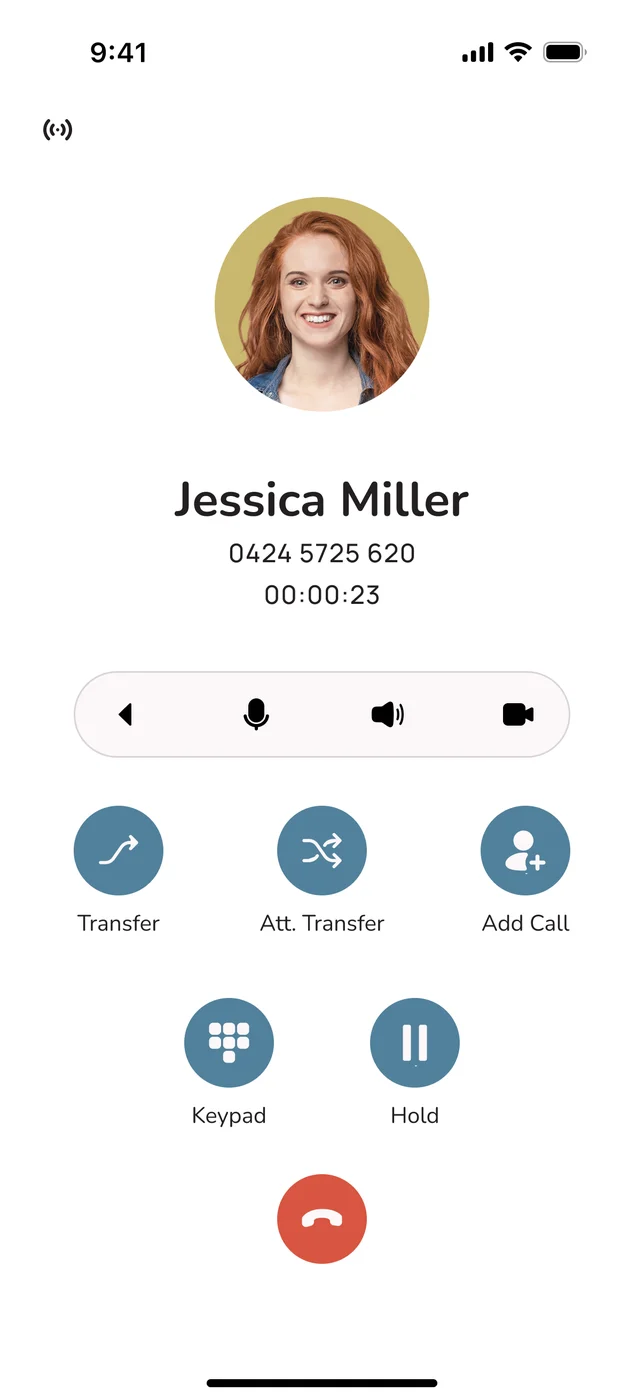
Free Android, iOS and PC apps mean you can be answering business calls the day the connection goes live, with nothing bought and nothing installed.
It stops being about the address
The same number rings your desk, your computer and your mobile, and keeps working if you move premises, work from a site, or open a second location.
It answers when you cannot
An AI voice agent with a natural Australian accent can answer after hours, handle common questions, take details and book appointments: no receptionist, no voicemail nobody checks.
There is one genuine consequence to plan for: with no copper fallback, your internet connection carries your calls. That makes failover a design decision rather than an afterthought: covered in the next section and in full in why one network is a single point of failure.
Three Honest Downsides of PON
No technology is free of trade-offs, and you should hear these from us rather than discover them.
| Trade-off | What it means | What to do about it |
|---|---|---|
| Capacity is shared | A passive splitter serves a group of premises, so a poorly dimensioned network can suffer contention at busy times. This is a network-engineering question, not a fibre question. | Judge the wholesaler by its backbone capacity and uptime guarantee, the two figures LightFast publishes, rather than by the access speed alone. |
| The ONT needs mains power | The fibre is passive, but the box on your wall is not. A blackout takes your connection down even though the network is undamaged. | Put a small UPS on the ONT and router. It is cheap, it takes ten minutes, and for any business that answers phones it is the highest-value $200 you will spend. |
| No analogue fallback | No copper means no old-fashioned line to fall back to. Your connection carries your calls. | Configure mobile failover on the app, plus overflow to a mobile or an AI agent, so a connection fault becomes a redirect rather than silence. |
One thing to get right on day one: your emergency service address
Because your number is no longer tied to a street, the address registered against your service is what tells the emergency call service where you are. On a brand-new estate, where the street may be newer than some address databases, check it is correct as soon as your service is live, and update it whenever you move. It takes two minutes and it is the one piece of admin that has consequences. See Triple Zero from a cloud phone for how it works and what the 2026 rules require.
How to Get Connected: Four Steps
| Step | What happens | Typical timing |
|---|---|---|
| 1. Check your address | Use the "Find RSPs" tool on the LightFast residents page to confirm coverage and see which retail providers serve your community. | Minutes |
| 2. Activate the fibre service | In a new build the lead-in and the ONT are usually already installed: the advantage of an estate designed with fibre from day one. Choose a plan from a connected retailer. | Days, and often faster than a copper-area install |
| 3. Order Uniden Voice | The phone system is independent of the access network: it runs over any decent connection, so it does not matter which retailer supplies the plan on the LightFast fibre. Extensions, call flows, IVR and apps are configured with you. | Same day, since the apps need no hardware |
| 4. Port your numbers | Free porting of existing numbers, or new numbers issued. This is the one step with a fixed carrier process and a scheduled cutover window. | Business days, scheduled with you |
Two sequencing notes worth having. Do not cancel an old phone service until porting has completed and been tested from an outside line: that is the single most common way businesses create a gap for themselves. And if you are opening at the new address while still operating from the old one, the cloud system can run both simultaneously, so there is no hard cutover day at all.
Strata, Apartments and Mixed-Use Buildings
LightFast also supplies strata services alongside the fibre: its site lists security and CCTV, access control, voice broadcast, public WiFi, and 5G and DAS systems for in-building mobile coverage. That combination is worth understanding if you own, manage or occupy a building in one of these communities, because it changes what a strata committee can offer.
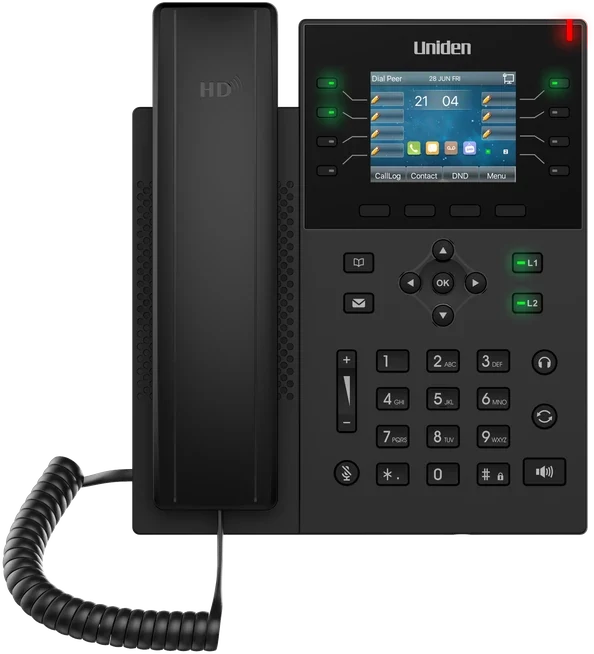
An intercom or entry system, a public-area WiFi service and a building-wide voice broadcast capability all run over the same fibre. A cloud phone system sits naturally alongside them: Uniden Voice is compatible with SIP intercoms and pagers as well as desk phones, which means a building's entry panel can ring a phone system rather than a single hard-wired handset in one apartment. For a mixed-use building with ground-floor commercial tenancies, that turns the entry intercom into something a business can actually answer, on a mobile, from anywhere.
The question to ask your strata manager
"Does the building's intercom terminate on a phone system or on hardware in a cupboard?" If it is hardware, every change (a new tenant, a moved office, an after-hours diversion) is a service call. If it is a phone system, it is a setting.
Running a Business From a Fibre Estate
A large share of the people moving into these communities are running something from home: a trade business, a consultancy, an online store, a professional practice with clients elsewhere. Symmetrical fibre changes what is possible from a spare room, and it is worth being concrete about how.
A business number that isn't your mobile
Stop handing out a personal mobile. A proper business number with an auto-attendant, business hours and a professional greeting costs a fraction of what it used to and takes an afternoon to set up.
Video meetings that hold up
Untimed HD video for client meetings: the thing symmetrical upstream was made for. No more apologising for your connection to somebody who is judging your professionalism.
Answered while you're on site
Calls follow you to the mobile app. For tradies especially, this is the difference between winning and losing a job: see what missed calls cost tradies.
SMS from the business number
Two-way business SMS from the same number people ring: quotes confirmed, appointments reminded, no personal number given out.
Cover while you work
An AI agent answers when you are on the tools or with a client, in an Australian accent, taking details and booking appointments rather than dumping people into voicemail.
Connected to what you already use
Calls, notes and recordings pushed into your CRM or accounting system: 1,000+ integrations and open APIs.
The broader point: the connection stopped being the constraint. On symmetrical fibre, a one-person business at a new address has the same communications capability as an office block, which was not true five years ago and is the genuinely new thing about these estates. If you are at the start of that, the small business tech stack for 2026 is a sensible next read.
Frequently Asked Questions
What to Read Next
Fibre is the road. These cover what you drive on it.