













The Five Calls a Venue Takes
Almost every venue treats its inbound calls as one stream. They are five, and they differ in value by more than an order of magnitude.
1 · The booking
Increasingly handled online, but the phone gets the exceptions: large tables, dietary requirements, "can we bring a cake", a change to tonight. Low value each, high volume.
2 · The operational question
Are you open Monday, do you have parking, is the kitchen still going, do you do gluten free. Almost all of it is answerable without a human, and almost none of it is.
3 · Suppliers and staff
The delivery driver at the wrong door, the chef calling in sick at 6am, the linen company. Time-critical, internal, and should never queue behind a customer.
4 · The complaint
Rare by phone and disproportionately important: a complaint made by phone and handled well usually does not become a review.
5 · The function enquiry
A birthday, a wake, a work Christmas party, an engagement. One of these is worth more than a hundred booking calls, and it is the one most likely to go unanswered.
And the problem
All five ring the same phone, in the same room, at the same moment, and get whatever attention is left over. The most valuable call gets the same treatment as "are you open Monday".
Before designing anything, do a week of counting. Tally each call into one of the five buckets on a sheet of paper at the host station. Most venues are surprised twice: by how much of category 2 is answerable by a recorded message, and by how few of category 5 they are actually getting compared to what they assumed.
The One That Pays for Everything
Work out your own number before reading further. Average function: heads × spend per head. For a great many Australian venues that is somewhere between $2,000 and $8,000, and for a wedding or corporate event considerably more.
Now consider how that caller behaves, because it is nothing like a booking caller.
| Booking caller | Function caller |
|---|---|
| Has chosen you already | Is shopping, and has a list of three or four venues |
| Will call back if you miss it | Rings the next venue on the list, usually within minutes |
| Wants a table | Wants confidence that you can handle their event |
| Two minutes | Ten minutes, then follow-up, then a site visit |
| Worth the average cover | Worth a hundred times it, and often produces repeat business for years |
The asymmetry that should decide your design
A missed booking call costs you one table, and there is a decent chance the customer books online instead. A missed function enquiry costs you the entire event, permanently, to a competitor, and you never learn it happened. Those two events sit in the same voicemail box, indistinguishable, and are treated identically. Almost every venue has this problem and almost none has looked at it.
Four changes, none expensive:
- Give functions their own path. A menu option, a direct number on the functions page of your website, or both. It costs nothing and it lets a high-value call bypass the host station entirely.
- Give that path a named owner and a deputy. Not "whoever picks up". Functions require someone who can answer questions about capacity, minimum spend and dates with confidence.
- Ring a mobile, not just the venue. The functions manager is often not standing next to a phone. The call should follow them.
- Guarantee a same-day response and mean it. If it goes to voicemail, that voicemail should be transcribed and visible immediately, not listened to at 11pm. In a shopping process, speed of response is frequently the deciding factor: the venue that rings back first is often the venue that gets it.
Design for Service Periods, Not Office Hours
Office phone systems are built around 9-to-5 and a lunch break. A venue's day has a completely different shape, and configuring venue phones on an office template guarantees failure at peak.
| Period | What the phone should do |
|---|---|
| Morning admin (roughly 9 to 11) | Everything rings through. This is when functions, suppliers and complex bookings are best handled, and when someone actually has time |
| Lunch service | Bookings to a quick path or an online prompt. Functions to a mobile. Operational questions answered by a recorded message. Minimum interruption to the floor |
| Afternoon lull | Everything rings through again, and this is when callbacks from the lunch period get worked. Build the habit; it is the highest-value hour on the phone |
| Dinner service | As lunch, but tighter. Nobody on the floor should be answering general enquiries at 7:30pm on a Saturday |
| Closed | Hours and address by recorded message, bookings to online, functions to voicemail with a transcript and a promised response time |
The recorded greeting is doing more work than you think
Category 2 (hours, address, parking, dietary, whether the kitchen is still open) is usually a third to a half of all calls and requires no human at all. Twenty seconds of recorded greeting handles most of it. That is not a downgrade in service; a caller who wanted to know if you were open on Monday and found out in twelve seconds had a better experience than one who waited ninety and interrupted a service. Keep it short, keep it current, and re-record it whenever anything changes.
Two configuration details that matter more than they sound. Have separate weekday and weekend schedules, because a venue's weekend shape is nothing like its weekday shape. And handle public holidays deliberately: a venue that is open on a public holiday while its phone insists it is closed loses a day of trade, and it happens every single year to venues whose holiday settings were configured once and never revisited.
The Loud Room Problem
An acoustic problem gets treated as a phone system problem and never gets solved. A busy dining room, a pub on a Friday or a club at capacity is a genuinely hostile environment for a phone call in both directions.
| Symptom | Fix |
|---|---|
| Staff shouting into the handset at the host station | A DECT cordless handset so the person can step into the corridor or office to take the call |
| Booking details taken down wrong: names, times, covers | Same fix. Nearly every wrong booking is a mishearing in a loud room, not carelessness |
| Nobody hears the phone ring at peak | Ring more than one device, and consider a visual indicator at the pass. A phone that cannot be heard is a phone that does not ring |
| Callers put on hold and forgotten | A hold timeout that returns the call to the queue rather than leaving it parked indefinitely |
| Function calls taken standing in a service doorway | Route them to a mobile so they can be taken somewhere quiet, and taken properly |
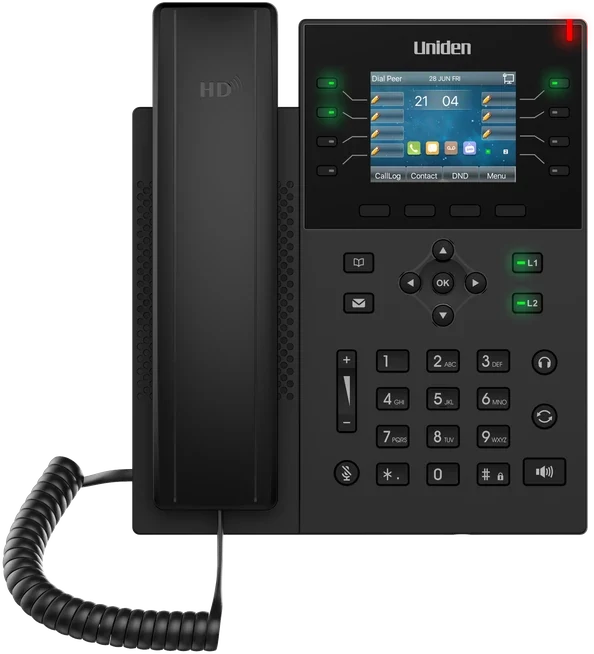
The general principle: every call that requires more than thirty seconds should be taken away from the floor. That means a cordless handset with real range, a mobile app on the manager's phone, or both, which is a design question rather than an equipment question, though the handset does have to be up to it. Our handset provisioning guide covers the hardware side, including why a venue's handsets should arrive configured rather than be set up by whoever is on shift.
Deposits, Card Numbers and a Trap
This section exists because almost no venue has considered it, and it is a real exposure.
Function bookings usually involve a deposit. Deposits are frequently taken by reading a card number over the phone. If your phone system records calls (and many do by default, which is often a good thing) then you are creating audio recordings containing full card numbers and security codes, and storing them.
Why this matters
Payment card industry security standards specifically restrict the storage of sensitive authentication data, including the security code, after authorisation, and a call recording is storage. A venue with two years of recorded deposit calls sitting in a system has an obligation problem and, more practically, a very attractive target. Nobody set out to do this. It is the completely predictable result of switching on call recording and separately taking deposits by phone, two sensible decisions that combine badly.
Three ways out, in order of preference:
Best: stop taking cards by phone
Send a payment link by SMS while the caller is still on the line. Faster, no transcription errors, no recording problem, and it gives you a receipt trail. Most function callers prefer it.
Good: pause the recording
Recording that can be paused for the payment portion and resumed afterwards. Requires staff to remember, which means it will sometimes be forgotten, but it is far better than nothing.
Minimum: don't record that path
If deposits are always taken on the functions line, exclude that line from recording entirely. Blunt, but it closes the exposure.
While you are looking at recording, check the consent side too: it varies by state and territory, and the practical answer for a venue is a single announcement on every recorded call regardless of location. Our call recording guide covers the jurisdictional detail.
The Calls That Arrive When You Are Closed
Hospitality enquiries do not respect trading hours. People plan events on Sunday evenings and organise work Christmas parties from their desks at 4pm on a Tuesday when your kitchen is closed. A significant share of a venue's enquiry volume arrives outside service.
Widely cited industry research suggests something in the range of 40 to 60% of calls to small service businesses arrive outside business hours, and that a large majority of people who reach voicemail do not leave a message. Treat those figures as directional rather than precise: the number that matters is your own. But the direction is not in dispute, and it points at three cheap fixes.
| Fix | What it does |
|---|---|
| Missed-call SMS | An automatic text on any unanswered call: hours, the booking link, and an invitation to reply with a function enquiry. Converts a dead end into an open conversation, and works whether you were closed or simply flat out |
| Voicemail transcribed to text | Messages readable at a glance rather than requiring someone to sit and listen. In practice this is the difference between function voicemails being actioned next morning and being actioned next week |
| A greeting that answers the top three questions | Hours, address, booking link. Most out-of-hours callers wanted one of those and can be finished in fifteen seconds |
Some venues go further and use an AI voice agent to take enquiries out of hours, answering the routine questions properly and capturing function details for a callback. That works well for hospitality precisely because the questions are so repetitive; which calls to automate covers how to decide, and the honest answer for most venues is to start with the missed-call SMS and the greeting, then consider the rest.
Multi-Venue Groups
Groups running three or more venues hit a different set of problems, and they compound.
| Problem | Design |
|---|---|
| Callers ring the wrong venue constantly | Transfer between sites as an internal call, not a "here's their number, try them". A caller who has to hang up and redial is a caller you may lose |
| Function enquiries should be handled centrally | One functions team seeing enquiries for every venue, able to place an event at whichever site fits. This alone frequently pays for the system |
| Each venue's phone is set up differently | One platform, one template, applied per site. Consistency is what makes a group's phones manageable at all |
| Nobody knows which venue misses calls | Reporting by site. Some venues answer 95% of calls and some answer 60%, and until it is measured it is invisible |
| Head office needs to reach a venue during service | A separate internal path that does not queue behind customers |
The central functions desk
For a group, this is usually the single highest-return change available. A caller who wants a room for forty in November on a Saturday does not care which of your venues they get, but if they ring the one venue that is booked out and are told no, they leave the group entirely. One team, seeing all enquiries, with visibility of every venue's availability, converts a “sorry, we're full” into a booking at your other site.
Designing for High Turnover
Hospitality staff turnover is high, and any phone design that requires training will decay within a season. The right design assumption is that the person answering the phone tonight started last week.
- Fewer options, not more. A three-option menu that everyone understands beats a seven-option menu that gets misused. Depth is the enemy.
- Transfer must be one button. If transferring to the functions manager requires remembering an extension, calls will be handled badly or not transferred at all.
- Nothing depends on a person's mobile number. Route to a role, "functions", not to a number that leaves with the person who had it.
- Print the one-page guide and put it at the host station. Answer, transfer, hold, functions, emergency. Five lines. It survives every induction that never happens.
- Test it with a new starter. If someone in their first week cannot transfer a call to functions on their first attempt, the design is wrong, not the person.
What to Build, in Order
Ordered by return, so a venue that stops after step three has still fixed most of it.
| Step | Do this | Why it is in this position |
|---|---|---|
| 1 | Count your five categories for one week | Free, and it tells you which of the rest matters most to you specifically |
| 2 | Give function enquiries their own path, owner and mobile | Highest value per call in the business, currently competing with "are you open Monday" |
| 3 | Record a greeting that answers the top three questions, and set service-period routing | Removes a third of all calls from the floor at peak |
| 4 | Turn on missed-call SMS and voicemail transcription | Recovers the after-hours and flat-out calls you currently never see |
| 5 | Fix deposits: payment link by SMS, or pause recording | Closes a real exposure most venues do not know they have |
| 6 | Get a cordless handset that reaches somewhere quiet | Every long call taken off the floor is a call taken down correctly |
| 7 | For groups: central functions desk and per-site reporting | Converts "sorry, we're full" into a booking at another venue |
5
Kinds of call, one design
1
Worth more than the rest
~⅓
Answerable by a greeting
0
Card numbers in recordings
None of this is a hospitality-specific product. It is ordinary phone system capability, arranged around how a venue actually runs rather than around an office template, which is the arrangement almost every venue inherited without ever choosing it. The counting exercise in step one takes a week and costs nothing, and it is genuinely the right place to start.
If seasonal peaks are your particular problem, the same principles apply with more urgency in November and December: set the function path up in September, not in the second week of the Christmas rush. And if you also run a delivery or takeaway operation, business SMS from your phone system covers order-ready notifications, which take a surprising amount of volume off the phone entirely.