










From One Giant Model to Many Specialists
When ChatGPT arrived at the end of 2022, the lesson most people took away was that one enormous model could do almost anything. Write a poem, summarise a contract, explain tax, draft a job ad. For a while the race in AI was about building ever larger general models, and every business tool bolted one on.
Businesses then tried to use those general models for real work, and found the gap. A model that knows a little about everything often knows too little about the one thing you need. The industry response has been to specialise. Instead of one general model, companies now use smaller models trained or tuned for an industry, such as health or finance, or for a single task, such as reading invoices or answering phone calls, and connect them to their own information.
Gartner put numbers on the trend. In its article 3 Bold and Actionable Predictions for the Future of GenAI, it predicts that by 2027 more than 50% of the generative AI models used by enterprises will be specific to their industry or business function, up from about 1% in 2023. In a press release on 9 April 2025 it went further, predicting that by 2027 organisations will use small, task-specific AI models at least three times more than general purpose large language models. Its reasoning was simple: general models give less accurate answers on tasks that need specific business context, while smaller specialist models respond faster and cost less to run.
These are predictions about large enterprises, but small businesses will feel the same shift through the tools they buy.
The Temp and the Receptionist
The easiest way to understand the difference is to think about staff. Picture two people starting on your front desk on the same Monday.
The first is a very bright temp from an agency. They are articulate, fast and polite, and they have general knowledge about almost everything. But they have never worked in your industry and never seen your price list. When a caller asks whether you can fit a hot water system in Penrith this week, they will give a confident, friendly answer. It may be completely wrong.
The second is a receptionist who has worked in businesses like yours for years and has spent a week learning yours. They know what a callout fee is, which suburbs you cover, who handles warranty claims and when to put a call straight through to you. They may not be able to write a sonnet, but they get your calls right.
A general purpose model is the temp. A domain-specific model, grounded in your business, is the receptionist. Both are useful. But when the job is talking to your customers, you want the one who knows the work, and the one who says "let me check that for you" instead of guessing.
Why a General Chatbot Gets Your Business Wrong
General models are trained on enormous amounts of public text. That makes them good at language and poor at anything that is not written down publicly. Your prices, hours, service area, booking rules and exceptions are exactly that kind of information. Ask a general chatbot about them and it has two choices: say it does not know, or produce something that sounds plausible. Too often it does the second.
There is also an Australian problem. Much of the text general models learn from is American. Without local tuning, an AI can misread "arvo", "rego", "servo" or "bottle-o", spell your suburb wrong, get confused by Medicare or GST, and format a phone number as if it were in Ohio.
| What the caller asks | A general chatbot might say | A specialist grounded in your business says |
|---|---|---|
| "Are you open Saturday arvo?" | Typical business hours, or a guess | "We are open until 1pm Saturday. Would you like a morning booking?" |
| "How much for a callout?" | An average figure from the internet | Your actual callout fee, or "I will have someone confirm that" if it depends |
| "Do you come out to Kellyville?" | "Yes, we serve the whole area!" | Checks your service area and answers yes or no |
| "Can I claim this on Medicare?" | General advice, possibly American | Your approved answer, and a transfer to reception for anything specific |
| "It's urgent, water everywhere" | Offers to take a message | Follows your urgent rule and puts the call through, or pages the on-call tech |
The better answer is not a better sentence. It comes from a different source of truth, which is what domain-specific AI is really about.
Three Ways a Model Becomes a Specialist
"Domain-specific" is used loosely in marketing, so it helps to know the three things it can actually mean. Most good business AI uses more than one of them.
Trained on an industry
The model is built or retrained on a large body of material from one field, such as medicine, law or finance. An early, well known example was BloombergGPT, a finance model Bloomberg described in 2023. This is expensive and usually done by large companies.
Fine-tuned for a task
A model is given extra training on examples of one job, for instance thousands of phone conversations, so it learns the shape of that task: short answers, taking turns, confirming details. Smaller models tuned this way are often faster and cheaper.
Grounded in your business
Often called retrieval, or RAG. Before answering, the AI looks up your own information: your FAQs, price list, service area, calendar or CRM. It answers from that, not from memory. For a small business this is the part that matters most.
Gartner names the last two, retrieval and fine-tuning, as the main ways businesses customise models for their own tasks. For a small business, you will almost never train a model yourself. What you are really choosing is a supplier whose AI is tuned for the job you need (answering calls, for example) and who makes it easy to ground that AI in your information and keep it up to date.
A useful rule of thumb
Fine-tuning teaches the AI how to do the job. Grounding tells it the facts of your business. You need both. A beautifully tuned phone agent that does not know your prices is still the temp, just a smoother one.
Why the Phone Is a Hard Domain
Text chat is forgiving. A chatbot can take a few seconds to reply, and the customer can reread the answer. A phone call gives the AI none of that room, which is why voice is one of the clearest cases for a specialist.
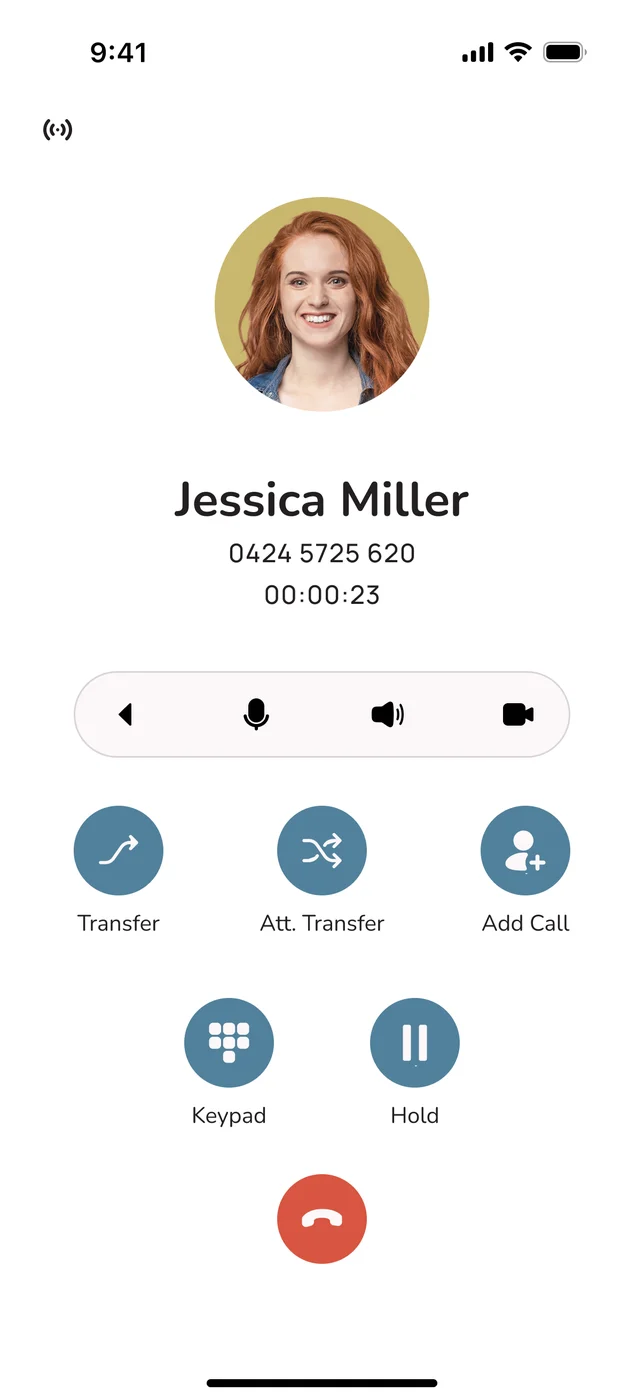
On a call, the AI has to hear the caller correctly over a noisy work site or a car speaker, understand broad Australian accents and local place names, answer within a second or so because a longer pause feels like the line has dropped, and cope with interruptions, because people talk over each other on the phone. Then it has to do things a general chatbot cannot: transfer the call to the right person, send a text with a booking link, check a calendar and book a time, take a message that makes sense, and know when to stop and hand over to a human.
Every one of those skills is specific to telephony. A general model can be taught to talk, but the listening, timing and call handling come from the phone system around it. That is why an AI receptionist built into a phone platform usually behaves better than a general chatbot connected to a phone number by a third party. We explain the difference between an AI that talks and one that acts in our guide to AI agents and agentic AI on the phone.
Questions to Ask an AI Vendor
Almost every phone and software provider now says it has AI, and many will soon say theirs is domain-specific. These questions cut through that.
| Ask | A good answer sounds like | A warning sign |
|---|---|---|
| What is it built for? | "Answering and routing business phone calls," with examples from businesses like yours | "It can do anything you need" |
| Where do its answers come from? | "From the information you give it, and it tells callers when it does not know" | No clear answer about grounding, or "the AI just knows" |
| How do I update it? | You can change hours, prices and FAQs yourself, and changes apply straight away | Every change is a support ticket or a paid project |
| What can it actually do on a call? | Transfer, take messages, send SMS, book into a calendar, with rules you set | It can only talk, or only take messages |
| Where is the call processed and stored? | A clear answer, per feature, including any overseas component | "In the cloud" |
| Is my call data used to train models? | A plain yes or no, in writing | Hesitation, or a link to a long policy |
| What does it cost as calls grow? | A simple price you can model at your call volume | Per-minute AI fees you only see on the bill |
The hosting and training questions deserve extra care. The company selling you the AI is often not the company running the model underneath, and the promises made by the model maker apply to their direct customer, not always to you. Our guide on why not all AI providers are equal walks through the layers between you and the model, and what to get in writing.
Test It With Your Own Questions
A demo shows you the vendor's best call. Your customers will not ask the vendor's questions. The only fair test of a specialist is your own work, so run it like a trial shift.
- 1
Write down your ten most common calls
Ask whoever answers your phones. Opening hours, prices, "can you come today", bookings, cancellations, "is my order ready". Use their exact words.
- 2
Add three awkward ones
An angry caller, an urgent job and a question the AI should not answer, such as a medical, legal or refund decision.
- 3
Give it your real information
Load your actual hours, price list and service area, not a sample business. That is the grounding you are testing.
- 4
Ring it like a customer
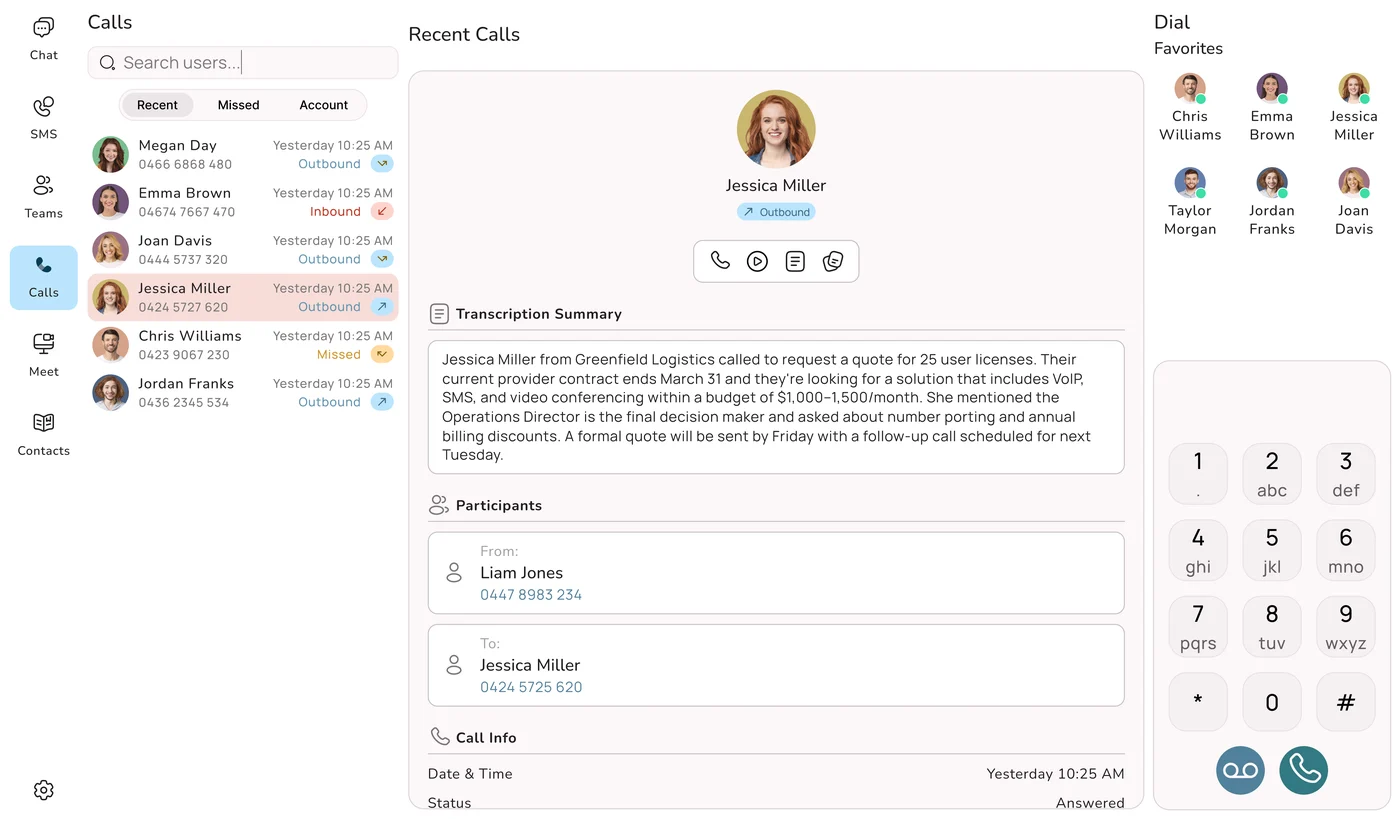
From a mobile, in the car, with background noise, with an accent if you have one. Interrupt it. Change your mind halfway.
- 5
Score what matters
Was the answer right? Did it admit what it did not know? Did the transfer, text or booking actually happen? How long were the pauses?
- 6
Check the paperwork afterwards
Look at the transcripts and summaries. They should match what was said, and they should be where your team will see them.
If an AI gets eleven of thirteen right and hands the other two to a person gracefully, that is a specialist worth having. If it answers all thirteen confidently and three of them are wrong, it is a temp with good manners. For the numbers side of the decision, our AI voice agent cost and ROI guide helps you work out whether it pays.
What to Do This Quarter
You do not need an AI strategy document. You need a few practical steps that will make any AI you use, now or later, more accurate.
| Step | Why it helps |
|---|---|
| Write your business facts down in one place | Hours, prices, service area, policies and who handles what. This is the grounding every specialist AI needs, and most businesses keep it in someone's head. |
| Pick one job for AI, not ten | After hours calls, overflow when you are busy, or booking. A narrow job is easier to get right and easier to measure. |
| Decide your hand-over rules | Which calls always go to a person, and how fast. Urgent, upset or high value callers should never be stuck with a machine. |
| Check your privacy obligations | From 10 December 2026 the Privacy Act requires businesses covered by the Act to explain certain automated decisions in their privacy policy. See our automated decisions guide. |
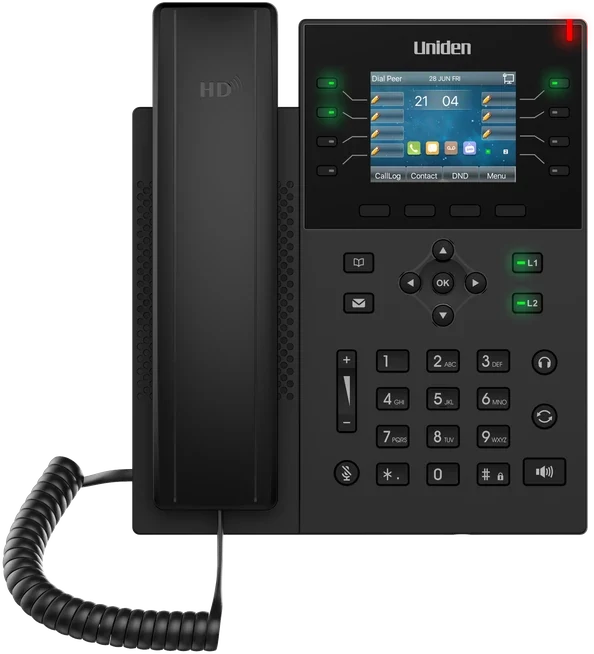
| Prefer AI inside your phone system | Fewer companies between the caller and the answer means lower delay, one bill and one place to ring when something is wrong. |
If you are still deciding whether AI suits your business at all, start with our plain guide on whether a small business can use AI.
How Uniden Voice Approaches It
Uniden Voice over Cloud is a business phone system first, and our AI is built for one domain: your phone calls. The AI phone agent runs on the same Australian platform that carries the calls, so there is no extra hop to an outside answering service, and it is set up around your business rather than around the internet. You give it your hours, services, prices and rules, and it answers callers in a natural Australian voice, takes messages, sends texts, books appointments and puts calls through to a person when they need one. Call summaries and transcripts land in the app, so your team can see what was said.
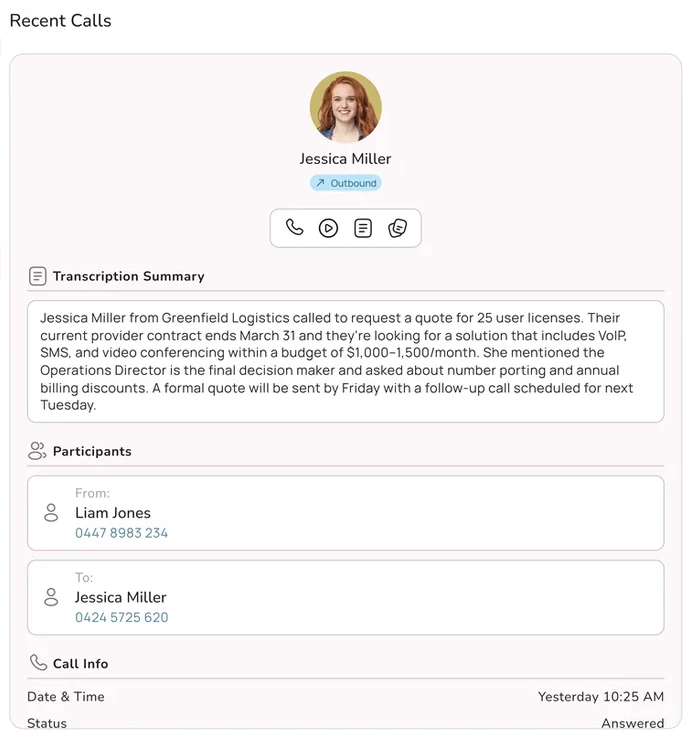
We will not tell you we have built our own giant model, because that is not the point. The point is the specialist on your phone line: tuned for calls, grounded in your information, hosted in Australia and backed by an Australian team you can ring on 1300 881 662. Bring us your ten most common calls and run the test in this article on us.