


















The Journey of a 000 Call
Almost nobody who buys a business phone system knows how an emergency call actually works, which is understandable: it is the one feature you hope never to use. But the architecture explains every practical decision in this article, and it takes a paragraph.
When somebody dials 000, the call does not go to the police, the fire brigade or the ambulance service. It goes to an emergency call service operated under a statutory framework, where an operator answers, establishes which service is needed and in which state or territory, and transfers the call to the relevant emergency services organisation. Alongside the voice call, the network passes information about where the call came from. That data is what determines how quickly help finds the caller if the caller cannot say where they are.
| Call from | What location information travels with it | How accurate |
|---|---|---|
| Mobile phone | Network- and handset-derived location from the mobile network | ✓ Often good, and improves as handset capabilities improve |
| Traditional copper line | The address the line physically terminates at | ✓ Exact: the line is the address |
| Fixed VoIP / cloud phone | The service address registered in the provider's records | Exactly as accurate as your records are |
| Softphone app away from the office | Still the registered service address, not the phone's GPS | Potentially wrong, and this is the real risk |
Read the last two rows together and the whole issue becomes visible. Cloud telephony did something genuinely valuable: it detached your phone number from your building. Emergency calling is the one place where that detachment has to be deliberately re-attached, in a database, by somebody who remembers to do it.
Why the Registered Address Beats GPS
People assume that because their phone knows where it is, the emergency operator does too. On a mobile call to 000 that is broadly true. On a call from a cloud phone system it is not, and it is worth being blunt about why.
Your softphone does not send GPS to the emergency operator
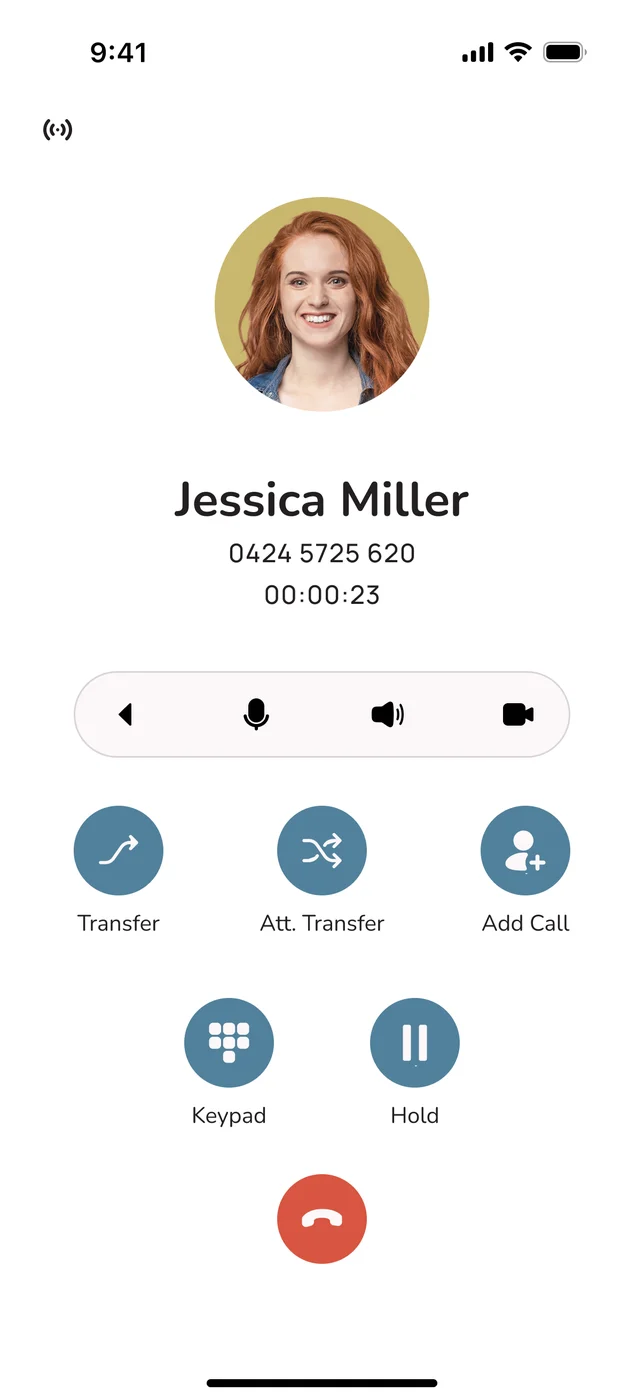
A softphone is an application making a call over a telecommunications service. The location information carried with an emergency call from that service comes from the service record, not the device. Your phone's GPS is not in that path. So a person dialling 000 from the mobile app in a warehouse across town presents whatever address is registered against their service, and if that is the head office, that is what the operator has.
This is not a flaw that a better app would fix. It is a consequence of the emergency call framework being built around identified services at known addresses, which is exactly what makes it reliable for the overwhelming majority of calls. The correct response is not to distrust the system: it is to keep your side of it accurate.
Three ways the address goes wrong
- You moved and nobody updated it. The most common by a wide margin. Businesses update the address on their invoices, their website and their Google listing, and forget the one that matters in an emergency.
- You have several sites on one account. A second branch, a warehouse, a workshop or a shopfront added later, all inheriting the original address because nobody was asked.
- The address is new enough that databases disagree. Genuinely common in new estates and new developments, where the street may be more recent than the records referring to it. If you are in a new community, see getting connected on LightFast Networks fibre, verify it explicitly rather than assuming.
"Certain VoIP Services": the Word That Matters
Official guidance says you can call Triple Zero from any fixed or mobile phone, from a satellite phone, and from certain VoIP services. That qualifier is doing a great deal of work, and it is the reason this article exists.
Emergency call access is not an automatic property of anything capable of making a phone call. It depends on the service being provided by a carriage service provider that carries emergency calls and passes the required information with them. Which produces a market with three quite different kinds of product sitting side by side:
A proper business phone service
Carries 000 with a registered service address per site, from a provider operating under the Australian regulatory framework. This is what a business phone system should be.
A calling app or collaboration tool
Many can dial out and take calls but do not support emergency calls, or support them only in some configurations. Frequently deployed without anyone checking which.
A cheap international SIP service
Some explicitly exclude 000 in their terms. Cheap per-minute rates, no emergency access, and no Australian obligations: a genuinely bad trade for a business premises.
Uniden Voice sits in the first category: emergency calls are carried, with a registered service address for each site, and Australian support to change it when you move. If you are comparing providers, this is one of the questions in how the alternatives compare that rarely appears on a feature matrix and should.
What Changed in 2025 and 2026
Australia has spent the last two years rebuilding the assurance around emergency calling, prompted by failures that led to a Senate inquiry into a Triple Zero service outage. If you buy telecommunications for a business, the direction of travel is worth knowing, because it changes what you are entitled to ask for.
| What | Detail | What it means for a business buyer |
|---|---|---|
| Triple Zero Custodian and Emergency Calling Powers Act 2025 | Commenced 1 November 2025. Establishes a Triple Zero Custodian within the federal communications department to oversee the emergency call ecosystem end to end. | Somebody is now accountable for the whole chain rather than each telco being accountable only for its own piece. |
| New ACMA powers | The ACMA can direct action from industry to ensure the emergency call service functions, and compel information sharing. | A regulator that can order remediation, not just investigate afterwards. |
| Mandatory testing during changes | From 1 November 2025, telcos must test Triple Zero during upgrades and maintenance, with improved network and device testing requirements. | Addresses the specific failure mode where an upgrade silently broke emergency calling. Fair to ask a provider how it complies. |
| Outage communication obligations | Enforceable obligations to communicate with customers and other stakeholders during major and significant local outages. | You are entitled to be told. See the new telco transparency rules. |
| Complaints handling for outages | Enhanced requirements specifically for network outage complaints. | A defined path when a provider is unresponsive after an incident. |
| Work in progress | The Custodian is considering standardised mandatory welfare checks, regular network testing including ahead of upgrades, and closing gaps in outage transparency. | Expect further obligations. Providers already doing this voluntarily will absorb them without a repricing conversation. |
The shift in one sentence
Emergency calling has moved from something assumed to work to something that must be demonstrated to work. That is a meaningful change, and the businesses that benefit are the ones that ask their provider to demonstrate it.
The outages that drove all of this are worth understanding in their own right, because they contain the practical lessons about network dependency: see the Optus Triple Zero outage and the Telstra national outage, plus the public outage registers now available to check a provider's record.
The Dial Plan Mistake Businesses Make
Here is a failure we see more often than the wrong-address problem, and it is entirely self-inflicted.
A business wants to control phone costs, so it restricts outbound dialling. Some extensions can only call internally. Some require a code for external calls. International dialling is barred. A warehouse phone is locked down to three internal numbers. All of this is sensible cost control, and unless it was configured carefully, it can also block 000.
The four configurations to check today
- Call barring rules. A rule that permits only internal calls must carve out emergency numbers explicitly. Many do not, by default.
- Access codes and prefixes. If your system needs a 0 or a 9 to reach an outside line, does 000 work without it? On a well-configured system, yes. Verify rather than assume.
- PINs and account codes. Never require a PIN for an emergency call. Nobody remembers a code under stress, and the person needing it may be a visitor.
- Lobby, lift, warehouse and public-area phones. The handsets most likely to be locked down, and most likely to be the nearest phone to an incident.
Do not test this by dialling 000
Emergency operators handle an enormous volume of non-genuine calls, and a test call occupies a line somebody else may need urgently. Verify the configuration in the system instead: that is where the answer is. If you want the call path itself verified end to end, ask your provider to arrange it properly; carriers have processes and test facilities for exactly this purpose.
Remote Workers and Multiple Sites
Hybrid work turned a small gap into a large one. If your whole account carries one address, then every remote worker, every branch and every site van presents that address on an emergency call. Three fixes, in order of value.
1. One registered address per physical site
The highest-value change and the one most businesses have not made. Every branch, warehouse, workshop and shopfront should be its own registered location, not an extension of head office.
2. Home addresses for permanently home-based staff
Where per-user service addresses are supported, register them. A permanent home worker is a site, and treating them as a desk in an office they never visit is the wrong model.
3. Written policy: emergencies go via mobile
For anyone who moves around, put it in the induction: use a mobile for 000, because a mobile carries network-derived location and a softphone carries a database entry. Say it once, in writing, and it is done.
That third point deserves emphasis because it costs nothing and it is the one that actually protects a mobile workforce. No configuration will make a softphone know it is at a construction site in another suburb. A mobile call will.
Power, Outages and the Mobile in the Drawer
A fixed VoIP service needs working power and a working internet connection. In a blackout, that path is unavailable, and it is worth saying clearly that this is not a peculiarity of cloud telephony. A modern nbn connection cannot carry a phone call without power either, and in new fibre estates there is no copper line to fall back on at all. The old picture of a phone that worked in a blackout describes a network that has largely been switched off.
So the plan cannot depend on the building. Three measures cover it, in ascending order of cost:
| Measure | What it protects against | Effort |
|---|---|---|
| A charged mobile on site | Everything. A mobile can reach 000 even with no service from your own carrier, no credit, and no SIM. | None, but only if people know where it is |
| A small UPS on the router and network gear | Short power interruptions, which are far more common than long ones. Keeps calls and internet running through them. | Ten minutes and a modest one-off cost |
| Mobile failover, plus overflow routing | Connection faults. Calls redirect to the mobile app over 4G or 5G, to mobiles, to another site, or to an AI agent that answers. | A configuration change, done once |
Notice that the third measure protects your business continuity while the first protects your people. They are different problems and both need answering. The continuity side is covered properly in why one network is a single point of failure.
000, 112 and 106: Settling the Myths
Three numbers, and a persistent amount of misinformation about them. Worth correcting in your workplace because the myths waste seconds that matter.
| Number | What it is | The myth to correct |
|---|---|---|
| 000 | Australia's primary emergency number. The one to teach, use and put in your procedures. | None. This is the answer. |
| 112 | An international standard emergency number recognised by mobile handsets under the GSM specification. From an Australian mobile it routes to the same Triple Zero service. | That it is "the secret number that gets priority" or works where 000 does not. It does not: it is an alternative, not an upgrade. |
| 106 | The text-based emergency service for people who are deaf or have a hearing or speech impairment, reached using a TTY device. | That you can SMS 000 or text 106 from a normal phone. You cannot, 106 needs a TTY. |
The useful business action: make sure 000 and 106 both appear in your written emergency procedures, and that staff know 000 works from a locked mobile with no credit. Both facts are worth more than any technical configuration in this article.
The Ten-Minute Check
Everything above, reduced to a list you can work through this afternoon.
| Check | Why | |
|---|---|---|
| 1 | Confirm the registered service address for every site on the account | It is what the emergency operator receives. Wrong here means wrong at the worst moment. |
| 2 | Confirm 000 dials from every extension with no prefix, code, PIN or supervisor | Call barring and access codes are the commonest self-inflicted block. |
| 3 | Check lobby, lift, warehouse and public-area handsets specifically | The most locked-down phones are often nearest the incident. |
| 4 | Put the site address on a label on or near fixed phones | So a caller can read it out. Cheapest control in this entire article. |
| 5 | Write the mobile-for-emergencies rule into your induction | The only thing that protects staff working away from a registered address. |
| 6 | Identify a charged mobile per site and tell people where it is | Works with no power, no internet, no credit and no SIM. |
| 7 | Add a UPS to the router and network equipment | Covers the short interruptions that make up most power events. |
| 8 | Add 000 and 106 to your written emergency procedures | Accessibility and clarity, at no cost. |
| 9 | Set a calendar reminder to re-check addresses every six months and on any move | Addresses drift. Reminders do not. |
| 10 | Ask your provider, in writing, how it carries emergency calls | Their answer is either immediate or it is informative. |
Nine of those ten cost nothing. If you do only one, do the first.
What to Ask a Provider Before You Sign
Five questions. A provider that runs its own Australian platform will answer all of them in a sentence each; that is part of why who actually operates your platform matters.
Does this service carry 000?
Not "can VoIP do 000": does this service, on this plan, in this configuration.
What address will it present, per site?
And how do we update it: self-service, or a request, and how quickly does it take effect?
How do you comply with the testing obligations?
Telcos must now test Triple Zero during upgrades and maintenance. Ask how, and expect a real answer.
How and how fast will you tell us about an outage?
There are enforceable obligations here now. Ask for the commitment in writing rather than in a slide.
Who do we ring, and where are they?
An Australian team inside the company that operates the platform can change an address today. A reseller lodges a ticket.
What happens to inbound calls in an outage?
Emergency outbound is one problem. Customers being able to reach you is the other, and the answer should be routing, not voicemail.
This article is general information about how emergency calling works on cloud phone systems, current at July 2026. It is not legal advice, and it does not replace your obligations under work health and safety law or your emergency management plan. For your specific configuration, ring us on 1300 881 662.
Frequently Asked Questions
What to Read Next
Emergency calling is the floor. These cover the resilience built on top of it.