


















How the Industry Is Actually Structured
Buy a business phone system in Australia and you will almost certainly be buying from a company that makes one third of it.
The standard arrangement looks like this. A software vendor writes the calling platform and the apps. A completely separate manufacturer, usually in Asia, builds the desk phone; the vendor rebadges it or simply resells it. A third party (often a hyperscale cloud provider, sometimes offshore) owns the compute the platform runs on. A fourth owns the network the calls traverse. Four companies, one logo on the invoice.
This is not a scandal. It is how most technology is assembled, and it produces perfectly good outcomes most of the time. Specialisation is efficient. The manufacturer that makes a million desk phones a year makes better desk phones than a telco would.
The problem is not quality. It is accountability. Every one of those boundaries is a place where a problem can sit unowned. And you never find out where the boundaries are on a good day: you find out on the one morning of the year when the phones are down and you are trying to work out who to ring.
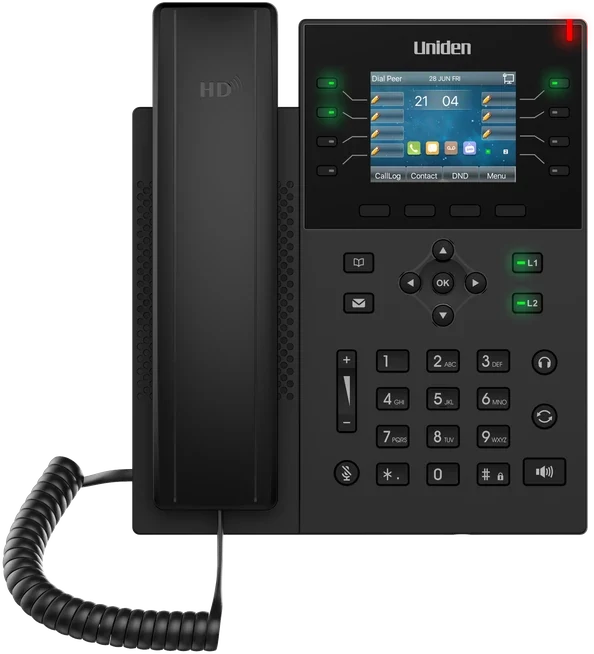
Uniden sits differently in that picture. It is a hardware company that has been making gear for Australian conditions since 1966 (radios, cameras, dash cams, cordless phones) and it also operates a cloud telephony platform. The EVOC2 on the desk and the platform it registers to come from the same company. That is an unusual combination, and the rest of this article is about what it changes.
The Gap, and the Day You Find It
Here is the scenario that makes this concrete, and every IT manager reading it will recognise the shape.
A handful of desk phones start dropping their registration every few hours. Calls in progress are fine; incoming calls sometimes ring and sometimes do not. It began, as far as anyone can tell, last Tuesday.
| You ring | They say | Where that leaves you |
|---|---|---|
| The phone system vendor | “Our platform shows the handsets de-registering. That is a device or network issue: we can see them dropping, not why.” | Reasonable, unhelpful, technically true |
| The handset manufacturer | “Firmware is current. Have you tried a factory reset? Please confirm the platform is on our compatibility list.” | A support portal in another time zone |
| Your IT provider | “Nothing changed on the network. Could be SIP ALG on the new firewall, but the vendor should confirm.” | Back where you started |
| The internet provider | “Line tests clean.” | Also true, also no help |
Every one of those answers is honest. Not one of them is ownership. And the cost of that is not the fault itself: it is the fortnight it takes to find it, during which somebody in your business spends several hours a week being a project manager for four companies who have no contract with each other.
The single-vendor version of the same fault
The handset, the provisioning system and the platform belong to the same company. The support engineer can see the device’s registration history and its firmware version and the platform-side logs in one place, and there is no boundary at which the conversation can be handed off. It may still take a day to find. But it takes one conversation, and the person having it cannot escape it.
Provisioning: Owned, Not Documented
The clearest practical difference shows up before anything has gone wrong at all, at deployment.
When the handset and the platform come from different companies, provisioning is a documented integration. The manufacturer publishes a configuration file format; the platform vendor writes a template against it; somebody maintains that template as both sides release new versions. It works, and it breaks in the specific way that all documented integrations break: quietly, one firmware release later, for a subset of devices.
When they come from the same company, provisioning is a product decision. On Uniden Voice, associating a handset with an extension is entering its MAC address in the portal. The phone is factory reset, it finds its provisioning server (SIP PnP first, then DHCP option 66, then TR-069, then static) pulls its configuration and registers. There is no template to maintain, because there is no boundary to maintain it across.
Configured before it ships
Order handsets and Uniden configures them against your account, then ships them to your business address. The person unboxing plugs in one cable. That is only possible because the same company holds both ends.
Re-assigned in two minutes
Staff change, desk move, branch transfer: re-point the MAC address in the portal, factory reset the phone. No technician, no SIP password anybody has to remember.
Features that actually appear
Platform features that need handset support (DSS key states, presence lamps, hot desking) arrive on the phone rather than sitting in a compatibility matrix marked “partial”.
On-screen labels that update
Change a name in the portal and the label beside the key changes. On a mixed setup this is exactly the kind of thing that works on three handset models and not the fourth.
The full sequence is written up in the EVOC2 plug-and-play guide if you want to see the mechanics.
Firmware: Tested Against the Platform It Will Run On
This is the least visible advantage and arguably the largest.
A handset manufacturer selling into thirty markets tests firmware against the platforms with the most units in the field. If yours is not one of them, your handsets receive firmware validated against somebody else’s system. Most of the time that is fine, because SIP is a standard. Occasionally it is not, and the failure is subtle: a codec negotiation edge case, a re-registration timer, a change in how the phone handles a particular SIP header. These are the faults that produce “it only happens on Tuesdays and only to Sharon” tickets.
The compatibility-list trap
When a provider tells you a handset is “supported”, ask a follow-up: supported by whom, and tested against which firmware version? A model appearing on a compatibility list often means someone confirmed it registered, once, on a firmware release from two years ago. It rarely means anyone is regression-testing new firmware against that platform before it reaches your desks.
When one company owns both, that question does not arise, because the firmware and the platform are released by people who work for the same organisation and are accountable for the same outcome. There is no version of the story where a firmware release ships without anyone having checked it against your phone system, because your phone system is their phone system.
One Number, and What That Is Worth
Businesses systematically underestimate this, because the cost is invisible in the accounts.
1
Support number for handset, platform and network
1
Invoice, one contract, one renewal date to track
1
Warranty path: the phone and the service have the same owner
0
Conversations that begin “that will be the other vendor”
The line item that never gets recorded is the owner’s time spent coordinating suppliers. A few incidents a year, a few hours each, plus the follow-up, plus the mental overhead of holding the whole picture in one head because nobody else has it. For a business with an owner whose time has genuine commercial value, that is a real number, and it is usually larger than the difference in per-seat pricing that everyone spends their negotiation energy on.
Add the Australian dimension: support in Australian hours by people who know what the nbn is, what happens at a Telstra exchange, and why a call to a 13 number behaves the way it does. Australian infrastructure and support is a longer argument in itself, but the short version is that a support conversation about an Australian network is faster with someone who lives on it.
The Software Half: What the Platform Has to Be Good At
None of the above is worth anything if the software is mediocre. A beautifully supported bad phone system is still a bad phone system. So here is the other half of the argument, stated as a set of tests you should apply to any provider, Uniden Voice included.
| What to test | Why it matters | Where Uniden Voice stands |
|---|---|---|
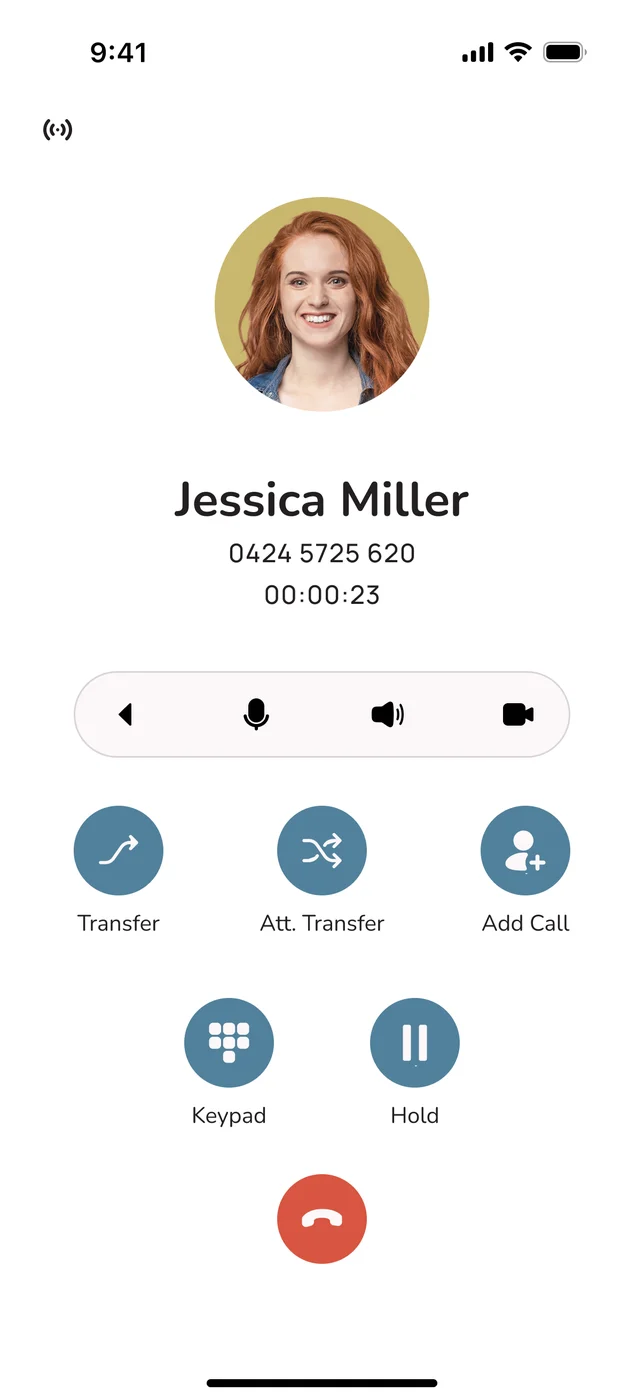
| Apps on every platform | Most staff will never use a desk phone daily. If the app is an afterthought, the system is an afterthought for most of your team. | ✓ Windows, Mac, iOS and Android apps: free, not a premium tier |
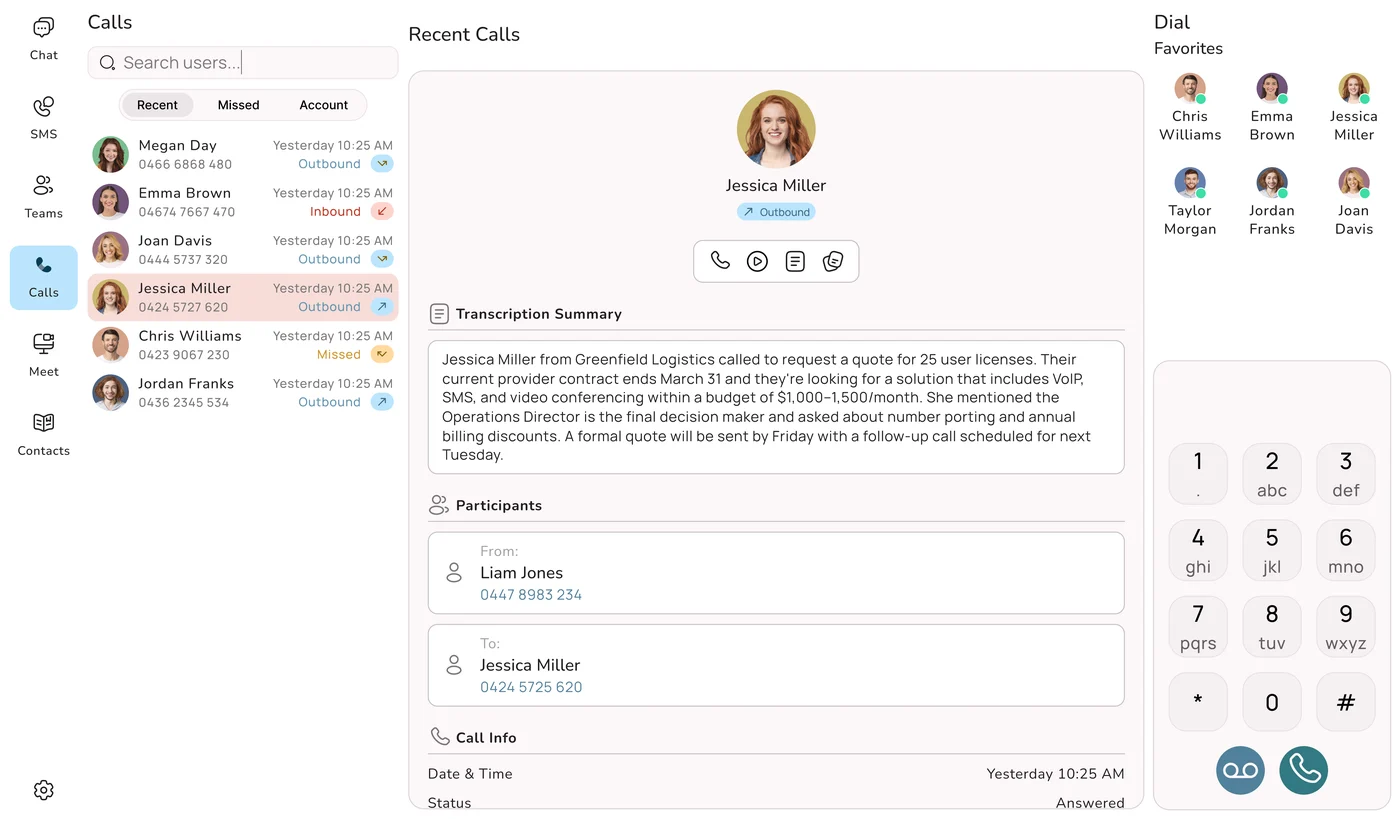
| AI that is included, not upsold | The single question that moves the total cost more than any other is whether AI features sit behind a premium plan. | ✓ AI call handling, transcription and summaries built into the platform |
| Open APIs | A phone system that cannot be connected to your CRM is a phone system that will be replaced in three years. | ✓ Open APIs and integrations across common Australian business software |
| Contract terms | A three-year term turns a bad decision into a three-year bad decision. | ✓ No lock-in: the terms should let you be wrong cheaply |
| Number portability | If leaving is hard, staying is not loyalty. | ✓ Bring your existing numbers |
| Where the data lives | Call recordings and transcripts are personal information. Jurisdiction is a compliance question, not a preference. | ✓ Australian hosted |
Apply those six tests to whoever you are currently considering. If the answer to the AI question is “that is our Pro tier” and the answer to the contract question is “thirty-six months”, the hardware argument in this article is the least of your problems.
The Australian Part Is Not Decoration
“Australian owned” appears on so many vendor pages that it has almost stopped meaning anything. Here is what it means operationally, which is narrower and more useful.
Support in your hours
A fault at 9am Tuesday reaches someone who is awake and at work, not a queue that opens when your day ends.
Data in Australian jurisdiction
Call recordings and AI transcripts contain personal information. Where they are stored is a live compliance question in 2026, not a nice-to-have.
Triple Zero handled properly
Cloud phone systems have specific obligations around emergency calling in Australia. A provider that operates here has to meet them.
Hardware built for here
Sixty years of making equipment for Australian heat, dust, distance and network conditions is not marketing. It is a long list of design decisions.
The Four Models, Compared
Every Australian business phone purchase falls into one of four structures. Here they are honestly, including where each genuinely wins.
| Model | What it looks like | Wins on | Costs you |
|---|---|---|---|
| Software vendor + third-party handset The industry default |
Global platform, rebadged handset, offshore hosting, support that follows the sun | Feature depth, scale, integrations breadth | Accountability at the boundaries; time zone; jurisdiction |
| Carrier bundle | Phone system bolted to a mobile and data contract from a major telco | One bill, familiar brand, sometimes sharp pricing | Feature ceiling, contract length, and support that treats voice as an add-on |
| BYO SIP + your own PBX | SIP trunks from one provider, hardware and software you own and run | Total control, lowest per-minute cost at scale | You are the integrator. Everything above becomes your problem by design |
| Hardware maker running the platform Uniden Voice |
Handset, platform, provisioning, hosting and support under one roof, in Australia | Accountability, deployment speed, one relationship | A narrower handset catalogue than a vendor-agnostic platform offers |
Notice that the last row has a real cost in it. That is deliberate, and it leads to the next section.
When a Mixed Setup Is Still Better
An argument you cannot state the limits of is a sales pitch. Here are the limits.
You have 200 handsets already
If you have recently bought a large fleet of a particular manufacturer’s phones, throwing them away to gain single-vendor accountability is a bad trade. Use a platform that provisions them well and revisit at refresh.
You need a specific exotic device
Paging systems, door intercoms, DECT fleets across a warehouse, hazardous-area handsets. A vendor-agnostic platform with a long compatibility list is the right tool.
You are a 2,000-seat enterprise
At that scale you have staff whose job is exactly the coordination this article describes, and the feature depth of a global platform may outweigh the accountability benefit.
You genuinely want no handsets
If everyone works from apps, the hardware argument is close to irrelevant to you: judge the platform on the six software tests above and ignore this article’s first half.
For everyone else (which is most Australian businesses between five and a couple of hundred people, with some desks, some vehicles and no full-time telephony specialist) the accountability argument is the one that pays.
How to Judge This for Yourself
Do not take any of the above on faith. Four questions, asked of every provider on your shortlist, will sort them faster than a feature comparison.
| Ask | What a good answer sounds like | What a bad answer sounds like |
|---|---|---|
| “Who makes the handset you are quoting me?” | A direct answer, including who supports its firmware and who tests it against the platform. | “It is our branded handset.” Ask again. |
| “If a phone drops registration, who do I ring, and can they see both sides?” | One number, and yes: device history and platform logs in one place. | Any answer containing the phrase “in the first instance”. |
| “Where is my call data stored, and who can access it?” | A country, a jurisdiction and a straightforward account of access. | “In the cloud.” |
| “What is the exit process, and how long does porting take?” | A plain description, no penalty for asking. | Hesitation, or a number of months. |
The pattern in those four is the same: you are testing for ownership, not features. Features are easy to compare on a website and easy to match. Ownership only reveals itself in the answers to awkward questions, which is exactly why they are worth asking before you sign rather than after.
If you want the hardware side in detail, the EVOC2 guide has the full specification and the provisioning sequence. If you want to see the rest of the range, connecting your Uniden products covers it. And if you are comparing providers properly, the 2026 comparison of Australian business phone systems is the place to start.