

















Why One Brand Across a Business Is Worth Something
Walk through a typical Australian small business and count the brands. There is a camera system somebody installed four years ago and nobody can log into. A dash cam in each vehicle, three different makes, all bought on special. UHF radios for the crew, from whoever had stock. A phone system on a contract signed by a person who has since left. Five suppliers, five apps, five support numbers, five warranty processes, and no single human being who understands how any of it fits together.
None of that is a technology problem. Every one of those products probably works. The problem is administrative surface area: the number of separate relationships you have to maintain to keep the lights on, and the number of phone trees you have to navigate on the day something breaks.
Uniden is unusual in the Australian market because the same brand covers both ends of that list. It has been making the gear that goes in Australian homes, sheds and work vehicles since 1966, and it also runs a cloud phone platform for businesses. That is not a common combination. Most phone providers are software companies that will happily sell you somebody else’s handset; most consumer electronics brands have never operated a telephone network.
The honest framing for this whole article: the cameras do not dial your phone system, and the dash cam does not appear in your call reports. These are separate products that share a brand, an Australian support operation and a design philosophy. What consolidating buys you is fewer suppliers, one warranty path, one number to ring, and gear that was built for Australian conditions by a company that has been doing it for sixty years. That is a procurement and support argument rather than an integration argument, and it is worth being clear about that up front.
The One That Connects Directly: EVOC2 and Uniden Voice
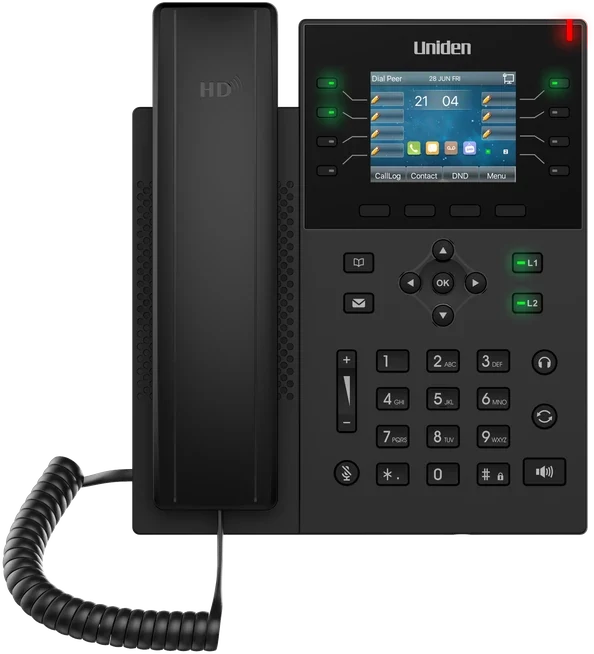
Start with the exception, because it matters. The Uniden EVOC2 is the only product in the range that connects to Uniden Voice rather than merely alongside it. It is a SIP desk phone built for the platform, and the relationship between the two is genuine: the handset is registered against an extension in the Uniden Voice portal by its MAC address, and it pulls its entire configuration down over the network the first time it is powered on.
12
SIP lines on a single EVOC2 handset
1 cable
Integrated PoE: power and network down the same Ethernet run
2 × 1Gbps
Gigabit ports, so a PC shares the desk drop
$249
Per handset, configured before it ships
The practical version: you order handsets, Uniden configures them against your account and ships them to your business address, and the person who unpacks the box plugs in one cable and starts making calls. There is no installer, no site visit and no config file emailed to somebody who does not know what to do with it. We have written that process up in detail in the EVOC2 plug-and-play guide.
Worth noting for the rest of this article: the EVOC2 also takes a USB Wi-Fi dongle if the desk has no Ethernet drop, and supports Bluetooth headsets natively. Both of those matter in the kind of premises where the cameras and the radios are also in play: workshops, yards, farm offices, sites where the cabling was never finished.
Security Cameras: Wi-Fi, Solar and 4G
The App Cam SOLO X2K family is the part of the range most Australian businesses will recognise, and it is genuinely well suited to work premises rather than just houses, for one specific reason: the cameras are 100% wire-free and solar compatible. On a yard, a farm gate, a storage compound or a half-built site, running power to a camera position is usually the entire cost of the project. Removing that removes the project.
App Cam SOLO X2K
2K Super HD wire-free spotlight camera, solar compatible, sold as single, twin and quad packs. Wi-Fi connected, viewed through the My Uniden+ app from anywhere.
SOLO X2K PT Kit
The same camera with 355° pan and tilt and a solar panel in the box. For covering a whole yard from one mounting point rather than three.
SOLO X2K 4G PT Kit
Pan and tilt, solar, and a 4G SIM instead of Wi-Fi. This is the one for sites with no internet at all: remote gates, machinery compounds, properties, jobs that have not been connected yet.
App Cam X24 / X24B
Indoor Wi-Fi cameras with two-way talk. Reception areas, stockrooms, back-of-house. The two-way audio is the useful part in a business.
App Cam X25PT
Indoor 2K with automatic motion tracking: the camera follows movement across the room rather than watching a fixed rectangle.
Free 7-day cloud backup
The SOLO series includes seven days of free rolling cloud storage, with no ongoing subscription. Footage can also go to an SD card locally.
Two features on the SOLO range deserve calling out for business use. Thermo Sense detection triggers on body heat and movement together rather than motion alone, which is the difference between a camera that alerts you when somebody walks into the yard and a camera that alerts you every time a branch moves, and a camera that cries wolf is a camera whose notifications everybody has muted by week three. And the subscription-free seven-day rolling cloud backup matters because the failure mode of local-only storage is that the thief takes the recorder.
Voice assistant control
The App Cam range works with Google Home and Amazon Alexa, so a camera feed can be thrown onto a screen with a voice command. In a business that is mostly a novelty, but in a retail back office or a workshop where nobody has clean hands, it is occasionally the fastest way to check the front door.
The Video Doorbell for a Trade Counter or Back Gate
The App Cam SOLO X2K Bell is a 100% wire-free smart video doorbell with a chime. In a house it is a doorbell. In a business it is something more useful: a way to run a trade counter, a back gate or an after-hours delivery door without staffing it.
The pattern that works: the door is locked, the doorbell is mounted, and the person who answers it is whoever is holding a phone, not whoever happens to be near the door. Pair that with an Uniden Voice ring group on the business number and you have covered both the people who knock and the people who ring, without either of them needing somebody sitting at a desk.
This is the clearest example in the range of two separate Uniden systems solving two halves of the same problem. They do not talk to each other. They do not need to. The person answering both is holding one phone.
In the Vehicle: Dash Cams and CarPlay
If you run vehicles, the dash cam question is not really about video quality. It is about what happens in the week after an incident, whether the footage exists, whether anybody can get it off the device without a fight, and whether the insurer accepts it.
| Product | Connects via | Why a business cares |
|---|---|---|
| iGO CAM 90 | Wi-Fi to phone | 4K (2160p) front camera, 135° capture angle, 3.16″ widescreen display, microSD to 128GB. Wi-Fi transfer means the driver pulls the clip off on the side of the road rather than driving the card back to the office. |
| Dash View 60+ | Wi-Fi + GPS | 5K Ultra HD with GPS, so the footage carries speed and location data. That is often the detail that settles a dispute rather than prolonging it. |
| Dash View 40R | Wi-Fi + GPS | Front and rear coverage with GPS. The rear camera is the one that matters for the most common commercial claim, being hit from behind while stationary. |
| iGO PLAY 10+ | Wireless CarPlay / Android Auto | Adds a wireless CarPlay and Android Auto screen to an older work vehicle. Relevant here because it puts hands-free calling into a ute that never had it, including calls placed through the Uniden Voice mobile app on the business number. |
That last row is the one people miss. A tradesperson taking a business call on their mobile from a ute is either doing it illegally, doing it badly on speaker, or not doing it at all. A CarPlay screen plus the Uniden Voice app on the phone means the call comes in on the business number, hands free, with the caller ID the customer recognises, and the call is still recorded and logged in the phone system like any other. That is a real workflow improvement built out of two products that have no technical connection to each other whatsoever.
XTRAK Smart UHF: Radios That Pair to a Phone
The XTRAK range is where the word “smart” on a UHF radio stops being marketing. The Pro models pair to a smartphone over Bluetooth 4.0 and run the XTRAK Pro app on iOS and Android, which adds location sharing between units: you talk to someone and you can see where they are.
XTRAK 50 / 50 Pro / 50-O
Handheld 5-watt waterproof smart UHF. The Pro adds location sharing through the app. For crews on foot, on a site, or spread across a property.
XTRAK 80 / 80 Pro
In-vehicle, 80 channels, 5W, large anti-glare OLED display, 2W magnetic-mount remote speaker mic, three programmable smart keys, Master Scan and triple watch.
Instant Replay
Records and replays up to six minutes of received audio. The single most practical feature on a work radio: “say that again” without having to ask.
Bluetooth vehicle audio
The 80 Pro pushes radio audio through the vehicle speakers, which in a noisy diesel is the difference between hearing the call and missing it.
Why this belongs in an article about a phone system: UHF and cloud telephony solve opposite halves of the coverage problem. UHF works where there is no mobile signal and no internet, licence-free, instantly, with no per-message cost. Uniden Voice works anywhere there is data, and connects your people to customers rather than just to each other. A crew working a property with patchy coverage needs both, and the failure mode of choosing only one is either “we can talk to each other but nobody can reach us” or “customers can reach the office but the office cannot reach the crew.”
The Full Connected Range at a Glance
Everything in the current Uniden Australia range that talks to a network or an app, and what it needs to work.
| Product | What it needs | App / platform | Business use |
|---|---|---|---|
| Uniden EVOC2 desk phone | Ethernet with PoE, or Wi-Fi via USB dongle | ✓ Uniden Voice: direct | The desk phone. Auto-provisioned from the Uniden Voice portal. |
| App Cam SOLO X2K (1/2/4 packs) | Wi-Fi | My Uniden+ | Wire-free 2K yard, entry and perimeter cameras. Solar compatible. |
| SOLO X2K PT Kit | Wi-Fi + included solar panel | My Uniden+ | 355° pan and tilt from one mounting point. |
| SOLO X2K 4G PT Kit | 4G SIM: no Wi-Fi required | My Uniden+ | Remote sites, gates, properties, unconnected jobs. |
| SOLO X2K Bell | Wi-Fi | My Uniden+ | Wire-free video doorbell with chime. Trade counters, back gates. |
| App Cam X24 / X24B | Wi-Fi | My Uniden+ | Indoor with two-way talk. Reception, stockroom, back of house. |
| App Cam X25PT | Wi-Fi | My Uniden+ | Indoor 2K with automatic motion tracking. |
| iGO CAM 90 | Wi-Fi to phone | Uniden dash cam app | 4K front dash cam, 135°, 3.16″ display. |
| Dash View 60+ | Wi-Fi + GPS | Uniden dash cam app | 5K with GPS speed and location data. |
| Dash View 40R | Wi-Fi + GPS | Uniden dash cam app | Front and rear with GPS. |
| iGO PLAY 10+ | Wireless CarPlay / Android Auto | Your phone | Hands-free calling and navigation in older vehicles. |
| XTRAK 50 Pro / 80 Pro | Bluetooth 4.0 + GPS on the phone | XTRAK Pro app | Smart UHF with location sharing between units. |
| XTRAK 50 / 80 | Nothing: standalone UHF | Not app connected | 80-channel UHF, instant replay, Master Scan. |
| Digital cordless phones, marine radios, baby monitors | Standalone | Not app connected | Part of the range; not part of the connected story. |
What "Connected" Honestly Means Here
This is the section most vendor pages leave out, so let us do it properly. There are three different things going on in the table above, and conflating them would be misleading.
| Kind of connection | Which products | What that actually means |
|---|---|---|
| Connects to Uniden Voice | EVOC2 handset | ✓ Genuine integration. Registered by MAC address against an extension, auto-provisioned, managed from the portal, appears in your call reporting. |
| Connects to the internet and an app | App Cams, doorbell, dash cams, XTRAK Pro | Separate systems. They connect to their own Uniden apps and cloud, not to your phone system. Same brand, same support operation, different login. |
| Connects to nothing | Standard UHF, cordless, marine, baby monitors | Standalone by design. That is a feature for UHF in particular: no network means nothing to go down. |
What we are not claiming
A SOLO X2K will not trigger a call to your business number. A dash cam clip will not attach itself to a call recording. If a vendor tells you their consumer camera line integrates with their PBX, ask them to demonstrate it. The value of a single-brand setup is real, but it is a commercial and support value, not a technical one, and it is easier to trust a company that tells you that plainly.
Four Businesses, Four Setups
Abstract ranges are hard to picture. Here is the same range assembled four different ways.
Building company, 12 staff, 5 vehicles
EVOC2 handsets in the office, Uniden Voice apps on every phone, Dash View 40R in each vehicle, iGO PLAY 10+ in the two older utes, XTRAK 80 Pro in the vehicles and 50 Pro handhelds on site, SOLO X2K 4G PT on the compound at the current job. One supplier for all of it.
Retail with a back dock
EVOC2 on the counter and in the office, X25PT indoor tracking camera in the stockroom, X24 with two-way talk at the dock, SOLO X2K Bell on the locked delivery door routed to whoever has a phone. The delivery driver gets answered without anybody walking out the back.
Rural business, poor coverage
SOLO X2K 4G PT on the front gate and the machinery shed, XTRAK handhelds across the property where there is no mobile signal, Uniden Voice on a fixed connection at the house or office with the mobile apps for anyone in range. UHF covers the dead zones; cloud covers the customers.
Professional services office
EVOC2 handsets, Uniden Voice with AI call handling and transcription, X24 indoor cameras for after-hours, and nothing else. Not every business needs the whole range: the point is that adding a camera later means a phone call to a supplier you already have.
The Part Nobody Costs: One Support Line
Here is the argument that actually decides this, and it has nothing to do with features.
When a business has five technology suppliers, the cost is not five invoices. It is the hour somebody spends on hold, and the hour after that spent being told it is somebody else’s problem. Multiply by a few incidents a year and it is one of the larger hidden line items in a small business, entirely invisible because nobody records it anywhere.
1
Australian brand across phones, cameras, radios and vehicles
1966
The year Uniden started making gear for Australian conditions
7 days
Free rolling cloud backup on the SOLO camera range
0
Site visits needed to deploy an EVOC2 handset
Consolidation also does something less obvious: it makes the next purchase easy. Once your phone system, your cameras and your radios come from one supplier, adding a camera to a new site is a phone call rather than a procurement exercise. That is the compounding benefit, and it is the reason businesses that consolidate tend to keep consolidating.
Where to Start
If you are reading this because you already own some Uniden gear and are wondering about the phone system, start at the phone system: it is the piece with a monthly cost attached, which means it is the piece where a decision either saves or wastes money every month.
Count what you already have
Cameras, dash cams, radios, phones. Note which brand, which app, and who you would ring if it stopped working. The list is usually longer than people expect.
Find your contract end dates
The phone system is the one that locks you in. Everything else is a purchase. Knowing when you are free is the whole timeline.
Start with the phones
A cloud phone system needs no hardware to try: the apps are free and you can keep your numbers. Handsets come later if you want them.
Add hardware where it earns its place
An EVOC2 on the desks that take real call volume. A 4G camera on the site that has no internet. Not everything, everywhere, at once.
If you want to go deeper on the handset itself, the EVOC2 plug-and-play guide covers what happens between opening the box and making the first call, and why hardware and software from the same company matters makes the case that this article has only touched on.