
Business phone system
- Business phone systemA complete cloud phone system, set up for you
- Features50+ features: IVR, queues, recording, desktop and mobile apps
- Call flowsDecide exactly how every call is answered and routed
- AI Agents Built inAnswer, book and follow up on calls, day or night
- Time to upgradeStill on an old PBX? Here is what you are missing
Apps and hardware
- Desktop app Live demoCalls, chat, SMS and AI summaries in one window
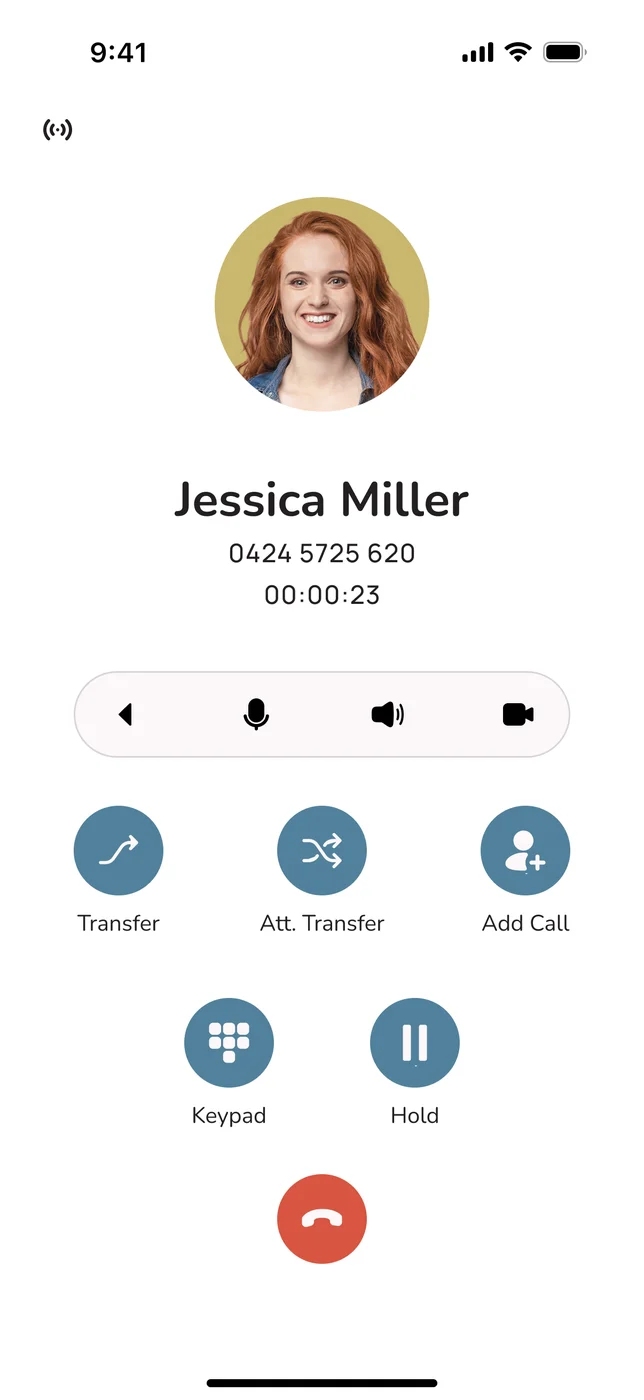
- Mobile app Live demoYour business number on your iPhone or Android
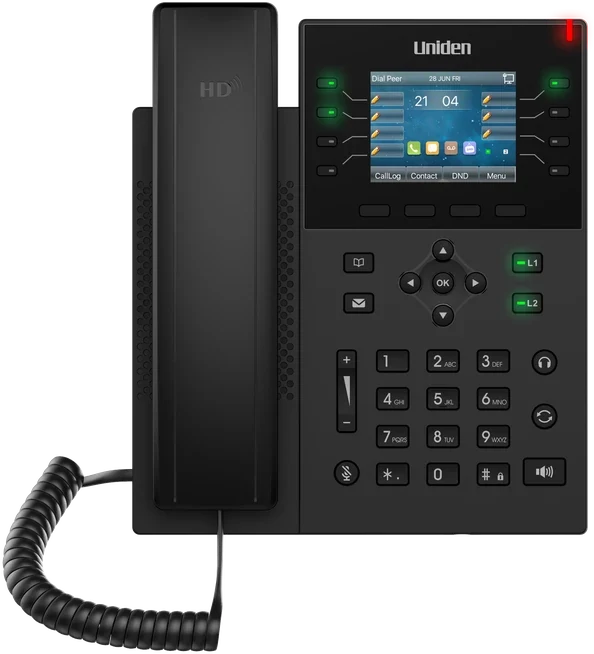
- Uniden desk phonesThe EVOC2 and a full range of office, DECT and conference phones
- Business NBNNBN set up alongside your phones, on one bill
- Why our internetBuilt for voice, so calls stay clear when the line is busy
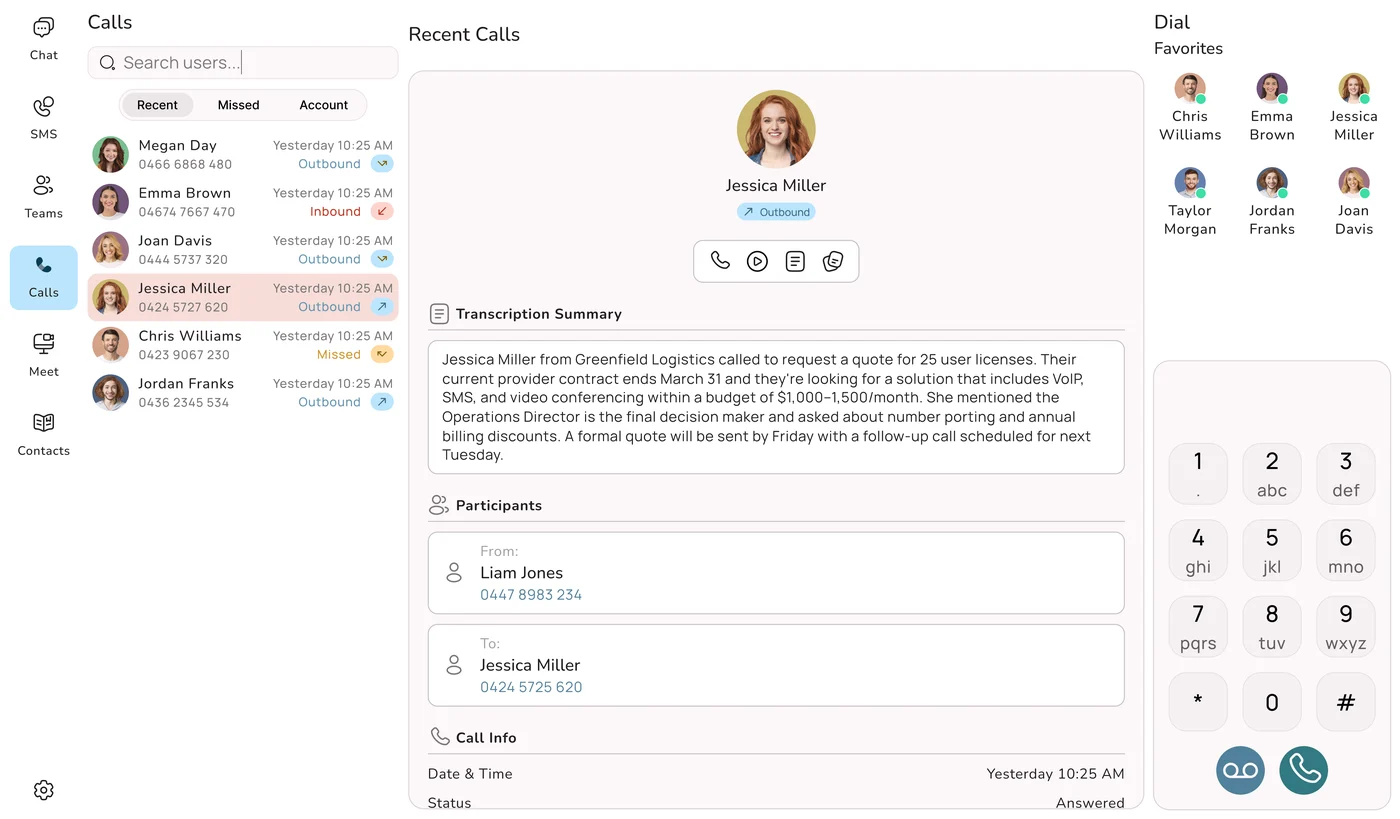
New Try it liveTake the Uniden Voice apps for a spin, right here
Click through working demos of the desktop and mobile apps: calls with AI summaries, team chat, SMS and more. No download, no sign up.
Desktop app demoMobile app demoDesigned, built, hosted and supported in Australia. Uniden desk phones, cloud apps and AI in one system.Book a demoAll features
AI on your phone line
Uniden Voice vs AI receptionists
See every comparisonAI AgentsEvery call answered, day or night
It answers on your own numbers, books the job, sends an SMS and warm transfers to your team when a person is needed.
Meet your AI agentBuilt into your phone system, not bolted on. No second number, no call forwarding.Book a demo
Professional services
Trades, retail and hospitality
Browse all industries Case study · Optical Solutions AustraliaFive branches, five phone systems, now one.5 sites1 systemRead the story
 Case study · Coco's Wealth of HealthWhen every enquiry and phone order matters.Maroubra organic health-food storeRead the story
 Case study · Shuriken Advisory GroupOne connected team across Sydney, home and overseas.30+ team1 platformRead the story
 Case study · Carlingford Dental SurgeryEvery call rings the whole team.Dental Carlingford, NSWRead the story
 Case study · PTSD Dogs AustraliaA direct line for veterans, answered from anywhere.Charity Sunshine Coast, QLDRead the story
 Case study · Imperial Realtor GroupSales calls to sales, rentals to property management.Real estate Mango Hill, QLDRead the story
 Case study · Good 2 Eat CateringA catering team on the move, on one number.Catering and events Sunshine Coast, QLDRead the story
 Case study · ManolutionsOne number for the firm, a direct line to Paul.Executive advisory Works across time zonesRead the story






Our customersFrom one-person shops to national brands
See how businesses like yours run their phones on Uniden Voice.
Find your industryWorking on your own? A real business number and NBN for sole traders, no lock-in.Sole tradersStartups
Phone plansBusiness phone planfrom$84.90/month3 users included on a 36-month term. Every feature, one simple per-user rate.Free setup and free number portingDesktop and mobile apps includedAI Agents built inSee phone plans![Uniden Voice mobile app on a call]()
![A small team working together at a desk]()
Internet, hardware and more

Bundle and savePhones and NBN from one Aussie team
One provider to call when something needs fixing. No finger pointing.
See NBN plansWe guarantee to beat any competitor's quote. Keep your existing numbers when you move across.Sign up online1300 881 662
Learn and get set up
The library at a glanceBrowse all
180business
guides403kreads
so far
guides403kreads
so far
Guides by topic
- Phone systems67
- AI24
- Industries18
- Costs13
- NBN8
- Security7
- News5
- Other guides38


Need a hand? Our support team is based in Australia.Contact support

Call us on 1300 881 662 or send a message and the team will get back to you.Send a message
Guides and Articles
For businesses, communication is key to success, but traditional phone systems often fail to meet the demands of modern operations. From high maintenance costs to limited flexibility, traditional phone systems can be burdensome. According to a study, 61% of customers have stopped business with a brand due to poor customer service, including inefficient communication. This highlights the critical role effective communication plays in business success.
The expectations of today’s customers are evolving. 86% of customers expect smooth transitions between different communication channels, whether via phone, email, or social media. As a result, businesses need a solution that supports flexible, reliable, and scalable communication. Enter the cloud-based phone system, a modern solution that’s transforming business communication.
Cloud-based phone systems are designed to simplify business communication, offering enhanced features, reduced costs, and the flexibility modern businesses require. Keep reading to explore the key reasons why a cloud-based phone system is the ultimate solution for businesses looking to upgrade their communication systems.
Simplified and cost-effective infrastructure
Traditional phone systems come with a hefty price tag. Not only do businesses need to purchase expensive hardware and equipment, but there are also ongoing costs for maintenance, upgrades, and repairs. For many small businesses, these costs can be prohibitive and inefficient.
Cloud-based phone systems, on the other hand, reduce these upfront investment costs significantly. Instead of purchasing physical phone lines, businesses subscribe to a service, which significantly lowers setup costs. Cloud-based phone systems are hosted and maintained by the service provider, meaning there are no hardware failures or maintenance fees to worry about. For businesses that are growing or changing, this also provides the scalability needed to accommodate new users or features as the business evolves.
With a cloud-based phone system, businesses only pay for the services they use, making it a cost-effective option for many small businesses. Uniden offers flexible pricing plans, ensuring that businesses can scale up or down according to their needs, without the burden of overpaying for unused services.
Flexibility and mobility for modern workplaces
With hybrid and remote work arrangements being increasingly common, businesses need communication solutions that can support their team, no matter where they are. A cloud-based phone system offers just that.
With a cloud-based phone system, employees can access the system from virtually anywhere, whether they’re at home, in the office, or on the go. This flexibility allows businesses to support remote teams, without sacrificing communication quality. Employees can make and receive calls, access voicemail, and use all the necessary communication tools without being tied to a physical office space.
This mobility also allows businesses to extend their reach to a wider talent pool. By providing employees with the tools to work from anywhere, businesses can attract and retain top talent, helping to build a diverse and flexible workforce.
Enhanced communication and collaboration tools
Cloud-based phone systems come equipped with a wide range of advanced features that enhance business communication. These features often go far beyond the capabilities of traditional phone systems, enabling better collaboration among teams and providing a more smooth communication experience for customers.
For example, cloud-based phone systems typically include video conferencing, instant messaging, and file-sharing capabilities, all integrated into the same platform. This integration makes it easier for teams to collaborate across locations, without the need for multiple communication tools or platforms. Team members can easily schedule video calls, share important documents, and chat in real time, all from one centralised system.
This enhanced communication can lead to improved collaboration, quicker decision-making, and ultimately, a more efficient workplace. For businesses, this translates to better customer service, more productive employees, and a simpler workflow.
Scalability to match business growth
One of the most significant benefits of a cloud-based phone system is scalability. As your business grows, your communication needs evolve, and a cloud phone system can easily scale to meet those needs. With traditional phone systems, adding new lines or features often requires complex installations and additional hardware, which can be time-consuming and costly.
With a cloud-based phone system, scaling is as simple as adding or removing users from the platform. New employees can be added with just a few clicks, and additional features can be activated or deactivated as needed. This flexibility ensures that businesses can grow without the hassle of constantly upgrading their phone infrastructure.
This scalability is perfect for businesses that may be expanding quickly and need a communication system that can keep up. A cloud phone system grows with your business, allowing you to focus on what matters most: serving your customers and expanding your reach.
Advanced features to optimise customer experience
Customer experience is a top priority for any business. The ability to provide fast, efficient, and personalised service is crucial in retaining customers and fostering long-term relationships. Cloud phone systems offer several features that can significantly enhance the customer experience.
For example, call routing ensures that calls are directed to the correct department or individual, reducing wait times and improving customer satisfaction. Voicemail-to-email features ensure that no communication is missed, even when employees are unavailable. These features can help businesses provide a more responsive and customer-centric service, ultimately leading to increased customer satisfaction and loyalty.
Cloud-based phone systems also provide analytics, allowing businesses to track and measure key communication metrics. This data helps businesses identify trends, optimise workflows, and ensure that customer interactions are always of the highest quality.
Cloud phone systems are the future of business communication
A cloud-based phone system offers a range of benefits that make it the ultimate solution for business communication. From cost savings and flexibility to scalability and enhanced collaboration, cloud-based phone systems provide everything modern businesses need to stay competitive.
For Australian businesses looking to future-proof their communication infrastructure, adopting cloud-based phone systems is a smart investment. Not only does it enable better customer service and collaboration, but it also ensures that your communication system is adaptable to future changes. With the ability to scale with your business and integrate smoothly with other tools, a cloud phone system provides the flexibility, reliability, and cost-effectiveness that traditional phone systems simply cannot match.
FAQs
How secure is a cloud-based phone system for business communication?
A cloud-based phone system offers robust security features, including end-to-end encryption, secure call routing, and regular software updates. These measures help protect sensitive business communications from cyber threats.
Can a cloud-based phone system improve customer service?
Yes, with features like call routing, voicemail-to-email, and the ability to track customer interactions, cloud-based phone systems can improve response times and provide more personalised customer service.
Is it difficult to switch to a cloud-based phone system?
No, switching to a cloud-based phone system is relatively easy. Many providers offer smooth migration services and support to ensure minimal disruption to your business.
Efficient communication is the backbone of any successful business, enabling teams to collaborate smoothly and respond to customer needs quickly. With businesses across Australia increasingly adopting hybrid and remote work models, choosing the right tools for communication has never been more critical. A recent survey reveals that nearly 30% of respondents work at fully remote companies, while 15% have the flexibility to work from home when required. Also, 43% of employees reported that part of their work involves full-time remote responsibilities.
This shift highlights the importance of robust communication systems that cater to diverse working environments. Cloud phone handsets, as part of modern communication setups, offer businesses the ability to maintain smooth operations while ensuring every team member stays connected, regardless of their location. Choosing the right handsets can significantly improve communication quality, productivity, and team efficiency.
With so many options available, businesses must carefully evaluate their needs to select VoIP handsets that align with their goals. This blog will guide Australian businesses through the process, ensuring you make an informed choice that benefits your company year-round.
Why selecting the best cloud phone handsets matters
VoIP handsets are central to modern business communication by providing clear and reliable connections for teams and customers alike. Whether handling customer calls, coordinating internally, or supporting remote staff, the right handsets can make all the difference.
For businesses operating in competitive markets, smooth communication translates to better productivity and enhanced customer satisfaction. High-quality VoIP handsets enable employees to work more efficiently, reducing disruptions caused by unclear audio or unreliable connections. By choosing handsets that integrate smoothly with cloud systems, businesses can create a unified communication environment that supports growth, flexibility, and long-term success.
With businesses needing to adapt quickly to changing demands, investing in the right communication tools ensures your team stays agile and connected, no matter where they are located.
Key features to consider when choosing VoIP handsets
Audio quality
Clear audio is essential for professional communication. Poor audio quality can lead to misunderstandings, wasted time, and frustrated customers or team members. When selecting VoIP handsets, look for models with noise-cancelling features and HD voice capabilities to ensure crystal-clear conversations. This is especially critical for businesses with remote employees who may work in varying environments.
Integration with cloud systems
Modern businesses rely on various software tools, such as CRMs, email systems, and project management platforms. The best VoIP handsets should integrate smoothly with cloud-based communication systems. Handsets that support features like call routing, voicemail-to-email, and real-time analytics can simplify workflows and improve team coordination.
User-friendly design and features
Not all employees are tech-savvy, so it’s essential to choose VoIP handsets that are easy to use. Look for intuitive designs with simple interfaces, programmable buttons, and customisable settings. User-friendly features save time during training and allow staff to make the most of the handset's capabilities.
Durability and build quality
VoIP handsets are often used daily, so durability is key. Businesses should invest in high-quality handsets made from reliable materials that can withstand frequent use. Models with sturdy designs and longer lifespans offer better value for money in the long run.
Mobility and flexibility (remote work capabilities)
In an era where remote work is commonplace, handsets with mobile capabilities are invaluable. Handsets that offer remote access through mobile apps or desktop integrations allow employees to stay connected whether they’re at home, on the go, or in the office. This flexibility helps businesses adapt to changing work environments without sacrificing communication quality.
Cost considerations when selecting VoIP handsets
When evaluating VoIP handsets, it’s important to strike a balance between price and performance. While it can be tempting to opt for the cheapest models, investing in quality handsets ensures better long-term value. Entry-level handsets may lack advanced features that enhance productivity, while premium models often offer benefits like HD audio, enhanced durability, and cloud integration.
Understanding your ROI is key. High-quality handsets reduce downtime, improve efficiency, and support customer satisfaction, all of which contribute to better business outcomes. Also, cloud-based handsets often come with flexible pricing plans, enabling businesses to choose solutions that align with their budget and growth goals.
By carefully evaluating costs and considering long-term benefits, Australian businesses can make informed decisions that meet their financial and operational needs.
Testing and setup of cloud phone handsets
Before fully implementing VoIP handsets, it’s crucial to test and ensure compatibility with your existing systems. Start by selecting a few models to trial, allowing key team members to assess their functionality and ease of use. Testing features such as call quality, voicemail integration, and mobile accessibility will help identify the best options for your business.
Integration with current communication systems, such as cloud platforms and CRM tools, should be smooth. Uniden, for example, offers handsets that are easy to integrate with cloud-based phone systems, ensuring minimal disruptions during the setup phase. The brand’s local Australian support team can also assist with installation, troubleshooting, and training to ensure a smooth transition.
By thoroughly testing and setting up your new VoIP handsets, you can minimise downtime and ensure your team is equipped with the tools they need to stay connected and productive.
Making the right choice for your business needs
Selecting the right cloud phone handsets is a critical step for businesses looking to enhance their communication systems. With features like clear audio quality, smooth cloud integration, and remote work capabilities, these handsets can significantly improve productivity and collaboration.
Investing in the right communication tools ensures your team can respond quickly, stay connected across locations, and provide excellent customer service. Cloud-based phone systems, when paired with the best handsets, offer a scalable and reliable solution that supports your business year-round.
Take the time to evaluate your needs and test options, and choose handsets that align with your goals. The right decision will help your team, simplify workflows, and set your business up for long-term success.
FAQs
1. Can cloud phone handsets be integrated with my current business systems?
Yes, most VoIP handsets are designed to easily integrate with your existing communication systems, such as CRMs and cloud-based tools. This ensures smooth workflows and better efficiency.
2. What’s the average cost of VoIP handsets for a business?
The cost can vary depending on the features and brand. Entry-level models start at a lower price point, while advanced handsets with additional capabilities may cost more. It’s important to assess your budget and requirements.
3. Are VoIP handsets suitable for remote teams?
VoIP handsets offer remote access through mobile apps and desktop interfaces, allowing your team to stay connected from anywhere. This is ideal for hybrid and remote work setups.
Unlocking seamless collaboration for professional teams with cloud-based communications technologies
As companies strive to enhance operational efficiency and innovation, fostering effective teamwork has become essential. In a fast-paced business environment, the way teams communicate can make or break productivity. Traditional methods of communication are often time-consuming and prone to inefficiencies, especially in the face of growing remote work trends.
This is where cloud-based communications technologies come into play, offering businesses a significant way to simplify their communication and collaboration processes. With the shift towards remote work, organisations are increasingly adopting cloud solutions to maintain real-time communication across teams, regardless of location. According to recent data, businesses can save up to 75% on communication costs with VoIP (voice over internet protocol) services, while nearly 59% of small businesses report increased productivity after implementing cloud-based communication systems. This shift is reshaping business operations, enabling teams to collaborate more effectively, and paving the way for greater flexibility and cost savings.
In this blog, we will explore how cloud-based communications technologies are changing teamwork and operational efficiency for Australian businesses, and why investing in these solutions is essential for future growth.
Why cloud-based communications technologies are essential for businesses
The increasing adoption of cloud-based communications technologies is not just a trend: it’s a fundamental shift driven by the need for more efficient and flexible business operations. Here are some key reasons why these technologies are vital for businesses today:
Real-time communication, regardless of location
Cloud-based communications technologies allow teams to communicate instantly, whether they are working from the office, at home, or on the go. This accessibility enables smooth collaboration, fostering a work environment where communication is never delayed by geographic boundaries. With tools like video conferencing, instant messaging, and VoIP calls, employees can stay connected, ensuring that business continuity is never interrupted.
Increased productivity and simplified project management
When communication is quick and effective, teams make decisions faster, share information more easily, and manage projects without unnecessary delays. Cloud-based solutions integrate a wide range of communication tools, such as email, calendars, document sharing, and task management platforms, all in one centralised location. This integration simplifies workflows, making it easier for teams to stay organised and focused on tasks.
Enhanced flexibility
As the modern workforce becomes more diverse and distributed, flexibility has become one of the top priorities for businesses. Cloud-based communications technologies offer teams the freedom to work from anywhere, using any device. Whether it’s a laptop at home or a mobile phone while on the move, cloud solutions ensure that your team has the flexibility to collaborate no matter their location.
Reduced infrastructure costs
On-premise communication systems often require costly hardware, maintenance, and IT support. Cloud-based phone systems, however, eliminate the need for physical infrastructure, allowing businesses to scale their communications smoothly without the need for complex installations. By removing the need for on-site equipment, businesses can reduce their operational expenses, making cloud solutions a more cost-effective alternative.
Benefits of cloud-based communications technologies for teams
Cloud-based communications technologies offer benefits that can transform how teams collaborate and interact. Let’s explore some of the key advantages:
Smooth communication across devices
One of the most significant benefits of cloud-based communications technologies is the ability to facilitate communication across multiple devices. Teams can communicate via instant messaging, voice calls, and video calls without the constraints of using a single device. This smooth communication flow ensures that team members can stay in touch no matter where they are working from or which device they are using.
Centralised collaboration tools
Cloud solutions integrate all your communication tools into one centralised platform. This includes email, calendar, document sharing, task management, and collaboration platforms, all accessible from a single interface. By bringing these tools together, cloud-based systems allow teams to work more efficiently, reducing the need for switching between different applications and improving overall productivity.
Scalability
As your business grows, so do your communication needs. Cloud-based communications technologies offer scalability, meaning businesses can easily expand their communications systems as they grow. Whether your team adds five employees or 50, cloud solutions allow you to scale up quickly without the hassle of installing new hardware or systems. This flexibility supports both short-term and long-term growth, making cloud solutions ideal for businesses of all sizes.
Improved security
Data security is a primary concern for businesses, especially when dealing with sensitive customer and internal information. Cloud-based services offer strong encryption and secure data backup, ensuring your communication data remains protected from breaches or loss. Also, cloud providers often comply with industry standards for data protection, which helps businesses stay in line with regulatory requirements.
Work flexibility
The flexibility offered by cloud solutions is invaluable in hybrid and remote work environments. Employees can access their communication tools from anywhere, at any time, using any device. This flexibility leads to increased employee satisfaction and helps businesses attract and retain top talent by offering work-from-home options or flexible working arrangements.
Simplified customer interactions
With centralised communication tools, businesses can simplify customer interactions, leading to faster response times and improved customer satisfaction. Whether it's handling customer service enquiries through chat or managing support calls via VoIP, cloud-based systems ensure that teams can respond quickly and efficiently to customer needs, improving the overall customer experience.
How businesses can maximise the potential of cloud communications
While cloud-based communications technologies offer numerous benefits, businesses must ensure they are maximising the potential of these tools to achieve the best results. Here are some strategies for businesses to get the most out of their cloud communication systems:
Invest in training
To fully use the capabilities of cloud-based systems, it’s important to invest in training for your team. Providing your staff with the necessary skills to use the communication tools effectively ensures everyone is on the same page, resulting in smoother collaboration and higher productivity.
Regularly evaluate performance
It’s essential to monitor and evaluate the performance of your cloud-based communication systems regularly. This allows businesses to identify areas where they can improve and simplify communication channels. Constant optimisation ensures that the system remains effective as the business evolves.
Integrate with other tools
To maximise productivity, businesses should integrate cloud-based communication tools with other platforms like CRM (customer relationship management) or ERP (enterprise resource planning) systems. This integration allows for more efficient workflows and a more connected business environment.
Focus on security and compliance
Cloud communication systems should be secure, with robust data protection protocols in place. Businesses must stay on top of security measures, especially with sensitive data, and ensure compliance with relevant industry standards and regulations.
Enhance team collaboration through cloud-based communications technologies
Cloud-based communications technologies are changing how businesses collaborate, communicate, and operate. By providing real-time communication, simplifying workflows, and offering scalability, these technologies help teams to work more efficiently and flexibly. Also, by reducing infrastructure costs and enhancing security, cloud solutions provide a cost-effective and secure alternative to traditional communication systems.
For Australian businesses looking to stay ahead of the competition, investing in cloud-based communications technologies is no longer optional: it’s essential for future growth. Choose the right cloud-based phone systems that suit your team’s needs and embrace the power of cloud technology to open up smooth collaboration and drive your business forward.
FAQs
What are cloud-based communications technologies?
Cloud-based communication tools like voice, video, messaging, and collaboration software are hosted in the cloud, eliminating the need for on-site infrastructure.
Can cloud-based communication systems support remote teams effectively?
Yes, cloud-based communication systems enable remote teams to stay connected with unified platforms for video conferencing, chat, and VoIP.
Are cloud-based communication systems secure?
Cloud-based communication systems use encryption and secure data storage, ensuring team and customer data protection, with compliance with data protection standards.
How can small businesses benefit from cloud-based communication systems?
Small businesses can reduce costs, boost productivity, and scale their communications easily while benefiting from flexible remote work solutions.
As organisations expand across borders and time zones, the need for reliable, flexible, and cost-effective communication solutions has never been greater. Enter cloud voice solutions, an innovative technology that is transforming the way businesses communicate internally and with their customers.
Also known as cloud telephony or hosted voice services, these solutions use the power of the internet to deliver voice communication services. Unlike traditional phone systems that rely on physical infrastructure, these voice solutions are hosted in the cloud, offering unparalleled flexibility and scalability. This technology is rapidly gaining traction among global businesses of all sizes, from startups to multinational corporations with the cloud phone market expected to reach USD 83 billion by 2026.
But why are businesses making the shift? Let’s find out.
Enhanced flexibility and scalability
One of the most significant benefits of cloud solutions is the flexibility they offer to global businesses. Traditional phone systems often require substantial upfront investments in hardware and are challenging to scale as the business grows. In contrast, cloud voice solutions can be easily scaled up or down to meet changing business needs.
For instance, a company expanding into new markets can quickly set up local phone numbers in different countries without the need for physical infrastructure. This allows businesses to establish a local presence in multiple markets rapidly. Similarly, during peak seasons or periods of high call volume, additional lines or features can be added instantaneously, ensuring that customer service remains uninterrupted.
Cloud solutions also support remote work smoothly. With the rise of distributed teams and flexible work arrangements, employees can access the company's phone system from anywhere with an internet connection. This level of flexibility is particularly valuable for global businesses operating across different time zones, as it enables continuous communication and collaboration regardless of physical location.
Cost reduction and improved ROI
These solutions offer significant cost savings compared to traditional phone systems saving up to 45% on call costs each month. By eliminating the need for on-premises hardware and reducing maintenance costs, businesses can reallocate their resources to core activities. The subscription model adopted by many cloud voice providers allows companies to pay only for the services they choose, further optimising costs.
International calling, which can be a significant expense for global businesses, is often more affordable with cloud voice services. Many providers offer competitive rates for international calls, and some even include unlimited international calling to certain countries in their packages. This can result in substantial savings for companies with a high volume of international communication.
The consolidation of voice and data networks can lead to additional cost reductions. By integrating voice services with other cloud-based applications, businesses can simplify their IT infrastructure and reduce overall technology costs. The improved efficiency and productivity resulting from these integrated solutions contribute to a higher ROI in the long run.
Advanced features and integration capabilities
Cloud voice services come packed with advanced features that can significantly enhance business communication. These may include call routing, voicemail-to-email transcription, and sophisticated analytics tools. These features can improve customer service, increase employee productivity, and provide valuable insights into communication patterns.
For global businesses, features like multi-language support and time-based routing are particularly valuable. These allow companies to provide localised customer experiences across different regions and ensure that calls are directed to the right departments or individuals, regardless of time zones.
Integration capabilities are another key advantage of cloud voice services. These systems can be easily integrated with other business tools such as CRM software, helpdesk systems, and collaboration platforms. This integration creates a unified communications ecosystem, enabling employees to access all necessary information and tools from a single interface. For example, when integrated with a CRM system, cloud solutions can provide instant access to customer information during calls, leading to more personalised and efficient customer interactions.
Enhanced reliability and business continuity
Today, communication downtime can have severe consequences. Cloud solutions offer enhanced reliability compared to traditional phone systems. Most providers operate on redundant networks with multiple data centres, ensuring that if one centre experiences issues, others can take over smoothly.
This distributed infrastructure also contributes to improved disaster recovery capabilities. In the event of a local disaster or outage, cloud voice services can be quickly rerouted to alternative locations, ensuring business continuity. This level of resilience is crucial for global businesses that need to maintain communication channels at all times.
Cloud voice providers typically offer service level agreements (SLAs) that guarantee high uptime and quality of service. This gives businesses peace of mind, knowing that their communication systems will remain operational even in challenging circumstances.
Select cloud voice solutions for your global enterprise
Cloud voice providers offer a range of benefits that are particularly advantageous for global businesses. From enhanced flexibility and cost savings to advanced features and improved reliability, these solutions are well-equipped to meet the complex communication needs of modern, international organisations. As businesses continue to expand globally and embrace remote work, the adoption of cloud-based phone systems is likely to accelerate, driving further innovation in this space.
FAQs
What should I consider when choosing a cloud solution provider?
When selecting a cloud voice solution provider, consider factors such as the features offered, reliability, scalability, cost, customer support, and integration capabilities. It's also important to consider the provider's experience with businesses similar to yours, especially if you're a global enterprise with specific needs.
Are cloud voice services secure?
Yes, cloud voice services can be very secure when implemented correctly. Reputable providers use encryption to protect calls and data, and they regularly update their security measures to guard against new threats. However, as with any internet-based service, businesses need to follow best practices for cybersecurity, such as using strong passwords and keeping software up to date.
How reliable are cloud solutions compared to traditional phone systems?
Cloud solutions can be very reliable, often more so than traditional phone systems. They typically operate on redundant networks with multiple data centres, which means if one centre has issues, others can take over. However, the reliability of cloud voice services does depend on the quality of your internet connection. A stable, high-speed internet connection is essential for optimal performance.
As your business grows, your communication needs change. With effective communication being an important part of business functions, it’s important to have a flexible system to accommodate these shifts. However, many small businesses still relying on traditional phone systems are missing out on scalability and cost-effectiveness.
Interestingly, 60% of small businesses in Australia are planning to phase out traditional phone systems and switch to business phone systems in the next 12 months. This isn’t surprising considering that 75% of small businesses reported cost savings after moving to cloud-based phone systems.
Enter the PBX phone system for small business operations. A cloud-based PBX system offers a scalable solution that addresses many challenges faced by small businesses. By integrating scalable solutions with a PBX system, small businesses can reduce costs, improve efficiency, and enhance customer service.
Unified communications (UC)
Unified communications refers to the process of integrating many communication tools and platforms into a simpler system. This generally includes video conferencing, voice calls, email, and instant messaging. When integrated with a PBX phone system for small business operations, unified communications can help create a cohesive communication process.
It also helps improve collaboration among your team members through varied channels regardless of the location or devices being used. Your employees have the freedom to switch between communication channels without disrupting their day-to-day activities and with multiple communication channels being utilised, employees are far more likely to improve customer service standards. This can be a significant advantage as 87% of customers are more likely to purchase goods and services if they have a positive customer experience.
While the benefits of unified communications are well-known, businesses investing in these systems that enable unified communications need to consider several implementation strategies to maximise their experience. For example, you need to choose a PBX phone system for small business operations that integrates with the unified communications platform. Look for solutions that are user-friendly and provide smooth integration.
You should also consider comprehensive training for your employees on the platform which will help them improve productivity and efficiency. Don’t forget to set clear guidelines when using different communication channels to prevent any confusion and ensure that the system is being used effectively.
CRM integration
CRM systems are important for businesses to manage customer data. Integrating it with your new PBX phone system can give you a complete 360-degree view of customer interactions which can help create more personalised and efficient processes.
With access to information like customer purchase history and preferences, you have the benefit of tailoring your services and products to their preferences. Better data is also a great way to establish targeted sales and marketing efforts that have the potential to increase your conversion rates. This integration also eliminates the need for manual data entry so that your employees can improve their productivity and you have an opportunity to reduce human errors within the business that can end up costing you more.
If this configuration is important to your business, remember to choose a PBX phone system that smoothly integrates with your existing CRM system. Most reputable phone systems can smoothly integrate with your existing systems to make it a more stress-free and simple process; however, it’s always a good idea to speak to your service provider and check on the capabilities before you commit to a specific phone system.
Think about the security measures. Since CRM integrations are centred around your customer data, you need to consider a cloud-based system that can offer you the peace of mind that your customer information is safe. One way to do this is to ensure compliance with proper safety standards.
Training, once again, becomes an important part of protecting your customer data. Ensure that adequate training is provided on the proper and safe usage of these integrated systems so that you can prevent any form of security violation.
Scalable call centre solutions
A cloud-based PBX phone system for small business operations is a great option if you’re thinking of scaling your business or call centre solutions because it helps you adjust your capacity based on demand. This is an especially important feature if you have fluctuating call volumes.
With cloud-based business phone systems, you can reduce unnecessary expenses during periods when the call volumes are low. If your business has a seasonal product or service, for example, you likely won’t get as many enquiries from customers during off-peak seasons. In this case, you can reduce the number of users and pick it up once demand starts picking up. You can also scale up during a special promotion or campaign and scale down once the event is over.
Cloud phones also offer several features that improve response times and reduce wait times which can improve customer satisfaction. With 60% of customers stating that they will not wait on the phone for more than one minute, these features can have a great impact on your business and may even be able to enhance its reputation for customer service.
For your business to have a strong foundation in making these cloud-based services work and get the desired results, ensure that you have the right analytics to monitor call centre performance and make decisions based on solid data. The right integrations can help you extract the information you need, whether it’s average call waiting time or abandoned calls, and use the data to improve your communications.
Switch to a PBX phone system for small business operations today!
Having a scalable communication system is a necessity and by integrating scalable solutions, your business can enhance its communication capabilities drastically and effectively.
From improved collaboration to enhanced productivity, these integrations come with several great benefits, giving you unparalleled flexibility to scale your business operations. Implementing these solutions may require an initial investment; however, the long-term benefits can quickly outweigh any reservations you may have about the cost.
With the right cloud-based PBX phone system for small business operations, you can create a communication infrastructure that doesn’t just complement your existing needs but also offers incredible support for where you want your business to go.
FAQs
Can I use my mobile phone with a PBX phone system?
Many modern PBX systems offer mobile apps that allow you to use your smartphone as an extension of your office phone system, enabling you to make and receive calls using your business number from anywhere.
How does a PBX system help with call routing and management?
PBX systems offer features like call queues and customisable call routing rules. This helps efficiently direct calls to the right person or department, manage high call volumes, and ensure callers reach the appropriate destination quickly.
Can a PBX phone system integrate with my other business software?
Many modern PBX systems, especially cloud-based ones, offer integrations with various business software including CRM systems, helpdesk software, and productivity tools like Microsoft OneDrive and more. This allows for simpler workflows and improved data management.
Maintaining clear and reliable communication channels is critical to staying competitive. The rise of remote work, hybrid office models, and digital tools means businesses need robust communication systems to connect teams, clients, and stakeholders. One of the most significant innovations in this field is the IP PBX system, which offers businesses greater flexibility, cost savings, and advanced features compared to traditional telephone systems.
An IP PBX system is a cloud-based solution that uses the internet to manage calls, eliminating the need for costly, outdated hardware and physical phone lines. Unlike traditional PBX systems, which rely on analogue technology, IP PBX systems provide advanced communication features such as call routing, voicemail-to-email, and analytics, all while reducing operational costs.
Understanding the IP PBX cost is essential to making informed decisions about upgrading their communication systems. With businesses reporting savings of up to 50% after switching to VoIP, the benefits are clear.
This blog will explore why IP PBX systems are a valuable investment for your business, what influences the cost, and how you can make the most of these systems to modernise your operations and future-proof your communications.
Why IP PBX systems are a valuable investment
Improved flexibility
One of the most compelling reasons for businesses to adopt IP PBX systems is the increased flexibility they offer. With features like call routing, companies can direct calls to the right department or individual, regardless of location. This is especially beneficial for businesses with remote workers, multiple locations, or a distributed workforce. The scalability of IP PBX systems also allows businesses to adjust their communication capacity as needed. Whether your company is expanding or reducing its workforce, the system adapts, providing a cost-effective solution that grows with your needs.
Enhanced productivity
IP PBX systems integrate smoothly with other modern business tools, boosting productivity across the organisation. For example, features like voicemail-to-email ensure no messages are missed, and call analytics can provide insights into communication patterns, helping managers make more informed decisions. These features simplify workflows and ensure employees can stay connected with minimal disruption. For Australian businesses, this means increased efficiency, more time to focus on core business activities, and ultimately, a stronger competitive edge.
Lower long-term costs
One of the primary attractions of IP PBX systems is their potential for lower long-term costs. Traditional PBX systems require significant upfront investment in hardware, installation, and maintenance. On the other hand, IP PBX systems are cloud-based, meaning businesses can save on physical infrastructure and maintenance costs. With a VoIP phone price that’s typically lower than traditional phone systems, companies can reduce their communication expenses significantly. This is particularly advantageous for small to medium-sized businesses that need to watch their budgets closely but still want access to sophisticated communication features.
Smooth scalability
The scalability of IP PBX systems means that businesses can expand their communication capabilities without costly upgrades or new installations. Whether you need to add new users, integrate new features, or connect additional devices, IP PBX systems provide a flexible solution that adapts to your business needs. For growing businesses, this can mean avoiding the substantial capital investment typically required to upgrade traditional PBX systems.
Advanced features
IP PBX systems come with a host of advanced features that go beyond the basics of voice communication. Businesses can access call recording, call forwarding, voicemail-to-email, and more, all as part of their plan. These features improve customer interactions, increase efficiency, and provide businesses with insights that can help improve their overall operations. With advanced analytics built into most IP PBX systems, businesses can monitor call quality, track performance, and gain valuable insights into their communication processes, ensuring a more simpler and effective business model.
What influences IP PBX cost?
While IP PBX systems offer clear advantages, understanding the factors that influence IP PBX cost is essential for businesses looking to make a strategic investment. Several elements play a role in determining the cost of implementing an IP PBX system:
Provider pricing models
IP PBX pricing can vary depending on the provider and their pricing structure. Some providers offer monthly subscriptions, while others may offer a one-time setup fee. Monthly subscriptions typically provide ongoing support, regular updates, and scalability as your business needs evolve. On the other hand, a one-time payment option may be ideal for companies that prefer to make a single, upfront payment and avoid recurring fees. It’s important to understand the total cost of ownership, including both short-term and long-term expenses, before deciding on a provider.
System size and complexity
The size and complexity of your business operations will have a direct impact on the IP PBX cost. For small businesses with fewer than 10 employees, the cost of implementing an IP PBX system will generally be lower than for larger companies with hundreds of employees. Larger organisations may require additional features, greater system capacity, and more advanced customisation, all of which can increase costs. Understanding your business’s communication needs and choosing the right plan is essential for getting the most out of your investment.
Hardware and integration needs
While IP PBX systems are cloud-based, they often require some hardware such as IP phones, headsets, or specialised devices. Also, businesses may need to integrate the system with existing communication tools, which can add to the overall cost. For example, businesses that need to integrate their IP PBX system with a CRM or other business software will need to factor in the cost of these integrations. Choosing an IP PBX provider that offers easy integration with your existing hardware and software can help mitigate some of these costs.
Support and maintenance
The cost of support and maintenance is another factor to consider when evaluating IP PBX cost. While cloud-based IP PBX systems generally require minimal on-site maintenance, ongoing technical support is often needed to ensure the system runs smoothly. Some providers offer 24/7 customer support, while others may provide more limited hours. For Australian businesses, having access to local support is critical, as it ensures quicker response times and a better understanding of local business needs. Make sure to factor in the cost of ongoing support when evaluating your options.
Customisation options
Many providers offer customisation options to tailor the IP PBX system to the specific needs of your business. Custom features such as call routing, voicemail setups, or even custom integrations can affect the overall cost. When considering the cost of an IP PBX system, businesses should evaluate whether they require custom features or whether the standard offerings will suffice. Customisation can provide significant benefits, but it’s important to weigh these benefits against the additional costs.
Reap the benefits of IP PBX systems for your business
In summary, understanding the IP PBX cost is essential to making an informed decision about your business's communication needs. By considering factors such as provider pricing models, system size, integration requirements, and support, businesses can find a solution that offers the best value for money. With lower long-term costs, smooth scalability, and advanced features, IP PBX systems provide a powerful, future-proof communication solution that helps your business stay competitive in a rapidly evolving digital market.
With flexible pricing options, local support, and modern features, IP PBX systems are a wise investment for businesses looking to modernise their communications. Start exploring VoIP phone prices and how an IP PBX system can help simplify your operations and future-proof your communication strategy today.
FAQs
Are IP PBX systems suitable for remote work setups?
Yes, IP PBX systems are designed to support hybrid and remote work environments, ensuring smooth communication across locations.
Can IP PBX systems grow with my business?
Absolutely. IP PBX systems are scalable, allowing you to expand users and features as your business grows without significant additional costs.
Do IP PBX systems require extensive maintenance?
Cloud-based IP PBX systems generally require minimal maintenance, with providers handling updates and troubleshooting remotely.
Even though communication is a key business driver, many small and medium-sized enterprises struggle to keep up with the latest technology due to budget constraints. The good news is that upgrading your communication infrastructure to a cloud-based system doesn't have to break the bank.
Let’s explore how you can enhance your business operations with affordable phone systems, providing you with cost-effective solutions that boost efficiency and productivity.
Understanding affordable phone systems
Before looking at the specifics of upgrading, it's important to understand what we mean by budget-friendly phone systems. These are communication solutions that offer advanced features and capabilities typically associated with high-end systems but at a fraction of the cost. They use modern technology, such as VoIP, to provide businesses with flexible, scalable, and feature-rich phone systems without the hefty price tag.
The benefits of upgrading to cost-effective phone systems
Upgrading your outdated phone system can bring a lot of advantages to your business.
Firstly, affordable phone systems often operate over the internet, which can significantly reduce or even eliminate traditional phone line costs, leading to substantial cost savings. Secondly, these systems offer great scalability. As your business grows, it can easily accommodate new users without requiring significant infrastructure changes, making them ideal for growing businesses.
Despite their lower cost, these phone systems often include advanced features like call forwarding, voicemail-to-email, and conference calling. These features can greatly enhance your team's productivity and communication capabilities. Also, with features like personal assistants and call queuing, you can handle customer calls more efficiently, leading to improved customer service and satisfaction.
Many affordable phone systems also offer excellent support for remote work. They often come with mobile apps and softphones, enabling smooth communication for employees working from home or on the go. This flexibility can be a big step forward in today's increasingly remote work environment with 4 in 10 Australians working from home at least once a week in 2023.
How to choose the right phone system
Selecting the right system for your business requires careful consideration of your needs and budget. Start by assessing your needs: consider the size of your business, the number of users you'll need to support, and the specific features that are essential for your operations. Next, evaluate your budget, determining how much you can afford to spend on both initial setup and ongoing costs.
Once you have a clear understanding of your needs and budget, research various options. Look into different providers and compare their offerings, prices, and customer reviews. Pay special attention to scalability - choose a system that can grow with your business to avoid the need for another upgrade soon. Also, consider integration capabilities. Ensure the system you choose can integrate with your existing tools and software to maintain a smooth workflow.
Top phone system options
While there are many options available in the market, a few popular types of affordable phone systems are worth considering. VoIP-based systems, which operate entirely over the internet, offer a wide range of features at competitive prices. Cloud-based PBX systems provide the functionality of a traditional PBX without the need for on-premises hardware, making them an excellent choice for businesses looking to minimise physical infrastructure.
Hybrid systems, which combine elements of traditional and VoIP systems, offer a balance of reliability and advanced features. These can be particularly useful for businesses transitioning from older systems. For businesses with technical expertise, open-source solutions can be an extremely cost-effective option, offering maximum customisation possibilities.
Implementing your new affordable phone system
Once you've chosen a system, a smooth implementation is key to realising its benefits. Begin by planning the transition: decide on a timeline and communicate the upcoming changes to your team. This preparation helps ensure everyone is on board and ready for the switch.
Next, prepare your network. Ensure your internet connection and network infrastructure can support the new system. This might involve upgrading your internet service or making changes to your network configuration. Following this, provide comprehensive training to your staff. Make sure everyone understands how to use the new system effectively, as this will be crucial for maximising its benefits.
Before going live, conduct thorough testing. Test all features and functions to identify and resolve any issues. This step can prevent disruptions when you officially switch over. After implementation, continually monitor the system's performance and make adjustments as needed. This ongoing optimisation will help you get the most out of your new affordable phone system.
Maximising the value of your phone system
To get the most out of your new system, it's important to utilise all its features. Many businesses only use a fraction of their system's capabilities, missing out on potential benefits. Take the time to explore and implement all relevant features. Keep your system updated regularly to ensure you have access to the latest features and security patches.
Many affordable phone systems provide analytics capabilities. Use this data to optimise your communication processes and identify areas for improvement. Also, regularly collect feedback from employees and customers. Their insights can be invaluable in fine-tuning the system to better meet your business needs.
The future of affordable cloud-based phone systems
As technology continues to evolve, we can expect affordable cloud-based phone systems to become even more feature-rich and cost-effective. Emerging technologies like AI and machine learning are likely to be integrated, offering even more advanced capabilities without significantly increasing costs. These advancements could lead to more sophisticated automated customer service options, improved call routing, and more accurate voice-to-text transcription, among other benefits.
Once you’ve found the right system with the right VoIP phone price for your business, you can position your business for success in today's volatile marketplace.
FAQs
Will an affordable phone be reliable enough for my business?
Yes, most modern affordable phones are highly reliable. They often use cloud-based technology, which means your service is backed up across multiple servers. However, the reliability also depends on your internet connection. With a stable, high-speed internet connection, affordable phone systems can be just as reliable as traditional systems, if not more so.
How difficult is it to set up and manage an affordable phone system?
The complexity of setup and management varies depending on the system you choose. Cloud-based systems are generally easier to set up and manage, often requiring little more than an internet connection and some basic configuration. On-premises systems might require more technical expertise. However, most providers offer support and management tools to help you easily administer your system, even without extensive technical knowledge.
How much can I expect to save by switching to an affordable phone system?
The amount you can save varies depending on your current setup and the new system you choose. However, many businesses report savings of 30-50% on their communication costs after switching to affordable phone systems. These savings come from reduced hardware costs, lower call rates (especially for long-distance calls), and decreased maintenance expenses.
With communication being a cornerstone of the business world, it should come as no surprise that 74% of businesses say that cloud phones are an investment priority. With 85% of businesses expecting to embrace cloud-led systems by 2025, the potential for more businesses to switch to these phone systems is high.
Just like large corporations, purchasing a cloud phone system for a small business is all about finding a better way of staying connected with stakeholders because it can be the difference between success and failure. From cost efficiency to flexibility and advanced features, many of these options were initially only available to large enterprises with big budgets to spend on sophisticated phone systems. This simply isn’t the case anymore and it’s just one of the reasons why cloud phones are becoming a more popular option.
But with the market being flooded with cloud-based phone systems with what can seem like an unlimited number of features, it can be overwhelming to select the right one with the right features for your small business.
Essential features to look for in a cloud phone system for a small business
If you’ve decided to invest in a cloud phone system for your business, you must have all the information to make the right decision because it’s a significant switch. You need to ensure that your decision aligns with your business needs and future plans.
Scalability and flexibility
As your business begins to scale, you need a phone system to keep up with your increased communication needs. Cloud phone systems give you incredible flexibility to add and remove users easily. This means that you can scale your business up or down without hassle.
Aside from adding and removing users, you can also modify the features as needed. Whether you need to hop on a conference call or need to get your voicemails sent directly to your email, you should be able to use the features you need without having to navigate complex systems that take up too much of your time.
Generally, if you were to add new features while using a traditional phone system, you would need expensive hardware upgrades, but cloud phones allow you to do this with in-built features that are regularly updated: minus the excessive costs or a complete overhaul of your phone system.
Advanced call management
Efficient call management leads to better customer service and employee productivity. One way to do this is by offering features like call queuing to manage high call volumes during peak hours. This can offer insights into estimated wait times, making it easier to improve customer satisfaction and control call abandonment rates.
Call forwarding is another popular feature where businesses don’t have to worry about missing important calls. Whether you’re expecting an important call from a prospective investor or looking to land a deal with a customer, call forwarding can help route calls to mobile phones, home offices, or any other number to ensure that you’re reachable no matter where you are.
Voicemail-to-email, as mentioned earlier, is an important feature that allows you to quickly scan and prioritise messages without going through every message. This can also lead to improved responsiveness and better time management.
Mobile integration
Today, everyone is living in a mobile-first world and the need to stay connected is becoming more important. Mobile apps, for instance, are now being used by businesses to make and receive calls on smartphones using their business phone numbers. Purchasing a cloud phone system for a small business helps you maintain a professional appearance even when working remotely.
The mobile capabilities offered by the cloud phone provider should have the same features as your office phone. This includes everything from voicemail management to call forwarding and even conference calling.
Collaboration tools
With 37% of Australians working from home at least once a week in 2023 as reported by the Australian Bureau of Statistics, employees should be able to stay connected from wherever they are working. Look for a system that offers top-quality video conferencing with features to host meetings with multiple individuals.
File-sharing capabilities are another way to simplify workflows and one way cloud phones do this is by offering integration options where everyone can access information in real time. Look for systems that can also offer quick messaging platforms that can reduce email clutter and improve team coordination without going through complex routes to achieve better communication.
Analytics and reporting
Data-driven decision-making is important for business growth and a reliable cloud phone system provides the necessary analytics and reporting capabilities to help optimise communication strategies.
Real-time analytics help businesses monitor call volumes and agent performance and even look into wait times. This is valuable information for businesses that want to improve their customer services, especially during peak times.
Detailed reports on historical data like call volumes and call durations can offer insights into call patterns that can help make informed decisions about training, staffing requirements, and resource allocation. Look for systems that offer customisable reporting options that give you the metrics that matter to you.
Choosing a cloud phone system for a small business: a critical decision for better communication
The best cloud system is the one that aligns perfectly with your specific needs. This is why businesses need to take the time to assess their needs and compare different providers and the features they offer for the price they quote.
As you begin the evaluation process, ask about the features that will contribute to your business objectives. Ask questions like, will it improve customer service? Will it have an impact on team productivity? Can it support your plans to grow?
By keeping these questions in mind you’ll have the information you need to make cloud phones a valuable asset to your small business.
FAQs
How secure is a cloud phone system for a small business?
Most reputable providers offer enterprise-grade security measures, including end-to-end encryption for calls and messages, secure data centres, and regular security updates. When choosing a cloud phone system for your small business, look for providers that comply with industry standards. It's also important to implement best practices within your business, such as using strong passwords and training employees on security protocols.
Is it possible to keep my existing phone numbers after switching to a cloud phone system?
Yes, most cloud phone system providers offer number porting, which allows you to transfer your existing phone numbers to the new system. This process ensures that your business can maintain continuity and avoid the hassle of changing phone numbers. When choosing a cloud phone system for your small business, confirm with the provider that they support number porting and inquire about any associated fees or timeframes for the porting process.
How reliable are cloud phone systems compared to traditional landlines?
Cloud phone systems can be just as reliable as traditional landlines, and in many cases, even more so. Unlike traditional systems that can be affected by local outages or physical damage to lines, cloud systems distribute their infrastructure across multiple data centres. This redundancy means that if one data centre experiences issues, others can take over smoothly.
Voice over Internet Protocol (VoIP) systems are changing how Australian businesses communicate, offering an affordable and modern alternative to traditional phone lines. With 82% of companies reporting significant savings after switching to cloud communication, it's no surprise that these communication systems are rapidly becoming the go-to choice for businesses interested in cutting costs and boosting efficiency.
However, evaluating the costs and benefits of VoIP is crucial for small businesses that want to switch to VoIP. While upfront expenses and subscription fees are factors to consider, the potential for long-term savings and enhanced functionality make VoIP systems a compelling choice.
This blog breaks down the key costs associated with VoIP phone systems, including setup fees, subscription models, and additional features, and highlights the value they bring to businesses.
What factors influence VoIP phone cost?
Understanding the components of VoIP phone costs helps businesses make informed decisions. Here are the primary factors:
Hardware expenses
Implementing a VoIP system may require specific hardware, such as IP phones, routers, and adapters. While many VoIP solutions allow the use of existing devices like computers or smartphones, investing in dedicated equipment can improve call quality and reliability. Costs for hardware vary based on the provider and the business's specific needs.
Installation and setup fees
The initial setup of a VoIP system might involve infrastructure upgrades, professional installation, and software configuration. For businesses with existing internet setups, these costs may be minimal. However, companies requiring network enhancements should budget for additional expenses.
Subscription plans
VoIP services typically operate on monthly subscription models tailored to business size and requirements. Plans can include features like unlimited calls, mobile app access, and priority customer support. Pricing tiers allow businesses to choose options that align with their needs and budgets.
Additional features
Many VoIP systems offer advanced features such as call forwarding, voicemail-to-email, and call analytics. While basic plans often include these tools, some premium features may incur extra fees. Businesses should assess which features are essential for their operations to avoid unnecessary costs.
How can businesses benefit from switching to VoIP in terms of cost?
Switching to a VoIP system can deliver substantial cost savings and operational efficiencies for Australian businesses. Here’s how:
Reduced call costs
VoIP systems offer lower rates for local, long-distance, and international calls compared to traditional landlines. This is particularly advantageous for businesses with overseas clients or remote teams, as unlimited calling plans can significantly reduce expenses.
Lower infrastructure and maintenance costs
Traditional phone systems require extensive infrastructure and ongoing maintenance, which can be costly. VoIP eliminates the need for physical landlines, reducing maintenance expenses. With most services hosted in the cloud, businesses benefit from smooth updates and minimal downtime.
Scalability and flexibility
VoIP systems are designed to scale easily. Businesses can add or remove lines and features as needed without incurring major expenses. This flexibility ensures that growing businesses can adjust their communication systems without financial strain.
Remote work efficiency
VoIP supports remote work by enabling employees to access the system from any location with an internet connection. This reduces the need for office space and other overhead costs while maintaining team productivity and communication continuity.
The long-term savings and benefits of investing in VoIP systems
Investing in a VoIP system offers more than immediate cost savings; it positions businesses for long-term success.
Cost-effective communication
With VoIP, businesses save on long-distance and international call rates. There’s also no need for expensive on-site systems, further reducing operational costs and overall VoIP phone costs.
Advanced features at no extra cost
VoIP plans often include features like voicemail-to-email, automated attendants, and call routing at no additional cost. These tools enhance productivity and simplify operations, offering excellent value for the overall VoIP phone cost.
Future-proof technology
Unlike traditional systems that require costly upgrades, VoIP systems are regularly updated with the latest features. This ensures businesses stay competitive without the need for significant additional investment.
Business growth and scalability
Expanding your communication system is simple with VoIP. Whether adding new lines, integrating mobile solutions, or expanding to multiple locations, VoIP supports business growth without the complications and expenses associated with traditional systems.
Is VoIP the right choice for your business?
VoIP phone systems offer a cost-effective, flexible, and scalable solution for Australian businesses looking to enhance their communication infrastructure. By eliminating the need for traditional landlines and providing advanced features at competitive prices, VoIP systems help businesses save money while improving efficiency.
As the demand for remote work and digital communication continues to grow, investing in a VoIP system ensures your business is equipped for the future. Explore VoIP phone price options, tailored plans and advanced features to find a cloud-based solution for your business needs.
FAQs
Are there hidden costs associated with VoIP services?
Most VoIP plans are transparent, but businesses should review contracts carefully to identify any fees for premium features, international calls, or additional support services.
How quickly can I set up a VoIP system for my business?
Many VoIP systems can be set up within a few days. Some providers offer easy plug-and-play solutions, making implementation smooth for small and medium-sized businesses.
Can VoIP systems handle high call volumes?
Yes, VoIP systems are built for scalability and can efficiently manage increasing call demands. This makes them suitable for businesses with high call volumes or seasonal fluctuations.
What equipment is needed for a VoIP system?
VoIP systems typically require an internet connection, IP phones, and optional devices like headsets or adapters. Many providers allow businesses to use existing hardware, reducing initial setup costs.
As companies increasingly embrace digital transformation, many turn to VoIP phone systems to simplify their communications. Recent studies predict the global VoIP market to reach $102.5 billion by 2026, a substantial increase from the $85.2 billion in 2021. This surge in adoption is not surprising, given that businesses can save up to 40% on their phone bills by switching to VoIP solutions.
If you're considering making the switch or upgrading your current system, knowing what to look for when you're ready to buy a VoIP phone system is essential. With this in mind, let’s explore some of the advanced features and considerations that can help you make an informed decision and choose a system that will propel your business communications into the future.
Advanced capabilities
As you prepare to buy a VoIP phone system, consider looking for solutions that incorporate advanced technologies that support cloud-based phones. These advanced features can significantly enhance your communication capabilities.
Advanced VoIP systems can offer intelligent call routing, automatically directing calls to the most appropriate team member based on factors such as skill set, availability, and past interactions. Advanced algorithms can analyse call patterns and customer interactions to provide valuable insights, helping you improve customer service and optimise your team's performance. Some systems even offer real-time speech analytics, providing instant feedback to your staff during calls and identifying areas for improvement.
Advanced security protocols and encryption
When evaluating VoIP systems, pay close attention to the security measures in place. Look for providers that offer end-to-end encryption for all voice and video communications. This ensures that your conversations remain private and protected from potential eavesdropping or data breaches.
Also, consider systems that support multi-factor authentication and role-based access controls, allowing you to manage user permissions more effectively. Some advanced VoIP systems also incorporate AI-driven anomaly detection, which can identify and flag suspicious activities in real time, providing an extra layer of protection against potential security threats.
Advanced analytics and reporting capabilities
To truly use the power of your VoIP system, look for solutions that offer comprehensive analytics and reporting tools. Advanced systems go beyond basic call logs and provide in-depth insights into various aspects of your communication. Look for features such as sentiment analysis, which can gauge customer satisfaction based on voice tone and speech patterns.
You should also consider systems that offer predictive analytics, helping you forecast call volumes, staffing needs, and potential customer issues before they arise. These advanced analytics can help you make data-driven decisions to improve your overall communication strategy and customer experience.
Scalability and flexibility in network architecture
As your business grows and evolves, your VoIP system should be able to adapt smoothly. Look for solutions that offer flexible network architectures, allowing you to easily scale up or down based on your needs. Consider systems that support hybrid deployments, combining on-premises and cloud-based components to create a tailored solution that fits your specific requirements.
Also, look for providers that offer better connection capabilities, which can optimise your network performance and ensure consistent call quality across multiple locations.
Advanced customisation and workflow automation
Finally, when you buy a VoIP phone system, consider the level of customisation and automation it offers. Look for systems that allow you to create complex call flows and automated processes tailored to your unique business needs. Advanced VoIP systems should offer robust Interactive Voice Response (IVR) menus and call routing rules.
Think about solutions that integrate with your existing business tools and allow for automated workflows. For example, a system that can create support tickets, schedule follow-up calls, or update customer records in your CRM based on call outcomes can significantly simplify your operations and improve efficiency.
Buy a VoIP phone system and make informed decisions for your business communications
As you start the journey to buy a VoIP phone system, keep these advanced considerations in mind. By focusing on advanced technologies and capabilities, robust security measures, integration with emerging technologies, advanced analytics, scalability, and customisation options, you'll be well-equipped to choose a system that not only meets your current needs but also positions your business for future growth and innovation all for the right VoIP phone price.
Remember, the right VoIP system can do more than just handle calls: it can become a powerful tool for enhancing customer experiences, improving team collaboration, and driving overall business success.
FAQs
If I’m switching to VoIP, can I keep my business’ existing phone numbers?
Yes, in most cases, you can port your existing phone numbers to your new VoIP system. This process is called number porting, and most reputable VoIP providers will assist you with this transition to ensure a smooth switch without any disruption to your business.
How secure are VoIP phone systems?
VoIP systems can be very secure when implemented correctly. Look for providers that offer multi-factor authentication, end-to-end encryption, and regular security updates. It's also important to ensure that your internal network is secure and that you have proper protocols for remote workers using the VoIP system.
Can VoIP systems integrate with our existing business tools and software?
Many modern VoIP systems offer extensive integration capabilities. They can often integrate with customer relationship management (CRM) software, helpdesk systems, email platforms, and other business tools. When choosing a VoIP provider, be sure to inquire about their integration options and compatibility with your existing software ecosystem.
According to GlobalNewswire, the global VoIP market is projected to rise from USD 134.8 billion in 2023 to USD 151.2 billion. These figures clearly show that many are turning to cloud-based phone services and leaving behind traditional phone systems with outdated technology that simply cannot keep up with today’s communication demands.
To meet these ever-increasing demands, cloud phone providers offer many benefits and services that traditional phone systems cannot compete with. From cost savings and scalability to flexibility and advanced features, these phone systems are changing how you communicate as a business. While the range of services offered can seem impressive, these same options can make it difficult to choose the right cloud-based phone systems, especially if you’re unfamiliar with the available options.
How to choose the right cloud phone providers for your business
Selecting the right provider is an important decision that has the potential to change the way your business communicates and significantly impact your overall productivity and efficiency. The right provider can help you open up a feature-rich solution that can simplify your operations and subsequently improve your customer experience as well.
Interestingly, a 2023 survey revealed that 60% of small businesses in Australia plan to switch to a cloud phone system by the end of 2024. This trend shows the growing recognition of the advantages offered by cloud-based solutions.
To ensure that your business makes the right choice, let’s take a look at some important factors that you need to consider when choosing cloud phone providers. We’ll look at the key aspects that can make or break your communication infrastructure, helping you make an informed decision that aligns with your business’s goals and objectives.
Assess your business needs
This may sound like an obvious step, but many businesses tend to underestimate or overestimate their communication requirements. So, before looking at the world of cloud-based phones, it’s important to take a step back and consider your business’s communication needs. This initial assessment can help you build a strong foundation for your decision-making process and help you narrow down your options with top-quality providers.
Start by evaluating the size of your business and the number of employees who will need to access the phone system. Are you a small startup with a handful of employees? Or a larger enterprise with hundreds of employees spread across different locations? Understanding your business’s size will help you identify the providers that cater to your business size.
Next, identify the essential features your cloud phone system will need. Think about common features like voicemail-to-email, conferencing capabilities, or call forwarding. Consult different departments and make a list of the must-have features and nice-to-have additions to guide your search for the right provider.
Consider your future scalability and potential growth as well. Can your preferred cloud phone provider scale up or down with your business? Ensure that you can add or remove users smoothly without disruptions to your business operations or costly upgrades.
Compare features and integration capabilities
Cloud phone systems offer many features designed to enhance business communication. When comparing providers, consider the following:
-
Essential features: Ensure that the provider offers core functions like call routing, voicemail-to-email, and video conferencing capabilities, all of which are must-have features for any business.
-
Integration with existing tools: Look for cloud phone providers that smoothly integrate with your existing business tools and platforms like CRMs and helpdesk software. This integration can help you improve your workflow efficiency and customer service.
-
Mobile app functionality: Having a mobile app is a feature that most providers offer, especially given that in early 2024, 33.59 million mobile connections were active in Australia. Evaluate the user experience and features offered by each provider’s mobile app and see if it adds value to your business communications.
-
Advanced features: Look for cloud phone providers that offer innovative solutions like interactive voice menus, personal assistants, and call reports. These technological advancements can offer you valuable insights and simplify your communication processes.
By carefully assessing these features and integrations, you can select the provider that aligns with your business communication needs without the hassle of changing most or all of your existing tools and platforms, saving you time and money.
Analyse pricing models and total cost of ownership
The feature-heavy benefits of cloud phone systems are clear and comprehensive. But what about the cost implications and the potential ROI that you stand to gain by opting for the right provider?
When choosing a provider, consider the financial aspects. But the stated price of the package should never be the sole consideration, you should also consider;
-
Pricing models: Compare per-user pricing versus feature-based pricing options. Determine which models align best with your business structure and level of usage.
-
Setup and hardware costs: Consider the upfront costs associated with the implementation. This can include everything from installation/setup fees to hardware requirements (if any).
-
Ongoing maintenance fees: One of the top benefits of cloud-based phone systems is a reduction in maintenance requirements. However, it’s always a good idea to check if there are any costs involved, especially when it comes to updates and support services.
-
Contract terms and flexibility: Review contract terms offered by different providers. Pay attention to commitment periods and scalability options.
-
Potential ROI and long-term savings: There are many long-term savings associated with cloud phone systems. To put these savings into perspective, research shows that VoIP solutions save 90% on international calls, 40% on local phone bills, and 75% on operational costs.
Review customer support and training options
Even if you select the most advanced and feature-rich cloud phone provider, you still need great support to bring it all together. That’s why it’s important to carefully evaluate the customer support and training offerings before settling on a provider.
First, look for providers that can offer flexible customer support options, whether it’s via the phone, email, or even live chat. Check if their services are available when you need them and consider testimonials from existing customers for more clarity.
Take a look at their onboarding process and training resources as well. Assess if they can offer you the support you need, provide practical tools for a smooth transition, and help you maximise the features available to you.
As mentioned earlier, customer reviews can also be a great way to gauge satisfaction levels and identify if any recurring issues could end up affecting your business operations and communications.
A strong track record is also important to demonstrate a commitment to continuous improvement and regular updates based on the latest technologies and features entering the market.
By understanding these elements, you can find a provider that not only offers you excellent service but also gives you the necessary tools to succeed with a brand-new system to improve your business communications.
Choose the right cloud phone for business communication efficiency
If you’re still using outdated, legacy phone systems, now is the time to take action and evaluate your current communication operations against future communication needs. Think about how cloud-based phone systems could transform your business.
Keep in mind that cloud phone systems are always evolving and choosing the right provider means that your business communications can keep up with these changes. With the right cloud phone system in place, you’ll be prepared to meet the communication challenges of today and tomorrow.
FAQs
How long does it typically take to set up a cloud phone system?
Set-up time varies depending on business size and complexity. Most cloud phone providers offer simpler setup processes to minimise disruption.
Can I keep my existing phone numbers when switching to a cloud phone system?
Yes, most cloud phone providers offer number porting, allowing you to transfer your existing phone numbers to the new system.
Are cloud phone systems suitable for remote or distributed teams?
Absolutely. Cloud phone systems are ideal for remote work, allowing employees to access the phone system from anywhere with an internet connection. They often include features like virtual extensions and mobile apps to support distributed teams.
Schools serve as important institutions for nurturing the minds of future generations. They are not just places of learning; they are vibrant communities where children develop essential life skills, social interactions, and a love for knowledge. However, as educational demands evolve, so too must the tools that facilitate learning. Technology is central to modern education, offering innovative solutions that enhance communication, collaboration, and engagement.
Voice over internet protocol (VoIP) technology is changing the communication market with the global VoIP market projected to reach a staggering $55 billion by 2025, reflecting its rapid growth and adoption across various sectors, including education.
In Australia, schools are increasingly embracing VoIP systems to modernise their communication infrastructures. These systems not only enhance internal communication among staff but also improve interactions with parents and students, thereby simplifying operations and enriching the overall educational experience.
By using VoIP technology, schools can create a more efficient, flexible, and secure communication environment, ultimately enriching the educational experience and preparing students for the challenges of the future. Here’s a detailed look at some of the advantages of adopting VoIP for schools:
Cost savings and budget efficiency
One of the most compelling reasons Australian schools are adopting VoIP technology is the significant cost savings associated with its implementation. Traditional phone systems can incur high monthly costs, particularly in a large school setting where numerous lines are needed. VoIP can cut communication costs by as much as 50%, allowing schools to allocate their limited budgets more effectively.
This reduction in expenses can free up funds that can be redirected towards more pressing educational requirements, such as classroom materials, technology upgrades, and extracurricular programs. For instance, a study indicated that schools implementing VoIP often see a return on investment within the first year due to these substantial savings.
Enhanced communication between staff, parents, and students
Effective communication is fundamental in the educational environment, and VoIP systems facilitate easier and faster connections between staff members, parents, and students. Traditional systems can be cumbersome, leading to delays in communication that can hinder school operations. VoIP simplifies this process, allowing staff to communicate effortlessly with one another and with parents.
Features such as integrated address books enable staff to quickly connect without searching for contact information. This means teachers can communicate directly with parents to discuss student progress or resolve issues swiftly, fostering a more engaged and collaborative school community. Enhanced communication also leads to better student support and encourages parents to take a more active role in their children's education, ultimately benefiting student outcomes.
Improved scalability for growing schools
As schools grow or adapt to changing needs, scalability becomes essential. VoIP systems offer remarkable flexibility, allowing schools to scale their communication systems without incurring significant costs. Whether a school is expanding to accommodate new students or adding staff for new programs, VoIP makes it easy to add new lines or extensions quickly.
This adaptability means that schools can efficiently maintain their communication infrastructure as they grow, without the need for costly hardware installations typical of traditional phone systems. For example, if a school opens a new campus or department, it can easily integrate the necessary VoIP lines, ensuring smooth communication across all locations. This scalability not only saves money but also supports continuous growth and operational efficiency.
Increased accessibility and flexibility
VoIP technology provides unparalleled accessibility and flexibility, allowing communication from any internet-enabled device. This capability is especially beneficial for staff who may need to work remotely or respond to urgent situations while off-campus.
Teachers can use their smartphones or tablets to make calls, send messages, or attend meetings without needing to be physically present at the school. This flexibility encourages staff to manage their responsibilities effectively, even when unexpected circumstances arise, such as weather-related events or personal emergencies. For instance, educators can engage with parents or colleagues from home, maintaining essential communication channels that support student success. This adaptability is crucial in today’s dynamic educational environment, where remote learning and hybrid models are becoming more prevalent.
Enhanced security and data protection
Users of cloud-based systems including VoIP have reported a 94% increase in security, further confirming the dependability of robust encryption and security features of VoIP technology that protect sensitive information from external threats. With the rise of digital communication, security has become a priority for schools which face unique challenges, including safeguarding student data and ensuring safe communication channels for staff and parents.
The enhanced security offered by VoIP technology is especially critical during crises or emergencies, where secure communication can make a significant difference in ensuring student safety and effective response measures. With features like call logging and recording, schools can also monitor communications for compliance and accountability, further strengthening their commitment to security.
Improved collaboration and integration
VoIP systems not only enhance communication but also promote collaboration by integrating with various educational tools and platforms. Many VoIP solutions offer smooth integration with learning management systems (LMS), scheduling applications, and student information systems (SIS). This integration allows for smoother workflows, enabling staff to access all necessary information from one platform.
As Australian schools continue to embrace digital solutions, the ability to integrate communication systems with educational tools will be essential for creating a more cohesive and effective learning environment.
Ensure long-term success with VoIP for schools
With the increasing emphasis on integrating technology in education, it’s clear that embracing advancements like VoIP can significantly impact the effectiveness of schools in delivering quality education.
The adoption of VoIP for schools presents numerous benefits, including cost savings, enhanced communication, scalability, accessibility, and security. As Australian schools continue to handle modern education, embracing VoIP technology is an essential step toward future-proofing their communication systems.
With the right VoIP solution, school phone systems can significantly improve operational efficiency, foster collaboration, and enhance the educational experience for staff and students. Investing in VoIP today will pave the way for a more connected and resilient educational environment for tomorrow. As education continues to evolve, the implementation of effective communication solutions will are central to supporting student success and engagement in the Australian education system.
FAQs
1. Why is VoIP for schools better than traditional phone systems?
VoIP offers significant cost savings compared to traditional phone systems, reduces hardware needs, and provides added features like scalability, flexibility, and easy integration with other communication platforms. It's ideal for schools looking to improve efficiency while staying within budget constraints.
2. How can VoIP systems help Australian schools enhance communication?
With VoIP, Australian schools can improve communication between staff, students, and parents by allowing faster and more reliable contact through a variety of channels such as voice, video, and instant messaging. The ability to reach people even when they are off-campus improves overall school connectivity.
3. How does VoIP for schools contribute to remote learning?
With the rise of remote learning, VoIP systems facilitate smooth communication between educators and students. They enable virtual classrooms through features like video conferencing and group chats, ensuring that learning can continue uninterrupted regardless of physical location. This flexibility is vital for maintaining educational standards during challenging times.
With businesses and stakeholders spread across different geographic locations, an efficient and reliable phone system is crucial for smooth communication. However, setting up a business phone system can be a complex process, and many organisations fall prey to common mistakes that can hinder productivity and lead to unnecessary expenses.
According to recent statistics, 94% of businesses reported increased productivity after implementing cloud-based systems. Also, Forbes reports that 70% of companies either already have or are planning to implement a digital transformation strategy in the future. With the growing popularity of cloud-based solutions, it's essential to understand the potential challenges faced during a business phone system setup, a critical part of the shift to the cloud, and how to overcome them.
Common mistakes to avoid during business phone system setup
When starting a business phone system setup, organisations often encounter various challenges that can impact the effectiveness of their communication infrastructure. These pitfalls, if not addressed, can lead to inefficiencies, increased costs, and frustrated users.
By understanding these potential challenges, you'll be better equipped to handle implementing a new phone system.
Inadequate needs assessment
One of the most critical mistakes organisations make is failing to conduct a thorough needs assessment before selecting a phone system. This oversight can result in choosing a system that doesn't align with the company's requirements, leading to inefficiencies and additional costs down the line.
To avoid this mistake, take the time to evaluate your current and future communication needs. Consider factors such as the number of users, call volume, desired features, and scalability requirements. Engage key stakeholders from different departments to gather comprehensive input and ensure the chosen system meets the needs of the entire organisation.
Overlooking network infrastructure
A common oversight in the setup process is neglecting to assess and upgrade the existing network infrastructure. The majority of modern phones, especially cloud-based solutions, rely on a stable internet connection. Failing to ensure your network can handle the increased bandwidth demands can result in poor call quality, dropped calls, and frustrated users.
Before implementing a new phone system, conduct a thorough network assessment. This may involve upgrading your internet connection, implementing Quality of Service (QoS) measures, or enhancing your network security. By addressing infrastructure issues proactively, you can ensure a smooth transition and optimal performance of your new phone system.
Insufficient user training
Even the most advanced phone system can fall short if users don't know how to utilise its features effectively. Many organisations make the mistake of underestimating the importance of comprehensive user training during the setup process.
To maximise the benefits of your new phone system, develop a thorough training program that covers all aspects of the system's functionality. This should include basic operations, advanced features, and troubleshooting techniques. Consider offering multiple training sessions and providing easily accessible documentation to support ongoing learning and adoption.
Neglecting security measures
The Australian Signals Directorate reported that in 2022-23, businesses reported 143 incidences in their critical infrastructures. In an era of increasing cyber threats overlooking security measures during business phone system setup can leave your organisation vulnerable to attacks. This is particularly crucial for cloud-based systems, where data is transmitted over the internet.
Ensure that your chosen phone system incorporates robust security features such as encryption, secure authentication methods, and regular security updates. Implement strong password policies and consider additional security measures like VPNs for remote workers.
Failure to plan for scalability
Small businesses in Australia have a significant failure rate with one in three businesses failing in their first year of operation. The odds keep diminishing with two out of four and three and out of four small business failures in the second and fifth years.
One of the reasons why businesses fail is their inability to evolve their systems and processes including communication. A common mistake is selecting a phone system that doesn't offer sufficient scalability to accommodate future growth or changes in business operations.
When setting up your business phone system, choose a solution that can easily scale up or down based on your needs. Cloud-based systems often offer greater flexibility in this regard, allowing you to add or remove users and features as required. Consider your long-term business goals and ensure your chosen system can adapt to support your organisation's growth trajectory.
Ignoring integration capabilities
Modern businesses rely on a variety of software tools and applications to simplify their operations. Failing to consider how your new phone system will integrate with existing tools can lead to inefficiencies and missed opportunities for productivity gains.
During the setup process, evaluate the integration capabilities of potential solutions. Look for systems that offer smooth integration with your customer relationship management (CRM) software, helpdesk applications, and other critical business tools. This integration can enhance workflow efficiency and provide valuable insights into customer interactions.
Ensuring a successful business phone system setup
By avoiding these common mistakes, organisations can significantly improve their chances of setting up business phone systems successfully. Take the time to thoroughly assess your needs, prepare your infrastructure, train your users, and plan for the future. With careful consideration and implementation, your new phone system can become a powerful tool for enhancing communication, productivity, and overall business success.
A successful setup requires thorough planning, ongoing support, and a commitment to using the full potential of your cloud-based phone system. By steering clear of these pitfalls, you'll be well on your way to establishing a robust and efficient communication infrastructure that supports your organisation's goals and growth.
FAQs
How long does it take to set up a business phone system?
The duration of a setup depends on the size of your business and the complexity of the system. Cloud-based systems often have shorter implementation times compared to on-premises solutions. It's important to work closely with your provider to establish a realistic timeline and ensure all necessary preparations are made before the installation begins.
What are the key features to look for in a modern business phone system?
Modern business phone systems should offer features such as call forwarding, voicemail-to-email, auto-attendant, call recording, and conference calling. Also, look for advanced capabilities like unified communications, mobile integration, and analytics.
What if there’s poor call quality after setting up the business phone?
If you encounter poor call quality after your setup, first check your internet connection and network infrastructure. Ensure that you have sufficient bandwidth and that Quality of Service (QoS) measures are in place.
Welcome to Uniden Voice over Cloud, where innovative communication meets the changing landscape of the National Broadband Network (NBN). In the dynamic realm of Australian business, the reliability of your communication system can make or break crucial moments. Let's explore why Uniden Voice over Cloud is not just a great product for NBN customers but a lifeline for businesses facing the dreaded impact of NBN outages.
1. Unmatched Reliability in NBN Environments:
NBN outages are the stuff of nightmares for businesses heavily reliant on smooth communication. Uniden Voice over Cloud rises to the occasion with unmatched reliability, ensuring that your business remains connected even when the NBN hits a rough patch. Our advanced infrastructure is designed to weather the storm, providing a constant lifeline for your critical communications.
2. Smooth Transition During NBN Outages:
One of the distinctive features that set Uniden Voice over Cloud apart is its ability to smoothly transition during NBN outages. When the unexpected happens, our system smoothly switches to our mobile app, allowing your business operations to continue without a hitch. No more frustrating downtimes or missed opportunities: Uniden Voice over Cloud keeps you connected when it matters most.
3. Enhanced Flexibility for Business Continuity:
We understand that business doesn't wait, especially during NBN outages. Uniden Voice over Cloud helps your team with enhanced flexibility. Whether you're in the office, working remotely, or on the move, our cloud-based communication system adapts to your needs. Keep the wheels turning and the conversations flowing, irrespective of NBN challenges.
4. Customer Support for Peace of Mind:
Navigating NBN outages can be stressful, but with Uniden Voice over Cloud, you're not alone. Our dedicated customer support team stands ready to assist you. From technical troubleshooting to providing solutions, we ensure that you receive the support you need, precisely when you need it. Say goodbye to the frustration of dealing with outages on your own.
5. Comprehensive Solution Tailored for Australian Businesses:
Uniden Voice over Cloud is not just a communication system; it's a comprehensive solution tailored for the unique needs of Australian businesses. We understand the challenges posed by the NBN, and our system is engineered to provide a robust and reliable communication infrastructure, ensuring that your business remains unaffected by the dreaded NBN outages.
6. Predictable Billing in Unpredictable Times:
In times of NBN uncertainty, Uniden Voice over Cloud offers predictability. Our subscription-based model ensures that your billing remains stable and predictable, allowing you to allocate resources efficiently. No more surprises, just a straightforward and cost-effective solution for your business communication needs.
Don't let the dread of NBN outages impact your business. Choose Uniden Voice over Cloud as your communication lifeline, providing reliability, flexibility, and peace of mind in the face of NBN uncertainties. Improve your business communication, because with Uniden, your connection is more than just a line; it's a lifeline.
Many Australian businesses are seeking more efficient and cost-effective phone systems as an essential step towards improving their business communication. With market research indicating a 7.9% growth in Australia’s VoIP market during the next few years, Voice over Internet Protocol (VoIP) technology is emerging as a top choice due to its ability to simplify communication while reducing costs.
Weighing the costs against the long-term benefits is a must when upgrading businesses to a VoIP phone system.
Here’s an overview of the primary financial and operational advantages of VoIP systems for Australian businesses, offering insights into setup, operational, and maintenance costs compared to traditional phone systems.
Initial cost savings of VoIP vs traditional phone systems
One of the main financial incentives for businesses to switch to a VoIP phone system is the reduced upfront cost. Traditional phone systems often require substantial investments in physical infrastructure, including expensive hardware such as private branch exchange (PBX) equipment. This hardware can quickly inflate costs, especially for businesses with multiple locations.
In contrast, VoIP systems are cloud-based, eliminating the need for on-site hardware. This significantly reduces the initial setup costs. The only requirement for a VoIP system is a stable internet connection and compatible devices, such as computers or VoIP phones. Many providers even offer the flexibility of integrating VoIP software with existing office equipment, allowing businesses to utilise current assets and avoid major installation expenses.
Operational costs: Subscription plans and call rates
Once a VoIP system is up and running, its operational costs offer a distinct advantage over traditional phone lines. Most VoIP providers offer subscription-based pricing models, making it easier for businesses to manage their monthly communication expenses. These subscriptions often include features such as unlimited local and international calls, which is especially beneficial for Australian businesses with global operations.
For instance, cost-effective basic VoIP phone plans are designed to accommodate small to medium-sized businesses with predictable call volumes. In comparison, advanced plans provide premium features such as call recording and auto-attendant services, allowing companies to customise their communication needs while keeping costs manageable. VoIP phone rates are generally lower than traditional landline costs, with many providers offering competitive international call rates, further contributing to operational savings.
Also, VoIP systems use internet bandwidth, which allows for the transmission of data and voice over a single network. This consolidation reduces the need for multiple service providers and can lead to significant savings in telecommunications expenses.
Flexibility and scalability of VoIP systems
For small to medium-sized enterprises (SMEs) in Australia, flexibility is essential. VoIP systems offer unparalleled scalability, allowing businesses to expand or downsize their communication networks as needed. Unlike traditional phone systems, which often require costly upgrades or additional lines, VoIP systems can be adjusted by simply increasing or reducing the number of lines through a software interface.
This scalability is ideal for businesses experiencing rapid growth or seasonal demand fluctuations. For example, during peak business periods, additional lines can be added in minutes, ensuring smooth communication without service interruptions. Once the demand subsides, those lines can be removed just as easily, preventing unnecessary ongoing costs.
Also, VoIP’s flexibility extends beyond scaling operations. Employees can access the VoIP system remotely, making it easier for businesses to support hybrid work environments and mobile teams. Whether staff are working from home or travelling, they can maintain their productivity using the same phone system, ensuring uninterrupted business operations.
Advanced features for lower VoIP phone rates
VoIP systems come equipped with an array of advanced features that are typically either unavailable or come at a premium with traditional phone systems. Voicemail-to-email, auto-attendants, call forwarding, and conference call capabilities are often included in even the most basic VoIP packages, allowing Australian businesses to optimise their communication processes without incurring additional costs.
For example, features like call forwarding and virtual voicemail ensure that employees remain accessible regardless of their physical location, boosting productivity and enhancing client satisfaction. Conference call functionalities, which can often be an added cost with traditional phone systems, are integrated into most VoIP packages, facilitating smooth team communication.
VoIP phone prices generally include these services as part of an all-inclusive package, making it more cost-effective than paying separately for each feature with a traditional system. This comprehensive approach reduces the complexity of managing multiple systems and keeps costs predictable and manageable.
Maintenance and support costs
Traditional phone systems often require regular maintenance and servicing, which can be time-consuming and costly. Businesses need to budget for the upkeep of on-site hardware, potential downtime, and the labour costs associated with repairs and troubleshooting.
In contrast, VoIP systems are hosted in the cloud, and their maintenance is handled by the service provider. Regular updates, bug fixes, and performance optimisations are carried out remotely, ensuring minimal disruption to the business. This hands-off approach to maintenance reduces both the financial burden and the potential for operational downtime.
Most VoIP service providers also offer 24/7 customer support as part of their service packages. This ensures that businesses can receive immediate assistance whenever an issue arises, preventing prolonged communication outages and minimising the risk of lost revenue due to system failures.
Long-term ROI for Australian businesses
When evaluating the long-term return on investment (ROI) of a VoIP system, the financial benefits become increasingly clear. While the initial costs of transitioning to a VoIP system are relatively low, the ongoing savings and operational efficiencies compound over time.
The flexibility and scalability of VoIP systems ensure that businesses only pay for what they need, allowing them to optimise communication expenses as they grow. Also, the advanced features provided at lower VoIP phone rates contribute to improved productivity, which can directly impact a business's bottom line.
As Australian businesses continue to evolve in a digital-first landscape, investing in a VoIP system positions them to scale with ease, reduce costs, and maintain a competitive edge in their industry.
Maximise communication efficiency and savings with VoIP
VoIP technology presents Australian businesses with a powerful communication solution that balances cost-effectiveness with advanced features and flexibility. The initial savings in setup, lower operational costs, and reduced maintenance overhead make VoIP systems a compelling alternative to traditional phone lines.
With benefits such as scalability, flexibility, and enhanced communication features at competitive VoIP phone rates, businesses can achieve both financial savings and long-term operational efficiency. For any Australian business looking to upgrade its communication systems, switching to VoIP is an investment worth considering.
FAQs
What’s the difference between VoIP phone rates and traditional phone line rates?
VoIP rates are typically lower as they use internet technology instead of expensive landlines.
Is VoIP secure for business communications?
Most VoIP providers use encryption and security protocols to protect calls and data, ensuring secure communication for businesses.
How does VoIP handle business continuity during outages?
VoIP systems offer backup features like call forwarding to mobile devices, ensuring that communication remains uninterrupted even during power or internet outages.
Cloud phone systems have emerged as a big step forward, offering flexibility, scalability, and cost-effectiveness. For businesses in Sydney looking to upgrade their telecommunications infrastructure, cloud phone systems present an excellent solution.
According to a recent study by Gartner, 85% of companies will have moved to cloud-based systems by 2025. This statistic highlights the growing trend towards cloud-based solutions, including telecommunications. Also, a report by MarketsandMarkets predicts that the global cloud-based contact centre market will reach USD 84.4 billion by 2029: a significant growth from USD 26.2 billion in 2024. These figures underscore the importance of adopting cloud-based systems for businesses of all sizes.
But for your business to truly reap the benefits that cloud phone systems in Sydney offer, you must understand how to set up your cloud phones for a better experience. Let’s take a closer look.
A step-by-step guide to setting up cloud phone systems in Sydney
Step 1: Assess your business needs and choose a provider
The first step in setting up cloud phone systems in Sydney is to evaluate your business requirements and select an appropriate provider. Consider factors like the number of users, call volume, required features, budget constraints, and integration needs with existing systems.
There are many cloud phone system providers in the market so it’s important to compare their offerings, reliability, customer support, scalability options, integration capabilities, and pricing structures to ensure you’re getting the best system.
Ask for demos or free trials to test the systems before deciding. This assessment will ensure you choose a solution that aligns with your business goals and provides the necessary functionality to improve your communication infrastructure.
Step 2: Prepare your network infrastructure
Once you've selected a provider, assess and prepare your network infrastructure for the new cloud phone system. Start by evaluating your internet connection. Cloud phone systems rely heavily on a stable and robust internet service so it’s important to ensure you have a connection that can support your new phone system. Ensure that your Sydney office has sufficient bandwidth to support voice calls, and consider implementing a backup internet solution to prevent downtime.
Next, examine your network infrastructure to determine if any upgrades are needed. This may include upgrading to PoE (Power over Ethernet) switches, implementing QoS (Quality of Service) settings on your router, or setting up VLANs (Virtual Local Area Networks) to prioritise voice traffic. Consult with your IT team or a network specialist to optimise your infrastructure for cloud phone systems, ensuring smooth operation and high call quality.
Step 3: Set up user accounts and configure hardware
With your infrastructure in place, the next step is to set up user accounts and configure the necessary hardware.
Work with your chosen provider to create individual user profiles, assign phone numbers and extensions, set up voicemail boxes, and configure call forwarding rules. Ensure each user has the appropriate permissions and features based on their role.
Next, select and configure compatible IP phones or softphones for your cloud phone system. Many providers offer a range of options, from basic models to advanced executive phones. Consider factors like display size and quality, number of line appearances, speakerphone capabilities, and headset compatibility when choosing your hardware. Once you've selected, configure the phones according to your provider's instructions, which typically involves entering account details and network settings.
Step 4: Implement call routing and train your staff
The fourth step involves setting up your call routing system and providing comprehensive training to your staff. Configure your call routing and Interactive Voice Response (IVR) to direct incoming calls. This includes setting up a main greeting, creating menu options for different departments, establishing business hours and after-hours routing, and configuring voicemail settings. Customise these settings to reflect your business structure and ensure callers can easily reach the right person or department.
Once your system is configured, focus on training your Sydney-based team on how to use the new cloud phone system. Cover topics like basic call handling, accessing voicemail, using advanced features like call transfer and conference calls, and troubleshooting common issues. You can create user guides or video tutorials for future reference, ensuring your team can fully use the new system’s capabilities.
Step 5: Test, optimise, and maintain
The final step in setting up cloud phone systems is to thoroughly test the system, optimise its performance, and establish a maintenance routine. Before going live, conduct comprehensive testing to ensure everything is working correctly. This includes making test calls to all extensions, verifying call quality, testing advanced features, and checking integrations with other business systems.
Address any issues or concerns before fully transitioning to the new system. Once your cloud phone system is up and running, regularly monitor its performance and gather user feedback. Stay in touch with your provider for software updates, security patches, and new feature rollouts. Continuously optimise your system to ensure it meets your evolving business needs. Remember that the transition to a cloud phone system is an ongoing process, so be prepared to adjust your setup as your business grows and technology advances.
Embracing the future of business communication with cloud phone systems in Sydney
Setting up cloud-based phone systems is a strategic move that can significantly enhance your business communication capabilities. By following this step-by-step guide, you'll be well-equipped to implement a robust and efficient cloud-based phone system that meets your unique needs.
FAQs
Can I keep my existing phone numbers if I move to a cloud-based phone?
Yes, in most cases, you can retain your existing phone numbers when transitioning to a cloud phone system. This process is called number porting. Most cloud phone system providers in Sydney offer number porting services, allowing you to transfer your current numbers to the new system. However, check with your chosen provider about the porting process and any associated fees.
How secure are cloud phone systems for business use?
Cloud phone systems can be very secure when implemented correctly. Reputable providers use encryption protocols to protect call data and often have multiple layers of security measures in place.
What are the main benefits of cloud phone systems for small businesses?
Cloud phone systems offer numerous advantages for small businesses, including increased flexibility, scalability, and cost-effectiveness. They allow employees to work remotely, scale up or down based on business needs, and reduce hardware and maintenance costs associated with traditional phone systems.
In the vibrant landscape of Australia, choosing the right communication system is crucial for the success of your enterprise. Allow us to elucidate why Uniden Voice over Cloud stands head and shoulders above the competition, particularly when compared to Telstra Dot.
Uniden Voice over Cloud prides itself on delivering unparalleled reliability. Experience consistently high-quality calls and data transmission, ensuring that your business communication remains smooth and uninterrupted. Telstra Dot, while reliable, may occasionally encounter outages, potentially disrupting your crucial conversations.
When it comes to customer support, Uniden Voice over Cloud takes the lead with our dedicated assistance. Our team is committed to promptly addressing your concerns and providing solutions, ensuring that you receive the support you need, when you need it. Telstra Dot, while offering reliable support, may not match the swiftness and responsiveness that Uniden is known for.
In the face of the dreaded NBN outage, Uniden Voice over Cloud smoothly transitions to our mobile app, allowing your business operations to continue without missing a beat. Telstra Dot, on the other hand, offers no functionality during NBN outages, leaving you stranded in critical moments.
Uniden Voice over Cloud stands out as the only communication solution that provides end-to-end support for both hardware and software. From modern plug and play phones to cloud-based software, our complete approach simplifies maintenance and ensures compatibility.
| Advantages | Uniden Voice over Cloud | Telstra Dot |
|---|---|---|
| Reliability | High reliability with HQ call quality & fail-over to our Free Mobile App. | May experience occasional outages as it requires an active and working NBN service. |
| Customer Support | Exceptional customer support with Australian based account and support managers. | Long response times, no local account manager. |
| NBN Offline Functionality | Smooth transition to mobile app during NBN outages. | Phone lines offline during NBN outages. |
| Hardware and Software Support | Comprehensive support for both our Uniden Plug and Play hardware and software. | Supports a limited number of 3rd party Telstra-approved devices and software with limited support. |
| Flexibility and Mobility | Offers unparalleled flexibility and mobility with cloud-based communication. | Limitations in mobility support. |
| Scalability | Highly scalable to accommodate businesses of all sizes. From 3 lines and users to unlimited we have you covered. | You can connect up to 9 separate lines, however, only a maximum of 3 lines can be used at the same time, whether they're calls you receive or calls you make (eg phones, fax or EFTPOS lines). You'll need to take up a separate plan for each phone line. |
| Integration with Cloud Services | Smoothly integrates with various 3rd party applications and cloud services. | No support to 3rd party applications. |
| Cost Efficiency | Predictable billing with a subscription-based model. | May have variable costs and additional charges. |
Effective communication is key in educational settings, serving as the backbone for collaboration among staff, students, and parents. With the increasing complexity of school environments, traditional communication systems often fall short of meeting the diverse needs of modern educational institutions. This is where VoIP phone systems for schools emerge as a significant solution, offering a comprehensive approach to school communication.
Traditional phone systems are often limited in functionality and incur high costs due to maintenance and long-distance charges. In contrast, VoIP systems provide flexibility and scalability, allowing schools to adjust their communication needs as they grow. Plus, using VoIP can reduce telecommunication budgets by up to 75% compared to traditional systems, ensuring you can reallocate funds to more important requirements.
Key benefits of VoIP phone systems for schools
1. Cost savings
The financial implications of switching to VoIP are noteworthy. Traditional phone systems often require costly hardware installations and ongoing maintenance fees. In contrast, VoIP solutions typically involve lower upfront costs due to their cloud-based nature. Schools can benefit from free setup and feature-rich systems, which are often part of the service package offered by many VoIP providers.
2. Long-term financial benefits
Beyond initial savings, the long-term financial benefits of adopting VoIP include reduced operational costs and increased efficiency. Schools can allocate funds saved from telecommunication expenses towards educational resources or programmes.
3. Advanced communication features relevant to schools
-
Call recording and monitoring: This feature allows schools to maintain records of important conversations for accountability and training purposes.
-
Voicemail-to-email functionality: Educators can receive voicemails directly in their email inboxes, simplifying communication and making conversations among students and staff more efficient.
-
Auto attendants and call routing: These features ensure that calls are directed to the appropriate departments or personnel without delay.
Safety and emergency features
Safety is essential in educational settings. VoIP systems enhance safety protocols through simpler emergency broadcasts where immediate alerts can be sent out to staff during emergencies. Also, an address book feature offers a centralised address book which greatly simplifies contacting key personnel during critical situations.
Benefits of VoIP for school administration
Implementing a VoIP system facilitates improved communication among staff, parents, and students. The integration of various communication tools, such as video conferencing and instant messaging, simplifies administrative processes.
Unified communication tools also enable smooth collaboration among staff members, enhancing productivity. Effective communication tools can improve teacher satisfaction and retention rates, ensuring that schools continue to employ the best educators.
VoIP phone systems for schools allow administrators to manage calls from various devices, providing the flexibility that is essential in today’s dynamic educational environments. This capability ensures that important communications are never missed.
If you’re planning on transitioning from traditional phone systems to VoIP then careful planning is essential. The steps to ensure a successful transition and integration include the following:
-
Assessment: Evaluate current communication needs and infrastructure.
-
Choosing a Provider: Research potential providers based on features, pricing, and support options.
-
Installation: Work with the chosen provider for a smooth installation process.
Considerations for choosing the right VoIP provider
Selecting a suitable VoIP phone systems provider involves examining features such as scalability, customer support availability, and integration capabilities with existing school systems.
Importance of training staff on new systems
Training is crucial for ensuring staff members are comfortable using new technologies. Effective training programs can lead to higher adoption rates and better utilisation of VoIP features.
Future-proofing school communication
VoIP technology is adaptable to future advancements in education technology. As schools increasingly integrate digital tools into their curricula, having a robust communication system like VoIP will be essential for supporting these initiatives.
As educational technologies evolve, such as AI-driven learning platforms or virtual classrooms, VoIP may even be able to integrate with these tools smoothly. This adaptability ensures that schools remain at the forefront of educational innovation and adapt to future technological advancement easily.
Choosing VoIP phone system for schools: a vital choice for improved communication
Adopting a VoIP phone system represents a significant step forward in enhancing communication within schools. The many benefits, ranging from cost savings to advanced safety features, make it an essential choice for modern educational institutions looking to improve their communication infrastructure. By investing in VoIP technology to integrate school phone systems, schools not only enhance their operational efficiency but also create a safer and more connected environment for students and staff alike.
As education continues to evolve in the digital age, embracing innovative solutions like VoIP will be crucial for fostering effective communication across all levels of the educational landscape
FAQs
1. How do VoIP phone systems for schools improve communication between teachers and parents?
VoIP enhances communication between teachers and parents through features like instant messaging, video conferencing, and voicemail-to-email capabilities. These tools allow educators to quickly reach out to parents for updates, meetings, or concerns, fostering a more collaborative relationship. Also, automated notifications can keep parents informed about important announcements or events.
2. Are VoIP phone systems secure for use in schools?
Yes, VoIP phone systems can be secure when properly configured. Most providers offer encryption protocols to protect voice data during transmission. Schools should also implement strong passwords, regular software updates, and network security measures (like firewalls) to safeguard sensitive information and ensure compliance with privacy regulations.
3. What kind of internet bandwidth is required for VoIP in schools?
The bandwidth required for VoIP depends on the number of concurrent calls and the quality of the audio desired. Generally, a standard VoIP call requires about 100 kbps (kilobits per second) per call. Schools should assess their current internet capacity and consider upgrading their bandwidth to accommodate peak usage times without compromising call quality.
Traditional communication methods, while once revolutionary, are starting to show their limitations in the face of evolving workplace dynamics and technological advancements. Enter voice-over cloud technology: a big step forward reshaping how Australian businesses communicate internally and with their customers.
The adoption of cloud technologies in Australian businesses has been on the rise. According to recent projections, the Public Cloud market in Australia is set to grow by an impressive 18.53%. This trend highlights the increasing recognition of the value added by cloud-based solutions, particularly in business communication.
Let's explore four key ways voice-over cloud is changing communication for modern Australian businesses.
Cost efficiency
One of the most compelling advantages of this technology is its cost-effectiveness. Traditional communication systems often require significant upfront investments in hardware and infrastructure. In contrast, these solutions eliminate the need for expensive on-premises equipment, drastically reducing initial costs.
Also, the ongoing expenses associated with maintenance and operations are substantially lower with cloud-based systems. Service providers handle updates, upgrades, and routine maintenance, freeing up valuable IT resources within the organisation. This shift in responsibility translates to significant cost savings over time.
The financial benefits are particularly noteworthy for small businesses. Studies indicate that 75% of small businesses experienced cost savings after transitioning to cloud phones. These savings can be redirected towards other critical business areas, supporting growth and innovation.
Cloud-based phones also generally operate on subscription models, allowing businesses to pay only for the services and features they need. This flexibility ensures that companies of all sizes can access enterprise-grade communication tools without breaking the bank.
Scalability and flexibility
The ability to scale operations quickly and efficiently is critical. Voice-over cloud technology excels in this aspect, offering unparalleled scalability and flexibility.
As businesses grow, their communication needs evolve. Cloud-based systems allow for smooth scaling, enabling companies to add or remove users, lines, and features with minimal effort. This agility ensures the communication infrastructure can keep pace with the organisation's growth without major overhauls or investments.
The flexibility of these solutions extends beyond scalability. It supports remote work arrangements: a trend that has gained significant traction in recent years. Data from the Australian HR Institute reveals that a staggering 97% of organisations are offering some form of flexible remote working in 2024. Cloud technology facilitates this shift by enabling employees to access the full suite of communication tools from anywhere with an internet connection.
Advanced features and integrations
Cloud-based phones aren’t just about replicating traditional phone systems in the cloud; it's about enhancing and expanding communication capabilities. These solutions have advanced features that can significantly boost productivity and improve customer service.
Features like voicemail-to-email transcription, call analytics, and automated attendants are standard in many cloud-based phone packages. These tools help businesses manage their communications more efficiently, gain insights into call patterns, and provide better customer experiences.
The integration capabilities of cloud-based phones are also a big step forward for many organisations. These solutions can smoothly integrate with other essential business tools such as CRM systems and collaboration platforms. This integration creates a unified communication ecosystem, simplifying workflows and enhancing efficiency.
The extensibility of voice-over cloud systems through APIs and third-party applications opens up a world of possibilities for customisation. Businesses can tailor their communication systems to their specific needs, creating unique solutions that give them a competitive edge in their respective markets.
Enhanced reliability and security
In an era where data breaches and system downtimes can have severe consequences, the reliability and security of communication systems are of utmost importance. This technology addresses these concerns head-on, offering robust solutions that outperform traditional systems.
Cloud service providers invest heavily in infrastructure, ensuring high uptime and implementing sophisticated disaster recovery mechanisms. This level of reliability is often difficult and costly for individual businesses to achieve with on-premises systems.
Security is another area where cloud solutions shine. Service providers regularly update their systems and apply security patches, protecting businesses against the latest threats. Data encryption and secure communication protocols are standard features, safeguarding sensitive information during transmission and storage.
The effectiveness of these security measures is evident in the statistics. An impressive 94% of companies report experiencing greater security after migrating to cloud-based communication systems. This increased security protects the business and builds trust with customers and partners.
Voice-over cloud solutions: a leap towards modern business communication
Embracing cloud-based phone systems isn't just an option: it's becoming necessary for those looking to stay competitive and agile. The benefits extend beyond mere communication, impacting overall operational efficiency, customer satisfaction, and ultimately, the bottom line.
For Australian businesses looking to change their communication systems, this technology offers a compelling solution. It's not just about keeping up with the times; it's about preparing for the future of business communication.
FAQs
Can cloud systems integrate with other business tools?
Yes. One of the key advantages of cloud-based phone systems is their ability to integrate with other business tools such as CRM systems, collaboration platforms, and various third-party applications.
Can cloud phone systems handle international calls efficiently?
Yes, cloud phone systems are excellent for international calling. They often offer lower international rates compared to traditional phone systems. Also, many providers have points of presence in multiple countries, which can improve call quality for international communications.
Can we keep our existing phone numbers when switching to a cloud-based phone system?
Yes, in most cases you can port your existing phone numbers to a cloud-based phone system. This process, known as number porting, allows you to maintain business continuity and avoid the hassle of changing your contact information.
Uniden Voice over Cloud offers a comprehensive solution that prioritises reliability, exceptional support, offline functionality during the dreaded NBN outages through the mobile app, and the unique ability to supply and support both hardware and software.
-
Reliability, The Foundation of Trust: Uniden Voice over Cloud has earned its reputation as the most reliable communication system in Australia. Businesses can rely on consistent, high-quality voice calls and data transmission, ensuring that communication remains smooth and uninterrupted. In a country where reliability is non-negotiable, Uniden Voice over Cloud emerges as the benchmark for dependable business communication.
-
Exceptional Customer Support, A True Partner: What sets Uniden Voice over Cloud apart is its commitment to exceptional customer support. Australian businesses value a partner they can trust, and Uniden provides unparalleled support. From troubleshooting technical issues to addressing concerns promptly, the dedicated support ensures that businesses can focus on their operations with confidence.
-
NBN Offline Functionality with Mobile App: Recognising the challenges posed by NBN outages, Uniden Voice over Cloud takes innovation to the next level. When the NBN is offline, the system smoothly transitions to a mobile app, ensuring that businesses can continue their operations without disruptions. This unique feature reflects Uniden's commitment to keeping businesses connected under any circumstances.
-
Hardware and Software Support, A Comprehensive Solution: Uniden Voice over Cloud stands alone as the only communication solution in Australia that provides end-to-end support for both hardware and software. From modern IP phones to modern cloud-based software, businesses can rely on Uniden for a complete communication solution. This comprehensive support simplifies maintenance, simplifies updates, and ensures compatibility across all aspects of the system.
-
Tailored for the Australian Business Market: Uniden Voice over Cloud understands the nuances of the Australian business market. The system is designed to cater to the specific needs of local businesses, offering features and support that align with the unique challenges and opportunities present in the Australian market.
From our unwavering commitment to customer support to its innovative approach to NBN outages and comprehensive support for both hardware and software, Uniden Voice over Cloud is not just a communication system: it's a true partner for Australian businesses. As companies handle modern communication.
The legal profession has always been built on the foundation of clear, timely, and confidential communication. Whether it's discussing case strategies with colleagues, negotiating with opposing counsel, or advising clients, the quality and efficiency of communication can make or break a case. Traditional phone systems, while reliable, often fall short of meeting the dynamic needs of modern law practices. This is where VoIP for law firms steps in, changing the way legal professionals connect and collaborate.
VoIP for law firms represents a significant leap forward in communication technology. By using the power of the internet to transmit voice and video data, VoIP systems offer a level of flexibility, scalability, and feature-richness that was previously unattainable with conventional phone lines. From smooth video conferencing to integrated document sharing, VoIP provides a comprehensive suite of tools designed to enhance every aspect of legal communication.
As we explore the specific ways VoIP can improve case collaboration for law firms, it's important to recognise that this technology is not just about replacing old phone systems with new ones. Rather, it's about reimagining how legal professionals can work together more effectively, serve their clients more efficiently, and ultimately drive better results in an increasingly competitive legal marketplace.
Improve case collaboration with VoIP for law firms
VoIP technology offers numerous features and capabilities that can significantly enhance collaboration within law firms. By using these tools effectively, legal professionals can simplify their workflows, improve communication, and ultimately provide better service to their clients. Let's explore some key ways in which VoIP can change case collaboration in the legal sector.
Smooth remote collaboration
One of the most significant advantages of VoIP for law firms is its ability to facilitate smooth remote collaboration. At a time when legal professionals often work from various locations, including home offices, courtrooms, and client sites, VoIP technology bridges the gap between team members regardless of their physical location. This capability is particularly valuable for firms with multiple offices or those working on cases that span different jurisdictions.
VoIP systems enable lawyers and support staff to conduct high-quality voice and video calls, share screens, and collaborate on documents in real time. For example, a team working on a complex litigation case can host virtual meetings where they discuss strategy, review evidence, and make critical decisions without the need for everyone to be in the same room. This level of flexibility not only saves time and reduces travel costs but also allows for more frequent and productive interactions among team members.
VoIP's mobile integration features also ensure that lawyers can stay connected and responsive even when they're on the go. Whether attending a court hearing or meeting with a client, legal professionals can access their office phone system through their smartphones, ensuring they never miss important calls or updates related to ongoing cases.
Enhanced client communication
Effective client communication is a cornerstone for building trust, managing expectations, and achieving successful case outcomes. VoIP technology offers several features that can significantly enhance the way law firms interact with their clients. One such feature is the ability to set up virtual reception services, which can provide a more professional and efficient first point of contact for clients calling the firm.
Advanced call routing capabilities ensure that clients are directed to the most appropriate team member based on their specific needs or the case they're enquiring about. This not only improves the client experience but also helps lawyers manage their time more effectively by prioritising urgent client matters.
Another valuable feature is the ability to conduct secure video conferences with clients. This is particularly useful for initial consultations, case updates, or when clients are unable to visit the office in person. Video calls provide a more personal touch compared to traditional phone calls, allowing lawyers to build stronger relationships with their clients and convey complex legal information more effectively.
VoIP systems often come with call recording capabilities as well, which can be invaluable for maintaining accurate records of client conversations. These recordings can serve as a reference for case details, help in preparing for court appearances, and even provide protection against potential disputes over what was discussed during a call.
Simpler document sharing and collaboration
Efficient document management and collaboration are essential for successful case outcomes. VoIP for law firms often integrates with document sharing and collaboration tools, creating a unified platform for communication and file management. This integration can significantly simplify the process of working on legal documents, contracts, and case files.
With VoIP-enabled collaboration tools, lawyers can initiate a call or video conference and simultaneously access and edit shared documents in real time. For example, during a team meeting to review a contract, all participants can view the document on their screens, make suggestions, and see changes as they happen. This level of synchronisation eliminates the need for multiple rounds of email exchanges and reduces the risk of version control issues.
The ability to quickly share and discuss documents during calls also facilitates faster decision-making processes. For example, if a time-sensitive settlement offer is received, the legal team can promptly review the document together, discuss its implications, and formulate a response without delay.
Improved case management and workflow integration
Many modern VoIP solutions offer APIs (Application Programming Interfaces) that allow for smooth integration with other software used by law firms, such as case management systems, time-tracking tools, and customer relationship management (CRM) platforms.
This integration can lead to significant improvements in workflow efficiency and data accuracy. For example, when a lawyer receives a call from a client, the VoIP system can automatically pull up relevant case information from the firm's case management system, providing instant access to critical details.
By integrating VoIP with other essential tools, law firms can create a more cohesive and efficient work environment. This not only improves internal collaboration but also enhances the overall quality of service provided to clients. The smooth flow of information between different systems reduces the risk of errors, saves time on administrative tasks, and allows legal professionals to focus more on the substantive aspects of their cases.
Embracing VoIP for enhanced legal collaboration and success
VoIP for law firms offers a lot of opportunities to improve case collaboration, enhance client communication, and simplify workflows. By using these advanced communication tools, legal professionals can work more efficiently, make better-informed decisions, and ultimately provide superior service to their clients.
As the legal industry continues to evolve, embracing VoIP technology is not just an option but a necessity for law firms looking to stay competitive and deliver excellence in their practice.
FAQs
Is VoIP secure enough for confidential legal communications?
Yes, VoIP can be highly secure when implemented correctly. Many VoIP providers offer end-to-end encryption for calls and messages.
Can VoIP integrate with our existing case management software?
Many modern VoIP systems offer integration capabilities with popular case management software. It's best to check with your VoIP provider about specific integrations or the availability of APIs that would allow for custom integrations with your existing systems.
What are the cost implications of switching to VoIP for our law firm?
While initial setup costs may vary, VoIP systems generally offer significant long-term cost savings compared to traditional phone systems. They often have lower monthly fees, reduced long-distance charges, and decreased hardware maintenance costs. Also, the improved efficiency can lead to indirect cost savings through increased productivity.
Business communication is in a state of flux and many businesses are changing the way they communicate with colleagues, customers, and stakeholders. Companies no longer rely on analogue phones with complex on-premise phone systems. Cloud-based business phone systems are taking centre stage and changing the game for Australian businesses.
This shift towards a cloud-based communication platform isn’t a passing trend. It’s a fundamental change that many businesses are turning to, leaving their traditional counterparts behind. From improved flexibility to better cost savings, cloud-based phones are using the latest technology to help businesses stay competitive in the growing digital marketplace.
But how are these phone systems making this a possibility for your local enterprise?
1. Enhanced flexibility and mobility
Flexibility and mobility are perhaps the most significant advantages offered by cloud-based phones. This has taken on renewed interest, especially with the rise in remote workers over the past few years.
Remote work enablement
Cloud-based phones play an important role in the shift to remote work. According to data released by the Australian Bureau of Statistics, 37% of Australians worked from home at least once during the week in 2023. With the right infrastructure being of critical importance, cloud-based solutions allow these employees to connect and communicate from anywhere in the world with a simple internet connection, ensuring that your business and employees can function regardless of their physical location.
Mobile integration
The integration with mobile devices is another big improvement for cloud-based business phones. Your employees can be reached on their business numbers from tablets, smartphones, or laptops, making on-the-go connectivity a possibility. This type of mobile integration has shown promise with 67% of mobile workers stating they had an increase in productivity and their ability to solve problems.
Unified communications
Cloud-based systems come equipped with unified communication platforms that combine voice, video, and messaging tools in a single interface. This integration facilitates better collaboration and efficiency, allowing your teams to switch between different modes of communication based on their business’s unique communication needs.
2. Cost efficiency and scalability
The financial benefits of cloud-based phones are substantial and lend to their overall attractiveness for businesses looking to optimise their communication costs.
Reduced infrastructure costs
Traditional phone systems need a lot of upfront investment, whether it’s hardware or ongoing maintenance costs. Cloud-based solutions eliminate the need for expensive infrastructure that can lead to substantial cost savings.
The figures also confirm this with 30% to 50% savings reported as a business’s average savings after switching to cloud-based communication systems.
Subscription models
Cloud-based phones come with subscription plans that allow your business to select the package that suits your communication needs and budget. This is especially important for small and medium businesses that may have fluctuating communication needs. For instance, if you have a seasonal business that has a surge in communication during a specific time of the year, you can increase your phone lines and reduce them once the demand subsides.
For companies that operate under these conditions, adding and removing users can be easily done without the need for expensive and complex changes in their communication infrastructure.
Lower communication costs
By using internet connectivity for calls, cloud-based systems can significantly reduce your call charges, especially when it comes to long-distance and international calls: an important element of communication if your business has operations outside of Australia.
Small businesses can save up to 90% on international calls by switching to cloud-based phones which can be a great option for your business that has teams and operations dispersed around the world.
3. Advanced features and integration
Cloud-based business phone systems are feature-rich and bring a lot to the table, especially if your business wants to incorporate the latest capabilities and improve efficiency.
Smart call routing
Intelligent call routing and personal assistant features make sure that your calls are directed to the right person or department, even if your staff are working remotely. This is a great way to boost your customer experience and increase the efficiency of internal communications.
CRM integration
Many cloud-based phones come with CRM integration capabilities and can even integrate with your existing productivity suites like Microsoft Drive. These integrations offer a more personalised and efficient customer experience as staff can access customer details and call history in real time during conversations.
The big improvement here is that you no longer need to spend time looking for this information manually and wasting valuable time in the process. With the right integrations, the information you need is readily available and customers don’t have to ensure long call wait times.
Analytics and reporting
Advanced analytics and reporting offer valuable insights into call patterns, employee performance, and customer satisfaction. These data-driven insights can help businesses make informed decisions about resource allocation, training needs, and customer service improvements.
4. Reliability and security
Cost efficiency and flexibility are clear advantages in the minds of many businesses, however, reliability and security are also equally important, especially if your business handles confidential information over the phone.
High uptime and reliability
Cloud-based phones typically offer comprehensive SLAs that address availability and uptime. Many providers can also implement redundancy measures that ensure that if the data centre is experiencing issues, the service will remain uninterrupted, however, it’s important to speak to the provider about the exact assurances they offer as they can change from one provider to another.
Data security
Security is an important consideration when selecting cloud-based business phone providers. They implement many layers of security measures including secure data centres, data encryption, and regular security audits. The effectiveness of these measures is reflected in the fact that 94% of companies report having better security after switching to cloud-based communication solutions.
Disaster recovery
Cloud-based phones come with built-in disaster recovery features which come into play in the event of a power outage or natural disaster. Businesses have the option of rerouting calls to mobile devices or alternate locations, ensuring business continuity.
Cloud-based business phones: changing the game for Australian businesses
As we’ve seen, cloud-based phones are indeed changing the game with their powerful combination of cost-efficiency, flexibility, and advanced features that traditional phones just cannot match.
As more and more organisations recognise these benefits, the switch to cloud-based platforms is likely to see an acceleration, perhaps transforming the Australian business market permanently.
FAQs
Are cloud-based phones suitable for small businesses?
Yes, cloud-based phones are excellent for small businesses. They offer advanced features without the need for significant upfront investment in hardware. The scalability of these systems also means small businesses can start with what they need and easily expand as they grow.
Can I keep my existing phone numbers when switching to a cloud-based system?
Yes, in most cases you can port your existing phone numbers to a cloud-based system. This process, known as number porting, allows you to maintain continuity in your business communications while benefiting from the features of a cloud-based system.
What kind of internet connection do I need for a cloud-based phone system?
While cloud-based business phones can work with most broadband internet connections, a stable and fast connection is recommended for optimal performance. Fibre or cable connections typically work well. It's also important to ensure sufficient bandwidth, especially if you'll be making many simultaneous calls or using video conferencing features.
In the fast-paced and changing legal landscape, effective communication is essential for lawyers. With the increasing reliance on technology, choosing the right business phone solution is crucial. Uniden Voice over Cloud emerges as the preferred choice for lawyers seeking a smooth and reliable communication system tailored to their unique needs.
-
Advanced Features for Legal Professionals: Uniden Voice over Cloud is equipped with advanced features specifically designed to meet the demands of legal professionals. From call recording and transcription services, integrations to billing platforms and to voicemail-to-email capabilities, lawyers can simplify their communication processes and enhance overall productivity.
-
Enhanced Mobility and Flexibility: Lawyers are often on the move, attending court hearings, client meetings, or working remotely. Uniden Voice over Cloud offers enhanced mobility, allowing legal professionals to stay connected wherever they are. With the flexibility to make and receive calls from any device with internet connectivity, lawyers can maintain a professional presence even when away from the office.
-
Secure and Compliant Communication: The legal industry places a high premium on confidentiality and data security. Uniden Voice over Cloud ensures compliance with Australian hosting and industry regulations. This feature is vital for lawyers dealing with sensitive client information and confidential discussions.
-
Scalability to Suit Law Firms of All Sizes: Whether a solo practitioner or a large law firm, Uniden Voice over Cloud offers scalable solutions. Lawyers can easily adapt their communication infrastructure as their practice grows, ensuring that the phone system remains a reliable and cost-effective investment for firms of all sizes.
-
Smooth Integration with Legal Software: Integration with popular legal software applications is crucial for lawyers to enhance efficiency. Uniden Voice over Cloud smoothly integrates with various legal software, providing lawyers with a cohesive and integrated approach to managing communication and case information.
-
Reliability: Legal professionals require a reliable phone system that ensures uninterrupted communication. Uniden Voice over Cloud offers high reliability with minimal downtime. Also, the local customer support ensures that any issues are promptly addressed, minimising disruptions to the business workflow.
Traditional school telephone systems, with their limited lines and basic functionality, are rapidly becoming obsolete in the face of technological advancements. Consider this: in 2023, it was reported that 50% of businesses have migrated their workloads to the cloud with 7% stating their intention to follow suit in 2024.
The pattern that these figures present isn’t just limited to business enterprises. As schools grow and communication needs evolve, educators are also turning to cloud-based systems that offer flexibility, scalability, and a host of other features designed to meet the unique requirements of educational institutions.
By upgrading to the modern cloud based phone systems, schools can enhance their communication capabilities, improve emergency preparedness, and create a more connected learning environment.
Let’s take a closer look at how schools can successfully shift to cloud-based communication systems.
Implementing Voice over Internet Protocol (VoIP) technology
One of the most significant advancements in telephone technology is the shift from traditional landlines to VoIP systems. VoIP utilises the school's existing internet connection to transmit voice calls, eliminating the need for separate phone lines. This technology forms the backbone of modern school telephone systems, offering improved call quality and reliability.
For Australian educators looking to upgrade, implementing VoIP is often the first step. The process involves assessing the school's current internet infrastructure to ensure it can support VoIP traffic. Many schools find that their broadband connection is sufficient, but some may need to upgrade to a faster or more stable internet service. Once the infrastructure is in place, schools can work with VoIP providers to set up the system, which typically includes installing IP phones or softphone applications on computers and mobile devices.
The benefits of VoIP for schools are numerous. It significantly reduces communication costs by eliminating traditional phone line rental fees and offering competitive call rates, especially for long-distance and international calls. VoIP also provides greater flexibility, allowing staff to make and receive calls from anywhere with an internet connection, which is particularly useful for remote learning scenarios or when staff are off-campus.
Integrating unified communications platforms
Modern telephone systems in schools go beyond simple voice calls. By integrating unified communications platforms, schools can create a comprehensive communication ecosystem that includes voice, video, messaging, and collaboration tools. This integration is crucial for creating a smooth communication experience for staff, students, and parents.
Australian educators can upgrade their systems by selecting a unified communications platform that caters to educational needs. These platforms often include features such as video conferencing, instant messaging, file sharing, and even virtual classrooms. The implementation process involves setting up the platform on the school's network and providing training to staff and students on how to use the various features effectively.
The benefits of unified communications in schools are far-reaching. Teachers can easily collaborate with colleagues, conduct virtual parent-teacher meetings, and facilitate remote learning when necessary. Administrative staff can manage communications more efficiently, with features like call routing and voicemail-to-email transcription. Plus, these platforms often integrate with existing school management systems, allowing for simpler operations and improved data management.
Enhancing emergency communication capabilities
In the current climate, school safety is a top priority, which means upgrading school telephone systems to include advanced emergency communication features is crucial. Modern systems offer sophisticated emergency notification capabilities that can make a difference in crises.
To upgrade in this area, Australian schools can implement systems that include features such as panic buttons, lockdown alerts, and mass notification systems. These can be integrated with existing security infrastructure, such as surveillance cameras and access control systems. The implementation process typically involves working closely with security experts and local emergency services to ensure that the system meets all safety requirements and protocols.
The benefits of enhanced emergency communication are clear. In the event of an emergency, staff can quickly initiate lockdown procedures, notify authorities, and communicate with the entire school community simultaneously. These systems often allow for targeted communications, ensuring that specific groups receive relevant information quickly. Also, many modern systems include features for post-incident reporting and analysis, helping schools continually improve their emergency response procedures.
Use cloud-based management and scalability with school telephone systems
Cloud-based management is a key feature of modern school phone systems, offering unparalleled flexibility and scalability. By moving telephone system management to the cloud, schools can easily adapt to changing needs and grow their communication capabilities without significant hardware investments.
FAQs
How much does it cost to upgrade to a modern school telephone system?
The cost of upgrading varies depending on the size of the school and the features required. However, many schools find that the long-term savings on call costs and maintenance offset the initial investment. It's best to get quotes from several providers to find a solution that fits your budget.
Will staff need extensive training to use the new system?
While modern systems offer many new features, they are typically designed to be user-friendly. Most providers offer training sessions and ongoing support. Staff generally find that the intuitive interfaces make the transition smooth and manageable.
Can we keep our existing phone numbers when upgrading?
Yes, in most cases, you can retain your existing phone numbers when upgrading to a new system. This process, known as number porting, is a standard feature offered by most modern telephone system providers.
Modern businesses, big and small, are turning to advanced cloud-based business phone systems to simplify their communications with the ultimate goal of improving the customer experience. With a sharp shift towards cloud-based phones, businesses are discovering new levels of flexibility and scalability in their communication infrastructure.
With businesses revealing that cloud-based phone systems reduce communication costs by 45%, it’s no surprise that many enterprises are making the switch sooner rather than later. If you’re looking to make the switch, you might have one question, ‘how much do business phone systems cost?’.
Throughout this blog, we will try to answer this question and reveal some of the key factors that influence the cost of cloud-based phones and how you can better plan your investment.
Factors influencing the cost of a cloud-based business phone system
While many factors can impact the cost of cloud-based phone systems for businesses, here are the top 3 reasons that could make a notable difference.
-
Features and functionality
The features and functionality of a business phone system can determine its cost. Basic features like voicemail, call forwarding, and caller ID are included in many standard packages. These features make up the base price of the system and are often bundled with advanced features.
From video conferencing to call analytics and mobile apps the number of basic and advanced features could make an impact on the price of the phone system. However, while the price is influenced by these features, it’s important to remember that cloud-based phones offer long-term cost savings. With 82% of companies stating that they have experienced lower call costs after making the switch from traditional to cloud-based phones, the cost benefits are evident.
Tailoring the system to meet your specific business communication needs can also factor into the cost. The level of customisation can have a direct impact on the cost of your new business phone system.
-
Number of users and extensions
One of the biggest advantages of cloud-based phones is their ability to scale with the business. Whether you want to add or remove users, these phone systems can accommodate your requirements. Keep in mind that the number of lines you require may influence pricing as many cloud-phone providers consider the number of users in their subscriptions or packages.
Different user types can also have different pricing structures. Understanding the nature of your business and the needs of each user in your business is important to get an accurate estimate of how much your new cloud-based phone system will cost.
-
Implementation and support
When you’re considering, ‘How much do business phone systems cost?’ take setup fees into account. The initial setup fees can include the cost of hardware, configuration services, installation, and more. Some providers may even wave setup fees which can make a big impact on your upfront costs.
Once you’ve installed the system, you’ll need to think about training your team on the new system so that they make complete use of the features and functionality. Training may cost you based on the level of training you need, however, you could take a look at the provider’s policies to check if training is offered at no charge or whether it will factor into the overall package or subscription.
If you require monthly or annual support services for updates, maintenance, or technical support, it could cost you extra. However, with the ease of using and maintaining cloud-based phone systems, these factors may not end up costing you as much as you may think.
Ways to plan an investment in business phone systems
Now that we’ve taken a closer look at the factors influencing costs, it’s time to discuss how to effectively plan your business phone system investment which is another important consideration for businesses asking themselves, ‘How much do business phone systems cost?’
-
Assess your business needs
Evaluate your current communication requirements and what your future communication needs will look like. Think about factors like the number of employees, expected business expansions, and even the growth of business communication needs like expanding your business into different geographical locations.
You should also settle on a realistic budget by considering the initial setup cost and ongoing monthly expenses. Take into consideration factors like future upgrades and scalability needs. With businesses experiencing significant savings with cloud-based phones, the switch to the new system could be the solution to long-term savings.
-
Research providers and compare plans
Investigate different providers, their reputations, and what their customers think about their services. Look for providers with a good track record of reliability and helping different businesses scale their businesses.
You should also compare different pricing plans. Look into the features that are offered in each pricing tier. Consider the cost-benefit ratio of each plan and how well it aligns with your business. This comparison will allow you to understand how much business phones cost across different providers and plans, making it a much easier way for you to make an informed decision.
-
Consider Total Cost of Ownership (TCO)
When asking yourself, ‘How much do business phone systems cost?’ pay attention to the initial costs and the long-term savings. While you may think that the upfront or initial cost is high, the long-term savings can prove cloud phone systems to be a worthwhile investment.
Look out for hidden costs like additional user fees, international calling rates, or the cost of additional features. Make sure you clarify every question you have about costs with the cloud phone provider to avoid any unexpected expenses once you’ve made the switch as it could end up costing you more than you bargained for.
‘How much do business phone systems cost?’ no one-size-fits-all answer
Simply put, there isn’t a clear-cut monetary value for how much business phone systems cost. It depends on the features, users, and implementation requirements of your business. By thoroughly assessing your needs, you can make a well-informed decision that stays within budget and aligns with your business goals.
Remember, while the cloud phone price is an important factor it shouldn’t be the determining factor since the right phone system can offer you many cost and operational benefits in the long run.
FAQs
Are there any hidden costs I should be aware of when investing in a business phone system?
While reputable providers strive for transparency, there can be some hidden costs to watch out for. These may include setup fees, hardware costs (if not included in the plan), charges for additional features or integrations, and potential fees for exceeding usage limits. It's essential to thoroughly review contracts and ask providers about any additional costs before committing to a system.
How can I determine the right number of users for my business phone system?
To determine the right number of users, start by assessing your current staff size and communication needs. Consider not just full-time employees but also part-time staff, remote workers, and any potential near-future hires. It's often wise to choose a scalable system that allows you to easily add or remove users as your business needs change, ensuring you're not paying for more than you need.
How long does it typically take to implement a new business phone system?
The implementation time for a new business phone system can vary depending on the complexity of the system and the size of your organisation. For small to medium-sized businesses, a cloud-based system can often be set up within a few days to a week. Larger enterprises or those requiring extensive customisation may need several weeks to a few months for full implementation.
It's best to discuss the timeline with your chosen provider to get a more accurate estimate based on your specific requirements.
As businesses worldwide transition towards more agile and efficient communication solutions, Uniden Voice over Cloud emerges as the evolutionary pinnacle of Voice over Internet Protocol (VoIP) technology. With its modern features and innovative approach, Uniden Voice over Cloud is reshaping the way organisations communicate, making it the ultimate evolution of VoIP.
-
Next-Level Flexibility and Mobility: Uniden Voice over Cloud transcends traditional VoIP systems by providing unparalleled flexibility and mobility. Users can smoothly connect from any location with internet access, breaking down geographical barriers. This newfound flexibility ensures that communication remains dynamic, adapting to the modern pace of business operations.
-
Scalability Without Limits: Unlike conventional VoIP systems that may face limitations in scalability, Uniden Voice over Cloud offers a scalable solution without constraints. Whether you're a small startup or a large enterprise, the system effortlessly adapts to your needs, ensuring that your communication infrastructure grows alongside your business.
-
Enhanced Collaboration Features: Uniden Voice over Cloud introduces a new era of collaboration with features that go beyond the traditional VoIP offerings. Integrated video conferencing, real-time document sharing, and collaborative tools help teams to work together smoothly, fostering enhanced productivity and efficiency.
-
Advanced Security Protocols: Security is an essential concern today, and Uniden Voice over Cloud addresses this with advanced security protocols. The system incorporates robust multi-layered security measures, ensuring that sensitive business communications remain confidential and protected from potential threats.
-
User-Friendly Interface and Intuitive Design: Uniden Voice over Cloud redefines user experience with an intuitive design and user-friendly interface. The platform is easy to navigate, minimising the learning curve for users and allowing organisations to maximise the benefits of advanced communication technology without the need for extensive training.
-
Smooth Integration with Cloud Services: Uniden Voice over Cloud goes beyond the confines of traditional VoIP by smoothly integrating with various cloud services. This integration enhances efficiency by connecting communication channels with cloud-based applications, creating a cohesive environment that optimises workflow and data management.
In Summery:
Uniden Voice over Cloud stands as the pinnacle of VoIP evolution, offering a smart communication solution for businesses of all sizes. With its unmatched flexibility, scalability, advanced security measures, and smooth integration with cloud services, Uniden Voice over Cloud is rewriting the playbook for effective communication in the digital age. By choosing Uniden Voice over Cloud, businesses not only embrace the evolution of VoIP but also position themselves at the forefront of the next era in communication technology.