

Business phone system
Hardware and internet
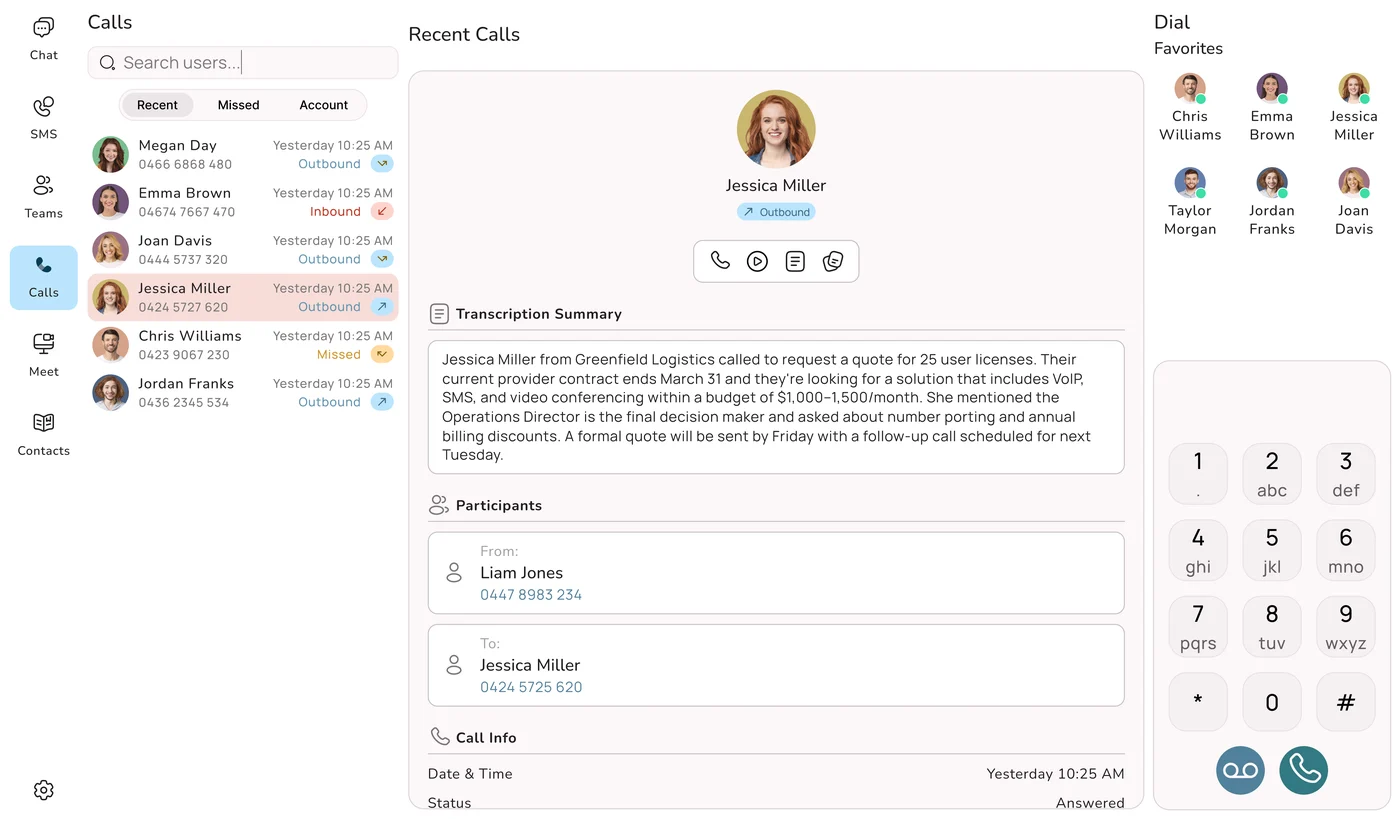
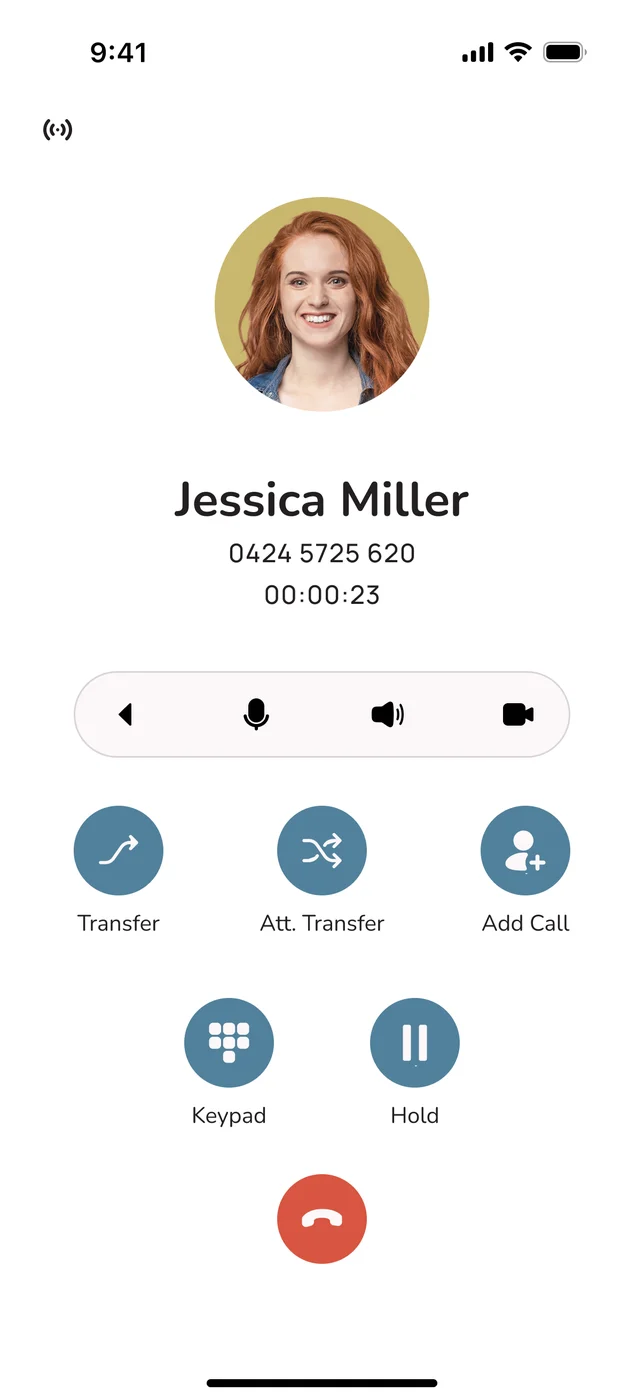
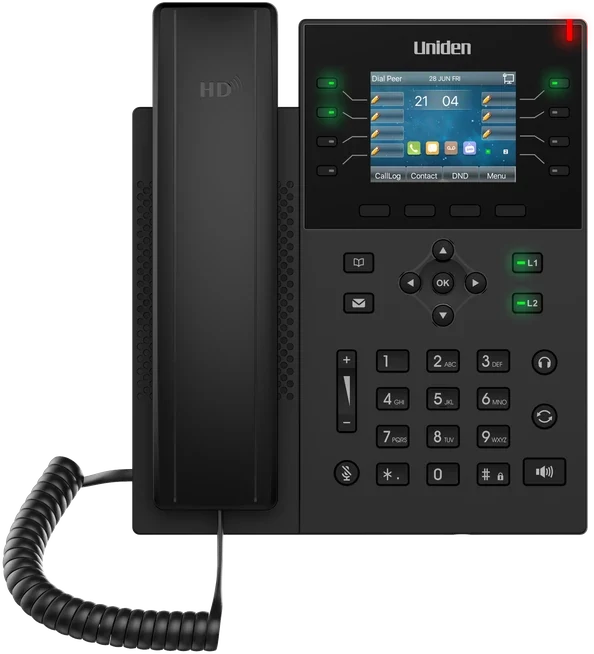
Uniden Voice over CloudOne number on your Uniden desk phone, laptop and mobile
Calls, SMS, team chat, video and AI summaries, with Uniden hardware on the desk. Start a call at your desk, finish it in the car.
See all featuresDesigned, built, hosted and supported in Australia. Uniden desk phones, cloud apps and AI in one system.Book a demoAll features
AI on your phone line
Uniden Voice vs AI receptionists
See every comparisonAI AgentsEvery call answered, day or night
It answers on your own numbers, books the job, sends an SMS and warm transfers to your team when a person is needed.
Meet your AI agentBuilt into your phone system, not bolted on. No second number, no call forwarding.Book a demo
Professional services
Trades, retail and hospitality
Browse all industries Case study · Optical Solutions AustraliaFive branches, five phone systems, now one.5 sites1 systemRead the OSA story
 Case study · Coco's Wealth of HealthWhen every enquiry and phone order matters.Maroubra organic health-food storeRead Coco's story





Our customersFrom one-person shops to national brands
See how businesses like yours run their phones on Uniden Voice.
Find your industryWorking on your own? A real business number and NBN for sole traders, no lock-in.Sole tradersStartups
Phone plansBusiness phone planfrom$84.90/month3 users included on a 36-month term. Every feature, one simple per-user rate.Free setup and free number portingDesktop and mobile apps includedAI Agents built inSee phone plans
Internet, hardware and more
Bundle and savePhones and NBN from one Aussie team
One provider to call when something needs fixing. No finger pointing.
See NBN plansWe guarantee to beat any competitor's quote. Keep your existing numbers when you move across.Sign up online1300 881 662
Learn and get set up
Need a hand? Our support team is based in Australia.Contact support
Call us on 1300 881 662 or send a message and the team will get back to you.Send a message
Guides and Articles
Almost nobody designs a multi-site phone estate. It grows. The second location opens and somebody local arranges a phone line because that is the urgent thing that week. The fourth location inherits whatever the previous tenant had. The seventh is acquired and comes with its own system, its own numbers and its own contract with eighteen months to run. By the eleventh, the organisation is paying eleven separate bills, running three or four different platforms, holding numbers registered to at least two entities and possibly to a former franchisee, and cannot answer the two questions that matter most: how many calls did the network miss last month, and which sites are missing them. Meanwhile the operational absurdities pile up. A queue in Perth overflows at 4pm while two staff in Adelaide sit idle, and there is no path between them. A customer rings the Newcastle branch, gets no answer, and never learns that the Maitland branch would have taken the booking. Head office publishes a standard for how calls are answered and has no way to know whether it happens. None of this is a technology problem: one platform across many sites has been ordinary for a decade. It is a design problem and, in a franchise network, a governance problem: which decisions belong to the centre and which belong to the site. This article covers both.
The email is always reassuring and usually accurate. Your service is moving to a new platform as part of an exciting transition, your plan and pricing are unchanged, and no action is required from you. Sometimes that is completely true and the right response is to file it. Sometimes it is the first notice of a migration that will change your call quality, your support path, your admin interface and, at renewal, your price, and the moment to do something about it is now rather than in eleven months. The difficulty is that four genuinely different events produce almost identical emails. A corporate acquisition, where somebody bought your provider and the service itself does not change. A platform migration, where the technology under your service is being replaced. A product retirement, where what you are on is being switched off on published dates. And a licensing or commercial change, where nothing technical happens but the terms do. Australia has had a great deal of all four in 2026: an energy retailer's telco base absorbed by a listed broadband provider with migrations running through the middle of the year, enterprise fibre and wholesale assets changing hands between major carriers, takeover activity among the mid-tier, a small-business voice platform being rebuilt on a partner's technology, and a list of legacy products with published end dates. This article separates the four, sets out what survives a change of ownership and what does not, and gives you a ninety-day checklist worth running whichever one you have received.
Two things happen in a real estate office on the same Tuesday. At 11:20am a buyer rings about a property they saw on a portal twenty minutes ago; nobody picks up, the call rolls to a mailbox, and by the time it is returned at 2:45pm they have booked an inspection with another agency and stopped answering unknown numbers. At 6:40pm a tenant rings about water coming through a ceiling; the office closed at 5:30pm, the recorded message gives a mobile number for emergencies, that mobile is on silent because its owner is at their child's concert, and the tenant, reasonably, arranges a plumber themselves. Those two failures look like the same problem, which is why agencies keep trying to solve them with the same fix. They are not. The first is a speed problem in a competitive market where the enquiry is worth thousands and the window is minutes. The second is a compliance and liability problem, because tenancy legislation across the states requires a landlord or agent to arrange urgent repairs quickly (commonly within twenty-four hours of being notified, with tighter timeframes for essential services in some jurisdictions) and generally allows a tenant who cannot reach the agent to arrange the repair and recover the cost. One is about winning work. The other is about what a tribunal will make of your evidence. This article treats them separately, because designing an agency phone system as one undifferentiated flow is the reason both keep happening.
Every business with a 1300 number has, at some point, been told it is theirs. It appears on the van, on the invoices, on the shopfront, in the Google listing and on ten years of printed material. And then one day the business decides to change provider, and discovers that the arrangement is more complicated than anyone mentioned at the start. All Australian phone numbers are a national resource managed by the ACMA on behalf of the Commonwealth, so nobody owns one outright, not you, and not your provider. What exists instead is a right of use, held by somebody, recorded somewhere. Which raises the only question that matters: is that somebody you? The good news is that the answer is knowable, the porting rules are considerably stronger than most business owners realise, and the whole check takes about twenty minutes. The less good news is that a number of Australian businesses have never asked, and a small number of them are going to be unhappy with the answer.
"I want AI to answer my calls." It is now one of the most frequent opening lines in any conversation about business phones in Australia, and it is a completely reasonable thing to want: you are missing calls, you cannot afford a full-time receptionist, and you have watched AI answer questions convincingly enough to think it could handle the twenty people a day who ring to ask what time you close. The complication is that four genuinely different products go by that name, they cost different amounts, they solve different problems, and picking the wrong one is how businesses end up with something their customers dislike. This is the plain-English version: what each option actually does, which of your calls to hand over first, what your customers will hear, the one design rule that decides whether they accept it, what it costs, and the Australian rules that apply.
A business rings a customer back about a quote. The customer never sees the call, because their carrier dropped it at the network edge for presenting a caller ID the business does not hold rights of use to. Another business rings the same customer an hour later and does reach the handset: where it displays under a red warning banner suggesting the call may be a scam, and goes unanswered. Neither business did anything wrong on purpose, neither was told what happened, and both concluded that outbound calling "does not work any more". It does work. What has changed is that two independent systems now sit between your dialler and the person you are calling: a network-level blocking regime under Australia's registered scam-reduction code, which is a rules-based system you can comply with precisely, and a reputation-labelling layer applied by carrier screening, handset software and third-party call-identification apps, which is a statistical system nobody publishes the internals of. They have different causes, different symptoms and different remedies, and treating them as one problem is why so many attempted fixes achieve nothing. This article separates them, sets out the six configuration and behaviour patterns that actually cause failed calls, gives you a diagnostic you can run in an afternoon with your own numbers and two handsets, and orders the remedies by how much difference each one makes.
Telecommunications reporting in Australia has a habit of stopping at the interesting bit. A carrier posts a result and the coverage is about the share price. A regulator sets a spectrum price and the coverage is about the lobbying. NBN Co changes an eligibility rule and the coverage is about consumer broadband. What almost nobody does is follow the numbers all the way down to the thing a business actually holds in its hand, which is an invoice. So that is what this does. Telstra's full-year results landed on 13 August 2026. The ACMA has settled the renewal price for mobile spectrum licences expiring between 2028 and 2032 at $7.32 billion, over industry objection. NBN Co has removed a requirement that kept several hundred thousand premises off full fibre. Each of those has a path to your phone bill, some of them shorter than you would expect and one of them much longer. Here is the chain, the timing, and the part where a business actually has some leverage.
If you run your business phones on Optus Loop, you have probably had a letter, an email, or a phone call about a migration. The service you bought is being replaced by a different platform, built by a different company, with a different app, a different admin console and a different way of doing almost everything. Optus calls it Optus Loop with RingCentral. Underneath the branding it is a platform replacement, and a platform replacement is not an upgrade: nothing carries across by itself, and everything you configured has to exist somewhere on the other side. This is what actually changes, what to check before your cutover date, what other businesses have reported about the experience, and the three options you have. One of them is only free for a short window, and that window is open right now.
PBX stands for private branch exchange, and the original problem it solved is easy to picture: a business with twenty staff could not afford twenty telephone lines, so it bought a cabinet that let twenty internal telephones share four external ones, and let those twenty people ring each other without using a line at all. Everything else (extension numbers, transfers, hold, hunt groups, a receptionist's console) grew out of that one idea. A century later the cabinet has usually disappeared into a data centre, but the vocabulary has not, which is why a 2026 quote still talks about extensions, trunks and concurrent calls. The difficulty is that the word now covers at least five genuinely different architectures. A traditional PBX and a multi-tenant cloud platform have almost nothing in common except the function they perform, and yet both are sold as "a PBX", and the middle categories (IP PBX, hosted PBX, virtual PBX, cloud PBX) are used interchangeably by vendors who mean different things by each. That matters commercially, because the five models differ in who owns the equipment, who is responsible when it breaks, what happens to your calls when your internet drops, how you are charged, and what you can take with you when you leave. This article defines each one plainly, sets out what you are actually buying, and gives you the questions that reveal which architecture is hiding behind a quote.
Australian telecommunications does not usually produce a busy fortnight. This one did. Between 29 July and 13 August 2026, the Telecommunications Industry Ombudsman published a systemic report drawing on nearly 28,000 complaints and told the government the regulatory framework needs overhauling; the ACCC launched a twelve-month inquiry into whether wholesale mobile access, including domestic roaming, should be regulated; the ACMA commenced Federal Court proceedings against Optus Mobile over the September 2025 emergency call outage; and the same regulator published a report ranking 33 telcos on how well they handle complaints. Add the transparency rules that came into force on 30 June and the messaging rules that started on 1 July, and you have six separate developments pointing in one direction. None of them were written with a forty-person business in mind. All of them change what you can verify about a provider before you commit to one, which is the practical point of this article.
If you build your business on reselling and supporting 3CX, the last twelve months have been a series of conversations you did not want to have. A fair use policy that caps extensions against simultaneous call licences, with enforcement from April. An edition shake-up that retired Enterprise Plus and renamed Enterprise to AI Edition. Renewal quotes that need explaining. And underneath all of it, the same structural fact that was always true and is now harder to live with: you carry first line support for a platform whose roadmap, pricing and licensing terms you do not control. This is what actually changed, what it does to the margin on a typical Australian deployment, and what a partner program looks like when the vendor owns the network, the platform and the support queue, and pays you every month rather than once a year.
Here is a sentence that tells you nothing: "our platform is powered by AI." It is now true of almost every business communications product on the market, and it is compatible with at least five completely different architectures, five different accountability structures and five very different answers to the only questions that matter. At one end sits a company that operates its own network, its own platform and its own infrastructure, and can tell you where a particular call was processed on a particular Tuesday. At the other sits a product built in a few months on a public model API, where the entire technical estate is somebody else's and the company you are contracting with cannot change a thing about how your data is handled, because it does not control the thing handling it. Both companies can pass a feature comparison. Both can run an impressive demonstration, because the demonstration is of the model, and the model is very good. The difference only surfaces in three situations: when a data residency review asks where your customer conversations were processed, when something goes wrong and you need it fixed rather than escalated, and when a regulator asks you, not your supplier, to account for an automated decision. This article sets out the five kinds of company, the layers your call audio actually passes through, and ten questions that separate them in about fifteen minutes.
Ask most business owners what their phone system does and they will describe something that rings. That description was accurate for about a hundred years and stopped being accurate somewhere around 2023, but the language has not caught up, which is why so many Australian businesses are paying separately for software their phone platform already includes. A cloud voice platform in 2026 answers calls without a human, writes the customer record as it goes, distributes work across a team, creates the follow-up, offers the appointment, hosts the video meeting, sends the confirmation text and then reports on every one of those things in one place. That is eight product categories, most of which are sold separately by somebody, and several of which appear on Australian business bank statements twice. This is an honest inventory of what a phone platform now covers, what it does not, and how to work out which of your subscriptions you are paying for out of habit.
Changing business phone providers has a reputation it mostly does not deserve. The great majority of changeovers are uneventful, and the ones that go wrong fail on a predictable short list: a contract with an exit term nobody read, a number range that could not be split, an alarm dialler that stopped reporting silently, and a cutover scheduled on a Friday afternoon. None of those are hard problems. They are just problems nobody looks for, because the conversation before a changeover is almost entirely about handsets and monthly cost: the two things least likely to cause trouble. This is the playbook: how to read your exit terms, what genuinely moves and what does not, the full inventory of devices quietly dependent on a phone line, a six-week timeline, and an hour-by-hour plan for the day itself.
Ask an Australian business what kind of phone system they have and the answer is usually a brand name, occasionally a technology, and almost never a generation. That is a problem, because the generation is the part that determines what happens next. A business on analogue copper lines, a business running an ISDN PBX in a comms cupboard, a business that bolted SIP trunks onto that same PBX in 2016, and a business on a cloud platform are four genuinely different situations with four different sets of options, four different risk profiles and four different bills. They are also, awkwardly, four situations that can all be described as having a phone system that works. This article lays out the four eras of business telephony (analogue POTS, digital ISDN with an on-premises PBX, VoIP, and Voice over Cloud) and what actually changed at each transition. It spends time on the distinction most buyers get wrong, which is that VoIP describes how voice travels and Voice over Cloud describes where the system lives, meaning they are separate decisions that get sold as one. And it finishes with a diagnostic you can run in five minutes to work out which era you are in, plus the honest arithmetic on when moving is worth it and when it is not.
One of the most common questions we are asked during a switch is also one of the most expensive to get wrong: does the hardware have to go? A business with forty desks may have twenty or thirty thousand dollars of handsets bolted to those desks, bought within the last few years, working perfectly well. The idea that changing phone provider means skipping the lot is one of the main reasons businesses stay somewhere they have stopped being happy. It is also, in most cases, untrue. Uniden Voice Over Cloud runs standard SIP, the same published protocol every serious handset manufacturer implements, so Yealink, Fanvil, Grandstream, Snom, Poly, Cisco and a long tail of intercoms, paging speakers and analogue adapters will register and work. This is the detailed version: which brands and models, what auto-provisions and what needs configuring by hand, the provisioning lock a departing provider can leave behind, the five things that never carry across, and how to audit your own fleet in an afternoon.
A venue phone rings hardest at exactly the moment nobody can answer it. Twelve-fifteen on a Friday, the room is full, the pass is backed up, and the phone at the host station has been ringing out for a minute because the only person who normally answers it is seating table nine. Somewhere in the calls going unanswered is a booking, an operational problem, a supplier, a complaint, and occasionally a woman planning her father's seventieth for forty people in November, who will ring the next place on her list within about ninety seconds. Venues almost always set their phones up like a small office. They do not operate like a small office. This is how to design a venue phone around service periods, a loud room, high turnover, and the one call that pays for everything.
There is a particular kind of silence that has now been officially explained. If you dial Triple Zero from a mobile and your own carrier's network is unavailable, your handset will try to place the call through another carrier's network instead. That process is called emergency camp-on, it is the reason emergency calls can be made with no credit, no active service and no SIM card at all, and it takes time. According to advice published today by the federal government and the mobile carriers, it can take up to sixty seconds, and during a Telstra outage earlier this year the maximum stretched to ninety. For the whole of that time there is generally nothing on the line. No ringing, no message, no reassurance. The advice being circulated is specific and slightly counter-intuitive: if the first attempt does not connect within about five seconds, hang up and immediately try again; on that second attempt, stay on the line for up to a minute. This article explains what camp-on actually is, what the screen indicators mean, where the advice came from and what it does not cover, and then does the part the news coverage does not, which is work out what an Australian business should actually change on the strength of it.
"Please listen carefully as our menu options have changed." Nobody has ever been pleased to hear that sentence. The phone menu is one of the few pieces of business technology that customers actively resent, that staff apologise for, and that almost every organisation running one privately admits is not very good, and yet it is still the front door to a large share of Australian businesses. The reason it survives is not that it works. It is that it solved a genuine problem in 1975, and until a couple of years ago there was nothing better to put in its place. That has now changed, and the change is not "a nicer menu". It is the removal of the menu entirely, in favour of something that simply asks the caller what they need. This covers why menus fail structurally rather than cosmetically, what replaces them, how to migrate off one in a fortnight, and the narrow cases where you should keep yours.
A contact centre report that says "average wait 42 seconds, 91% of calls answered" sounds healthy and can describe a queue where a hundred people a week hang up after four minutes. Averages are the problem: they are dominated by the many easy calls and say nothing about the tail, and the tail is where your complaints, your churn and your reviews come from. This is a practical guide to the six measurements that carry real information (service level, average speed of answer, abandonment, first contact resolution, handle time and occupancy) what each one actually measures, what Australian benchmark data says good looks like in 2026, the four ways these numbers routinely mislead, and how to turn each symptom into a specific change rather than a target on a wall.
Every conversation about AI and security in the last two years has been about AI as the threat, and that framing is not wrong. The Australian Signals Directorate has assessed that AI almost certainly enables malicious actors to execute attacks at greater scale and speed, and the numbers behind that assessment are not subtle: more than 84,700 cybercrime reports in a year, roughly one every six minutes, with the average cost per incident rising fifty per cent to $80,850. Convincing phishing used to require somebody who could write. Convincing voice impersonation used to require an impressionist. Neither is true now. What gets far less attention is that the same technology is unusually good at the defensive side of exactly this problem, and that some of the most valuable places to deploy it are on the layer businesses think about least: the phone. Voice is where the social engineering actually lands. It is where the authorisation gets given, where the invoice detail gets changed, where the urgent request from the boss arrives, and it is almost always the least monitored channel in the business. This article sets out eight specific gaps that AI closes on that layer, states plainly the four it does nothing for, and covers the governance you need before you switch any of it on, including the obligation that lands on 10 December 2026 and applies to more businesses than expect it.
Most business phone systems are a black box with a nice front end. Calls go in, calls come out, and the data those calls generate (who rang, when, how long, what was said, what happened next) stays locked inside a portal you can look at but not use. If you want to do something the vendor did not think of, you raise a request and wait. We took the opposite view. Every operation you can perform in our portal is available through an open REST API, every event that happens on your account can be pushed to your systems the instant it occurs, and every record we hold about your calls and messages is yours to pull out whenever you want. This is what that surface actually covers across voice and SMS, seven things teams build with it in about a week, the Australian compliance layer that applies once you start sending programmatically, and why openness is a commercial commitment rather than a feature.
If your business operates outside the metro coverage footprint, 2026 has produced a lot of encouraging headlines and very little you can install. The ACCC has launched a twelve-month inquiry that will consider making mobile roaming mandatory. Telstra has become the first Australian carrier to launch direct-to-mobile satellite messaging, so a standard handset can now send a text with no tower in range. And a Universal Outdoor Mobile Obligation has been flagged for 2027. All three matter. None of them answers the phone at your depot next Tuesday. This is a straight reading of what each one is, what it isn't, and, the useful part, the design that makes a regional business reliably contactable using what exists today.
Ask a business owner who supplies their phone system and they will answer instantly. Ask who supplies the cameras on the yard, the doorbell at the trade counter, the dash cams in the vehicles and the UHF radios in the cabs, and the answer usually takes a while, involves at least three companies, and ends with somebody checking an old invoice. That fragmentation is not free. It shows up as four apps nobody has taught the new staff member, four warranty processes, four support numbers with four different hold times, and a monthly subscription line for each device that quietly outgrows what the device cost to buy. This article does two things. First, it lists every product in the Uniden Australia range that talks to a network or an app as at August 2026: the wire-free cameras and their solar, pan-tilt and 4G variants, the video doorbell, the indoor cameras, the dash cam families, the smart UHF radios and the EVOC2 desk phone. Second, it states plainly what a business gains by running that estate on one brand alongside Uniden Voice, including the subscription-free arithmetic that most buyers never do, and the two places where a single brand buys you nothing at all.
You have the ABN, the business name, the logo and probably the website. Then somebody asks for your number, and you give them your mobile, because it is right there and the business is only you. Six months later that mobile number is on a hundred invoices, two hundred business cards, the van, three directory listings and every quote you have sent, and it is also the number your kids ring on. Untangling that is the single most annoying job in a growing small business, and it is completely avoidable. This is the whole phone setup for a new Australian business: which number type to choose and why, how many lines you actually need, what you have to buy versus what you can skip entirely, the five call flows to set up on day one, and the seven mistakes that cost real money later. It takes about a week and most of it takes an afternoon.
On 10 December 2026 a new transparency obligation commences under the Privacy Act. If you use personal information in an automated decision that could significantly affect someone's rights or interests, your privacy policy has to say so: what kinds of information, and what kinds of decisions. The audits currently under way in Australian businesses are almost all aimed at CRMs, credit tools, hiring software and pricing engines. Very few are aimed at the phone system, which is a shame, because a modern phone platform routes by caller identity, prioritises by customer value, qualifies with an AI agent, decides who gets a callback and who waits, and increasingly scores the humans who answer. Some of that is in scope. Some of it clearly is not. Knowing which is which is a two-hour job, and it is much easier to do in August than in December.