













The Moment That Tells You Everything
Nobody chooses a phone system or an IT provider because of the support. We choose on features, price and whether the demo looked easy. Then, months later, something goes wrong. A handset will not register after a power cut. A new staff member cannot log in to the app. Calls to your main number are going to a voicemail nobody set up. And the thing you actually bought turns out to be whatever happens next.
For a large company with an IT team, a slow provider is an irritation. For a small business, it is the owner on hold instead of serving customers, or a day of missed calls nobody can get back. That is why the most important question to ask any technology provider is not what their product does. It is what happens when you ring them.

Why Support Is Getting Harder to Reach
Across the technology industry, support has been moving away from people. Phone numbers get harder to find on websites. Help centres, chatbots and ticket forms sit in front of any human. Some large platforms sell through resellers, so the company you pay does not run the system, and the company that runs the system will not talk to you. When a problem crosses the line between your internet, your phone provider and the platform, each one can point at the others.
Customers have noticed. In a Gartner survey of nearly 5,800 customers, published in July 2024, 64% said they would prefer companies did not use AI for customer service, and 60% worried that AI would make it harder to reach a person. Gartner has since predicted that by 2028 the European Union will require a "right to talk to a human" in customer service, and that none of the Fortune 500 will have fully eliminated human service by then. The direction is clear. Automation is fine for simple questions. When the problem is real, people want a person.
None of this means automation is bad. A good help article at 11pm is useful, and an AI that can reset a voicemail PIN instantly is better than waiting. The problem is when automation is the only door. Our article on what happens when your provider is acquired covers one common way support quietly gets worse after you have signed.
What Caring About Your Business Looks Like
"We care about our customers" is on every provider's website, so it tells you nothing. Caring shows up in behaviour you can observe. Here are six signs, and every one of them can be checked.
They answer the phone
A published support number, answered by a person in a reasonable time. Not a callback form, not a sales line that transfers you to a queue.
They know your setup
The person who answers can see your account, your numbers and your call flows. You should not have to explain your business from scratch every time.
They speak plainly
They explain what went wrong and what they did in words you understand, without making you feel silly for asking.
They tell you first
If there is an outage or planned work, you hear about it from them, ideally before your customers notice.
They own the problem
If it is not their fault, they still help you find out whose it is. No "that is your internet, call them" and hang up.
They tell you what not to buy
A partner will say when you do not need the upgrade, the extra licence or the new handset. That is how you know the advice is for you.
The last one is the most telling. A provider that only calls when it wants to sell you something is a vendor. One that rings to say "you are paying for three users who have not logged in since March, want us to remove them?" is a partner.
What Poor Support Costs a Small Business
The price of a phone system is easy to compare. The cost of poor support is not, because it arrives as lost time and lost calls rather than a line on the invoice. It is worth thinking through before you choose.
| Where it shows up | What it looks like in a small business |
|---|---|
| Missed calls | While the phones are down or misrouted, every caller who gets a dead tone or a strange message is a customer who may not try again. |
| The owner's time | Hours on hold, in chat windows and writing tickets, usually by the person whose time is worth most to the business. |
| Workarounds that stick | Diverting everything to a personal mobile "just for today", which then becomes the way things are done for a year. |
| Features you pay for and never use | Call recording, queues or AI answering that nobody helped you set up properly, so they sit idle. |
| Customer trust | Regulars who could not get through, or who heard the wrong message, and quietly wonder whether you are still trading. |
There is a quieter cost too. When support is hard to reach, people stop asking. They put up with small problems, avoid changes and never get the value out of the system they are paying for. Good support is what turns a feature list into features you actually use.
Test Them Before You Sign
You would not hire a staff member without talking to them. Treat a technology partner the same way. These tests take an hour spread over a week, and they tell you more than any sales presentation.
- 1
Ring the support line, not the sales line
Sales always answers. Find the support number on the website and call it. Note how long it takes to reach a person, and whether you reach one at all.
- 2
Call at an awkward time
Try late on a Friday afternoon, or first thing on a Monday. That is when problems happen and when support is busiest.
- 3
Ask a real question
Something like "if my internet drops, where do my calls go?" Listen for a clear answer in plain English, not a script.
- 4
Ask who fixes what
Does the company you pay run the platform and the network, or resell someone else's? The more hand-offs, the more places a problem can get stuck.
- 5
Talk to a customer your size
Ask for a reference, or look for reviews that mention support by name. A business like yours will tell you what really happens.
- 6
Read the support part of the contract
Support hours, how to escalate, whether phone support costs extra, and what it takes to leave, including taking your numbers with you.
If you are already with a provider and these tests make you nervous, our guide to changing business phone provider without losing calls explains how to move safely.
Questions to Ask and Answers to Listen For
Here are the questions we would ask any phone or IT provider, including us. The good answers are specific. The warning signs are usually vague.
| Ask | A good answer sounds like | A warning sign |
|---|---|---|
| How do I reach support when something is broken? | "Ring this number and you will get a person, here are the hours." | "Log a ticket in the portal and we will get back to you." |
| Where is your support team based? | A clear answer, and people who understand Australian business hours, numbers and carriers. | Hesitation, or "it depends which team picks it up". |
| Do you run the platform or resell it? | "We run it," or an honest explanation of who does what and how they escalate. | No clear answer about who fixes the underlying system. |
| What happens during an outage? | How calls fail over, how you will be told, and where to check status. | "We do not really have outages." |
| Who owns my phone numbers? | "You do. You can port them whenever you like." | Fees, notice periods or confusion about porting. |
| Will you help me set it up properly? | A named onboarding step, with someone checking your call flows and hours. | A login and a link to the help centre. |
| Can I leave if it is not working? | Month to month, or a short term with clear exit terms. | Long lock-ins and early termination fees. |
For the wider buying process, our guide on how to choose a cloud phone provider and our ranked list of the best business phone systems in Australia cover features and pricing. This article is about the part those lists cannot measure.
A Simple Scorecard
If you are comparing two or three providers, score each one out of ten on these six things after you have done the tests above, then weight them. This is the weighting we suggest for a small business. Adjust it to suit yours.
Price is deliberately left off. Compare it once you have a shortlist of providers you would trust, using our phone system cost guide. A slightly cheaper plan from a provider you cannot reach is rarely cheaper by the end of the year.
Where AI Fits in Good Support
This is not an argument against AI. Used well, it makes support faster. An AI assistant can answer "how do I change my voicemail greeting" at midnight, reset a password in seconds, or gather the details of a fault before a person picks it up, so they start with the facts instead of twenty questions. The same is true of AI in your own business: an AI receptionist that answers when you are on a job is a good thing, as long as callers can reach you when it matters.
The rule for good AI support
Automation handles the simple and the repetitive. A person handles anything urgent, unusual or emotional. And there is always a clear, quick way to reach that person. If a provider's AI cannot hand you to a human who can see what you have already said, it is a barrier, not a service.
What the First Year Should Look Like
A good partnership has a shape. You should be able to feel it working in the first twelve months, not only when something breaks.
| When | What a good partner does |
|---|---|
| Before go-live | Asks how your business actually takes calls, sets up hours, call flows and voicemail to match, and ports your numbers on a date that suits you. |
| Go-live day | Is on hand while the numbers move, and checks with you that calls are arriving where they should. |
| First month | Checks in to fix the small things you have noticed, such as a greeting that is too long or a staff member who has not installed the app. |
| Every few months | Looks at missed calls and unused licences with you and suggests changes, including ones that save you money. |
| When you grow | Adds people, numbers or locations quickly, and tells you honestly when you need something bigger and when you do not. |
If you are just starting out, the same thinking applies from day one. Our guide on what to do after getting your ABN explains why the first phone system, and the people behind it, matter so much for a new business.
How Uniden Voice Supports You
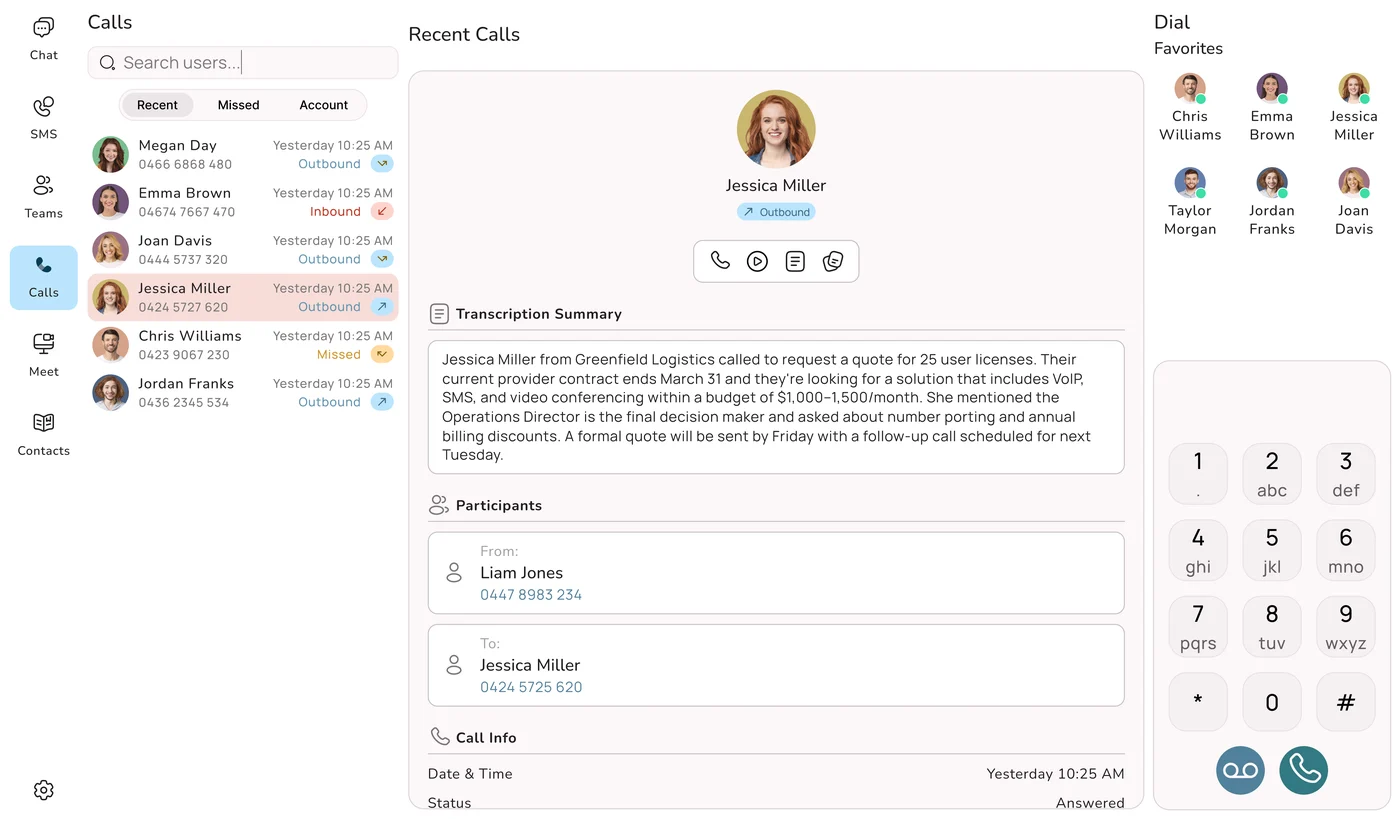
Uniden Voice over Cloud is Australian owned, hosted in Australia and supported by an Australian team. When you call 1300 881 662 you talk to someone who can see your account, your numbers and your call flows, and who can make the change while you are on the line. We will help you set it up rather than hand you a login: talk us through how your business takes calls and we will help you get hours, queues, voicemail and AI answering to match. Uniden Voice is also sold and supported through a network of local dealers, IT providers who may already know your business and can come on site when needed.
There are no lock-in contracts, your numbers are yours to take with you, and we would rather tell you that you do not need an upgrade than sell you one. Read more about the Australian infrastructure behind Uniden Voice, or call us and run the tests in this article on us. That is exactly what they are for.